Two-year Old Cold Cases of Israelis (and Gazans) Killed After October 7, 2023

The Jerusalem Post recently published a story about Israel’s Institute of Forensic Medicine and how it identifies deceased bodies.

“From the moment the remains arrive at the institute, identification is conducted through three methods: dental records, CT scans, and DNA testing.

“Even if we identify the remains using one method, it’s not enough until we have definitive identification. In most cases, whenever possible, we perform all three methods to get a final result.” According to Kugel, this is because the “findings” often arrive in an unorganized manner, and no one knows to whom they belong.”

Oh, and there’s one additional complication. Some of the bodies died as long as two years ago. Some of these remains were returned from Gaza after the latest cease fire. I don’t know how many of these people died after October 7, 2023, but it’s possible that some of them may have.

“It’s important to understand that our daily work is to examine bodies that arrive within hours or a few days in rare cases. Here, we’re dealing with a two-year period, and that makes a significant difference in how the remains were preserved, under what conditions, and how that affects the identification process.”

But they aren’t just identifying Israelis.

“Identifying former Hamas leader Yahya Sinwar was a defining moment for Kugel.

“‘Once you’re with the body and examining it, you don’t think at that moment that you’re examining someone very significant. We also had to understand what caused his death. Obviously, he had a head injury, but we tried to understand what preceded what.’

“When we finished, a colleague said to me: ‘Do you understand who you’ve examined now? The man who is responsible for the massacre of thousands of people.’ You don’t think about it while working, just as with the good people who were killed in the war, you just check and identify. After that, at home, you continue to read about him and his family; it goes with you, and then you process what you go through at the institute.”

This is a common challenge in forensics. Identification of a particular person may result in a number of emotional responses, whether it is a criminal or a victim. But the forensic professional’s job is to simply examine the evidence. The grief comes later.

H/T Forensics and Law in Focus.

Avoiding Deleterious Forensic Nursing

Warning: this post discusses sexual assault and child abuse.

Hippocrates. By Unidentified engraver – 1881 Young Persons’ Cyclopedia of Persons and PlacesUpload by RedWolf 05:45, Jan 10, 2005 (UTC), Public Domain, https://commons.wikimedia.org/w/index.php?curid=164808

The Hippocratic Oath imposes duties on medical professionals, including this one:

I will follow that system of regimen which, according to my ability and judgment, I consider for the benefit of my patients, and abstain from whatever is deleterious and mischievous.

From https://www.health.harvard.edu/blog/first-do-no-harm-201510138421.

For people like me who do not use the word “deleterious” on a daily basis, it means “harmful often in a subtle or unexpected way.”

The dictates of the Hippocratic Oath lead us to forensic nursing (as defined by 1NURSE.COM), the invasive nature of some forensic techniques, and what companies such as Foster+Freeman are doing to minimize invasive evidence capture.

What is forensic nursing?

From the U.S. Federal Bureau of Investigation, https://www2.fbi.gov/publications/leb/2002/jan2002/jan02x29x1.jpg.

As 1NURSE.COM notes, forensic nursing is multidisciplinary, operating “at the critical juncture of medical science and the legal system.”

Forensic nursing is a specialized branch that integrates medical expertise with forensic science to provide comprehensive care for individuals impacted by violence, abuse, or criminal activities. These professionals serve as a crucial link between the realms of healthcare and the legal system, collaborating with law enforcement, attorneys, and other professionals to gather evidence, provide expert testimony, and ensure justice for victims.

From https://www.linkedin.com/pulse/forensic-nursing-exploration-intricate-profession-1nurse-com-iedyc/.

When I started my forensic career 29 years ago, I was solely involved in the capture and processing of fingerprints from criminals. If I may be honest, the well-being of the individual who provided the forensic evidence was NOT an overriding concern.

But within a year or two I started to get involved in the capture and processing of fingerprints from NON-criminals who were applying for and receiving government benefits.

  • For that market we HAD to concern ourselves with the well-being of our clients, to make fingerprint capture as easy as possible, and to treat our clients with the utmost respect.
  • In the end it didn’t matter, because in the popular mind fingerprinting was associated with criminals, and benefits recipients didn’t want to be treated like criminals no matter how nice we were. To my knowledge, all of the benefits recipient fingerprint programs in the United States have all ceased.

Forensic nursing needs to gather the necessary forensic evidence while preserving the compassionate care that nurses are required to provide.

Invasive forensic techniques

So if we have to take care when gathering information from benefits recipients, imagine the level of care we need to take when gathering information from crime victims. Returning to 1NURSE.COM’s article, here are two of the tasks that forensic nurses must perform:

Sexual Assault Forensics: Specializing in sexual assault examination, forensic nurses provide not only compassionate care but also play a pivotal role in collecting evidence essential for legal proceedings. Their expertise ensures a sensitive approach while preserving the integrity of forensic evidence. Example: A forensic nurse conducting a sexual assault examination may collect biological samples and document injuries to aid in prosecuting the assailant.

Child Abuse Investigation: Forensic nurses are instrumental in assessing and documenting cases of child abuse. They collaborate with child protective services and law enforcement to ensure the safety and well-being of the child. Example: A forensic nurse working on a child abuse case may conduct a thorough examination to document injuries and provide expert testimony in court.

From https://www.linkedin.com/pulse/forensic-nursing-exploration-intricate-profession-1nurse-com-iedyc/.

The “compassionate care” part is important, as Foster+Freeman notes in a separate article:

We have focussed a lot on how the investigation works when looking for crimes of a distressing nature but not actually how this investigation process can affect the victim of these crimes and put the victim first. This period can be incredibly distressing for the victim, and the investigation can make this worse as it is making the victim re-live this experience.

https://www.linkedin.com/pulse/victim-first-forensics-focusing-victims-crime-foster-freeman-gnw6e/

As part of their duties, the forensic nurse has to capture evidence from the very parts of the body that were assaulted during the abuse crime itself. No one wants to go through that again. How can evidence capture be less invasive?

Three ways to minimize invasive evidence capture

While it’s not possible to completely erase the pain that crime victims suffer during a forensic investigation, there are ways to minimize it. The Foster+Freeman article highlights three ways to do this:

  • Capture evidence via non-invasive techniques. As a supplier of alternate light source (ALS) technology, Foster+Freeman notes that its products can discover evidence, even at the subdermal layers, without touching the victim. “Using an ALS is a non-invasive and non-destructive way to examine potential evidence on the skin. This is especially important when dealing with fragile or sensitive skin, as it minimizes the risk of causing further harm during the examination process.”
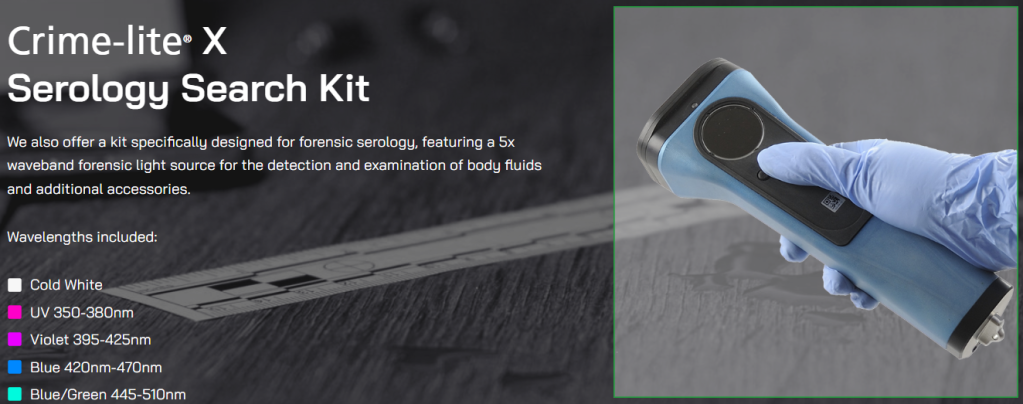
  • Capture evidence quickly. Forensic nurses do not want to prolong an examination. There are ways to gather evidence as quickly as possible. For example, rather than using multiple ALS devices, you can use a single one; Foster+Freeman’s Crime-lite® X Serology Search Kit is “a multispectral light source that has been made with five wavelengths of light integrated into one unit.”
  • Capture evidence thoroughly. What’s the point of putting a victim through the trauma of evidence capture if it doesn’t result in a conviction? Because of this, it’s important to capture as much evidence as possible. A variety of alternate light sources accomplishes this.

Foster+Freeman is just one of a multifarious array of companies that supply evidence collection solutions to forensic nurses and other forensic professionals.

And no, Foster+Freeman didn’t sponsor this post, although Bredemarket is available to provide writing services to Foster+Freeman or to other companies who need to drive content results.

And now that I’ve successfully used “multifarious,” I need to find a way to use “deleterious.” Keep your eyes open.

The Double Loop Podcast Discusses Research From the Self-Styled “Inventor of Cross-Fingerprint Recognition”

(Part of the biometric product marketing expert series)

Apologies in advance, but if you’re NOT interested in fingerprints, you’ll want to skip over this Bredemarket identity/biometrics post, my THIRD one about fingerprint uniqueness and/or similarity or whatever because the difference between uniqueness and similarity really isn’t important, is it?

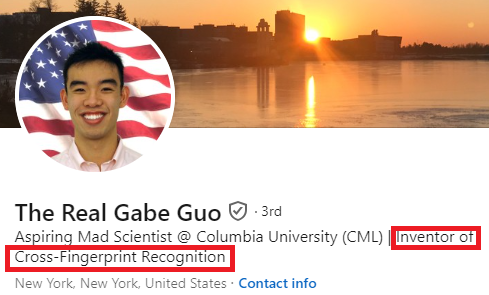
Yes, one more post about the study whose principal author was Gabe Guo, the self-styled “inventor of cross-fingerprint recognition.”

In case you missed it

In case you missed my previous writings on this topic:

But don’t miss this

Well, two other people have weighed in on the paper: Glenn Langenburg and Eric Ray, co-presenters on the Double Loop Podcast. (“Double loop” is a fingerprint thing.)

So who are Langenburg and Ray? You can read their full biographies here, but both of them are certified latent print examiners. This certification, administered by the International Association for Identification, is designed to ensure that the certified person is knowledgeable about both latent (crime scene) fingerprints and known fingerprints, and how to determine whether or not two prints come from the same person. If someone is going to testify in court about fingerprint comparison, this certification is recognized as a way to designate someone as an expert on the subject, as opposed to a college undergraduate. (As of today, the list of IAI certified latent print examiners as of December 2023 can be found here in PDF form.)

Podcast episode 264 dives into the Columbia study in detail, including what the study said, what it didn’t say, and what the publicity for the study said that doesn’t match the study.

Eric and Glenn respond to the recent allegations that a computer science undergraduate at Columbia University, using Artificial Intelligence, has “proven that fingerprints aren’t unique” or at least…that’s how the media is mischaracterizing a new published paper by Guo, et al. The guys dissect the actual publication (“Unveiling intra-person fingerprint similarity via deep contrastive learning” in Science Advances, 2024 by Gabe Guo, et al.). They state very clearly what the paper actually does show, which is a far cry from the headlines and even public dissemination originating from Columbia University and the author. The guys talk about some of the important limitations of the study and how limited the application is to real forensic investigations. They then explore some of the media and social media outlets that have clearly misunderstood this paper and seem to have little understanding of forensic science. Finally, Eric and Glenn look at some quotes and comments from knowledgeable sources who also have recognized the flaws in the paper, the authors’ exaggerations, and lack of understanding of the value of their findings.

From https://doublelooppodcast.com/2024/01/fingerprints-proven-by-ai-to-not-be-unique-episode-264/.

Yes, the episode is over an hour long, but if you want to hear a good discussion of the paper that goes beyond the headlines, I strongly recommend that you listen to it.

TL;DR

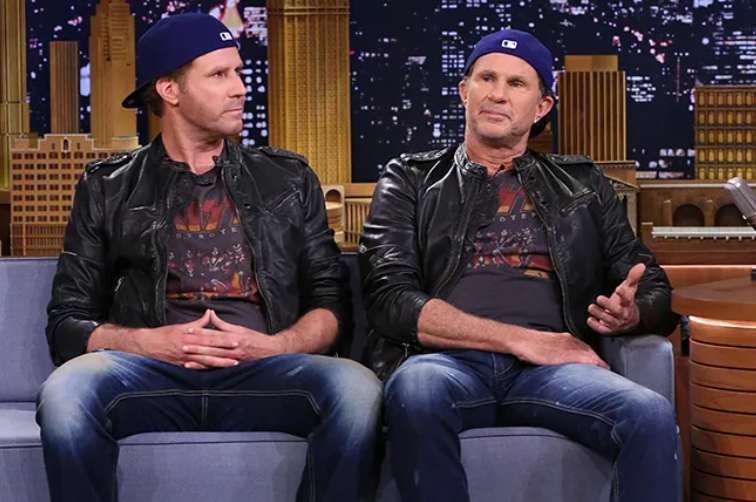
If you’re in a TL;DR frame of mind, I’ll just offer one tidbit: “uniqueness” and “similarity” are not identical. Frankly, they’re not even similar.

Will Ferrell and Chad Smith, or maybe vice versa. Fair use. From https://www.billboard.com/music/music-news/will-ferrell-chad-smith-red-hot-benefit-chili-peppers-6898348/, originally from NBC.

Did the Columbia Study “Discover” Fingerprint Patterns?

As you may have seen elsewhere, I’ve been wondering whether the widely-publicized Columbia University study on the uniqueness of fingerprints isn’t any more than a simple “discovery” of fingerprint patterns, which we’ve known about for years. But to prove or refute my suspicions, I had to read the study first.

My initial exposure to the Columbia study

I’ve been meaning to delve into the minutiae of the Columbia University fingerprint study ever since I initially wrote about it last Thursday.

(And yes, that’s a joke. The so-called experts say that the word “delve” is a mark of AI-generated content. And “minutiae”…well, you know.)

If you missed my previous post, “Claimed AI-detected Similarity in Fingerprints From the Same Person: Are Forensic Examiners Truly ‘Doing It Wrong’,” I discussed a widely-publicized study by a team led by Columbia University School of Engineering and Applied Science undergraduate senior Gabe Guo. Columbia Engineering itself publicized the study with the attention-grabbing headline “AI Discovers That Not Every Fingerprint Is Unique,” coupled with the sub-head “we’ve been comparing fingerprints the wrong way!”

There are three ways to react to the article:

  1. Gabe Guo, who freely admits that he knows nothing about forensic science, is an idiot. For decades we have known that fingerprints ARE unique, and the original forensic journals were correct in not publishing this drivel.
  2. The brave new world of artificial intelligence is fundamentally disproving previously sacred assumptions, and anyone who resists these assumptions is denying scientific knowledge and should go back to their caves.
  3. Well, let’s see what the study actually SAYS.

Until today, I hadn’t had a chance to read the study. But I wanted to do this, because a paragraph in the article that described the study got me thinking. I needed to see the study itself to confirm my suspicions.

“The AI was not using ‘minutiae,’ which are the branchings and endpoints in fingerprint ridges – the patterns used in traditional fingerprint comparison,” said Guo, who began the study as a first-year student at Columbia Engineering in 2021. “Instead, it was using something else, related to the angles and curvatures of the swirls and loops in the center of the fingerprint.” 

From https://www.newswise.com/articles/ai-discovers-that-not-every-fingerprint-is-unique

Hmm. Are you thinking what I am thinking?

What were you thinking?

I’ll preface this by saying that while I have worked with fingerprints for 29 years, I am nowhere near a forensic expert. I know enough to cause trouble.

But I know who the real forensic experts are, so I’m going to refer to a page on onin.com, the site created by Ed German. German, who is talented at explaining fingerprint concepts to lay people, created a page to explain “Level 1, 2 and 3 Details.” (It also explains ACE-V, for people interested in that term.)

Here are German’s quick explanations of Level 1, 2, and 3 detail. These are illustrated at the original page, but I’m just putting the textual definitions here.

  • Level 1 includes the general ridge flow and pattern configuration.  Level 1 detail is not sufficient for individualization, but can be used for exclusion.  Level 1 detail may include information enabling orientation, core and delta location, and distinction of finger versus palm.” 
  • Level 2 detail includes formations, defined as a ridge ending, bifurcation, dot, or combinations thereof.   The relationship of Level 2 detail enables individualization.” 
  • Level 3 detail includes all dimensional attributes of a ridge, such as ridge path deviation, width, shape, pores, edge contour, incipient ridges, breaks, creases, scars and other permanent details.” 

We’re not going to get into Level 3 in this post. But if you look at German’s summary of Level 2, you’ll see that he is discussing the aforementioned MINUTIAE (which, according to German, “enables individualization”). And if you look at German’s summary of Level 1, he’s discussing RIDGE FLOW, or perhaps “the angles and curvatures of the swirls and loops in the center of the fingerprint” (which, according to German, “is not sufficient for individualization”).

Did Gabe Guo simply “discover” fingerprint patterns? On a separate onin.com page, common fingerprint patterns are cited (arch, loop, whorl). Is this the same thing that Guo (who possibly has never heard of loops and whorls in his life) is talking about?

From Antheus Technology page, from NIST’s Appendix B to the FpVTE 2003 test document. I remember that test very well.

I needed to read the original study to see what Guo actually said, and to determine if AI discovered something novel beyond what forensic scientists consider the information “in the center of the fingerprint.”

So let’s look at the study

I finally took the time to read the study, “Unveiling intra-person fingerprint similarity via deep contrastive learning,” as published in Science Advances on January 12. While there is a lot to read here, I’m going to skip to Guo et al’s description of the fingerprint comparison method used by AI. Central to this comparison is the concept of a “feature map.”

Figure 2A shows that all the feature maps exhibit a statistically significant ability to distinguish between pairs of distinct fingerprints from the same person and different people. However, some are clearly better than others. In general, the more fingerprint-like a feature map looks, the more strongly it shows the similarity. We highlight that the binarized images performed almost as well as the original images, meaning that the similarity is due mostly to inherent ridge patterns, rather than spurious characteristics (e.g., image brightness, image background noise, and pressure applied by the user when providing the sample). Furthermore, it is very interesting that ridge orientation maps perform almost as well as the binarized and original images—this suggests that most of the cross-finger similarity can actually be explained by ridge orientation.

From https://www.science.org/doi/10.1126/sciadv.adi0329.

(The implied reversal from the forensic order of things is interesting. Specifically, ridge orientation, which yields a bunch of rich data, is considered more authoritative than mere minutiae points, which are just teeny little dots that don’t look like a fingerprint. Forensic examiners consider the minutiae more authoritative than the ridge detail.)

Based upon the initial findings, Guo et al delved deeper. (Sorry, couldn’t help myself.) Specifically, they interrogated the feature maps.

We observe a trend in the filter visualizations going from the beginning to the end of the network: filters in earlier layers exhibit simpler ridge/minutia patterns, the middle layers show more complex multidirectional patterns, and filters in the last layer display high-level patterns that look much like fingerprints—this increasing complexity is expected of deep neural networks that process images. Furthermore, the ridge patterns in the filter visualizations are all generally the same shade of gray, meaning that we can rule out image brightness as a source of similarity. Overall, each of these visualizations resembles recognizable parts of fingerprint patterns (rather than random noise or background patterns), bolstering our confidence that the similarity learned by our deep models is due to genuine fingerprint patterns, and not spurious similarities.

From https://www.science.org/doi/10.1126/sciadv.adi0329.

So what’s the conclusion?

(W)e show above 99.99% confidence that fingerprints from different fingers of the same person share very strong similarities. 

From https://www.science.org/doi/10.1126/sciadv.adi0329.

And what are Guo et al’s derived ramifications? I’ll skip to the most eye-opening one, related to digital authentication.

In addition, our work can be useful in digital authentication scenarios. Using our fingerprint processing pipeline, a person can enroll into their device’s fingerprint scanner with one finger (e.g., left index) and unlock it with any other finger (e.g., right pinky). This increases convenience, and it is also useful in scenarios where the original finger a person enrolled with becomes temporarily or permanently unreadable (e.g., occluded by bandages or dirt, ridge patterns have been rubbed off due to traumatic event), as they can still access their device with their other fingers.

From https://www.science.org/doi/10.1126/sciadv.adi0329.

However, the researchers caution that (as any good researcher would say when angling for funds) more research is needed. Their biggest concern was the small sample size they used in their experiments (60,000 prints), coupled with the fact that the prints were full and not partial fingerprints.

What is unanswered?

So let’s assume that the study shows a strong similarity between the ridges of fingerprints from the same person. Is this enough to show:

  • that the prints from two fingers on the same person ARE THE SAME, and
  • that the prints from two fingers on the same person are more alike than a print from ANY OTHER PERSON?

Or to use a specific example, if we have Mike French’s fingers 2 (right index) and 7 (left index), are those demonstrably from the same person, while my own finger 2 is demonstrably NOT from Mike French?

And what happens if my finger 2 has the same ridge pattern as French’s finger 2, yet is different from French’s finger 7? Does that mean that my finger 2 and French’s finger 2 are from the same person?

If this happens, then the digital authentication example above wouldn’t work, because I could use my finger 2 to get access to French’s data.

This could get messy.

More research IS needed, and here’s what it should be

If you have an innovative idea for a way to build an automobile, is it best to never talk to an existing automobile expert at all?

Same with fingerprints. Don’t just leave the study with the AI folks. Bring the forensic people on board.

And the doctors also.

Initiate a conversation between the people who found this new AI technique, the forensic people who have used similar techniques to classify prints as arches, loops, whorls, etc., and the medical people who understand how the ridges are formed in the womb in the first place.

If you get all the involved parties in one room, then perhaps they can work together to decide whether the technique can truly be used to identify people.

I don’t expect that this discussion will settle once and for all whether every fingerprint is unique. At least not to the satisfaction of scientists.

But bringing the parties together is better than not listening to critical stakeholders at all.

Claimed AI-detected Similarity in Fingerprints From the Same Person: Are Forensic Examiners Truly “Doing It Wrong”?

I shared some fingerprint-related information on my LinkedIn feed and other places, and I thought I’d share it here.

Along with an update.

You’re doing it wrong

Forensic examiners, YOU’RE DOING IT WRONG based on this bold claim:

“Columbia engineers have built a new AI that shatters a long-held belief in forensics–that fingerprints from different fingers of the same person are unique. It turns out they are similar, only we’ve been comparing fingerprints the wrong way!” (From Newswise)

Couple that claim with the initial rejection of the paper by multiple forensic journals because “it is well known that every fingerprint is unique” (apparently the reviewer never read the NAS report), and you have the makings of a sexy story.

Or do you?

And what is the paper’s basis for the claim that fingerprints from the same person are NOT unique?

““The AI was not using ‘minutiae,’ which are the branchings and endpoints in fingerprint ridges – the patterns used in traditional fingerprint comparison,” said Guo, who began the study as a first-year student at Columbia Engineering in 2021. “Instead, it was using something else, related to the angles and curvatures of the swirls and loops in the center of the fingerprint.”” (From Newswise)

Perhaps there are similarities in the patterns of the fingers at the center of a print, but that doesn’t negate the uniqueness of the bifurcations and ridge ending locations throughout the print. Guo’s method uses less of the distal fingerprint than traditional minutiae analysis.

But maybe there are forensic applications for this alternate print comparison technique, at least as an investigative lead. (Let me repeat that again: “investigative lead.”) Courtroom use will be limited because there is no AI equivalent to explain to the court how the comparison was made, and if any other expert AI algorithm would yield the same results.

Thoughts?

https://www.newswise.com/articles/ai-discovers-that-not-every-fingerprint-is-unique

The update

As I said, I shared the piece above to several places, including one frequented by forensic experts. One commenter in a private area offered the following observation, in part:

What was the validation process? Did they have a qualified latent print examiner confirm their data?

From a private source.

Before you dismiss the comment as reflecting a stick-in-the-mud forensic old fogey who does not recognize the great wisdom of our AI overlords, remember (as I noted above) that forensic experts are required to testify in court about things like this. If artificial intelligence is claimed to identify relationships between fingers from the same person, you’d better make really sure that this is true before someone is put to death.

I hate to repeat the phrase used by scientific study authors in search of more funding, but…

…more research is needed.

The tone of voice to use when talking about forensic mistakes

Remember my post that discussed the tone of voice that a company chooses to use when talking about the benefits of the company and its offerings?

Or perhaps you saw the repurposed version of the post, a page section entitled “Don’t use that tone of voice with me!”

The tone of voice that a firm uses does not only extend to benefit statements, but to all communications from a company. Sometimes the tone of voice attracts potential clients. Sometimes it repels them.

For example, a book was published a couple of months ago. Check the tone of voice in these excerpts from the book advertisement.

“That’s not my fingerprint, your honor,” said the defendant, after FBI experts reported a “100-percent identification.” They were wrong. It is shocking how often they are. Autopsy of a Crime Lab is the first book to catalog the sources of error and the faulty science behind a range of well-known forensic evidence, from fingerprints and firearms to forensic algorithms. In this devastating forensic takedown, noted legal expert Brandon L. Garrett poses the questions that should be asked in courtrooms every day: Where are the studies that validate the basic premises of widely accepted techniques such as fingerprinting? How can experts testify with 100 percent certainty about a fingerprint, when there is no such thing as a 100 percent match? Where is the quality control in the laboratories and at the crime scenes? Should we so readily adopt powerful new technologies like facial recognition software and rapid DNA machines? And why have judges been so reluctant to consider the weaknesses of so many long-accepted methods?

Note that author Brandon Garrett is NOT making this stuff up. People in the identity industry are well aware of the Brandon Mayfield case and others that started a series of reforms beginning in 2009, including changes in courtroom testimony and increased testing of forensic techniques by the National Institute of Standards and Technology and others.

It’s obvious that I, with my biases resulting from over 25 years in the identity industry, am not going to enjoy phrases such as “devastating forensic takedown,” especially when I know that some sectors of the forensics profession have been working on correcting these mistakes for 12 years now, and have cooperated with the Innocence Project to rectify some of these mistakes.

So from my perspective, here are my two concerns about language that could be considered inflammatory:

  • Inflammatory language focusing on anecdotal incidents leads to improper conclusions. Yes, there are anecdotal instances in which fingerprint examiners made incorrect decisions. Yes, there are anecdotal instances in which police agencies did not use facial recognition computer results solely as investigative leads, resulting in false arrests. But anecdotal incidents are not in my view substantive enough to ban fingerprint recognition or facial recognition entirely, as some (not all) who read Garrett’s book are going to want to do (and have done, in certain jurisdictions).
  • Inflammatory language prompts inflammatory language from “the other side.” Some forensic practitioners and criminal justice stakeholders may not be pleased to learn that they’ve been targeted by a “devastating forensic takedown.” And sometimes the responses can get nasty: “enemies” of forensic techniques “love criminals.”

Of course, it may be near to impossible to have a reasoned discussion of forensic and police techniques these days. And I’ll confess that it’s hard to sell books by taking a nuanced tone in the book blurb. But if would be nice if we could all just get along.

P.S. Garrett was interviewed on TV in connection to the Derek Chauvin trial, and did not (IMHO) come off as a wild-eyed “defund the police” hack. His major point was that Chauvin’s actions were not made in a split second, but in a course of several minutes.

Words matter, or the latest from Simon A. Cole

I’m going to stop talking about writing text for a bit and look at the latest goings-on in the forensic world. Why? After seeing a recent LinkedIn post from Itiel Dror, I began wondering what Simon A. Cole was doing these days.

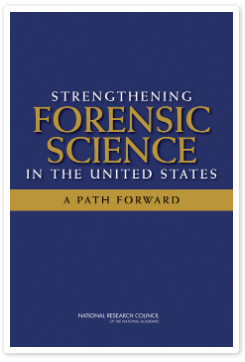
Cole is probably most famous for his book Suspect Identities, which (among other things) questioned the way in which fingerprint evidence was presented as irrefutable. Cole’s book was published in 2001, and in the following years, additional questions on fingerprint conclusions (such as the contradictory conclusions in the Brandon Mayfield case) culminated in the 2009 release of a landmark report from the National Academy of Sciences, Strengthening Forensic Science in the United States: A Path Forward. Among other things, this report changed the way in which forensic scientists expressed their conclusions.

Which brings us back to the question of what Simon A. Cole is doing these days.

OK, I lied. I DIDN’T stop talking about writing text. Because Cole’s forensic studies are all about the words that are used when talking about forensic conclusions.

Earlier this year, Cole co-authored a paper entitled “How Can a Forensic Result Be a ‘Decision’? A Critical Analysis of Ongoing Reforms of Forensic Reporting Formats for Federal Examiners.” As the beginning of the abstract to this paper reveals, Cole and his co-author Alex Biedermann believe that the choice of words is very important.

The decade since the publication of the 2009 National Research Council report on forensic science has seen the increasing use of a new word to describe forensic results. What were once called “facts,” “determinations,” “conclusions,” or “opinions,” are increasingly described as “decisions.”

Cole’s and Biedermann’s paper looks at that one word, “decisions,” from both a lay perspective and a scientific perspective. It also looks at other words that could be used, such as “interpretation” and “findings.” In the conclusion, the paper leans toward the latter.

…we tend to think that “findings” is the most appropriate of all the reporting terms floating around. “Findings” does the best job of conveying—to the expert and customer alike—that the report concerns the evidence alone. Not the evidence combined with other evidence. And, not the evidence combined with preferences. “Findings” helps more clearly distinguish between the analysis of the evidence and the inference to be drawn from that analysis. And, “findings” is commonly used in other fields of science to describe the analysis of (empirical) evidence.

The whole discussion might seem like a bunch of quibbling, but if I’m in court being charged with a murder I didn’t commit, it makes a huge difference to me whether a fingerprint comparison is reported as a “fact,” a “likelihood ratio,” a “decision,” a “finding”…or an “interpretation”…or an “opinion.” That list of possible words covers the entire spectrum.

Even if you’re not a forensic examiner (and I’m not), this precision in word choice is admirable. Especially when the life or death of a person is potentially at stake.