I won’t say who said this, but I know for a fact the person believes it.
“I think too much knowledge is actually bad in tech: you’re biased.”
And this view is widely held.

Identity/biometrics/technology marketing and writing services

I won’t say who said this, but I know for a fact the person believes it.
“I think too much knowledge is actually bad in tech: you’re biased.”
And this view is widely held.
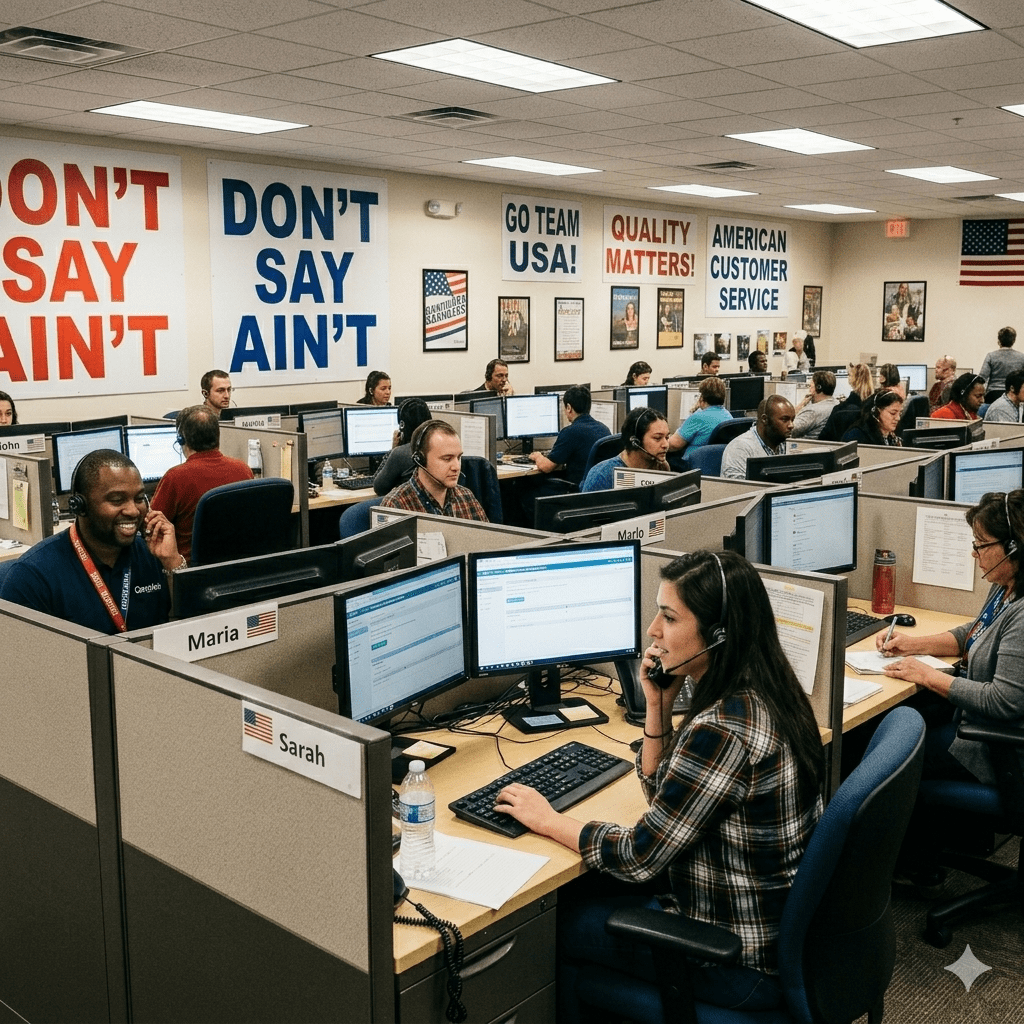
I belatedly learned about Federal Communications Commission Chair Brendan Carr’s proposals regarding call centers. But it’s important to note that there are three different proposals, each with different impacts.
Regarding those prized call center jobs that Americans hunger to fulfill so much, will the “reforms” include the abolition of the national $7.25 an hour minimum wage to make U.S.-based call center positions more attractive to employers? Well, employers in states that don’t have a higher minimum wage, anyway. Because call center jobs are a prime example of the jobs that Americans DON’T want to do. They’re worse than the data labeler jobs that require you to watch adult content.
Plus, many of these $7.25 an hour minimum wage states are in places where “American Standard English” is not widely spoken. Take Georgia and Oklahoma, each of which have a state minimum wage of $5.15, but that wage is overridden by the higher federal level.
Will the FCC consider Okie Talk as American Standard English?
Or will companies be required to import Yankees to make those calls? And offer unsweet tea options in the break room?
Which brings us to robocalls. Most people hate robocalls. (My secret: when someone from a random number calls me about my Google business listing, I immediately turn on call recording and the accompanying announcement. That shuts them up.)
But when thinking about possible ways to battle robocalls, the first answer that doesn’t come to mind is tariffs. That’s about as effective as…well, tariffs. Ask Jack Daniels and Jim Beam how tariffs have worked out for them.
Of course, both companies could solve their income problems by setting up call centers to call Americans, in American Standard English, and urge them to buy American…
…well, except that both Jack Daniels and Jim Beam are age restricted products, which makes calling somewhat difficult. I don’t think ANY company is pioneering age estimation by voice.

If you’re on a platform such as Facebook, you sometimes receive advertisements that are VERY specific. Such as, “This is the perfect drink holder for California white males over the age of 50!” It’s almost as if they know everything about you…because they do.
Unless you implement privacy restrictions and don’t allow platform advertisers to reference your personal information.
Of course, if the advertiser isn’t able to narrowcast directly to you, the advertiser will broadcast to everybody.
And Facebook will start showing you advertisements in Chinese.
And if you complain to Facebook and ask why you’re seeing Chinese ads, Facebook will simply reply, “We are prohibited from using your personal information. Since there are a billion Chinese, we take a guess that you’re Chinese and show you those ads.”
Which brings us to age and social media.
Back when Marky Mark created The Facebook, he initially targeted college-age users. But as time went on, Facebook and its competitors started aiming for younger ages.
This makes sense. Advertisers want to target consumers who are suspectible to changing their minds and are not set in their ways. So while a super kewl soft drink manufacturer isn’t going to target me, it is going to target 18 year olds…and 16 year olds…and 14 year olds…and 12 year olds.
A recent DKC report stated that 42% of all household spending is influenced by 8- to 14-year-olds, and that this age group is DIRECTLY spending over $100 billion per year.
So you can bet that advertisers are clamoring to purchase ad time on Facebook, TikTok, and the other social media services to get a pipeline to the brains of these 8 to 14 year olds…whoops, 12 to 14 year olds, since most social media services require you to be at least 12 years old to have an account.
But what if access to that entire age group is cut off entirely?
We’re seeing all over the world that jurisdictions are enacting or trying to enact bans on the use of social media for people under 16 years of age. The latest country to propose such a move is Indonesia:
“Authorities in the country, which is Southeast Asia’s largest economy, said Friday they expect social media platforms to deactivate the accounts of under-16s from March 28, starting with YouTube, TikTok, Facebook, Instagram, Threads, X, Bigo Live and Roblox.”
In other words, all the popular sites that teens love.
And in certain jurisdictions, the companies will implement age verification and age estimation technology to ensure that kids don’t like about their ages to get in.
Assuming these prohibitions stand, this causes a huge problem for B2C marketers that target teens: how do you market to them when the direct pipelines to this age group are cut off?
I’m just thankful that Bredemarket and its clients sell to adults. You don’t really see 13 year olds buying biometric technology.

We’ve talked about Levels 1 and 2 of iBeta’s confirmation that particular biometric implementations meet the requirements of ISO 30107-3. But now with Yoti’s confirmation, we can talk about iBeta Level 3.
From iBeta:
“The test method was to apply 1 bona fide subject presentation that alternated with 3 artefact presentations such that the presentation of each species consisted of 150 Presentation Attacks (PAs) and 50 bona fide presentations, or until 56 hours had passed per species. The results were displayed for the tester on the device as “Liveness check: Passed” for a successful attempt or “Liveness check: Failed” for an unsuccessful attempt.
“iBeta was not able to gain a liveness classification with the presentation attacks (PAs) on the Apple iPhone 16 Pro. With 150 PAs for each of 3 species, the total number of attacks was 450, and the overall Attack Presentation Classification Error Rate (APCER) was 0%. The Bona Fide Presentation Classification Error Rate (BPCER) was also calculated and may be found in the final report.
“Yoti Limited’s myface12122025 application and supporting backend components were tested by iBeta to the ISO 30107-3 Biometric Presentation Attack Detection Standard and found to be in compliance with Level 3.”
More from Yoti itself.
“Yoti’s MyFace is the first passive, single-selfie liveness technology in the world to conform to iBeta’s Level 3 testing under ISO/IEC 30107-3 – their highest level for liveness checks.”
Also see Biometric Update and UK Tech.
After all, facial age estimation is of no meaning whatsoever if the face is fake. So it was important that Yoti receive this confirmation.

More and more jurisdictions are mandating age assurance (either age verification or age estimation) to access online services. Perhaps racy content, perhaps gambling content, or in some cases even plain old social media. But in a technical sense these age assurance mechanisms are a network problem…and you can just route yourself around a problem.
Your jurisdiction doesn’t allow you to visit the Sensuous Wildebeests website? Just install a virtual private network (VPN) to pretend that you’re in a different jurisdiction that allows access.
Problem solved…for now.
But Secrets of Privacy indicates what’s next:
“After the Online Safety Act triggered a 6,000+% surge in VPN usage, the House of Lords tabled an amendment to ban children from using VPNs. Under the proposal, VPN providers would have to verify the age of all UK users. The government has said it will “look very closely” at VPN usage.”
For more information on this proposal, see TechRadar.
And this is just one of many examples of government examination, and perhaps regulation, of VPN use.
But as Secrets of Privacy points out, there’s one big problem. VPN users aren’t only kids trying to dodge the law, or individuals trying to protect their privacy. There’s one very big class of VPN users who would NOT appreciate government regulation.
“VPNs are fundamental to modern business IT, which makes a “ban” hard to envision. Every corporation with remote workers uses them. Diverse industries, such as banking, law, finance, and ecom giants all depend on VPN technology. You can’t ban VPNs without breaking the backbone of modern IT systems.”

Of course, some argue that VPNs are an outmoded security mechanism. Here’s what Fortinet says:
“VPNs were developed when networks were different than they are now. Before the advent of cloud applications, resources were isolated within a secure corporate network perimeter. Now, modern networking infrastructures are being deployed that can quickly adapt and scale to new business requirements, which means applications and data are no longer contained within the corporate data center. Instead they reside across distributed multi-cloud and hybrid data center networks.
“This change has led to a rapid expansion of the attack surface, and in the face of this changing cybersecurity environment, Zero Trust Network Access (ZTNA) has received more attention as an alternative to VPNs for remote access.”
Of course, VPNs will fade away at the same time the password dies…in other words, not any time soon. And while Secrets of Privacy speculates about a two-tier solution in which corporations can use VPNs but individuals cannot…we’ll see.
Do you have trust, or zero trust, that VPNs will be regulated in ALL jurisdictions in the future?
Ask questions.

Online games can conceal all sorts of things. For example, back in 2020 a 12 year old allegedly received this message in a chat on the Roblox online platform:
“You’re 12, I expect you to be a little slow on the upbringing, but soon I’ll corrupt you beyond your wildest dreams.”
This chat message wasn’t from another 12 year old, but reportedly from an adult man known in Roblox as “Doc,” with the purported legal name of Jadon Shedletsky. “Doc” was known to have made similar comments publicly, such as self-referencing as “the old man with kids in his basement.”
But “Doc” wasn’t Jadon Shedletsky. He was in reality Arnold Castillo, and several years later was sentenced to 15 years in federal prison after pleading guilty to Transportation of a Minor with Intent to Engage in Criminal Sexual Activity and Coercion and Enticement of a Minor. In additon to Roblox, Castillo used Discord and Instagram to communicate with the girl, and Uber for the “transportation of a minor” part.
Understandbly Roblox and the parents of Roblox’s youthful users don’t want the kids to strike up chats with people like Castillo. So Roblox is limiting chats between young kids and adults.
“[O]ur age check requirement to chat, which launched in select regions in early December, is rolling out globally wherever chat is available. Users in the U.S. and select regions will see in-app prompts asking them to complete an age check to chat with others. Over the next week, these prompts will roll out to all regions where chat is available.”
But how do you enforce such rules when kids normally don’t have identification?
According to Biometric Update, with age estimation.
“Roblox uses facial age estimation (FAE) technology from Persona for its Trusted Connections feature, which requires users to do an age check before they can interact with others on the platform….
“The technology used by our vendor, Persona, has been tested and certified by third-party laboratories. The age estimation models used achieved a Mean Absolute Error of 1.4 years for users younger than 18, based on testing by the Age Check Certification Scheme in the UK.”
There are differences between age verification and age estimation, but there are also times when you can only use one or the other.
As biometric product marketing experts know.

The U.S. Census Bureau has provided follow-up information that supplements its earlier report on Native American casinos, which I previously discussed. It turns out that the immigrant populations (you know, people of English and other descents) are cashing in also.
“The national total of state sales tax revenue from sports betting soared 382%, from $190 million in the third quarter of 2021 (when data collection began) to $917 million in the second quarter of 2025, according to the U.S. Census Bureau’s Quarterly Summary of State and Local Tax Revenue (QTAX).
“Sports betting became possible in May 2018 when the U.S. Supreme Court struck down the Professional and Amateur Sports Protection Act. Since then, a majority of states have legalized some form of sports betting; including online, mobile, retail sports betting and pari-mutuels (such as wagers made on horse-racing).
“Sports betting is a growing industry, and the tax revenue it generates helps fund public schools, roads, highways, law enforcement and gambling addiction treatment.”
Read the entire piece here.

A dizzying array of federal government agencies is interested in biometric verification and biometric classification, for example by age (either age verification or age estimation). As Biometric Update announced, we can add the Federal Trade Commission (FTC) to the list with an upcoming age verification workshop.
The FTC has a history with this, having rejected a proposed age estimation scheme in 2024.
“Re: Request from Entertainment Software Rating Board, Yoti Ltd., Yoti (USA) Inc., and Kids Web Services Ltd. for Commission Approval of Children’s Online Privacy Protection Rule Parental Consent Method (FTC Matter No. P235402)
“This letter is to inform you that the Federal Trade Commission has reviewed your group’s (“the ESRB group”) application for approval of a proposed verifiable parental consent (“VPC”) method under the Children’s Online Privacy Protection Rule (“COPPA” or “the Rule”). At this time, the Commission declines to approve the method, without prejudice to your refiling the application in the future….
“The ESRB group submitted a proposed VPC method for approval on June 2, 2023. The method involves the use of “Privacy-Protective Facial Age Estimation” technology, which analyzes the geometry of a user’s face to confirm that the user is an adult….The Commission received 354 comments regarding the application. Commenters opposed to the application raised concerns about privacy protections, accuracy, and deepfakes. Those in support of the application wrote that the VPC method is similar to those approved previously and that it had sufficient privacy guardrails….
“The Commission is aware that Yoti submitted a facial age estimation model to the National Institute of Standards and Technology (“NIST”) in September 2023, and Yoti has stated that it anticipates that a report reflecting NIST’s evaluation of the model is forthcoming. The Commission expects that this report will materially assist the Commission, and the public, in better understanding age verification technologies and the ESRB group’s application.”
You can see the current NIST age estimation results on NIST’s “Face Analysis Technology Evaluation (FATE) Age Estimation & Verification” page, not only for Yoti, but for many other vendors including my former employers IDEMIA and Incode.
But the FTC rejection was in 2024. Things may be different now.

The FTC has scheduled an in-person and online age verification workshop on January 28.
“The Age Verification Workshop will bring together a diverse group of stakeholders, including researchers, academics, industry representatives, consumer advocates, and government regulators, to discuss topics including: why age verification matters, age verification and estimation tools, navigating the regulatory contours of age verification, how to deploy age verification more widely, and interplay between age verification technologies and the Children’s Online Privacy Protection Act (COPPA Rule).”
Will the participants reconsider age estimation in light of recent test results?

This is the week that we celebrate how much companies in Sweden and elsewhere know about us.
Including estimated ages.
Which may or may not (I’m not telling) be as accurate as software that analyzes your face for age estimation.
And the companies gathering the data can then sell it to advertisers and others who use it in all sorts of ways.
It will be interesting to see the corporate messaging that I and other Spotify users will receive over the next few days.
“If you listen to Depeche Mode, perhaps our Medicare plans may interest you.”
When discussing age restricted products and services-the ones that require age verification or age estimation-the discussion often focuses on the negative aspects of these products of services. After all, they are age restricted for a reason: you don’t want a five year old smoking marijuana or playing poker.
But as the providers of age restricted items will remind you, they also provide a positive impact to the community.
And sometimes the government also joins in the chorus of praise.
Here’s what the U.S. Census Bureau says about Native American casinos:
“The expansion of tribal casinos that began in the 1990s helped improve economic conditions faster for American Indians relative to the U.S. population as a whole, according to joint U.S. Census Bureau and university research, though there is still progress to be made: the American Indian poverty rate was 19.6% in 2024, greater than that year’s national average of 12.1%, according to Census Bureau data….
“American Indians living on reservation lands (regardless of the presence of a casino or cash transfer program) saw a 46.5% rise in real per capita income compared to 7.8% for the United States as a whole.”
Read the entire article here.

 Bredemarket