Okta Talks About Evil Twins

Public wi-fi can be fun, especially when you don’t realize which networks were legitimately set up by the business.

And they’re really fun when someone pulls the “evil twin” trick, described by Okta.

“A hacker looks for a location with free, popular WiFi. The hacker takes note of the Service Set Identifier (SSID) name. Then, the hacker uses a tool like a WiFi Pineapple to set up a new account with the same SSID. Connected devices can’t differentiate between legitimate connections and fake versions.”

The next steps are to trick users into providing the authentication details for the “good” network, lure people into logging in to the “evil” network, then steal any unencrypted data.

Of course you don’t have to go to those extremes. If the business fails to publicize what the “good” network is called, just set up a network called “ReelOffishelWiFi” and see how many suckers you get.

(Imagen 4)

Ubiquity Via Focus…On Where?

So Bredemarket’s talking about “ubiquity via focus”?

Focus on where?

On the Bredemarket blog, your source for the latest identity/biometric and technology news.

And your source for the most up-to-date information on Bredemarket’s content-proposal-analysis services.

Be sure to visit https://bredemarket.com/blog/

Or better yet, subscribe at https://bredemarket.com/subscribe-to-bredemarket/

The Best Deepfake Defense is NOT Technological

I think about deepfakes a lot. As the identity/biometric product marketing consultant at Bredemarket, it comes with the territory.

When I’m not researching how fraudsters perpetrate deepfake faces, deepfake voices, and other deepfake modalities via presentation attack detection (liveness detection) and injection attack detection

…I’m researching and describing how Bredemarket’s clients and prospects develop innovative technologies to expose these deepfake fraudsters.

You can spend good money on deepfake-fighting industry solutions, and you can often realize a positive return on investment when purchasing these technologies.

But the best defense against these deepfakes isn’t some whiz bang technology.

It’s common sense.

  • Would your CEO really call you at midnight to expedite an urgent financial transaction?
  • Would that Amazon recruiter want to schedule a Zoom call right now?

If you receive an out-of-the-ordinary request, the first and most important thing to do is to take a deep breath.

A real CEO or recruiter would understand.

And…

…if your company offers a fraud-fighting solution to detect and defeat deepfakes, Bredemarket can help you market your solution. My content, proposal, and analysis offerings are at your service. Let’s talk: https://bredemarket.com/cpa/

CPA

(Imagen 4)

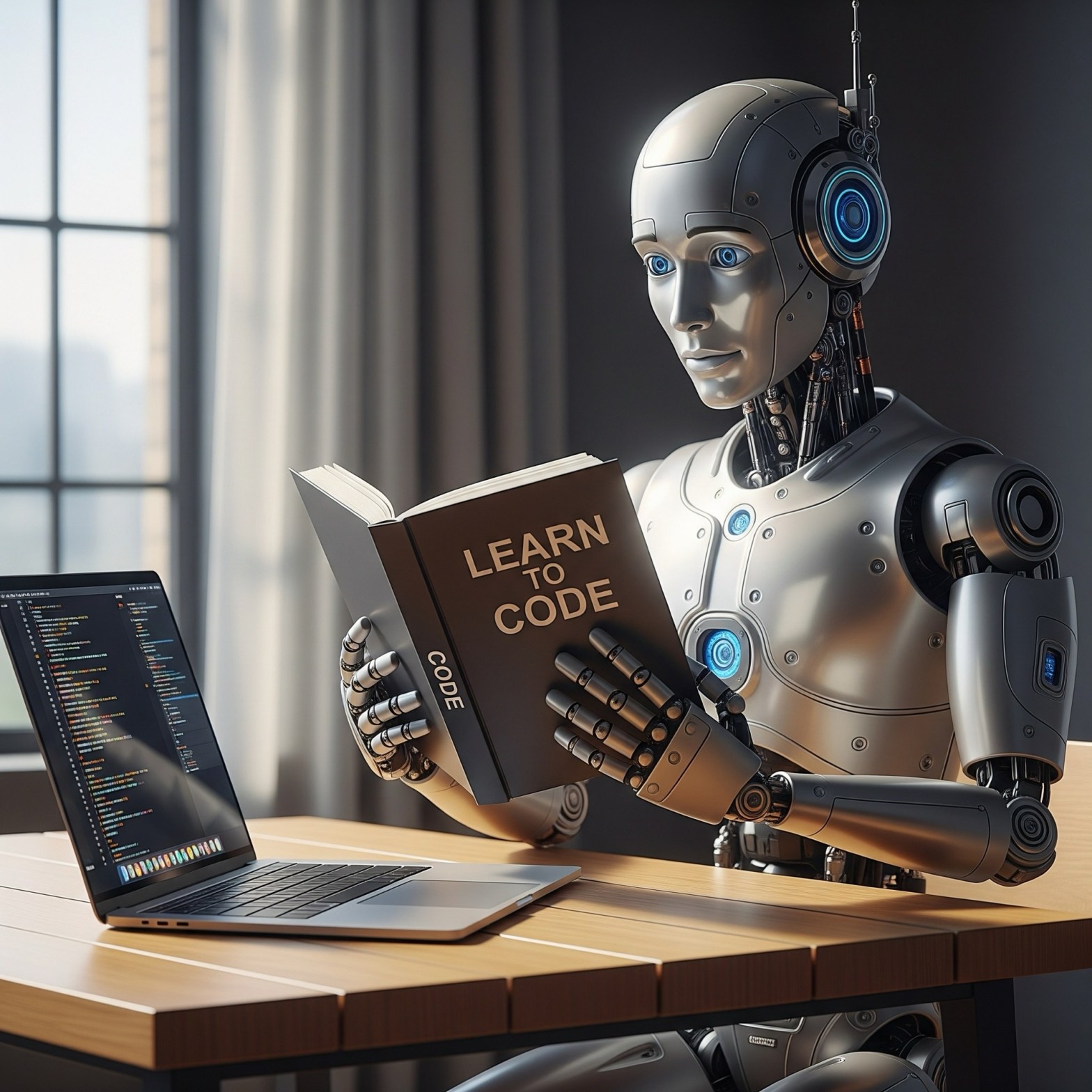
Don’t Learn to Code

(Imagen 4)

Some of you may remember the 2010s, when learning to code would solve all your problems forever and ever. 

There was even an “Hour of Code” in 2014:

“The White House also announced Monday that seven of the nation’s largest school districts are joining more than 50 others to start offering introductory computer science courses.”

But people on the other side of the aisle endorsed the advice:

“On its own, telling a laid-off journalist to “learn to code” is a profoundly annoying bit of “advice,” a nugget of condescension and antipathy. It’s also a line many of us may have already heard from relatives who pretend to be well-meaning, and who question an idealistic, unstable, and impecunious career choice.”

But the sentiment was the same: get out of dying industries and do something meaningful that will set you up for life.

Well, that’s what they thought in the 2010s.

Where are the “learn to code” advocates in 2025?

They’re talking to non-person entities, not people:

“Microsoft CTO Kevin Scott expects the next half-decade to see more AI-generated code than ever — but that doesn’t mean human beings will be cut out of the programming process.

“”95% is going to be AI-generated,” Scott said when asked about code within the next five years on an episode of the 20VC podcast. “Very little is going to be — line by line — is going to be human-written code.””

So the 2010s “learn to code” movement has been replaced by the 2020s “let AI code” movement. While there are valid questions about whether AI can actually code, it’s clear that companies would prefer not to hire human coders, who they perceive to be as useless as human journalists.

Simeio: Identity is the Perimeter of Cybersecurity

Simeio opened its monthly newsletter with a statement. Here is an excerpt:

“May spotlighted how even the most advanced enterprises are vulnerable when identity systems are fragmented, machine identities go unmanaged, and workflows rely too heavily on manual intervention—creating conditions ripe for risk. Enterprises need to get the message: identity is the perimeter of cybersecurity, and orchestration is the force multiplier. It’s time to learn how to effectively leverage it.”

Read the rest of Simeio’s newsletter on LinkedIn at https://www.linkedin.com/pulse/identity-matters-may-2025-identitywithsimeio-iby0e

Of course, there’s that interesting wrinkle of the identities of non-person entities, which may or may not be bound to human identities. Simeio, with its application onboarding solution, plays in the NPE space.

As for me, I need to start thinking about MY Bredemarket monthly LinkedIn newsletter (The Wildebeest Speaks) soon. June approaches. (Here’s the May edition if you missed it.)

Ubiquity Via Focus

Well, that’s done and over with.

So let’s move forward with the third year of the revived Bredemarket.

In case you missed it, Bredemarket provides content-proposal-analysis services for identity/biometric and technology firms by means of standard writing offerings.

And Bredemarket will improve its capabilities to serve you…by the means of ubiquity via focus.

No, Bredemarket isn’t ready to reveal what “ubiquity via focus” is yet…but I think you’ll figure it out.

Ubiquity Via Focus.

Identity-Bound Non-Person Entities

In my writings on non-person entities (NPEs), I have mentally assumed that NPEs go their own way and do their own thing, separate from people. So while I (John Bredehoft) have one set of permissions, the bot N. P. E. Bredemarket has “his” own set of permissions.

Not necessarily.

Anonybit and SmartUp have challenged my assumption, saying that AI agents could be bound to human identities.

“Anonybit…announced the first-ever live implementation of agentic commerce secured by decentralized biometrics, marking a significant milestone in the evolution of enterprise AI.

“Through a strategic partnership with SmartUp, a no-code platform for deploying enterprise AI agents, Anonybit is powering authenticated, identity-bound agents in real-world order, payment, and supply chain workflows….

“Anonybit’s identity token management system enables agents to operate on behalf of users with precise, auditable authorization across any workflow—online, in-person, or automated.”

So—if you want to—all your bot buddies can be linked to you, and you bear the responsibility for their actions. Are you ready?

(Imagen 4)

Two Years

On May 30, 2023 I wrote a post in the Bredemarket blog, announcing an increase in Bredemarket’s business hours to full time.

I also announced a change in scope.

“If you need a consultant for marketing or proposal work, and your company is involved in the identification of individuals, Bredemarket can accept the work.”

Because…I learned at 7:30 that morning that my individual identification employer was no longer my employer. Several of us lost our jobs that day.

As it turns out, my view of my employment future was overly optimistic.

“Maybe I’ll find a new full-time position in a couple of weeks, and I’ll again have to reduce hours and scope.”

As it ended up, I didn’t…and I haven’t.

Your credentials are too impressive, so we are moving in a different direction.

And I’m paying full price for my healthcare—no employer subsidy.

Your opportunity remains.

Bredemarket has openings.

(Pictures not from Craiyon, but from Imagen 4.)

Make America Hallucinate Again

While some are concentrating on the political aspects of this story, I would like to focus on the technological aspects.

“[Dr. Katherine] Keyes is cited in a paper titled ‘Changes in mental health and substance use among US adolescents during the COVID-19 pandemic,’ which appears on page 52 of the MAHA report and lists JAMA Pediatrics as the journal. A representative for the journal confirmed to ABC News the paper does not exist.”

Quoted from https://abcnews.go.com/Politics/rfk-jrs-maha-report-contained-existent-studies/story?id=122321059

Anybody who has paid attention over the last two years knows EXACTLY what happened.

The word “hallucination” comes to mind.

Figure it out yet?

Someone took a shortcut in researching and/or writing the MAHA paper…something that all the generative AI companies are saying is a perfectly wonderful thing to do. After all, you won’t lose your job to AI…you will lose your job to someone who uses AI’s “help.” Until AI hallucinates and puts organic food dye-free egg whites on your face.

The continued inaccuracies in generative AI-authored writing are not limited to one political movement.

(Imagen 4)