David Hentschel: ARP 2500 synthesizer (uncredited)
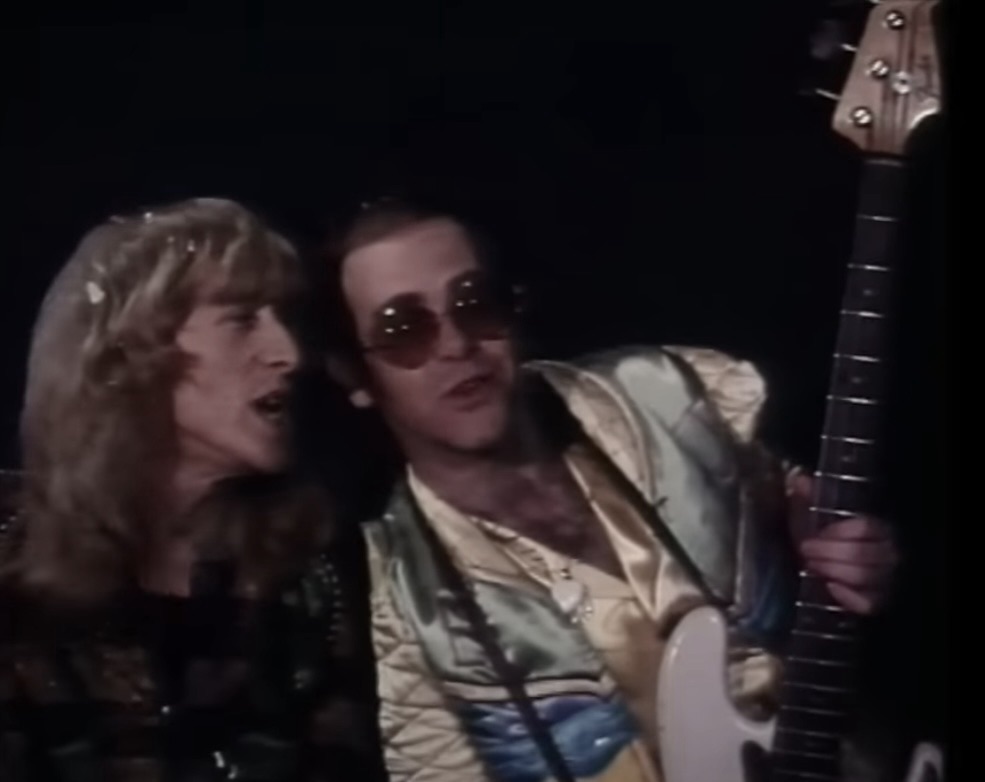
The video doesn’t match this list. According to the video, Elton played more than the guitar, and Bernie Taupin performed on the track.
So while we didn’t use the term “deepfake” in 1973, this promotional video meets at least some of the criteria of a deepfake.
And before you protest that everybody knew that Elton John didn’t play guitar…undoubtedly some people saw this video and believed that Elton was a guitarist. After all, they saw it with their own eyes.
There is a lot of discussion about data scraping, an activity in which Company 1 takes the information publicly posted by Company 2 and incorporates it into its own records.
In the identity world, this takes the form of a company “scraping” the facial images that were publicly posted by a second company, such as a social media company.
I think that we all know of one identity company that is well-known (a euphemism for “notorious”) for scraping facial images from multiple sources. These not only include government-posted mugshots, but also content posted by private social media firms.
Needless to say, the social media companies think that data scraping is completely evil and terrible and identity vendors that do this should be fined and put out of businress. The identity vendor is question has a different view, even stating at one point that it had a (U.S.) First Amendment right to scrape data.
But what happens when someone wants to scrape data FROM an identity company?
The case is CITY OF SEDRO-WOOLLEY and CITY OF STANWOOD, Washington Municipal Corporations vs. JOSE RODRIGUEZ. The following are findings of fact:
“On April 10, 2025, Defendant, Jose Rodriguez made a Public Records Request to the Snohomish Police Department. He requested all of the city’s Flock cameras pictures and data logs between 5 pm and 6 pm on March 30, 2025.”
This particular record does not indicate WHY Rodriguez made this request, but 404 Media provided a clarification from Rodriguez himself.
“I wanted the records to see if they would release them to me, in hopes that if they were public records it would raise awareness to all the communities that have the Flock cameras that they may be public record and could be used by stalkers, or burglars scoping out a house, or other ways someone with bad intentions may use them. My goal was to try getting these cameras taken down by the cities that put them up.”
The City of Stanwood (don’t know its relation to Snohomish) answered Rodriguez in part:
“Stanwood PD is not the holder of the records you’re seeking; you may be able to request the records at FlockSafety.com.”
Incidentally, this is a common issue with identity databases using vendor softwares; who owns the data? I’ve addressed this before regarding the Milwaukee Police Department.
Now some legal talent may be able to parse what the word “holder” means, especially in regard to data hosted in the cloud. Perhaps Stanwood PD was trying to claim that since the records weren’t on site, it wasn’t the “holder.”
Anyway, the defendant subsequently made a similar request to the City of Sedro-Woolley, but for a different date. Sedro-Woolley didn’t provide the images either.
Then it gets weird.
What happened to the data?
“The Flock records sought by Defendant from Stanwood and Sedro-Woolley have been auto-deleted.”
Well how convenient.
And the listed statements of fact also contain the following:
“The contract between Flock and Stanwood sates that all Flock images generated off Flock cameras located in Stanwood are the property of Stanwood.
“The contract between Flock and Sedro-Woolley states that all Flock images generated off Flock cameras located in Sedro-Woolley are the property of Sedro-Woolley.”
The judge’s ruling
Fast forward to November 6, when Judge Elizabeth Neidzwski ruled on the cities’ claim that the Flock camera data was not a public record.
“IT IS HEREBY ORDERED, ADJUDGED AND DECREED that Plaintiff’s motion for Declaratory Judgment that the Flock camera records are not public records is DENIED.”
404 Media noted that the cities argued that they resisted the request to…protect privacy.
“In affidavits filed with the court, police argued that ‘if the public could access the Flock Safety System by making Public Records Act requests, it would allow nefarious actors the ability to track private persons and undermine the effectiveness of the system.’ The judge rejected every single one of these arguments.”
Of course, there are those who argue that the police themselves are the “nefarious actors,” and that they shouldn’t be allowed to track private persons either.
But the parties may take the opposite argument
This is not the only example of conflicting claims over WHO has the right to privacy. In fact, if the police were filming protestors and agitators and wanted the public’s help in identifying them, the police and the protestors would take the opposite arguments in the privacy issue: the police saying the footage SHOULD be released, and the protestors who were filmed saying it SHOULD NOT.
I confess that I love my promotional videos. After all, someone has to.
If you haven’t figured it out yet, my current super-sweet saccharine crush is “Bredemarket: Services, Process, and Pricing,” originally shared here on the Bredemarket blog last Wednesday.
= = reel
Bredemarket: Services, Process, and Pricing.
But I’m forced to admit that there are billions of people who never read the Bredemarket blog, and therefore will never see this post or the original one. Their loss. Thank you to those of you who do stop by; it’s appreciated.
But I can catch a few of them by sharing my video on other social platforms.
If you want to lose 15 minutes of your life, redundantly watch all of them.
So here’s my ask, if you are so inclined. Share this video with your friends on one of the platforms to help me get the word out about how Bredemarket can help technology marketing leaders…um, get the word out.
The perfect is the enemy of the good, and I proved that today by creating a video…and then another one…and then another one.
I planned to write on GoFundMe “helper” scammers, ways to detect scammers, and ways to flush out scammers via a honeypot: a post prominently featuring the word “GoFundMe.”
So I created a video.
Version One. 89 seconds.
After posting that video I decided it was too long and created a shorter version.
Version Two. 44 seconds.
You’ve never seen this before…because just before I was going to post that video I decided it was too long and edited it further.
Version Three. 30 seconds.
I went ahead and posted that third version, leaving the first version active.
And for all I know I will create a fourth version.
And I don’t know whether the first or third video is better. My intuition tells me the third one is better, but maybe the prospects will prefer the first version. Or the second one, which almost never saw the light of day.
Which one do you prefer? Tell me in the comments.
The unavoidable call to action
You know, all this iterating teaches us a lot about B2B sales.
I know some marketing leaders who are afraid to post anything, waiting for the perfect moment.
They’re still waiting.
Don’t let your competitors steal your prospects from you while you delay. Bredemarket can help. Book a free meeting with me: https://bredemarket.com/mark/
As some of you know, my generative AI tool of choice has been Google Gemini, which incorporates guardrails against portraying celebrities. Grok has fewer guardrails.
My main purpose in creating the two Bill and Hillary Clinton videos (at the beginning of this compilation reel) was to see how Grok would handle references to copyrighted music. I didn’t expect to hear actual songs, but would Grok try to approximate the sounds of Lindsey-Stevie-Christine era Mac and the Sex Pistols? You be the judge.
And as for Prince and Johnny…you be the judge of that also.
Most of my recent generative GI experiments have centered on Google Gemini…which has its limitations:
“Google Gemini imposes severe restrictions against creating pictures of famous figures. You can’t create a picture of President Taylor Swift, for example.”
Why does Google impose such limits? Because it is very sensitive to misleading the public, fearful that the average person would see such a picture and mistakenly assume that Taylor Swift IS the President. In our litigious society, perhaps this is valid.
“One common accusation about Grok is that it lacks the guardrails that other AI services have.”
During a few spare moments this morning, I signed up for a Bredemarket Grok account. I have a personal X (Twitter) account, but haven’t used it in a long time, so this was a fresh sign up.,
And you know the first thing that I tried to do.
Grok.
Grok created it with no problem. Actually, there is a problem, because Grok apparently is not a large multimodal model and cannot precisely generate text in its image generator. But hey, no one will notice “TWIRSHIITE BOUSE,” will they?
But wait, there’s more! After I generated the image, I saw a button to generate a video. I thought that this required the paid service, but apparently the free service allows limited video generation.
Grok.
I may be conducting some video experiments some time soon. But will I maintain my ethics…and my sanity?
And what about Freja? Well, if the Danish Copyright Act takes effect on March 31, 2026 as expected, Cali John can get into a ton of trouble if he uses the video to create a realistic, digitally generated imitation of Freja. Again, consent is required. Again, there can be monetary penalties if you don’t get that consent.
But there’s another question we have to consider.
The vendor responsibility
Does the videoconference provider bear any responsibility for the violations of Illinois and Danish law?
“5. USE OF SERVICES AND YOUR RESPONSIBILITIES. You may only use the Services pursuant to the terms of this Agreement. You are solely responsible for Your and Your End Users’ use of the Services and shall abide by, and ensure compliance with, all Laws in connection with Your and each End User’s use of the Services, including but not limited to Laws related to recording, intellectual property, privacy and export control. Use of the Services is void where prohibited.”
But such requirements haven’t stopped BIPA lawyers from filing lawsuits against deep pocketed software vendors. Remember when Facebook settled for $650 million?
So remember what could happen the next time you participate in a multinational, multi-state, or even multi-city videoconference. Hope your AI note taker isn’t capturing screen shots.
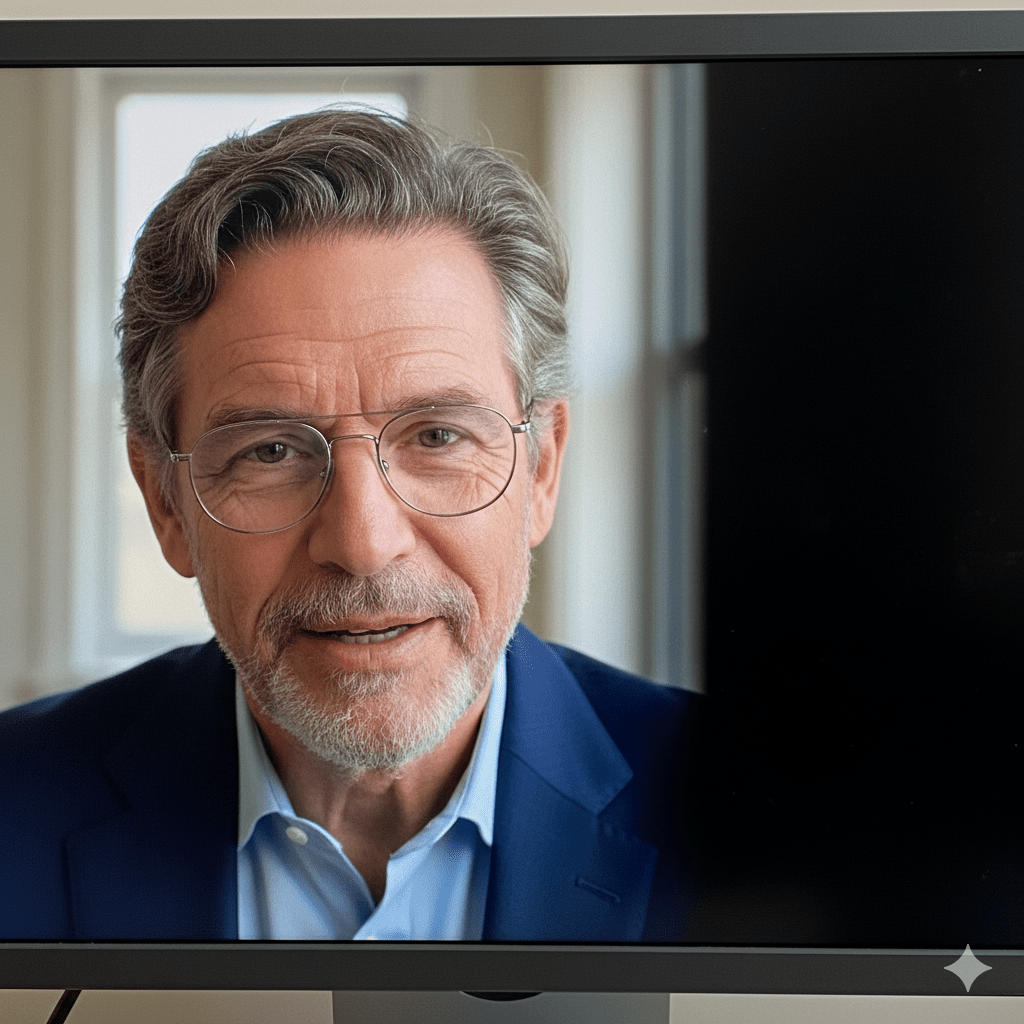
It was 8:48, just before an important client meeting this morning, and I was freaking out. I had scheduled the meeting in Google Meet, and I started up the session…and the right third of the camera view was obscured.
Imagen 4 re-creation. I didn’t think to take a screenshot at the time. And no, I don’t have facial hair.
I attempted various fixes:
I stopped Google Meet, started it again…and got the same result.
I logged off and logged back in again…and got the same result.
I restarted my computer (turn it off and turn it back on again)…and got the same result.
I tried Zoom…and got the same result.
Which meant that the possible problem was a hardware problem with the camera itself. Which meant a lot of hassle sending the computer in for a fix, which was especially upsetting because this was a new computer.
A black section in a laptop camera feed is most often due to a hardware issue, such as a damaged camera sensor or a problem with the ribbon cable that connects the camera to the motherboard. Software issues are less likely to cause a precise, consistent black area like this, but they’re still worth checking.
Then I began working down the checklist that Bredebot provided, beginning with the first item.
The most common and easiest issue to rule out is a physical object blocking the lens. This could be a speck of dust or debris, a stray piece of a sticker, or a misplaced privacy slider. Even a tiny particle on the lens can show up as a large black spot or area in the image.
A speck of dust? Just a simple speck of dust causing that major of an obstruction?
Not having a can of compressed air available, I used my mouth to blow on the top of the laptop screen.
The obstruction partially cleared, and now three fourths of the screen was visible.
One more blow, and my “critical hardware failure” was fixed.
What does this mean?
So some computer problems are NOT fixed by turning it off and turning it on again. Sometimes a lot of hot air is necessary.
Imagen 4.
By sheer coincidence, the Just A Band song “Huff + Puff” is on my current Spotify playlist. Nothing to do with computer video hardware, but it’s a good song.
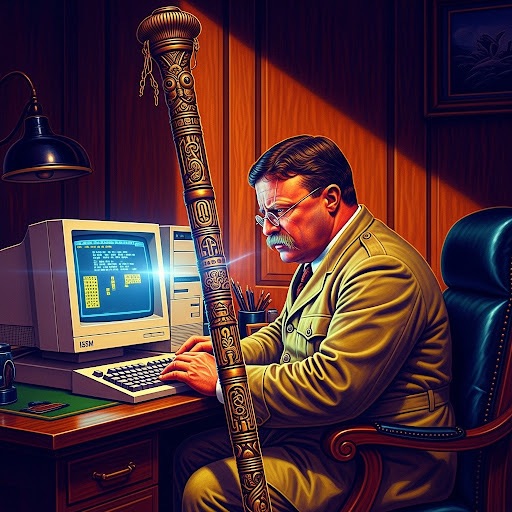
So I just created a short reel for no purpose other than to illustrate Theodore Roosevelt’s famous saying “Speak softly and carry a big stick.”
But then I began thinking. For product marketers, is “speaking softly” an idea that should be relegated to the early 20th century? The answer to that question partially depends on whether you are marketing in an earlier awareness stage, or a later conversion stage.
But the reel doesn’t get that deep.
Speak softly.
An aside (overly serious product marketers skip this part)
Originally this reel was supposed to be a single image, with no stick, showing President Roosevelt to the audio accompaniment of Paul Simon’s “Loves Me Like a Rock.”
To be honest, ORIGINALLY the President was supposed to be Nixon, whose mama loved him and was a saint.
But once Roosevelt got behind the Presidential podium, my mind traveled to earlier times in the Dakotas and Cuba, and the stick—softly—inserted itself.
Excluded from the reel but not forgotten: my earlier fictional conception of Roosevelt overseeing the construction of the Panama Canal, previously shared here.
A man, a plan…
And if you haven’t already figured it out, Teddy appears to be safe from the restrictions from Google’s guidelines on depictions of famous figures. As I said before, no picture generation of President Richard Nixon, or President Taylor Swift.
“This quote often attributed to Theodore Roosevelt is actually a West African proverb. Roosevelt writes this in a letter to Henry Sprague on January 26, 1900.”
A year and a half later, after Roosevelt’s political enemies had maneuvered him into the then-obscure position of Vice President of the United States (subsequently characterized as a bucket of warm…spit), he expounded upon the phrase at the Minnesota State Fair on September 2, 1901.
Deep fried pizza on a stick. Not historically accurate.
(He and his political enemies had no way of knowing that later that month McKinley would be assassinated and Roosevelt would be President. Oops.)
“”Speak softly and carry a big stick—you will go far.” If a man continually blusters, if he lacks civility, a big stick will not save him from trouble; and neither will speaking softly avail, if back of the softness there does not lie strength, power. In private life there are few things more obnoxious than the man who is always loudly boasting; and if the boaster is not prepared to back up his words his position becomes absolutely contemptible. So it is with the nation. It is both foolish and undignified to indulge in undue self-glorification, and above all, in loose-tongued denunciation of other peoples.”
As Roosevelt noted, the “and” it’s important. A soft speaker without a big stick will not be persuasive.
But is speaking softly all that important?
Speaking loudly: Berliners, Crazy Eddie
There are certainly instances, both in diplomacy/politics and product marketing, in which speaking loudly is extremely effective. Avoiding the 21st century (we really don’t want to go there) and confining myself to the 20th, the masses of people at the Berlin Wall were very loud.
“The Treaty of Portsmouth formally ended the Russo-Japanese War of 1904–05. The negotiations took place in August in Portsmouth, New Hampshire, and were brokered in part by U.S. President Theodore Roosevelt….Although the actual importance of Roosevelt’s mediation and personal pressure on the leadership in Moscow and Tokyo to the final agreement is unclear, he won the Nobel Peace Prize for his efforts in moderating the talks and pushing toward peace.”
Of course, everyone knew that negotiations were taking place in Portsmouth, just like everyone knew that Egypt and Israel were negotiating at Camp David 70+ years later.
“The world of golf was left stunned on Tuesday as the PGA Tour, DP World Tour and rival Saudi-backed LIV circuit, who have been involved in a bitter fight that has split the sport, announced a shock agreement to merge and form one unified commercial entity….The bombshell announcement was slammed by many PGA Tour players who were left in the dark about the merger…”
Not historically accurate. I don’t think.
For the moment, ignore the fact that the merger hasn’t happened two years later. The heated war between the PGA and the LIV meant that while a merger made financial sense (see the NFL and the AFL bidding up football player prices in the 1960s), no one expected a PGA-LIV merger to happen.







 Bredemarket