There’s a Reason Why “Tech” is a Four-Letter Word

By Tomia, original image en:User:Polylerus – Own work (Vector drawing based on Image:Profanity.JPG), Public Domain, https://commons.wikimedia.org/w/index.php?curid=3332425

We often use the phrase “four-letter word” to refer to cuss words that shouldn’t be said in polite company. Occasionally, we have our own words that we personally consider to be four-letter words. (Such as “BIPA.”)

There are some times when we resign ourselves to the fact that “tech” can be a four-letter word also. But there’s actually a good reason for the problems we have with today’s technology.

Tech can be dim

Just this week I was doing something on my smartphone and my screen got really dim all of a sudden, with no explanation.

So I went to my phone’s settings, and my brightness setting was down at the lowest level.

For no reason.

“Any sufficiently advanced technology is indistinguishable from magic.”

– Arthur C. Clarke, quoted here.

So I increased my screen’s brightness, and everything was back to normal. Or so I thought.

A little while later, my screen got dim again, so I went to the brightness setting…and was told that my brightness was very high. (Could have fooled me.)

I can’t remember what I did next (because when you are trying to fix something you can NEVER remember what you did next), but later my screen brightness was fine.

For no reason.

Was Arthur C. Clarke right? And if so, WHY was he right?

Perhaps it’s selective memory, but I don’t recall having this many technology problems when I was younger.

The shift to multi-purpose devices

Part of the reason for the increasing complexity of technology is that we make fewer and fewer single-purpose devices, and are manufacturing more and more multi-purpose devices.

One example of the shift: if I want to write a letter today, I can write it on my smartphone. (Assuming the screen is bright enough.) This same smartphone can perform my banking activities, play games, keep track of Bredemarket’s earnings…oh, and make phone calls.

Smartphones are an example of technologial convergence:

Technological convergence is a term that describes bringing previously unrelated technologies together, often in a single device. Smartphones might be the best possible example of such a convergence. Prior to the widespread adoption of smartphones, consumers generally relied on a collection of single-purpose devices. Some of these devices included telephones, wrist watches, digital cameras and global positioning system (GPS) navigators. Today, even low-end smartphones combine the functionality of all these separate devices, easily replacing them in a single device.

From a consumer perspective, technological convergence is often synonymous with innovation.

From https://www.techtarget.com/searchdatacenter/definition/technological-convergence

And the smartphone example certainly demonstrates innovation from the previous-generation single-purpose devices.

When I was a kid, if I wanted to write a letter, I had two choices:

  1. I could set a piece of paper on the table and write the letter with a writing implement such as a pen or pencil.
  2. I could roll a piece of paper into a typewriter and type the letter.

These were, for the most part, single purpose devices. Sure I could make a paper airplane out of the piece of paper, but I couldn’t use the typewriter to play a game or make a phone call.

Turning our attention to the typewriter, it certainly was a manufacturing marvel, and intricate precision was required to design the hammers that would hit the typewritter ribbon and leave their impressions on the piece of paper. And typewriters could break, and repairmen (back then they were mostly men) could fix them.

A smartphone is much more innovative than a smartphone. But it’s infinitely harder to figure out what is wrong with a smartphone.

The smartphone hardware alone is incredibly complex, with components from a multitude of manufacturers. Add the complexities of the operating system and all the different types of software that are loaded on a smartphone, and a single problem could result from a myriad of causes.

No wonder it seems like magic, even for the best of us.

Explaining technology

But this complexity has provided a number of jobs:

  • The helpful person at your cellular service provider who has acquired just enough information to recognize and fix an errant application.
  • The many people in call centers (the legitimate call centers, not the “we found a problem with your Windows computer” call scammers) who perform the same tasks at a distance.
By Earl Andrew at English Wikipedia – Own work, Public Domain, https://commons.wikimedia.org/w/index.php?curid=17793658
  • All the people who write instructions on how to use and fix all of our multi-purpose devices, from smartphones to computers to remote controls.

Oh, and the people that somehow have to succinctly explain to prospects why these multi-purpose devices are so great.

Because no one’s going to run into problems with technology unless they acquire the technology. And your firm has to get them to acquire your technology.

Crafting a technology marketing piece

So your firm’s marketer or writer has to craft some type of content that will make a prospect aware of your technology, and/or induce the prospect to consider purchasing the technology, and/or ideally convert the prospect into a paying customer.

Before your marketer or writer crafts the content, they have to answer some basic questions.

By Evan-Amos – Own work, Public Domain, https://commons.wikimedia.org/w/index.php?curid=11293857

Using a very simple single-purpose example of a hammer, here are the questions with explanations:

  • Why does the prospect need this technology? And why do you provide this technology? This rationale for why you are in business, and why your product exists, will help you make the sale. Does your prospect want to buy a hammer from a company that got tired of manufacturing plastic drink stirrers, or do they want to buy a hammer from a forester who wants to empower people to build useful items?
  • How does your firm provide this technology? If I want to insert a nail into a piece of wood, do I need to attach your device to an automobile or an aircraft carrier? No, the hammer will fit in your hand. (Assuming you have hands.)
  • What is the technology? Notice that the “why” and “how” questions come before the “what” question, because “why” and “how” are more critical. But you still have to explain what the technology is (with the caveat I mention below). Perhaps some of your prospects have no idea what a hammer is. Don’t assume they already know.
  • What is the goal of the technology? Does a hammer help you floss your teeth? No, it puts nails into wood.
  • What are the benefits of the technology? When I previously said that you should explain what the technology is, most prospects aren’t looking for detailed schematics. They primarily care about what the technology will do for them. For example, that hammer can keep their wooden structure from falling down. They don’t care about the exact composition of the metal in the hammer head.
  • Finally, who is the target audience for the technology? I don’t want to read through an entire marketing blurb and order a basic hammer, only to discover later that the product won’t help me keep two diamonds together but is really intended for wood. So don’t send an email to jewelers about your hammer. They have their own tools.
By Mauro Cateb – Own work, CC BY-SA 4.0, https://commons.wikimedia.org/w/index.php?curid=90944472

(UPDATE OCTOBER 23, 2023: “SIX QUESTIONS YOUR CONTENT CREATOR SHOULD ASK YOU IS SO 2022. DOWNLOAD THE NEWER “SEVEN QUESTIONS YOUR CONTENT CREATOR SHOULD ASK YOU” HERE.)

Once you answer these questions (more about the six questions in the Bredemarket e-book available here), your marketer or writer can craft your content.

Or, if you need help, Bredemarket (the technology content marketing expert) can craft your content, whether it’s a blog post, case study, white paper, or something else.

I’ve helped other technology firms explain their “hammers” to their target audiences, explaining the benefits, and answering the essential “why” questions about the hammers.

Can I help your technology firm communicate your message? Contact me.

Bredemarket logo

Technology firms and qualitative benefits

If you are a technology business who is communicating the benefits of your products or services, don’t assume that these benefits have to be quantified. Qualitative benefits can work just as well.

But what are benefits?

As Kayla Carmichael has noted, features answer the “what” question, while benefits answer the “why” question.

She notes that a company’s clients don’t care if your vacuum cleaner has a washable lifetime filter. That’s just a feature, or what the product does.

Your clients care about eliminating extra costs, which is the benefit that the washable lifetime filter provides, and why the client should care.

How do you discover benefits?

Let’s say your boss tells you to write about the washable lifetime filter. Imagine that you’re conversing with one of your clients, and you tell them that your vacuum cleaner has a washable lifetime filter.

Now imagine that your client responds…

…”So what?

You respond that the client only has to buy one filter, rather than buying a new one every few months.

“So what?”

(Yes, your client may ask the “so what” question several times, like a small child. And you should do the same, to dive down into the true benefits of a particular feature.)

By Mindaugas Danys from Vilnius, Lithuania, Lithuania – scream and shout, CC BY 2.0, https://commons.wikimedia.org/w/index.php?curid=44907034

To the client’s last “so what” question, you respond that the client will save money!

Now the client is impressed and knows why they should care about your washable lifetime filter.

Quantitative benefits are great

In certain cases, the client may be even more impressed if the benefits can be expressed in numeric form.

For example, let’s say that a disposable vacuum cleaner filter costs $35 and lasts for 6 months. I have no idea whether these numbers are accurate; my last name isn’t Hoover, after all.

Whoops, not those Hoovers. I couldn’t find a picture of William Henry “Boss” Hoover or son Herbert William Hoover Sr.

Back to my guesses about disposable vacuum cleaner filters. If my numbers are correct, you can tell your client that your washable lifetime filter can save the client $700 over a ten-year period. Depending on your price points, the savings may be more than the cost of the vacuum cleaner itself. (Again, I’m not Hoover, so don’t quote me.)

With a couple of fancy leaps of logic, you could then say to the client:

“Would you like to MAKE money by buying this vacuum cleaner?”

Hey, whatever works. I’m a marketer, not a salesperson.

But qualitative benefits can be just as great

You can’t always quantify benefits, because to quantify benefits you need data, and you may not have the data close at hand. The data may not even exist.

This won’t stop your marketing efforts, though, since qualitative benefits can be just as powerful as quantative ones.

I’m going to take the marketer’s easy way out and just cite something that Apple did. I’ll admit that Apple sometimes has some pretty stupid statements (“It’s black!“).

But sometimes the company grabs people’s attention with its messaging.

Take this July 2022 article, “How Apple is empowering people with their health information.”

You probably already saw the words “empowering people” in the title. Sure, people like health information…but they really like power.

By Andreas Bohnenstengel, CC BY-SA 3.0 de, https://commons.wikimedia.org/w/index.php?curid=61536009

There are more examples within the article:

  • Referring to an underlying report, the article states that “The first section describes Apple’s focus on personal health and fitness features on Apple Watch and iPhone that offer actionable, science-based insights.” So what? It turns out these actionable, science-based insights “help protect users’ health and safety.”
  • Apple’s chief operating officer, Jeff Williams, is quoted as saying “We believe passionately that technology can play a role in improving health outcomes.” Nice, but Williams subsequently returns to the power theme: “…they’re no longer passengers on their own health journey. Instead, we want people to be firmly in the driver’s seat.”

Of course, this isn’t the first time that Apple has referred to empowering the individual. The company has done this for decades. Remember (then) Apple Computer’s slogan, “The Power to Be Your Best”? If you missed that particular slogan, here’s a commercial.

From https://www.youtube.com/watch?v=s5S9VvMMxhU

There’s not one statistic in that commercial. It doesn’t say that the Macintosh computer would equip you to jump 5% higher, or sing on key 99.9% of the time. And Apple Computer didn’t claim that the Macintosh would equip you to draw bridge images 35.2% faster.

But the viewer could see that a Macintosh computer, with its graphical user interface, its support of then-new graphic programs, and (not shown in the ad) the ability to distribute the output of these graphic programs via laser printers, gave Macintosh users the power to…well, the power to be their best.

And some potential computer buyers perceived that this power provided infinite value.

As you work out your benefit statements, don’t give up if the benefits cannot be quantified. As long as the benefits resonate with the customer, qualitative benefits are just fine.

What are your benefits?

Before you draft your marketing material, or ask someone to draft it for you, you need to decide what your benefits are.

I’ve written a book about benefits, and five other things that you need to settle before creating marketing content.

Click on the image below, find the e-book at the bottom of the page, and skip to page 11 to read about benefits.

Feel free to read the rest of the book also.

What Technologists Should Do Before Commissioning Thought Leadership Pieces

“Thought leadership” is the rage in all sorts of enterprises, including technology companies.

By CrisNYCa – Own work, CC BY-SA 4.0, https://commons.wikimedia.org/w/index.php?curid=94532194

But should you hop on the bandwagon? And if you do, how should you proceed?

Why technology thought leadership is important

Should you hop on the thought leadership bandwagon? I suggest that you should.

Why? Michael Brenner’s “The Smart CIO’s Guide to Thought Leadership in Tech” explains.

Tech is the fastest-changing industry in the world. New innovations, tools, and capabilities are continuously reshaping the way every company does business….

Companies of all types, then, turn to tech thought leadership to understand emerging trends and potential disruptions.

For CIOs and other tech thought leaders, this presents a huge opportunity. Establishing yourself as a tech thought leader gives you a wide audience and a platform for increasing your brand’s (and your own) visibility.

From https://marketinginsidergroup.com/content-marketing/thought-leadership-in-tech/

Benefits for your business and yourself? Sounds like a win-win to me. Be sure to read Brenner’s article for more of his thoughts.

Who should write the thought leadership piece?

Ready to be a thought leader? You need to get someone to write the thought leadership piece.

  • You could write it yourself.
  • You could have someone write it for you.
  • You could work with a writer and collaboratively create the piece.

How you work is up to you. Perhaps you have communication experience and know how to convey technical thoughts to non-technical audiences. Or perhaps you dread writing and would love to pass that task to someone else.

Now what?

Once you’ve decided who will write your thought leadership piece, you don’t want to just start typing. You need to prepare.

Whether you’re writing the first draft, or someone else is writing the first draft, you need to specify your needs for the piece.

And ask some questions before you start writing.

Click on the image below to find out what questions you need to ask.

Bredemarket can’t join the Google Bard waitlist (yet)

I have several Google accounts, and one of them received a notification that the waitlist for Bard is now open.

Since I try to consolidate my AI efforts under the Bredemarket account, I used that account to access the Bard waitlist.

That didn’t work.

This Google Account isn’t supported

Bard does not currently support Google Workspace accounts or when our systems indicate you may be under 18.

In essence, Google wants personal accounts, not accounts from people who use Google to manage their businesses.

There are other restrictions:

For now, Bard is available only in US English in the US and UK.

So I used one of my other Google accounts to join the waitlist.

For Bredemarket purposes, I will continue to explore other AI assistants.

Two Benefits of Virtual Power Plants (VPPs)

(Updated 4/16/2022 with additional benefits information.)

Everything is virtual

Many of our lives changed significantly in March 2020, when we left our offices and cubicles and decamped to makeshift desks in our homes. Since that time, those of us who are still working from home (WFH) have interacted with others via telephone, Cisco WebEx, Google Meet, Microsoft Teams, Slack, Zoom, and other virtual collaboration tools.

At the same time, some people have plunged neck-deep into the world of non-fungible tokens (NFTs) for applications ranging from joining the Bored Ape Yacht Club to using NFTs for decentralized digital identity.

And I haven’t even gotten into Second Life v2.0 and its ilk.

In short, we’re doing a lot of things virtually.

We live in an increasingly virtual world. You can hold virtual meetings with virtual friends using virtual reality systems hosted on virtual servers. 

From https://www.greentechmedia.com/articles/read/so-what-exactly-are-virtual-power-plants

Virtual power plants (VPPs) and the Shelter Valley VPP project

Oh, and there’s one more thing that we’re doing virtually.

And in energy circles, one of the biggest buzzwords in recent years is the virtual power plant, or VPP.

From https://www.greentechmedia.com/articles/read/so-what-exactly-are-virtual-power-plants

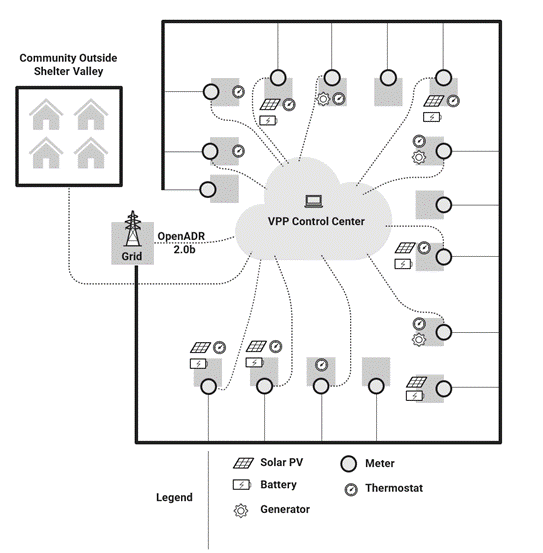
What is a virtual power plant (VPP)? Let me provide an example of a test implementation of a VPP by Alternative Energy Systems Consulting, Inc. (AESC) and San Diego Gas & Electric (SDG&E).

Shelter Valley. By Stalbaum – Own work, CC BY-SA 3.0, https://commons.wikimedia.org/w/index.php?curid=15825812

This 18 month pilot project is described by SDG&E on its page about the Shelter Valley Virtual Power Plant Project.

As part of our Sustainability Strategy and commitment to reach net zero greenhouse gas emissions by 2045, SDG&E is launching a Virtual Power Plant (VPP) Pilot Project in 2022, an initiative to strengthen community resilience and electric reliability in the unincorporated community of Shelter Valley in East San Diego County. 

From https://www.sdge.com/major-projects/shelter-valley-virtual-power-plant-pilot-project

Two benefits of virtual power plants

SDG&E realizes that you can’t just talk about the features of virtual power plants. SDG&E’s customers don’t care about features. Its customers only care about what’s in it for them. So SDG&E collected some benefits of virtual power plants.

(4/16/2022: For additional information on benefits, click here.)

The first benefit: community resilience and electric reliability

The first benefit that SDG&E identified for VPPs can be found in the text above, where it noted that virtual power plants can “strengthen community resilience and electric reliability.”

Now I’ll grant that Californa isn’t Texas, but there are more and more times where California’s electric power goes out, due either to very high temperatures, very high winds, or very high fire danger.

So SDG&E consumers (and consumers from other electric utilities) are more interested in electric reliability. If VPPs can provide that reliability, great!

So how does a VPP strengthen community resilience and electric reliability?

A key element of a VPP is its distributed energy resources, or DERs. With home-based solar power, batteries, smart thermostats, and other energy technologies, the days of a single centralized power source are over.

The second benefit: lower investment and operating costs

But rather than siloing these DERs, a VPP arranges to have them work as a single unit, just like a conventional power plant, but with a difference.

In other words, a VPP can mimic or potentially replace a conventional power plant and help address distribution network bottlenecks, but with lower investment and operating costs.

From https://www.sdge.com/major-projects/shelter-valley-virtual-power-plant-pilot-project

Note that SDG&E doesn’t take this a step further and say that this will result in a reduction in building of conventional power plants.

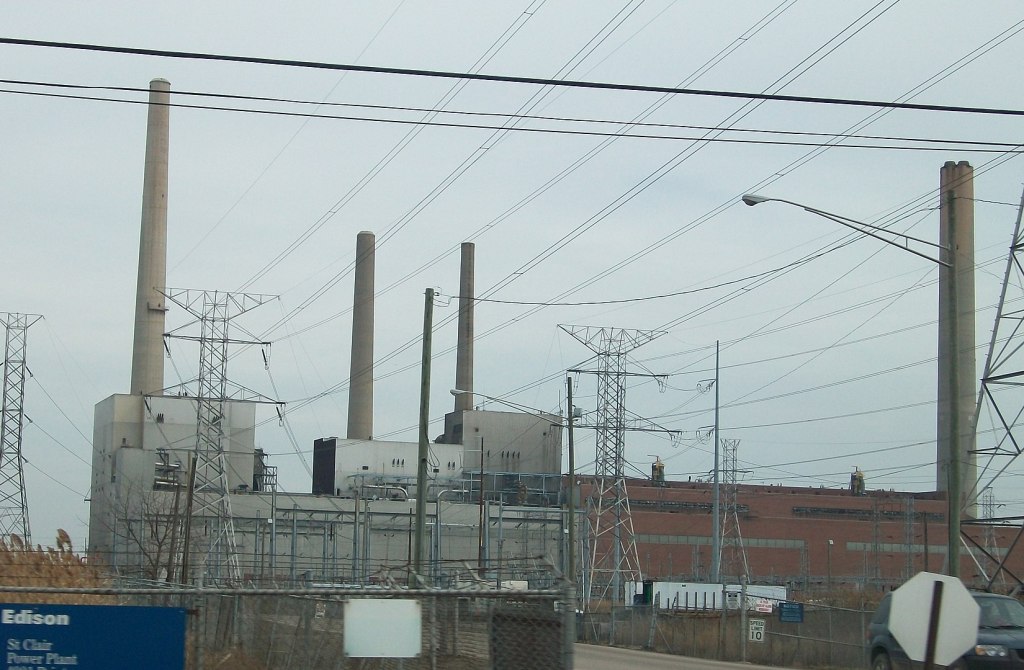
St. Clair Power Plant.
Since VPPs look like residential/commercial communities (because they are), most of us think that VPPs are prettier than many conventional power plants such as this one. By Cgord (talk) – (Cgord (talk)) created this work entirely by himself. Transferred from Wikipedia., GFDL, https://commons.wikimedia.org/w/index.php?curid=19912142

And SDG&E definitely doesn’t say that this will result in lower rates for energy consumers. But maybe some energy utility will make this commitment.

A musical postlude

A major component of a VPP is the solar energy that is generated by solar cells on people’s homes. Of course, solar energy is nothing new, as those of us who recall a certain song know all too well.

From https://www.youtube.com/watch?v=Y43XLVqjytQ

I’ll grant that there are differing views

Volvo LIGHTS heavy duty electric truck initiatives in Fontana, Ontario, and Chino

I recently learned that Bill Fries passed away earlier this month. You may not recognize his name, but people of a certain age are very familiar with his voice.

Fries, an advertising executive, provided the voice of the character “C.W. McCall” in the 1970s song “Convoy,” which dealt with truckers using citizens band (CB) radio to communicate with each other about driving conditions and “smokeys” (police officers enforcing the then-universal 55 mph speed limit). The music was provided by Chip Davis, famous today for Mannheim Steamroller.

Even today, truckers are an essential part of goods distribution in the United States.

Across the United States, more than 70% of all goods used in our daily lives—from food to manufactured products—are transported to our stores and homes by trucks. As the nation’s demand for goods continues to reach record levels, our cities are facing an increase in congestion, noise, and air pollution.

From https://www.lightsproject.com/

The statement on trucking above was taken from the Volvo LIGHTS website. LIGHTS is an acronym for Low Impact Green Heavy Transport Solutions, where “Low Impact” aims to reduce impacts on congestion, noise, and air pollution.

How? Via electricity. Specifically, via Volvo’s VNR Electric truck.

Volvo VNR Electric battery configuration. From https://www.volvotrucks.us/trucks/vnr-electric/

Regardless of how you feel about the good and bad points of fossil fuels, battery power, solar power, nuclear power, coal power, etc., battery power is a part of our transportation solutions. The Volvo LIGHTS project lists five community benefits from using electric trucks. All five are listed here, but I’m only going to highlight one of them.

Less Congestion from being able to make deliveries at night with much quieter truck engines

From https://www.lightsproject.com/community-benefits/

This particular benefit addresses both congestion and noise, and the other four benefits address these two impacts as well as the impact of air pollution.

Volvo LIGHTS is performing several proofs of concept, three of which are taking place in the Inland Empire.

Fontana (TEC Equipment)

From Volvo LIGHTS (additional details here, including the vehicles deployed and the charging infrastructure):

TEC Equipment owns the West Coast’s largest network of full service, heavy-duty truck dealerships. Through the Volvo LIGHTS project, they introduced a comprehensive sales and service strategy for battery electric trucks and provided fleet operators the opportunity to lease battery electric trucks from TEC Equipment for real-world trials.

In August 2021, TEC Equipment was named Volvo Trucks’ first EV Certified Dealer in North America, indicating that their maintenance and repair crew at their Fontana dealership is fully trained and equipped to meet the service needs of fleets operating these advanced zero-emission trucks.

Back in 2020, TEC Equipment commented on the initiative on its website:

“We are proud that our Fontana dealership will be first in in North America to pilot the Volvo VNR Electric model,” said David Thompson, president and CEO of TEC Equipment. “Through the Volvo LIGHTS project, we are gaining valuable hands-on experience for our drivers and maintenance staff to ensure that we are well prepared to support the widescale deployment of these advanced, zero-emission trucks throughout the Southern California freight corridor.”

Ontario (Dependable Supply Chain Services)

From Volvo LIGHTS (additional details here):

Dependable is demonstrating the ability for battery electric trucks and equipment to successfully transport goods in its daily routes, as well as at its warehouse facilities. To ensure the ongoing reliability of the trucks and maximize uptime, DHE is road testing Volvo’s remote diagnostic onboard technology, which will alert TEC Equipment in advance when its battery electric trucks need maintenance.

The onsite smart chargers use Greenlots’ cloud software to integrate with Volvo’s truck telematics to balance the needs of the vehicle, facility, and utility grid. To further mitigate grid impacts and energy costs, DHE also integrated onsite solar panels and hopes to garner the benefits of second-life batteries.

In this Vimeo, Dependable’s drivers identity other benefits of electric trucks, including an increased ability to hear emergency vehicles, as well as a decrease in smelly fuel-saturated clothes after your shift is over.

Incidentally, the references to “Greenlots” on the Volvo LIGHTS website for Dependable (and for NFI, below) are outdated. Shell acquired Greenlots in 2019, which now does business as Shell Recharge Solutions. Shell isn’t putting all of its eggs in the fossil fuels basket.

Chino (NFI Industries)

From Volvo LIGHTS (additional details here):

NFI is demonstrating the ability for battery electric trucks and equipment to successfully transport goods in its daily routes, as well as at its warehouse facilities. Having confidence that the trucks can reliably complete their routes was critical for NFI. Their fleets are road testing Volvo’s self-learning driveline control algorithms enabling drivers to optimize energy usage and range.

The onsite smart chargers use Greenlots’ cloud software to integrate with Volvo’s truck telematics to balance the needs of the vehicle, facility, and utility grid. To further mitigate grid impacts and energy costs, NFI continues to explore the viability of onsite solar panels.

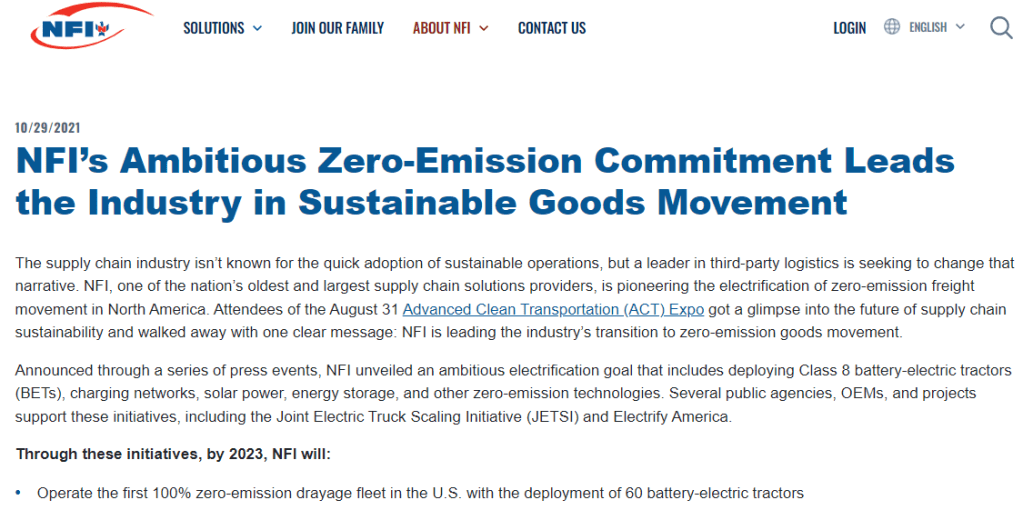
NFI is working with Volvo, Daimler, and others on an ambitious project to “[o]perate the first 100% zero-emission drayage fleet in the U.S. with the deployment of 60 battery-electric tractors.” NFI wants to achieve this by 2023.

What does this mean?

These and other initiatives allow trucking companies to realize the benefits described above, from improved distribution to nicer smelling uniforms. The initiatives also allow flexibility should our diesel supplies be threatened.

And the Inland Empire, with its extensive warehousing footprint, provides an ideal proving ground to see whether these technologies will work in practice.

But I don’t know that electric trucks will give us any good songs.

From https://www.youtube.com/watch?v=j3VN54M1OXA

When you DON’T want to cut the cord

No pretty picture in this post, for reasons that will become apparent.

My home office is (drumroll) at home, which means that my laptop accesses the world via the wi-fi on my home Internet service.

Well, not at the moment, since one of the outside wires that runs to my modem was accidentally cut, and can’t be repaired until tomorrow.

While I can conduct a limited amount of business using my phone’s 4G connection, I can’t do anything substantive. If an emergency pops up I can go to a Starbucks (if not closed due to COVID) or another wi-fi source, but for the most part I am limited in what I can do.

Let’s see how much I CAN do.

Technological rapidity and #COVID19 #Omicron responses

So I took almost a week off from “bredemarketing,” but it’s not like anything happened.

Well, except for a new COVID-19 variant and the attending travel shutdowns and other changes.

And now people are wondering when Omicron will hit the United States. Frankly, it’s probably already here.

But as we become more familiar with things, and as our technology improves, our responses are quicker.

Take this Thermo Fisher Scientific press release.

Thermo Fisher Scientific Inc. (NYSE:TMO)…today confirmed that its polymerase chain reaction (PCR) TaqPath COVID-19 Combo Kit*, and TaqPath COVID-19 CE-IVD RT-PCR Kit*, which test for the presence of SARS-CoV-2, are not impacted by the emerging B.1.1.529, or Omicron variant, enabling accurate test results.

https://thermofisher.mediaroom.com/2021-11-29-Thermo-Fisher-Scientific-Confirms-Detection-of-SARS-CoV-2-in-Samples-Containing-the-Omicron-Variant-with-its-TaqPath-COVID-19-Tests

That’s quick.

But test results are one thing; minimization of harm is another.

Moderna is already at work on a treatment to address the Omicron variant. Within the next few weeks, he said the company will know whether the new strain will require an altogether new vaccine, a specially formulated booster, or simply a higher dose of vaccines currently available.

From https://www.newsweek.com/moderna-estimates-weeks-before-omicron-vaccine-resistance-understood-variant-spreads-1653983

Considering how long it took to develop the first vaccines (which were already developed at a breakneck pace), that’s quick also.

When the old Dollar General (that is really new) meets the new DoorDash (that is really old)

I briefly alluded to Dollar General in a post that I wrote back in June.

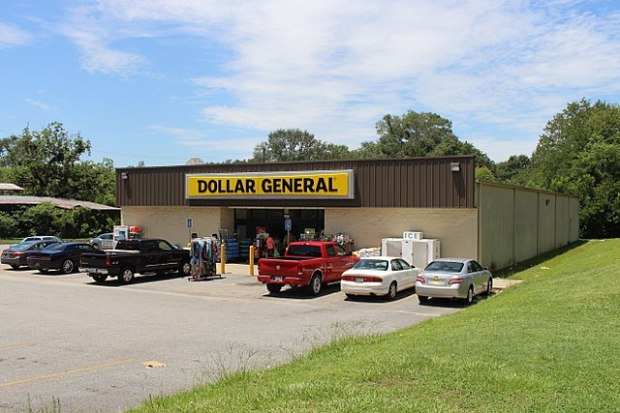
Dollar General store in Arlington, Georgia. By Michael Rivera – Own work, CC BY-SA 4.0, https://commons.wikimedia.org/w/index.php?curid=61224685

The picture above is what I picture when I think of Dollar General. In fact, it looks similar to a Dollar General that I’ve seen outside of Huntsville, Alabama: just a building with a parking lot out in a field by a major road. You can hear the crickets chirping at night.

Not the kind of place where you’d expect to see a lot of futurists connecting a spectrum of innovation where human and biological system designs interact together seamlessly.

But as I noted in June:

Yes, even Dollar General is embracing technology, but as far as I can tell it is concentrating on consumer-facing technology and hasn’t adopted blockchain yet. But I could be wrong.

From https://bredemarket.com/2021/06/16/yes-walmart-is-a-technology-company/

I failed to quote from the linked article at the time, which dates from 2019.

Digital is becoming a “big part” of customers’ lives, Dollar General chief executive Todd Vasos said last year.

Dollar General is also building a digital strategy because customers who redeem digital savings coupons and use the new Dollar General app, released last year (2018), spend about twice as much on average as regular shoppers….

It’s not a surprise that Dollar General has been slow to embrace digital. The company’s core customers make about $40,000 a year per household, more than $20,000 below the national average.

Because of the income gap, Dollar General’s main customers are often “behind the curve” on new technology….But smartphones are ubiquitous now, and about 85% of Dollar General’s customers use one, in line with the national average.

From https://www.cnn.com/2019/05/14/business/dollar-general-app/index.html

Well, now Dollar General customers have a new way to use their smartphones.

Dollar General (NYSE: DG) today announced a partnership with DoorDash (NYSE: DASH), the nation’s leading last-mile logistics platform, to offer on-demand delivery of household essential items, including food, snacks, cleaning supplies, and more, at everyday low prices customers trust Dollar General to provide….

On-demand delivery from DoorDash is currently available from more than 9,000 Dollar General stores with plans to expand to more than 10,000 locations by December 2021. Dollar General and DoorDash initially piloted a program in summer 2021 with approximately 600 stores in rural and metropolitan communities.

From https://newscenter.dollargeneral.com/news/dollar-general-and-doordash-announce-partnership-to-offer-on-demand-delivery-of-everyday-essentials.htm

In the minds of some, Dollar General seems very old school while DoorDash seems very cutting-edge. But behind the scenes, Dollar General provides as much tech innovation as another rural success story, Cracker Barrel. And when you think about it, DoorDash is just a warmed-over techie delivery service.

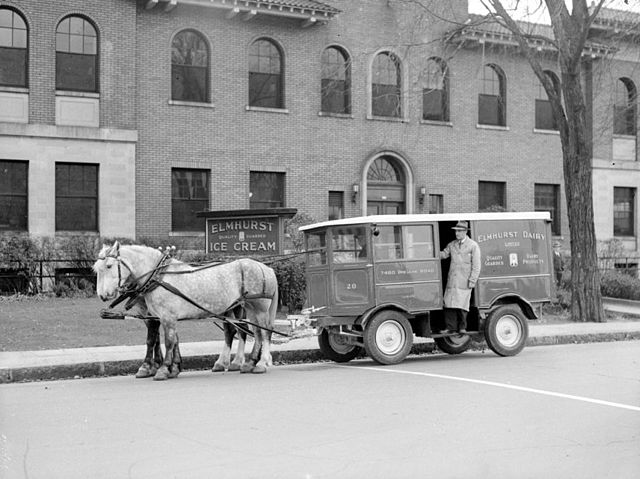
By Conrad Poirier – This file has been scanned and uploaded to Wikimedia Commons with the gracious permission and cooperation of Bibliothèque et Archives nationales du Québec and Wikimedia Canada under the Poirier Project., Public Domain, https://commons.wikimedia.org/w/index.php?curid=34364242

And delivery services have been around forever.

A QR code is not a way of life

For years I have adopted and used the phrase “a tool is not a way of life,” and almost started a blog with that title. I’m glad I didn’t, because…well, because a tool is not a way of life, and who would want to read an entire blog with posts about THAT?

One tool that I have used off and on is the QR code. Years ago, one of my annual corporate goals was to explore how my then-employer could use QR codes; at the time, there wasn’t any pressing need to adopt them.

I have since chosen to adopt QR codes for some of my Bredemarket work, especially in cases where an online reader may need additional information.

(UPDATE February 20, 2023: Did I really write that? Read why I regret one word in the paragraph above.)

For more information about the Bredemarket 2800 Medium Writing Service, scan the QR code above. My content creation process didn’t fit on this brochure.

Of course, I’m not the only one who has adopted QR codes, and dissemination of detailed information isn’t the only reason to use QR codes.

For example, you may want to use QR codes to prevent yourself from dying due to a global pandemic.

And when that particular use case emerged about two years ago, restaurants rushed to adopt it, and vendors of QR code solutions rushed to promote them.

[M]any of these fortune tellers have something to sell. The most recent of these visionaries are those who have declared that QR codes are here to stay. Leaders in the online ordering and pay-by-phone business offer statistics to prove that the technology has been fully embraced and will continue to outlive the pandemic as the norm for restaurants. Operators who have fully leaned into QR code integration celebrate the news, broadcasting to investors that the technological investments and the pivots to less employee-reliant labor models were prudent, if not prescient, moves.

But now that the pandemic is (hopefully) receding, the shakeout (no, not THAT shakeout) is occurring. For some restaurants, ordering and paying with QR codes and other technological devices is a benefit, but for others, it is a detriment.

If your product is an immersive experience—or the facilitation of relationships—QR code usage may turn out to be counterproductive….

At Barcelona Wine Bar, we heard early on the frequent complaints from guests about QR fatigue and pivoted back to paper menus. Sales increased as each of our restaurants returned to in-person service. More importantly, so did guest satisfaction. We have recently returned thick, leather-bound wine lists to our tables for guests to leaf through instead of asking them to do more mindless online scrolling. QR ordering and payment will remain an option out of courtesy to those who feel safer or find it more convenient. However, as hosts, we would much prefer the opportunity for a final check-in and good-bye.

Here is another example of using a tool when it makes sense, and not using it when it doesn’t.

And this doesn’t have to do with “authenticity,” since the Barcelona Wine Bar concept is just as much a manufactured concept as that of Cracker Barrel and Starbucks (which have embraced QR codes and related technologies).

I only have one complaint that applied to both the Barcelona Wine Bar concept AND the Starbucks concept.

If you are an operator who puts little stock in on-site dining, recognize that customers on their phones often do not hear music, notice artwork and architectural details, nor care if the bartender is smiling or not. 

Perhaps there’s a reason why customers do not hear your music.

Perhaps the customers do not like your music.

If a restaurant truly wants to facilitate conversation, turn the danged music off!