On occasion I like to get futuristic, and I began wondering about the following: since we’re already capable of automating (with human review) much of the work that occurs BEFORE submitting a proposal, how long will it take to automate the work AFTER submitting a proposal?
Specifically, what would happen if the proposal evaluation process were automated? And what would that mean for proposal writing?
See my LinkedIn article on the topic, “What happens when proposal evaluators are no longer human?
I decided to write posts on some of the red bullets to explain the types of services that Bredemarket offers.
The first post described Bredemarket’s RFx response services.
The second described Bredemarket’s sole source response services.
The third described Bredemarket’s proposal template services.
Which brought me to the fourth bullet, which was a fairly interesting project.
The technical leave behind project
This particular project was an unusual one, for two reasons.
First, there were four companies involved:
Bredemarket.
The company that contracted Bredemarket.
The company that contracted the company that contracted Bredemarket.
The final customer.
Despite all of the layers on this particular project, the people from all four companies worked well together and got the job done.
The second unusual thing about this particular project was that although it was not a proposal project per se, it required proposal expertise.
While I can’t go into details, I can briefly say that the goal of the project was to provide “technical leave behinds” for the final customer. The customer was a consulting firm with significant technical expertise in a particular vendor’s product family. When the customer visited one of its clients, it wanted to leave its client with one or more of these technical leave behinds, each of which was devoted to one of the many products in the product family.
So while these technical leave behinds were not proposals themselves, and on first glance appear to be more along the lines of Bredemarket’s content marketing work, they fulfilled a proposal-like purpose by providing information that the client could subsequently use to request information or a proposal from the consulting firm.
Because of this, the technical leave behinds had to be customer centric and respond to specific needs that customers may have. Maybe not to the specific level of detail that would satisfy 100% of any one customer’s specific needs, but the leave behinds at least had to address some major needs in template form.
“So Bredemarket can author technical leave behinds. So what?”
The benefit to you is that Bredemarket can work with you to create text to meet any of your needs, even if it doesn’t fit into some nice neat category such as a sole source proposal or an RFP response or a case study or a white paper or a blog post. For example, over the years I’ve not only created technical leave behinds, but I’ve also created and/or maintained trade show demonstration scripts, brief company analyses, customer and competitor installation lists, internal information services, external information services (including dedicated LinkedIn and Facebook pages devoted to particular topics), website and social media analyses, and a myriad of other pieces of written content.
If you need any type of written content that can help your company connect with other companies, let me know and I’ll work with you to create that content.
OK, now I’m done with expanding on the red bullets. There’s no point in expanding on the fifth bullet, “Additional proposal work for Bredemarket itself,” because that service is of no benefit to you. It only benefits me. Similarly, my MorphoTrak and Printrak proposal work won’t benefit you, unless you work for IDEMIA and are making money off of my prior work.
Again, if you missed any posts in the series, be sure to visit parts one, two, and three. And let me know if I can help you.
Often when a company first writes a proposal, the entire thing is written from scratch by a bunch of proposal writers, subject matter experts (SMEs), and executives, and after some extraordinary effort, the proposal goes out the door.
Then the time comes to write a second proposal. “Let’s start with the text from the first one,” everybody says, and the second proposal goes out the door (hopefully with less effort).
This borrowing from other proposals continues, except when it doesn’t. At some point, someone is going to say, “All of these previous proposals are terrible, so I’m going to write my own.”
After a few years, the company has a collection of proposals…and quite possibly a host of problems. Here are a few things that could happen:
The proposals include inconsistent information. Some say that the company’s solution is supported on Windows 11, others say it’s supported on Windows 10 and 11, and there’s an old proposal that says the company’s solution is supported on Windows 7. Unfortuately, that latter proposal may be the one that someone borrows to write a new proposal, with disastrous results.
The proposals include even more inconsistent information. Maybe some proposals say the product name is GreenWidget. Others say it’s Green Widget. Others say it’s WidgetCo’s GreenWidget. Others say it’s GreenWidget by WidgetCo, Inc. And heaven help you if WidgetCo was acquired by BigMegaCorp.
The proposals include downright incorrect information. Maybe half of the proposals that you’ve issued over the years talk about how GreenWidget operates on both 110 volts and 220 volts. An engineer, reading the proposal that you submitted to the customer yesterday, says to you, “Oh, we discontinued 220 volt support last year.” Oops.
So how do you not only prevent these inconsistencies and mistakes from happening, but ensure that everyone is conveying the same message?
First, you create a proposal template, proposal library, proposal boilerplate, or whatever you want to call it that includes a standard set of text to use in every future proposal (RFx response or sole source letter). This text is reviewed by subject matter experts, executives, and others to ensure that it is correct.
Second, you review this text on a regular basis to make sure that it is up to date, and references to old operating systems and sunsetted features are removed so that they don’t slip into future proposals.
My experience with proposal templates
My personal experience with templates dates back over twenty years, from multiple perspectives.
After several years of working for Printrak, we decided that we needed to establish a standard set of proposal text for both RFP responses and sole source letters. So a coworker (Dorothy) and I flew to San Francisco for some training in the use of a particular package.
However, before I could actively participate in implementing the package, I changed jobs and became a product manager.
In other words, I was now one of the subject matter experts that not only needed to ensure the proposal text was accurate, but in some cases actually provide the proposal text that described the new features of my product.
So Dorothy and her coworker Peter had to contact me to provide my inputs to them.
Sometimes more than once.
In fact, one time they were so surprised that I finally DID provide input that Dorothy created an origami of a flying pig. I have a picture of that flying pig somewhere, but rather than hunt it up I’ll display this picture instead. You get the idea.
Dorothy and Peter had the last laugh, however, because I eventually rejoined Proposals when Dorothy moved to Marketing, and therefore I was responsible for bugging the SMEs about reviewing and updating proposal text.
Dorothy and Peter left the company before I did. After one final switcheroo in which I went to Marketing and Dorothy to Proposals, Dorothy ended up leaving the company. Peter eventually left himself to get married, and move to…
(Major intrusion of reality follows.)
…Kyiv, Ukraine, in his new wife’s home country. Obviously with everyone that’s been going on over the past few days, I’ve been monitoring Peter’s social media posts closely. At the time I am writing this post (noon Pacific Time on Monday February 28), I believe Peter and his wife are still safe.
Let’s move on.
Bredemarket’s solution for proposal template services
I’ve helped clients with various types of proposal templates.
In some cases, I’ve helped clients who have purchased prepackaged proposal template solutions. As of today, I offer specific experience in Upland Qvidian and Privia products, and I’ve been told that other solutions such as RFPIO and RocketDocs are similar.
In some cases, I’ve helped clients who didn’t want to spend money to acquire those prepackaged solutions. In those cases, I’ve created Microsoft Word files, either letters which can be customized to meet the needs of a particular customer, or files from which people can extract vetted responses and incorporate them into letters or RFx responses.
In either case, my clients benefit from responses that have been reviewed by subject matter experts for accuracy, are easy to use, and can generate business for my clients very quickly.
One of my clients was extremely happy with my solution.
“I just wanted to truly say thank you for putting these templates together. I worked on this…last week and it was extremely simple to use and I thought really provided a professional advantage and tool to give the customer….TRULY THANK YOU!”
Do you need Bredemarket’s proposal template services?
Whether you need a library of responses, or one or more template letters, I can help you.
I hope that you’ve enjoyed this series on the proposal services that Bredemarket can provide, and I hope that you’ve seen how all of these services can work together.
This is the second post in a series that discusses the proposal services that Bredemarket can provide. A previous post described Bredemarket’s RFx response services. This post describes Bredemarket’s sole source response services.
The nice thing about sole source responses is that you’re (usually) not competing against anyone else, and therefore have the customer’s full attention. In some cases, the customer has specifically asked you to prepare a proposal. In other cases, you provide an unsolicited proposal to the customer.
Of course, a sole source proposal needs to respond to the customer’s requirements. Obviously the customer hasn’t provided you with a written Request for Proposal, but perhaps the customer has provided some written or verbal list of what is required. And if the customer hasn’t provided you with this information, ask. There’s no point in proposing a 1,000 record fingerprint system when the customer really wants a 10,000 record face system.
In addition, a sole source proposal has to be customer centric, just like a formal RFP response. Far too many sole source proposals spend an inordinate amount of time talking about how great the proposer is, and little or no time talking about what the customer needs.
Bredemarket’s solution for sole source response services
Once I understand what the end customer needs, and what my client can offer to meet the end customer’s needs, I can help the client come up with a story that resonates with the end customer. In some cases, the client already has a proposal library that describes its standard products and services that can be used as a starting point. Remember, however, that standard text often has to be massaged to meet the needs of a specific client. Even when I’ve created a proposal template for a client (foreshadowing a future post in this series!), I’ve often found that the template text needs to be modified a bit when it’s placed in a final letter to a client.
In all cases, my sole source proposal services are similar to my content marketing services in one respect; they are collaborative. Both my input and my client’s input is essential to ensure that the final product makes the case to the customer.
Do you need Bredemarket’s sole source response services?
It occurred to me that some of the acronyms in the red bullets above may be gobbledygook to some people, so I thought I’d delve into some of the bullets, beginning with the first one.
(Warning: post series ahead.)
The need for RFx response services
“RFx” is shorthand for a number of “request for” items, including requests for proposals, requests for information, and requests for comment. These RFx documents ask entities to submit a formal response in the format dictated by the RFx document. The response may be one page long, five pages long, or one thousand pages long. The response may include a simple narrative, or the entity may need to submit specific forms with specially formatted answers to dozens or hundreds or thousands of questions.
In the ideal world, the entity knows that the RFx document is coming, and has been working for years on its response. (How can you know how to respond when the RFX hasn’t even been issued? Know your customer.)
In the non-ideal world, an account manager goes to the proposal team and says, “Hey, our customer issued an RFP last week. I had no idea it was coming. But the customer really likes us, as long as we get our price down.”
In any case, an entity that wants to respond to an RFx needs to read the document and develop a response that puts the customer first (see Truth Number One here), complies with all requirements, scores high on the RFx’s evaluation criteria, is easy for an evaluator to evaluate (see Truth Number Two here), and wins the business.
Bredemarket’s solution for RFx response services
As you can see from my collateral, Bredemarket has assisted its clients with nine (so far) RFx responses, all of which were either responses to Requests for Information (RFIs), or responses to Requests for Proposal (RFPs).
There are differences between the two.
In the Request for Information stage, you still have an opportunity to shape the final procurement (if a final procurement takes place). For example, if you offer a green widget and your competitors do not, your RFI response will make an important point about how the customer will benefit from a green widget, and a solution without a green widget is substandard.
(One important point here. I didn’t say that the RFI response should say that XYZ Company offers a green widget that is a technological marvel. I said that the RFI response should say that the customer will benefit from a green widget.)
In the Request for Proposal stage, the time to shape the final procurement has already passed. (This is why you engage with a customer years before the customer issues an RFP.) At this stage you have to go all out and win the business, telling the customer how they will benefit from your solution.
The mechanics of writing an RFx response have varied between my clients. In some cases, I have worked with one or two people to come up with the response, and the client then sent it out. In other cases, I have worked as part of a team of dozens of people in multiple companies to come up with the response, and followed multiple processes to ensure that the proposal is not only sound, but is approved at the corporate level of the client. Some processes are dictated by the client, but some clients have no processes which means that I need to implement a simple one to get the job done.
Do you need Bredemarket’s RFx response services?
If you need help responding to an RFP, RFI, or related document:
(Updated 4/18/2022 with additional customer focus information.)
You’re probably familiar with “two truths and a lie,” where a person makes three statements and you have to guess which of the three is a falsehood.
As part of my ongoingefforts to update the Bredemarket website, I just updated my “Bredemarket and proposal services” page. Among other things, it now contains two BOLD CAPITALIZED truths…and no lies.
I’ll be the first to admit that these truths, picked up during my time in the proposals industry, are in no way unique to me. Many other people have shared them frequently, and I’ve heard both of these truths shared in the last month alone on a recent proposal engagement.
But I suspect that some people are not aware of these truths, so I thought I’d share them.
Truth Number One
Here’s the first of the two truths from my “Bredemarket and proposal services” page.
THE CUSTOMER DOESN’T CARE ABOUT HOW WONDERFUL YOUR FIRM IS.
Allow me to use an example that won’t impact any of my work with my clients.
Mark owns a meat company that provides meat to restaurants and other food services. Carlos owns a taco truck and needs meat for his tacos. The meat has to meet U.S. Food and Drug Administration and California state standards, needs to meet Carlos’ own standards, and needs to be delivered every day at 7:00 am so that Carlos can get his taco truck on the road.
So when Mark approaches Carlos, this is what he says:
Guasti Meat was established on February 23, 1947 in Guasti, California by Michael Smith, a butcher who was originally born in Nowata, Oklahoma. The company was headquartered in Guasti for 17 years before moving to its current facility in Colton, California. Our main building occupies 97,526 feet of floor space and incorporates Guasti Meat’s color scheme, which was established by Morton Smith Jr., an artist and nephew of the founder who has also produced designs for Enron, Kodak, Montgomery Ward, and other well-known firms. We employ 250 personnel, all of whom are entitled to post-secondary educational benefits. We sell meat to over 1,000 customers in 17 U.S. states.
Did Mark ask Carlos about what Carlos likes to see in the meat he purchases?
Did Mark ask Carlos where the meat should be delivered?
No.
Mark’s attitude was that if he shared these important facts about Guasti Meat, Carlos would be so impressed that he would immediately start to do business with such a respectable company.
This is obviously ridiculous, but many companies act in the same fashion when writing proposals. When they write their executive summaries, the first thing that they talk about is themselves.
Who cares?
(4/18/2022: For additional information on customer focus, click here.)
The customer has their OWN problems that they need to solve. Tell the customer how you will solve them.
Before I ever wrote a single proposal for Printrak, I actually helped write a Request for Proposal (RFP) for another company. Now frankly it was a pretty simple RFP, in which the respondents merely had to check items in a checklist to indicate whether the respondents’ software packages could do what we wanted. Even with the short responses that we as evaluators had to read, we didn’t spend much time on them.
Did the respondent check every single box? Well, obviously they didn’t read the requirements carefully, because no one does everything. Let’s not look at them.
Did the respondent ignore all of the boxes and write a separate description? Well, if they don’t have time to answer our questions, let’s not look at them either.
How many companies are left? Two? OK, we’ll talk to them.
And that was the evaluation time that was spent on simple proposal responses. How much time do you think evaluators will spend evaluating one of Bredemarket’s recent projects, in which I contributed to a 1,000-page proposal that had hundreds upon hundreds of requirements? Remember that evaluators have to read these responses for ALL of the proposals that are submitted.
The proposal team for this project wrote our responses as follows:
In the first part of every requirement response, make sure that we explicitly say that we comply. That way, even if the evaluator only spends ten seconds reading our response, the evaluator will at least know that we claim compliance.
“If the evaluator only spends ten seconds reading our response”?
Yes.
After all, the evaluators have to read ALL of the material in OUR proposal, plus ALL of the material in all the OTHER proposals. They’re not going to have the luxury to spend an inordinate amount of time, such as five minutes, reading each single response. The evaluators are going to plow through the responses as quickly as possible.
Because of this, our writing team also did the following:
Use the RFP language in your response.
I gave an example on my page:
Oh, and if the customer refers to a “product demonstration,” then your proposal had better use the exact words “product demonstration.” If you say that you will provide a “capabilities presentation,” the customer will not see the words THEY were looking for and may conclude that you refuse to provide the product demonstration that they want.
Let’s face it; if an evaluator is only spending ten seconds on your response, the evaluator is going to look at the RFP requirement that says “product demonstration,” and then skim your response for the words “product demonstration.”
If the evaluator immediately finds those specific words in your response, then the evaluator is happy, marks compliance, and moves on to the next requirement to see how you complied with that one.
If the evaluator doesn’t find those specific words in your response, then the evaluator has to stop, think, and read the words that you used in your response.
If you’re lucky, the evaluator will see your words “capabilities presentation,” conclude that you meant to say “product demonstration,” and grudingly give you credit while cussing you out for making the evaluation harder.
If you’re NOT lucky, the evaluator will miss your words “capabilities presentation,” conclude that you have NOT committed to a product demonstration, give you no points, regret the ten seconds of life that were lost, and then move on to the next response and wonder if you aren’t compliant with that one either.
I shouldn’t have to say this, but you want your proposal evaluator to LIKE you, not HATE you. Make the evaluator’s job easier.
The rest of the story
These two truths are only part of the new content on my Bredemarket and proposal services page. I also incorporated updated proposal statistics in the brochure at the top of the page, expressed a few other opinions about proposal work (while restraining myself from writing much, much, more). and borrowing some text from this post to beef up the examples of proposal deliverables at the bottom of the page.
So viewers of the Bredemarket and proposal services page will now have updated information about the number of projects I have completed, the services I have offered, and the truths to which I hold.
My biometric/identity collateral wasn’t the only thing that I updated yesterday.
As part of my preparation for yesterday evening’s Ontario IDEA Exchange meeting, I took the time to update my “local” brochure. (Because local is important: see the first of my three goals for 2022.) This brochure includes a section that discusses the types and numbers of pieces that I have prepared for clients, including the number of case studies, the number of RFx responses, and so forth.
Those numbers hadn’t been updated since last September.
Before going to the meeting, I wanted to make sure my “local” brochure had the latest numbers.
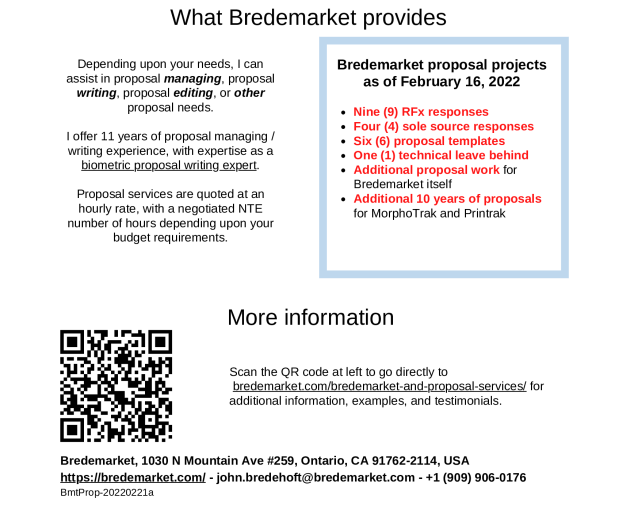
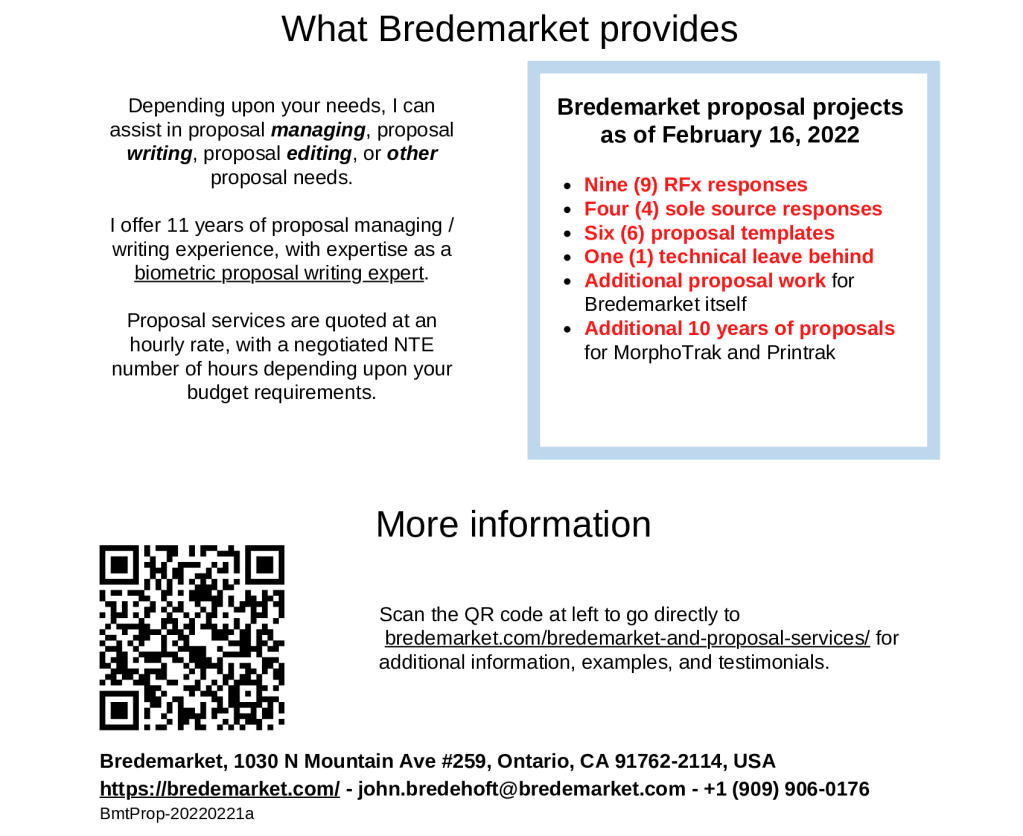
I’ll go ahead and share them with you. This covers the projects that Bredemarket has completed for clients over the last 18 months, as of February 16, 2022:
Fourteen (14) case studies
Eight (8) articles (blog posts)
Three (3) service offering descriptions
Three (3) white papers
Nine (9) RFx responses
Four (4) sole source responses
Six (6) proposal templates
One (1) technical leave behind
Two (2) biometric analyses
Inland Empire B2B Content Services from Bredemarket.
As it turns out, I didn’t hand out my local brochure to anyone at last night’s IDEA Exchange. (It was a small crowd, most of whom I already knew.)
But at least I’ve tabulated the numbers.
Now I just have to update all of my NON local collateral…
Come to think of it, I also have a meeting conflict at that time on Thursday, December 16.
And on Monday, December 20.
And a bunch of other days.
On Monday, December 6, I started a (non-identity) proposal consulting contract that will require a significant number of hours until the proposal is submitted on approximately Tuesday, January 25.
This is by far the biggest consulting contract that I have ever landed. I’d throw a party for myself, but I’m pretty busy. Between this proposal consulting contract, my other continuing consulting work, end of year health care enrollment. and other tasks, I can’t exactly party all the time.
The “significant hours” that I’m spending on this particular proposal are roughly equivalent to the hours that I spent every week as an employee before I started consulting.
Actually, it’s not exactly the same as being an employee. For example, there won’t be a holiday party this month attached to this consulting gig. (Although because of budget cuts, my former employer had stopped the annual holiday parties anyway.)
This proposal contract has one big similarity to my former employee lifestyle.
A ton of meetings.
Now I’ve had meetings for my other consulting gigs, but for most projects there’s only one or two meetings for the entire project.
I’m only a week into this consulting gig, and I’m already averaging three meetings per day.
None of these thrice-daily meetings lasts longer than an hour, and I bet that some of you have many more than three meetings per day. But the meeting time does add up.
Luckily I organize a number of these meetings myself, so I can ensure that my meetings never last longer than an hour.
(I don’t like meetings. The best person to arrange a meeting is a person who doesn’t like meetings. Such a person will get the meeting business done as soon as possible, before people fall asleep or run away screaming in agony.)
And the two people who (so far) have arranged the remainder of my meetings for this proposal project feel the same way.
Now I can’t guarantee that all of the meetings for this proposal will be short and sweet, and in fact expect that the meetings between Christmas and New Year’s may be longer than an hour. (Yes, meetings between Christmas and New Year’s. It’s proposal work.)
I carved out some time late Wednesday morning to take a look at a book that I acquired back in late October.
The book is the 2019 edition of the Shipley Business Development Lifecycle Guide, which I won at a raffle at the APMP Western Chapter Training Day. (And yes, I won it in the presence of my SMA colleagues. But hey, good information comes from a variety of places.)
In fact, it was my late 1990s exposure to the Shipley lifecycle that prompted me to LEAVE proposals (the first time).
Let me explain.
As the Shipley Business Development Lifecycle points out, in the ideal world there are a number of proposal preparation steps that take place BEFORE a Request for Proposals (RFP) is issued. In this ideal world, the following conversation would take place after final RFP release:
Well, the RFP just dropped, and it’s almost exactly what we expected. A few tweaks in the interface requirements, but everything else is identical to our mockup. So we can just polish our previous plans, perform several more sanity checks, and win this!
It’s no surprise that sometimes situations are NOT ideal, and perhaps this conversation may take place instead:
Hey, our customer just released an RFP for a new system. I had no idea that they were going to release an RFP this year. Well, we’ve been the incumbent for years, and the people using our software seem to like us. I think. I don’t know the person who actually released the RFP, but my cousin’s brother-in-law knows him. As long as we come in with the lowest price, we’re certain to win this!
Obviously (or hopefully) most RFP releases are somewhere between these two extremes. But it got me thinking: what would it be like to move to the left on the Shipley timeline and participate in the pre-RFP release activities?
I ended up becoming a product manager, and later in my career (after a second stint in Proposals) became a strategic marketer and corporate strategist. But even in these other positions, I continued to dabble in proposals, primarily as a subject matter expert.
So I was already somewhat familiar with the contents of the Shipley guide, but now I had the entire guide in my hands. (I think I had a Shipley book twenty years ago, but I no longer have it.) This allowed me to review the contents at my leisure.
OK, maybe not THAT relaxed. My eyes have to be open, for one thing. (And certain paper products belong in the bathroom, not the living room.)
One nice thing about the printed guide: rather than numbering all the steps sequentially from 1 to 96, they are numbered within each phase. The steps in Phase 0 (Market Segmentation) are numbered from 0.1 to 0.6, the steps in Phase 1 (Long-Term Positioning) from 1.1 to 1.6, and so forth.
The lifecycle is much less imposing that way. If you tell management that you want to implement a 96-step process to win a customer, management will probably tell you to take a hike. (Even Martin Luther didn’t write 96 theses.) A 7-phase process is more palatable. (Marketing!)
After Phases 0 and 1, the Shipley Business Development Lifecycle contains 5 other phases:
Phase 2, Opportunity Assessment
8 steps
Phase 3, Capture/Opportunity Planning
15 steps
Phase 4, Proposal Planning
31 steps
Phase 5, Proposal Development
18 steps
Phase 6, Post-Submittal Activities
12 steps
The final five (of seven) phases in the Shipley Business Develoopment Lifecycle.
The proposal planning phase (Phase 4) deserves a mention, since this is the phase in which Shipley practitioners outline the proposal, draft the executive summary, and update the winning price…all before the RFP is issued.
Obviously you have to know your customer really well to do all of that in advance, and if you don’t know your customer, your competitor probably already does.
Needless to say, I’m not going to duplicate the entire book here; it’s copyrighted, after all. But I do want to highlight the final step in the process, which is either step 6.12 or step 96 depending upon how you number things.
Hold a victory party (win or lose), including review teams.
Actually, you can tailor this step and hold TWO victory parties: one to celebrate that you got the proposal out the door, and a second if you win the contract.
Regardless of how many victory parties you actually hold, be sure to invite all of the contributors. It’s in your self-interest to do so.
Contributors who feel appreciated are more inclined to support subsequent proposal efforts.
Shipley Associates, Shipley Business Development Lifecycle Guide (2019 edition), page 82.
So that’s a few highlights. I only got a chance to look at a portion of the book on Wednesday morning, but it contains a wealth of valuable information for proposal managers/writers AND capture managers AND strategic marketers, corporate strategiests, and product managers.
Enough to make you happy so that you don’t cry. (I couldn’t leave this out.)











 Bredemarket
