I first mentioned OpenAI’s Sora last October in connection with the privacy concerns of its Cameo feature. Does Cameo create an innocuous likeness, or an evil deepfake?
As it turns out, neither. Sora is going to the tech graveyard.
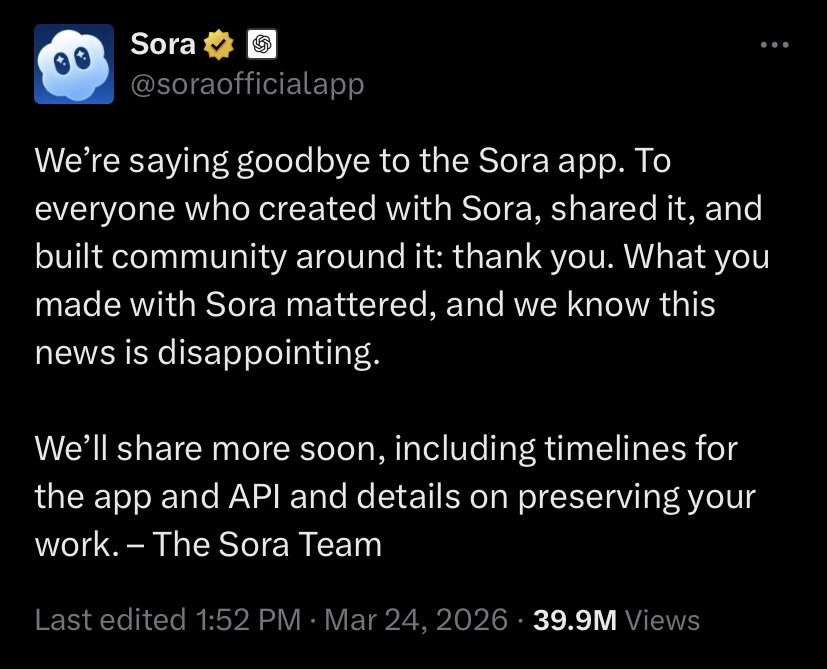
We’re saying goodbye to the Sora app. To everyone who created with Sora, shared it, and built community around it: thank you. What you made with Sora mattered, and we know this news is disappointing.
We’ll share more soon, including timelines for the app and API and details on preserving your work. – The Sora Team
I recently mentioned again how ALL the identity verification companies use the following two elements in their product marketing:
“We use AI.”
“Trust!”
If you read three marketing messages from three IDV vendors, I defy you to tell them apart. Admittedly my last comparison took place years ago, so I took a fresh look at the 2026 versions. Here are two:
“Industry-leading AI-driven Technology”
“We make it easy to safeguard your customers with AI-driven identity verification.”
Thankfully the companies are finally mentioning differentiators other than trust, but the magic letters AI still persist.
AI is everywhere and nowhere
But you can’t really blame the IDV vendors when everyone is injecting the two letter word in their messaging.
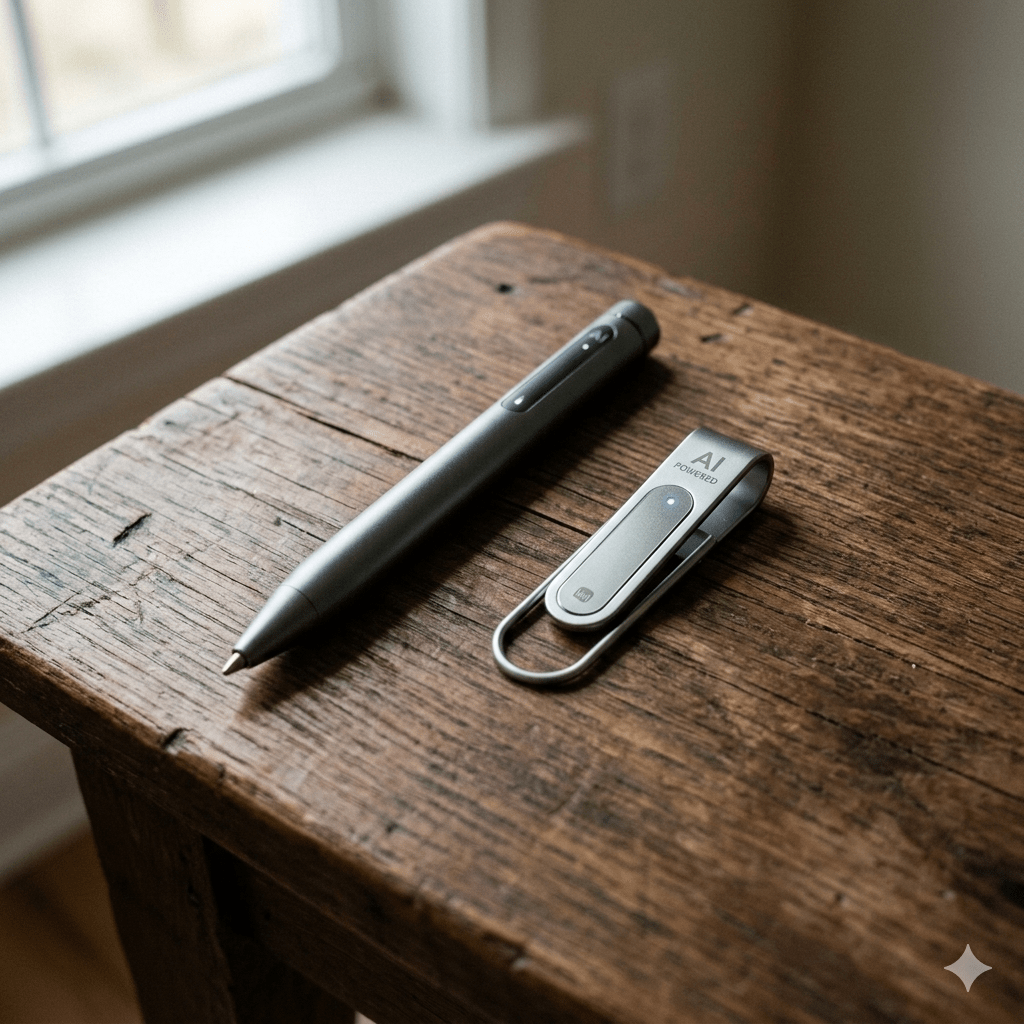
20 years ago, anyone who talked about an AI-powered vacuum cleaner would have been relegated to the back of the hall and told to put on his Vulcan ears.
“Handwrite only the critical points. Let Flowtica AI summarize and visualize the rest-audio, photo and even your sketches – into insights. Stay focused in the flow”
I participate in several public and private AI communities, and one fun exercise is to take another creator’s image generation prompt, run it yourself (using the same AI tool or a different tool), and see what happens. But certain tools can yield similar results, for explicable reasons.
On Saturday morning in a private community Zayne Harbison shared his Nano Banana prompt (which I cannot share here) and the resulting output. So I ran his prompt in Nano Banana and other tools, including Microsoft Copilot and OpenAI ChatGPT.
The outputs from those two generative AI engines were remarkably similar.
But Harbison’s prompt was relatively simple. What if I provided a much more detailed prompt to both engines?
Create a realistic photograph of a coworking space in San Francisco in which coffee and hash brownies are available to the guests. A wildebeest, who is only partaking in a green bottle of sparkling water, is sitting at a laptop. A book next to the wildebeest is entitled “AI Image Generation Platforms.” There is a Grateful Dead poster on the brick wall behind the wildebeest, next to the hash brownies.
So here’s what I got from the Copilot and ChatGPT platforms.
Copilot.
ChatGPT.
For comparison, here is Google Gemini’s output for the same prompt.
Gemini.
So while there are more differences when using the more detailed prompt (see ChatGPT’s brownie placement), the Copilot and ChatGPT results still show similarities, most notably in the Grateful Dead logo and the color used in the book.
So what have we learned, Johnny? Not much, since Copilot and ChatGPT can perform many tasks other than image generation. There may be more differentiation when they perform SWOT analyses or other operations. As any good researcher would say, more funding is needed for further research.
But I will hazard two lessons learned:
More detailed prompts are better.
If the answer is critically important, submit your prompts to multiple generative AI tools.
People weren’t laughing at Joel R. McConvey when he reminded us of a different saying:
“In Silicon Valley parlance, ‘create the problem, sell the solution.'”
Joel R. McConvey’s “tale of two platforms”
McConvey was referring to two different Sam Altman investments. One, OpenAI’s newly-released Sora 2, amounts to a deepfake “slop machine” that is flooding our online, um, world in fakery. This concerns many, including SAG-AFTRA president Sean Astin. He doesn’t want his union members to lose their jobs to the Tilly Norwoods out there.
The deepfake “sea of slop” was created by Google Gemini.
“What if we could reduce the efficacy of deepfakes? Proof of human technology provides a promising tool. By establishing cryptographic proof that you’re interacting with a real, unique human, this technology addresses the root of the problem. It doesn’t try to determine if content is fake; it ensures the source is real from the start.”
Google Gemini. Not an accurate depiction of the Orb, but it’s really cool.
As I’ve said before, proof of humanness is only half the battle. Even if you’ve detected humanness, some humans are capable of their own slop, and to solve the human slop problem you need to prove WHICH human is responsible for something.
Which is something decidedly outside of World’s mission.
But is it part of YOUR company’s mission? Talk to Bredemarket about getting your anti-fraud message out there: https://bredemarket.com/mark/
Matthew Prince of Cloudflare recently described an alleged imbalance affecting content creators, and what Cloudflare and others are doing about it. It turns out that today’s AI web crawlers behave differently than yesterday’s search web crawlers.
The revolution
Prince began his article by describing a win-win deal facilitated by a content-gathering company known as Google. Google’s web crawlers would acquire site content, but the content creators would win also.
“The deal that Google made with content creators was simple: let us copy your content for search, and we’ll send you traffic. You, as a content creator, could then derive value from that traffic in one of three ways: running ads against it, selling subscriptions for it, or just getting the pleasure of knowing that someone was consuming your stuff.”
Sounds like a win-win to me.
The new power generation
What Prince didn’t say is that not everyone was thrilled with the arrangement.
Let’s start with Spain, and the relationship between Spanish online publications and Google Noticias (Google News).
Imagen 4.
The publishers thought they were getting the raw end of the deal, since Google would present summaries of the publishers’ content on Google pages, but no one would go to the publishers’ pages. Why bother? Google had shared the important stuff.
“Reacting to a law that requires news sites in Spain to charge for their content, Google shut down its Google News service in the country….The tech company and other news aggregators would face steep fines if they publish headlines and abstracts without paying.”
At the time, I cast this as a battle between the nations and plucky individuals fighting for freedom…ignoring the fact that Google (cited twice below) was more powerful than some nations.
As an aside, it’s worth noting that several nations subsequently banded together to implement GDPR, shifting more power to the governments.
Oh, and the Spanish law was changed to conform with European Union copyright law. As a result, Google Noticias came back online in Spain in 2022, eight years later.
3rdeyegirl (bear with me here)
Back to Cloudflare’s Matthew Prince, who talked about a brand new voracious web crawler that didn’t feel like a win-win. Rather than presenting links to outside content, or summaries of content accompanied by prominent links, AI tools (including Google’s own) would simply present the summaries, burying the links.
“Google itself has changed. While ten years ago they presented a list of links and said that success was getting you off their site as quickly as possible, today they’ve added an answer box and more recently AI Overviews which answer users’ questions without them having to leave Google.com. With the answer box they reported that 75 percent of queries were answered without users leaving Google. With the more recent launch of AI Overviews it’s even higher.”
Imagen 4.
So the new AI-sponsored web crawlers and their implementation effectively serve to keep readers in the walled gardens of OpenAI, Google, Microsoft, and the rest.
Walled gardens again? It’s just human nature. Having to click on a link to go somewhere else causes friction. This very post links to Cloudflare’s article, my old Empoprise-BI blog, and a multitude of other sources. And I bet you won’t click on ANY of those links to view the other content. I know. WordPress tells me.
As Prince himself puts it:
“…increasingly we aren’t consuming originals, we’re consuming derivatives.”
So what’s Cloudflare doing about the AI web crawlers that are sucking information away with little or no return to the content creators?
Blocking them by default.
“That changes today, July 1, what we’re calling Content Independence Day. Cloudflare, along with a majority of the world’s leading publishers and AI companies, is changing the default to block AI crawlers unless they pay creators for their content. That content is the fuel that powers AI engines, and so it’s only fair that content creators are compensated directly for it.”
Cloudflare envisions a marketplace in which AI companies will pay creators for high quality content.
However, today’s content creators may face the same challenges that Spanish periodicals faced from 2014 to 2022. They may prevent their content from being ripped off…but no one will ever know because the people who go to ChatGPT will never learn about them.
Because in the end, most people are happy with derived content.
But your hungry people want to hear from you.
If you are a tech marketer who needs help creating content, talk to Bredemarket.
Keeping the internet open is crucial, and part of being open means Reddit content needs to be accessible to those fostering human learning and researching ways to build community, belonging, and empowerment online. Reddit is a uniquely large and vibrant community that has long been an important space for conversation on the internet. Additionally, using LLMs, ML, and AI allow Reddit to improve the user experience for everyone.
In line with this, Reddit and OpenAI today announced a partnership to benefit both the Reddit and OpenAI user communities…
Perhaps some members of the Reddit user community may not feel the benefits when OpenAI is training on their data.
While people who joined Reddit presumably understood that anyone could view their data, they never imagined that a third party would then process its data for its own purposes.
Oh, but wait a minute. Reddit clarifies things:
This partnership…does not change Reddit’s Data API Terms or Developer Terms, which state content accessed through Reddit’s Data API cannot be used for commercial purposes without Reddit’s approval. API access remains free for non-commercial usage under our published threshold.















 Bredemarket