Yes, I know that marketing personas are representations of your hungry people (target audience) that wonderfully focus the mind on the people interested in your product or service. But if we’re being honest with ourselves, a software purchase is not greatly influenced by a non-person entity’s go-to coffee shop order.
Or whether the purchasing manager is 28 or 68.
So don’t go overboard in persona development.
That is all.
Except for the Bredemarket content-proposal-analysis promo.
Have you ever seen a piece of content that makes you ill?
I just read a week-old comment on a month-old LinkedIn post. The original poster was pursuing a new opportunity, and the commenter responded as follows:
“Incredible achievements! Your journey with GTM teams is truly inspiring. It’s exciting to see you ready to tackle the next challenge. What qualities do you value most when looking for your next venture?”
At least it didn’t have a rocket emoji, but the comment itself had a non-person entity (NPE) feel to it.
Not surprisingly, the comment was not from a person, but from a LinkedIn page.
And not a company page, but an industry-specific showcase page for the tech industry.
Needless to say, I see nothing wrong with that. After all, Bredemarket has its own technology LinkedIn showcase page, Bredemarket Technology Firm Services.
But when Bredemarket’s LinkedIn pages comment on other posts, I write the comments all by myself, and don’t let generative AI draft them for me. So my comments have none of these generic platitudes or fake engagement attempts that don’t work.
I have absolutely no idea why the “incredible achievements” comment was, um, “written” or what its goals were.
Awareness? Consideration? Conversion? Or mere Revulsion?
Yes, I broke a cardinal rule by placing an undefined acronym in the blog post title.
99% of all readers probably concluded that the “NPE” in the title was some kind of dangerous drug.
And there actually is something called Norpseudoephedrine that uses the acronym NPE. It was discussed in a 1998 study shared by the National Library of Medicine within the National Institutes of Health. (TL;DR: NPE “enhances the analgesic and rate decreasing effects of morphine, but inhibits its discriminative properties.”)
From the National Library of Medicine.
But I wasn’t talking about THAT NPE.
I was talking about the NPEs that are non-person entities.
A particular freelance copywriter holds similar beliefs, so she was shocked when she received a rejection notice from a company that included the following:
“We try to avoid employing people who use AI for their writing.
“Although you answered ‘No’ to our screening question, the text of your proposal is AI-generated.”
There’s only one teeny problem: the copywriter wrote her proposal herself.
(This post doesn’t name the company who made the false accusation, so if you DON’T want to know who the company is, don’t click on this link.)
Face it. (Yes, I used that word intentionally; I’ve got a business to run.) Some experts—well, self-appointed “experts”—who delve into the paragraph you’re reading right now will conclude that its use of proper grammar, em dashes, the word “delve,” and the Oxford comma PROVE that I didn’t write it. Maybe I’ll add a rocket emoji to help them perpetuate their misinformation. 🚀
Heck, I’ve used the word “delve” for years before ChatGPT became a verb. And now I use it on purpose just to irritate the “experts.”
The ramifications of a false accusation
And the company’s claim about the copywriter’s authorship is not only misinformation.
It’s libel.
I have some questions for the company that falsely accused the copywriter of using generative AI to write her proposal.
How did the company conclude that the copywriter did not write her proposal, but used a generative AI tool to write it?
What is the measured accuracy of the method employed by the company?
Has the copywriter been placed on a blocklist by the company based upon this false accusation?
Has the company shared this false accusation with other companies, thus endangering the copywriter’s ability to make a living?
If this raises to the level of personal injury, perhaps an attorney should get involved.
From imgflip.
A final thought
Seriously: if you’re accused of something you didn’t do, push back.
After all, humans who claim to detect AI have not been independently measured regarding their AI detection accuracy.
And AI-powered AI detectors can hallucinate.
So be safe, and take care of yourself, and each other.
On Threads, Dr. Jen Gunter called our attention to the newly-introduced H.R. 238, “To amend the Federal Food, Drug, and Cosmetic Act to clarify that artificial intelligence and machine learning technologies can qualify as a practitioner eligible to prescribe drugs if authorized by the State involved and approved, cleared, or authorized by the Food and Drug Administration, and for other purposes.”
Presumably these non-person entities would not be your run-of-the-mill consumer generative AI packages, by rather specially trained Large Medical Models (LMMs).
Even so, don’t count on this becoming law in the next two years. For one, Rep. David Schweikert introduced a similar bill in 2023 which never made it out of committee.
““How do I make sure we’re embracing technology and using it to bring disruptive cures to market, or other opportunities to market?” Schweikert asked. “And does that also now help lower drug pricing?””
Before you reject this idea entirely, Rep. Schweikert cited one example of technology decision-making:
“Schweikert noted that the FDA last month approved Apple Watch’s atrial fibrillation feature for use in clinical trials — the first such digital health tool approved for inclusion in the agency’s Medical Device Development Tools program.”
But before anything like this will ever happen with prescriptions, the FDA will insist on extremely rigorous testing, including double-blind tests in which some prescriptions are written by currently-authorized medical professionals, while other prescriptions are written by LMMs.
And even when the ethical questions surrounding this are overcome, this won’t happen overnight.
Oosto has highlighted two reasons why it’s critical to identify people in healthcare environments.
Healthcare facilities account for 42% of infant abductions…
Think about it. If all you need to identify yourself (or impersonate someone else) is your name and birthdate, a fraudster could easily gain access to a facility and abduct someone else’s child.
(H)ealthcare workers experience violence—both physical and verbal—at a shockingly 5 times higher rate than other industries. This violence accounts for up to 73% of all nonfatal workplace injuries caused by violence.
Again, if you don’t know who you’re dealing with, bad things can happen. I’ll admit that identity verification doesn’t solve this-people can attack healthcare workers even if their identities are known-but the danger of unidentified assaults is great.
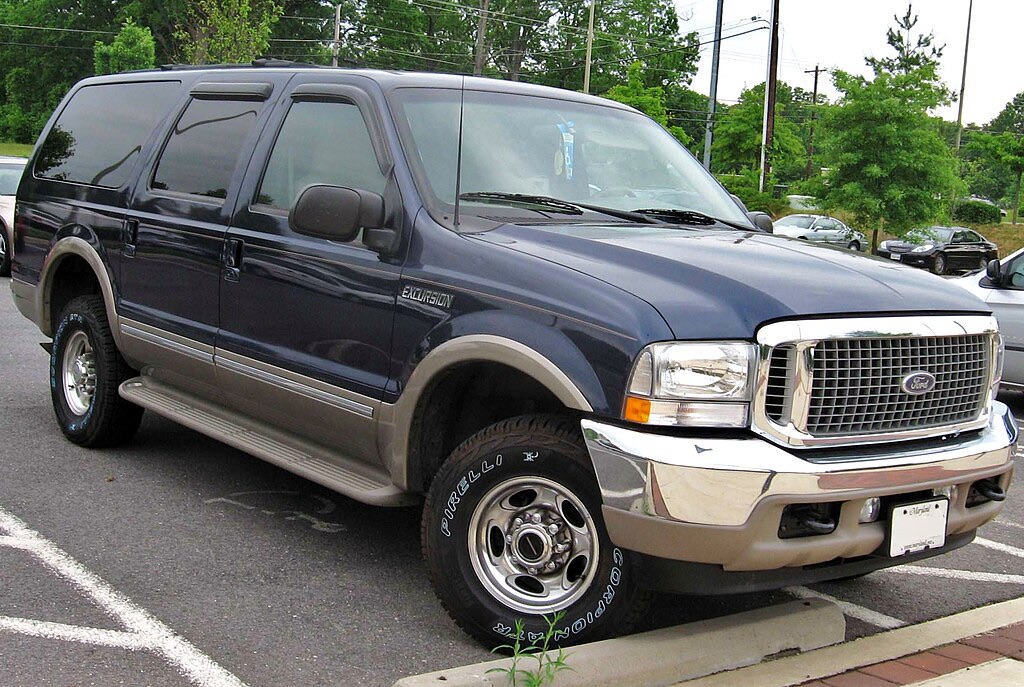
But I’m going to concentrate on sport utility vehicles here.
Because of their expense, certain NPEs such as vehicles and real estate are associated with title, or proof of ownership.
Just because I have physical possession of a car or house doesn’t mean that I’m the lawful owner. Maybe I am house sitting. Or renting a car. Or I am a squatter or thief. When it comes to legal (and financial) title, possession is NOT 9/10ths of the law. Otherwise, Hilton and Hertz would be out of business.
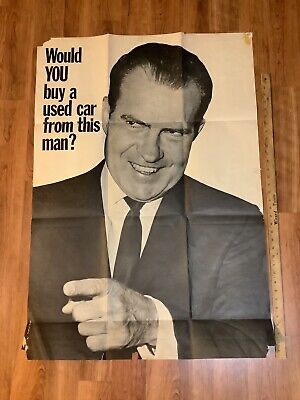
Old anti-Richard Nixon ad.
But what happens when the physical NPE and the title diverge? Two victims of now-convicted car salesman Ronald Johnson found out the hard way, according to KTTN:
“In 2022, Johnson orchestrated a scheme that led to a Pennsylvania buyer paying $41,750 for a 2002 Ford Excursion that he had already sold to a South Dakota buyer for $45,000. The South Dakota buyer received the title, while the Pennsylvania buyer was given the SUV, leaving the latter unable to register the vehicle lawfully.”
But how do you verify that the title is real? For vehicles:
“The title should have a watermark, a raised seal, a unique vehicle identification number, a unique title number, and the owner’s information.”
And as for the owner, my regular readers know how to verify THAT.
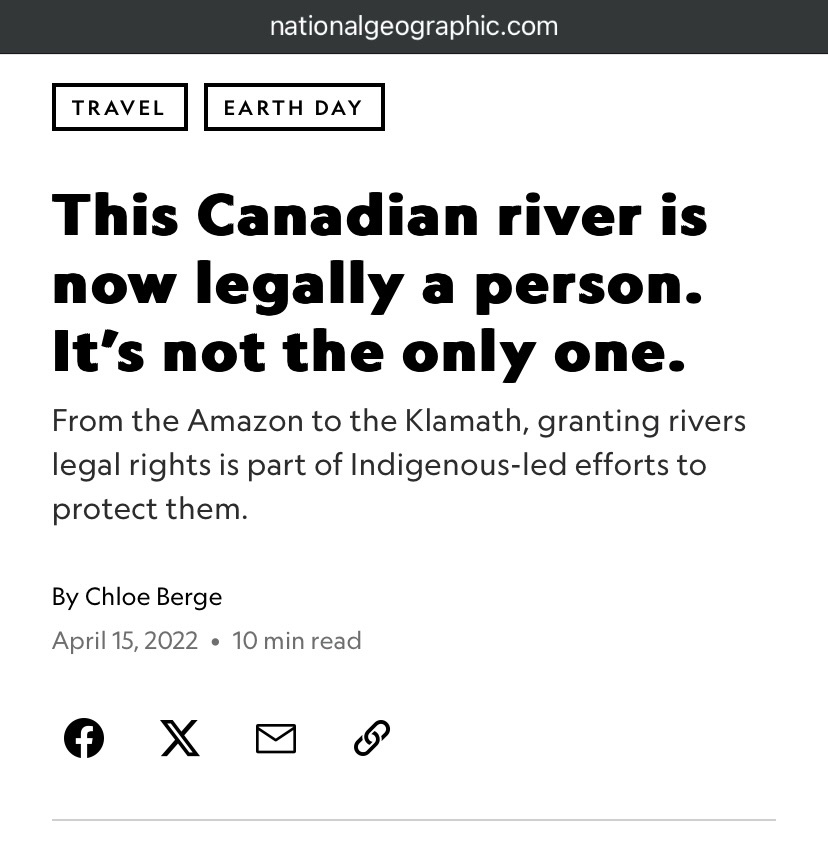
I thought I knew the difference between persons and non-person entities (NPEs), and then the Innu Nation does this:
With its thunderous rapids carving through a wild boreal forest in Quebec’s Côte-Nord region, the Magpie River is well known to white water rafters from around the globe. What these travelers may not know is that the Magpie recently became the first river in Canada to be granted legal personhood.
I have a telehealth appointment next week with a medical professional whom I have previously met. And I assume she will participate in the telehealth appointment.
In the future, of course, she may not.
Way back in April 2013, I wrote a tymshft piece entitled “You will still take a cab to the doctor’s office. For a while.” It speculated about a future 2023 medical appointment in which the patient took a driverless cab to a medical facility. In the office, the patient was examined by remote staff…or so she thought.
“Well, I’m glad you’ve gotten used to the procedure,” replied the friendly voice. “I hope you like me!”
“I do,” said Edith. “You’ve been very helpful. But I’ve always wondered exactly WHERE you were. If you were in Los Angeles, or in Mississippi, or perhaps in India or China, or perhaps even in one of the low-cost places such as Chad. If you don’t mind my asking, exactly where ARE you?”
“I don’t mind answering the question,” replied the friendly voice, “and I hope you don’t take my response the wrong way, but I’m not really a person as you understand the term. I’m actually an application within the software package that runs the medical center. But my programmers want me to tell you that they’re really happy to serve you, and that Stanford sucks.” The voice paused for a moment. “I’m sorry, Edith. You have to forgive the programmers – they’re Berkeley grads.”
“Oh,” said Edith after a moment. “This is something new. I’m used to it in banking, but I didn’t realize that a computer program could run an entire medical center. Well…who picks up the trash?”
“That’s an extra question! Just kidding,” replied the friendly voice. “Much of the trash pickup is automated, but we do have a person to supervise the operation. Ron Hussein. You actually know him – he was your cab driver in 2018 when you came here.”
Re-reading this 2013 piece, I was amused at three things I got wrong.
First, Google, Facebook, and Apple did NOT merge to form Gaceapple, “the important merger that saved the tech industry in the United States from extinction.” American tech firms are still powerful…for now.
Second, my assumption of cab companies adopting driverless cars assumed the continued existence of cab companies. Ride share services have reduced the presence of traditional companies dramatically.
Third, my assumption that medical firms would sink untold sums of money into centralized automated medical examination rooms could be questioned…especially for routine appointments like Edith’s. Why not just let Edith’s smartphone—perhaps with a single attachment—gather the data?
Of course, there are medical ethics questions that underlie this entire discussion of remote telehealth and the use of non-person entities (NPEs). And we are struggling with those right now.
In “On Attribute-Based Access Control,” I noted that NIST defined a subject as “a human user or NPE (Non-Person Entity), such as a device that issues access requests to perform operations on objects.” Again, there’s a need to determine that the NPE has the right attributes, and is not a fake, deep or shallow.
There’s clearly a need to identify non-person entities. If I work for IBM and have a computer issued by IBM, the internal network needs to know that this is my computer, and not the computer of a North Korean hacker.
But I was curious. Can the five (or six) factors identify non-person entities?
Let’s consider factor applicability, going from the easiest to the hardest.
The easy factors
Somewhere you are. Not only is this extremely applicable to non-person entities, but in truth this factor doesn’t identify persons, but non-person entities. Think about it: a standard geolocation application doesn’t identify where YOU are. It identities where YOUR SMARTPHONE is. Unless you have a chip implant, there is nothing on your body that can identify your location. So obviously “somewhere you are” applies to NPEs.
Something you have. Another no brainer. If a person has “something,” that something is by definition an NPE. So “something you have” applies to NPEs.
Something you do. NPEs can do things. My favorite example is Kraftwerk’s pocket calculator. You will recall that “by pressing down this special key it plays a little melody.” I actually had a Casio pocket calculator that did exactly that, playing a tune that is associated with Casio. Later, Brian Eno composed a startup sound for Windows 95. So “something you do” applies to NPEs. (Although I’m forced to admit that an illegal clone computer and operating system could reproduce the Eno sound.)
Something you know. This one is a conceptual challenge. What does an NPE “know”? For artificial intelligence creations such as Kwebbelkop AI, you can look at the training data used to create it and maintain it. For a German musician’s (or an Oregon college student’s) pocket calculator, you can look at the code used in the device, from the little melody itself to the action to take when the user enters a 1, a plus sign, and another 1. But is this knowledge? I lean toward saying yes—I can teach a bot my mother’s maiden name just as easily as I can teach myself my maiden name. But perhaps some would disagree.
Something you are. For simplicity’s sake, I’ll stick to physical objects here, ranging from pocket calculators to hand-made ceramic plates. The major reason that we like to use “something you are” as a factor is the promise of uniqueness. We believe that fingerprints are unique (well, most of us), and that irises are unique, and that DNA is unique except for identical twins. But is a pocket calculator truly unique, given that the same assembly line manufactures many pocket calculators? Perhaps ceramic plates exhibit uniqueness, perhaps not.
That’s all five factors, right?
Well, let’s look at the sixth one.
Somewhat you why
You know that I like the “why” question, and some time ago I tried to apply it to identity.
Why is a person using a credit card at a McDonald’s in Atlantic City? (Link) Or, was the credit card stolen, or was it being used legitimately?
Why is a person boarding a bus? (Link) Or, was the bus pass stolen, or was it being used legitimately?
Why is a person standing outside a corporate office with a laptop and monitor? (Link) Or, is there a legitimate reason for an ex-employee to gain access to the corporate office?
The first example is fundamental from an identity standpoint. It’s taken from real life, because I had never used any credit card in Atlantic City before. However, there was data that indicated that someone with my name (but not my REAL ID; they didn’t exist yet) flew to Atlantic City, so a reasonable person (or identity verification system) could conclude that I might want to eat while I was there.
But can you measure intent for an NPE?
Does Kwebbelkop AI have a reason to perform a particular activity?
Does my pocket calculator have a reason to tell me that 1 plus 1 equals 3?
Does my ceramic plate have a reason to stay intact when I drop it ten meters?








 Bredemarket