Who are you?
What is that?
Identity and cybersecurity are pretty basic, when you think about it.
(Imagen 3)

Identity/biometrics/technology marketing and writing services

Who are you?
What is that?
Identity and cybersecurity are pretty basic, when you think about it.
(Imagen 3)

Update to my prior post.
According to Reuters, CVE funding has been extended…for 11 months.
So like everything else, the fix for the problem is temporary.
(Imagen 3)
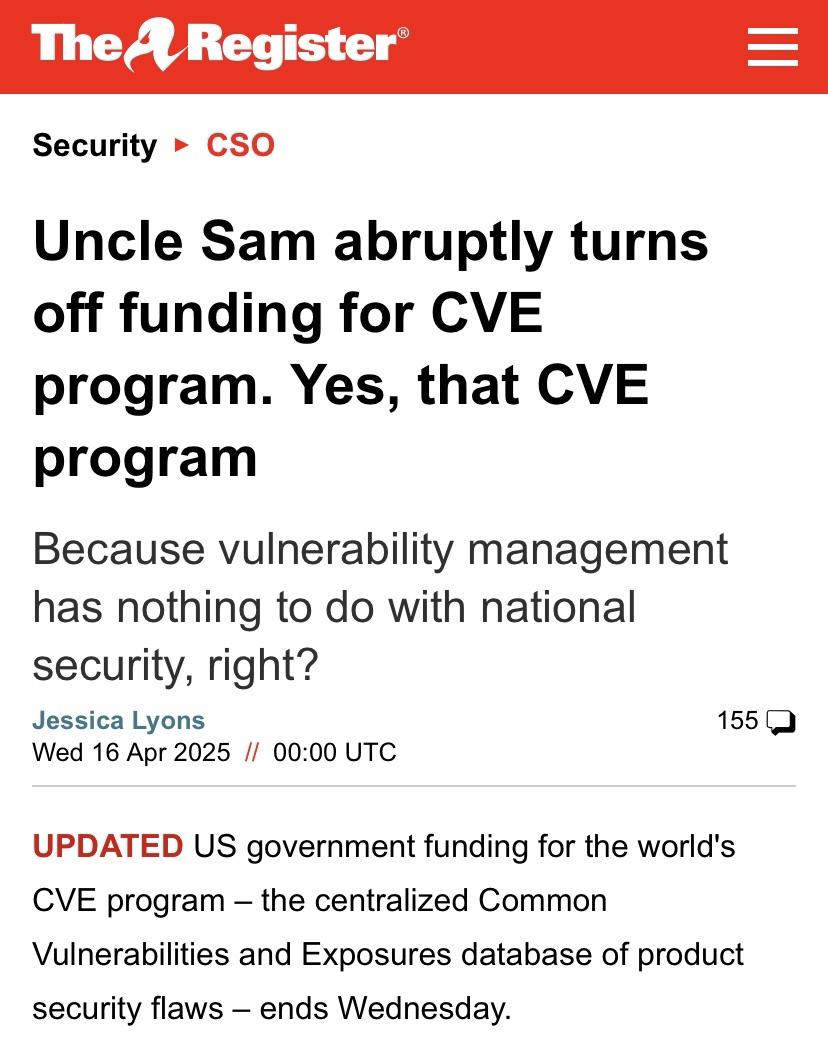
From The Register:
“The [CVE] program is sponsored, and largely funded by the Cybersecurity and Infrastructure Security Agency, aka CISA, under the umbrella of the US Department of Homeland Security. It appears MITRE has been paid roughly $30 million since 2023 to run CVE and associated programs.”
$30 million is peanuts.
If the U.S. government won’t fund it (and it still may), and if private firms won’t fund it, perhaps the EU will take it over. Or Canada. Or China.
The only complication is whether MITRE can run it if someone other than the feds is paying.

I just listened to a third-party risk management (TPRM) Mitratech webinar about NIST cybersecurity frameworks, hosted by OCEG, which talked about a farm.
No, they’re not planting corn at NIST’s Gaithersburg headquarters.
(At least I don’t think so. I haven’t been there since early 2009, back when Motorola and Safran people couldn’t talk about the possible acquisition. We did anyway. But I digress.)
Back to TPRM. In Mitratech’s case, FARM stands for “frame, assess, respond, and monitor.”
Here’s how Mitratech introduced the topic in a 2022 post:
NIST SP 800-53 is considered the foundation upon which all other cybersecurity controls are built. With SP 800-161 Rev. 1, NIST outlines a complementary framework to frame, assess, respond to, and monitor cybersecurity supply chain risks. Together, SP 800-53 and supplemental SP 800-161 control guidance present a comprehensive framework for assessing and mitigating supplier risks.
If you visit the latest (as of 2024) update to SP 800-161, you can find NIST’s explanation of the FARM in Appendix G. The three referenced levels in the quote below are the enterprise, mission, and operations levels.
The first approach is known as FARM and consists of four steps: Frame, Assess, Respond, and Monitor. FARM is primarily used at Level 1 and Level 2 to establish the enterprise’s risk context and inherent exposure to risk. Then, the risk context from Level 1 and Level 2 iteratively informs the activities performed as part of the second approach described in The Risk Management Framework (RMF). The RMF predominantly operates at Level 3 [SP80037], – the operational level – and consists of seven process steps: Prepare, Categorize, Select, Implement, Assess, Authorize, and Monitor.
Briefly:
Section G.2 of the document includes much, much more detailed definitions of the FARM elements, should you be interested. I’d provide those details myself, but then I fear I’d have to say to you, “Sorry if I’ve stayed too long.”

Unified identity platform.
Originally posted on Instagram: https://www.instagram.com/share/_94gnxtmi
The song is “Unified” by Unified Highway.
This is painful, but it has to be done.
I’ve spent 30 years working with the identities of PEOPLE and ensuring that all PEOPLE accessing a system are properly identified.
In other words, leaving a huge GAPING security hole.
Look at what Okta is doing;
“[N]ew Okta Platform capabilities…help businesses secure AI agents and other non-human identities with the same level of visibility, control, governance, and automation as human ones. The Okta Platform will now bring a unified, end-to-end identity security fabric to organizations for managing and securing all types of identities across their ecosystem, from AI agents to API keys to employees.”
I think that “unified” will take the place of “trust” as the identity buzzword. Thankfully.
If you’re only selling biometrics, or maybe biometrics and ID cards, where will your customers go to get the rest of their systems? Or will you just be a commodity supplier to the companies that provide the REAL systems?
(Unified security AI picture from Imagen 3)

In my career, I’ve experienced all levels of process maturity, ranging from “process for process’ sake” to “winging it.”
Now the ability to “wing it” can be used in some circumstances but not in others. Obviously improvisational comedians “wing it” by definition. But Ike (pre-matrix) couldn’t have used the “wing it” approach on D-Day.
What about cybersecurity? Can you “wing it” when you’re attacked?
The evolving threat landscape demands robust governance architectures and well-defined board duties to ensure resilience against cyberthreats. Effective cybergovernance not only protects an organization’s digital assets but also reinforces trust among stakeholders.
Governance is a critical component of cybersecurity, if for no other reason than to prove that your organization actually HAS cybersecurity. Ideally an organization will govern its cybersecurity by some type of “maturity model.”
And that’s more than refraining from calling someone a poopy head.
(AI image from Imagen 3)

I’ve been around a ton of compliance frameworks during and after the years I worked at Motorola.
There is one compliance framework that is a little different from CMM, ISO, GDPR, and all the others: the System and Organization Controls (SOC) suite of Services.
The most widely known member of the suite is SOC 2® – SOC for Service Organizations: Trust Services Criteria. But you also have SOC 1, SOC 3, SOC for Cybersecurity, SOC for Supply Chain, SOC for Steak…whoops, I made that one up because I’m hungry as I write this. But the others are real.
But the difference about the SOC suite is that it’s not governed by engineers or scientists or academics.
It’s governed by CPAs.
And for once I’m not talking about content-proposal-analysis experts.
I’m talking about the AICPA, or the Association of International Certified Professional Accountants.
Which begs the question: why are a bunch of bean counters defining compliance frameworks for cybersecurity?
Ask Schneider Downs. As an accounting firm, they may have an obvious bias regarding this question. But their answers are convincing.
So that’s why the accountants are running your SOC 2 audit.
And don’t try to cheat when you pay them for the audit.
A few of you may have detected that the phrase “SOC it to me” is derived from a popular catchphrase from the old TV show Rowan & Martin’s Laugh-In.
A phrase that EVERYBODY said.
(Wildebeest accountants from Imagen 3)

I learned about the following story via the Identity Jedi, which leads me to my early and self-serving call to action:
If you’re interested in identity, The Identity Jedi Newsletter is a must-read. It’s packed with educational and insightful content. And if you would like to subscribe to the newsletter, please use my referral link: https://www.theidentityjedi.com/subscribe?ref=YoUVK0Uos1&_bhlid=7fecfad9eb7fd8bcdb529e945e11346b5897acdc I’m in the running to get an Identity Jedi mug. Thanks.
Enough self-serving content. Let’s get to what I learned about in the newsletter: namely, this article from CSO Online, “The urgent reality of machine identity security in 2025.”
As you know, I’ve been spending more and more time concentrating on identity issues when a person is not present. This is what the attribute-based access control folks refer to as “non-person entities” (NPEs).
In the article, CyberArk’s Scott Carter makes the following points:
What does this mean?
Well, for CyberArk, it means that it endorses technologies such as automating certificate lifecycle management. And by the strangest coincidence, CyberArk offers a solution…
But for us, it means that we don’t only need automation, but we also need governing processes to ensure that ALL the people and NPEs that are accessing our systems are properly managed, quickly commissioned, and quickly decommissioned.
(Image from Imagen 3. Yes, I’m falling into the habit of reusing images for multiple use cases. It’s easier that way.)

I’m admittedly fascinated by the parallels between people and non-person entities (NPEs), to the point where I asked at one point whether NPEs can use the factors of authentication. (All six. Long story.)
When I got to the “something you are” factor, which corresponds to biometrics in humans, here is what I wrote:
Something you are. For simplicity’s sake, I’ll stick to physical objects here, ranging from pocket calculators to hand-made ceramic plates. The major reason that we like to use “something you are” as a factor is the promise of uniqueness. We believe that fingerprints are unique (well, most of us), and that irises are unique, and that DNA is unique except for identical twins. But is a pocket calculator truly unique, given that the same assembly line manufactures many pocket calculators? Perhaps ceramic plates exhibit uniqueness, perhaps not.
But I missed one thing in that discussion, so I wanted to revisit it.
Now this doesn’t apply to ceramic plates or pocket calculators, but there are some NPEs that assert uniqueness.
Our smartphones, each of which has an International Mobile Equipment Identity (IMEI) number.
Let’s start off with the high level explanation.
IMEI stands for International Mobile Equipment Identity. It’s a unique identifier for mobile devices, much like a fingerprint for your phone’s IMEI number.
Now some of you who are familiar with biometrics are saying, “Hold it right there.”
But let’s stick to phones, Johnny.
Each IMEI number is a 15-digit code that’s assigned to every mobile phone during its production. This number helps in uniquely identifying a device regardless of the SIM card used.
This is an important point here. Even Americans understand that SIM cards are transient and can move from one phone to another, and therefore are not valid to uniquely identify phones.
What about IMEIs?
I won’t go into the specifics of the 15-digit IMEI number format, which you can read about here. Suffice it to say that the format dictates that the number incorporate the make and model, a serial number, and a check digit.
Why not? Because everyone says so.
It’s even part of the law.
Changing an IMEI number is illegal in many countries due to the potential misuse, such as using a stolen phone. Tampering with the IMEI can lead to severe legal consequences, including fines and imprisonment. This regulation helps in maintaining the integrity of mobile device tracking and discourages the theft and illegal resale of devices.
To all of the evidence above about the uniqueness of IMEI numbers, I only have two words:
So what?
A dedicated person can create or modify multiple smartphones to have the exact same IMEI number if desired. Here’s a recent example:
The Indore Police Crime Branch has dismantled two major digital arrest fraud rackets operating in different parts of the country, seizing a massive database containing private details of 20,000 pensioners in Indore….
A dark room in the flat functioned as the nerve centre of the cyber fraud operation, which had been active since 2019. The group specialised in IMEI cloning and used thousands of SIM cards from select mobile networks.
“Oh, but that’s India,” you say. “That couldn’t happen in a First World country.”
A Calgary senior is warning others after he was scammed out of $1,000 after buying what he thought was a new iPhone 15 Pro Max.
“I didn’t have any doubt that it was real,” Boyd told Global News….
The seller even provided him with the “original” receipt showing the phone had been purchased down east back in October 2023. Boyd said he also checked the phone’s serial number and the International Mobile Equipment Identity (IMEI). All checked out fine.
Boyd said the first sign of a problem was when he tried to update the phone with his own information and it wouldn’t update. It was only after he took it to a representative at a local Apple retailer, that he realized he had been duped.
Even IMEICheck.net, which notes that the threat of stealing one’s phone information is overrated, admits that it is possible (albeit difficult) to clone an IMEI number.
In theory, hackers can clone a phone using its IMEI, but this requires significant effort. They need physical access to the device or SIM card to extract data, typically using specialized tools.
The cloning process involves copying the IMEI and other credentials necessary to create a functional duplicate of the phone. However, IMEI number security features in modern devices are designed to prevent unauthorized cloning. Even if cloning is successful, hackers cannot access personal data such as apps, messages, photos, or passwords. Cloning usually only affects network-related functions, such as making calls or sending messages from the cloned device.
Again, NOTHING provides 100.00000% security. Not even an IMEI number.
So if you are claiming uniqueness of your smartphone’s IMEI, be aware that there are proven examples to the contrary.
Perhaps the shortcomings of IMEI uniqueness don’t matter in your case, and using IMEIs for individualization is “good enough.”
But I wouldn’t discuss war plans on such a device.
(Imagen 3 image. Oddly enough, Google Gemini was unable, or unwilling, to generate an image of three smartphones displaying the exact same 15-digit string of numbers, or even a 2-digit string. I guess Google thought I was a fraudster.)
Oh, and since I mentioned pocket calculators…excuse me, calcolatrici tascabili…

 Bredemarket