(Imagen 4)
This one didn’t pass the GV test.
For the picture that did, go here.

Identity/biometrics/technology marketing and writing services


(Imagen 4)
As we think about the single piece of written content that received approval 249 years ago today, I want to revisit my earlier statement about how long it takes content to convert. 4 months? 17 months?
“It takes longer than three days for content marketing to yield results. One source estimates four to five months. Another source says six to twelve months. Joe Pulizzi (quoted by Neil Patel) estimates 15 to 17 months. And all the sources say that their estimates may not apply to your particular case.”
The estimates certainly didn’t apply to the United States of America.

The content approved by the Continental Congress on July 4, 1776—namely, the Declaration of Independence—had a strong call to action.
“That these United Colonies are, and of Right ought to be Free and Independent States; that they are Absolved from all Allegiance to the British Crown, and that all political connection between them and the State of Great Britain, is and ought to be totally dissolved; and that as Free and Independent States, they have full Power to levy War, conclude Peace, contract Alliances, establish Commerce, and to do all other Acts and Things which Independent States may of right do.”
So how long did it take for this statement to become reality?
More than 17 months, that’s for sure.
Actually, it took over 7 years. The Treaty of Paris was signed on September 3, 1783.
You want to talk about turnover? During the time from content approval to conversion, the United States went through seven (or eight) Presidents:
And I didn’t even try to figure out how many “Chief Revenue Officers” we had during that time. CROs are often fired when they don’t bring in enough money, and during the 1770s and 1780s the U.S. Government was spectacularly bad at bringing in money.
But that topic is better suited for Constitution Day, which we celebrate on September 17.
But for now, enjoy the day.

Apple pie and Chevrolet not included.
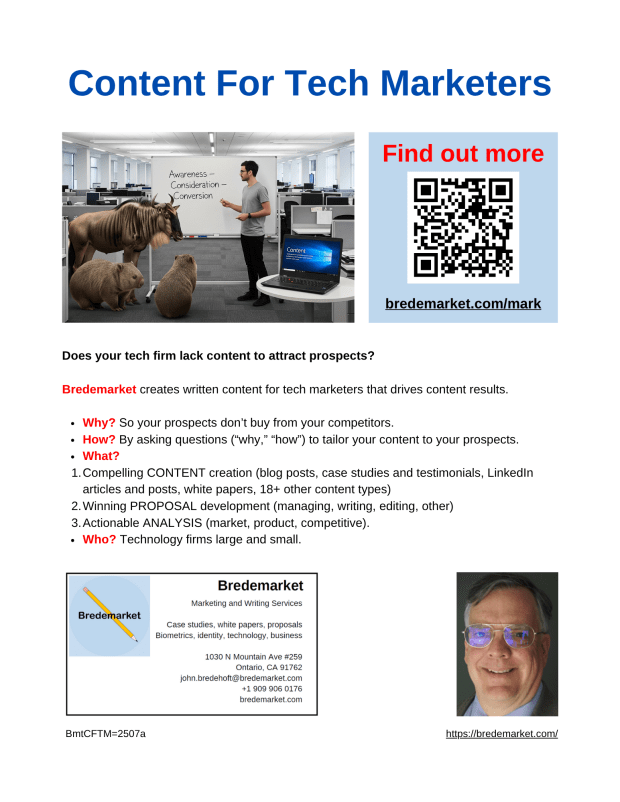
But if you have your own content needs and Thomas Jefferson isn’t your employee, Bredemarket can provide content for tech marketers.

(Imagen 4)
This week I’ve been expanding an internal document for a Bredemarket client.
I guess I could call it a Frequently Asked Questions (FAQ) document for salespeople, although it contains more than just the FAQs.

Why expand it? Because we added new FAQ categories.
(Right now a lot of you are making notes to scrub Windows 10 from your marketing collateral. Good for you.)
Of course, FAQs aren’t the only content that product marketers create. There are others.
If you need help creating or maintaining your content, Bredemarket can help.


(Richard Henry Lee)
It was Saturday, June 28, and I was looking over Bredemarket’s scheduled posts. And I saw that I had posts scheduled through Tuesday, July 1 and needed a post for Wednesday the 2nd.
That’s easy, I thought.
Since Bredemarket offers its marketing and writing services to identity/biometric and technology firms in the United States, July 2 is the perfect day for an Independence Day post.
But…you heard me right. From the Constitution Center:
“Officially, the Continental Congress declared its freedom from Great Britain on July 2, 1776, when it voted to approve a resolution submitted by delegate Richard Henry Lee of Virginia, declaring ‘That these United Colonies are, and of right ought to be, free and independent States, that they are absolved from all allegiance to the British Crown, and that all political connection between them and the State of Great Britain is, and ought to be, totally dissolved.’”
That day was so momentous that John Adams predicted:
“The Second Day of July 1776, will be the most memorable Epocha, in the History of America.
“I am apt to believe that it will be celebrated, by succeeding Generations, as the great anniversary Festival. It ought to be commemorated, as the Day of Deliverance by solemn Acts of Devotion to God Almighty. It ought to be solemnized with Pomp and Parade, with Shews, Games, Sports, Guns, Bells, Bonfires and Illuminations from one End of this Continent to the other from this Time forward forever more.”
Well, Adams ALMOST got it right.
So what happened on July 4, if we actually declared independence on July 2?
You see, it’s one thing to declare independence from the United Kingdom. It’s another to let the United Kingdom know about it.
As John Adams knew all too well, a committee of five was working on a declaration to address the latter. But the committee’s work still required approval. And some in the Continental Congress were troubled by one part of Thomas Jefferson’s Declaration:
“He [King George III] has waged cruel war against human nature itself, violating its most sacred rights of life & liberty in the persons of a distant people who never offended him, captivating & carrying them into slavery in another hemisphere or to incur miserable death in their transportation thither.”
Delegates from Southern and Northern colonies alike objected to the clause: Southerners like Jefferson himself who profited from slaves, and Northerners who profited from transporting them from Africa to here.
But that’s boring, so let’s listen to a song about it.
Anyway, the troublesome clause was removed from the Declaration of Independence, settling the slavery issue for all time so that the country would never have to deal with it again…until 1787. And 1820. And 1850. And 1861.
After all the edits were completed to the Declaration of Independence, the Continental Congress followed up on its momentous July 2 act with a minor bookkeeping detail two days later, actually approving the declaration.
Except…that the printed versions of the document included the July 4 date, not the date of Richard Henry Lee’s resolution on July 2.
So no red, white, and blue soup for you today. Wait a couple of days.
And marvel at how a single piece of written content resulted in profound changes to this country…and many others.

I snuck a future-famous teenager into an Instagram reel I posted on Sunday. See the final scene in the reel. https://www.instagram.com/reel/DLfyc4HSBYh/
This scene is incredibly inaccurate. A teenage Napoleon was NOT looking on as George Washington presented a copy of the Declaration of Independence to King George III during the Treaty of Paris negotiations in 1783.
But at least the two Georges picture is more accurate than my picture of Thomas Jefferson eating a hot dog as a baseball game was played nearby.
I will talk about the Declaration of Independence, in a content marketing context, later this week. On Wednesday, of course.

Does your LinkedIn content look like this?

Fix that, before your competitors steal your rightful revenue.
Schedule a meeting with Bredemarket to discuss your needs at https://bredemarket.com/cpa/.
And if you want to see Bredemarket’s LinkedIn content, visit:
(Imagen 4)

In a recent Content Marketing Institute webinar (REALLY recent: it’s still going on as I type this), co-presenter Brittany Bowen made the point that the case studies that content marketers produce help prove their worth.
Perhaps it’s time for Bredemarket to talk about case studies again. I haven’t discussed case studies in detail in many months.
And perhaps it’s time to reshare Bredemarket’s own case studies. Which were written in April 2023 (I was still at Incode, and only had six questions rather than seven) and desperately need an update.
If I can help you with case studies, contact me. https://bredemarket.com/cpa/
(Yes, this is a repurpose and expansion. Live the repurposing dream.)

I previously used this tumbleweed image (public domain) in a November post. At the time I had just emailed people at a number of companies, but discovered that three of the companies had ceased to exist.
I wonder how many emails would bounce if I sent a new email tomorrow.
Are you giving your prospects the silent treatment? This could have adverse consequences.
If you have blog or other content marketing needs, contact Bredemarket: https://bredemarket.com/cpa/

(This is the old version of this post. See the new version from July 8 with improved algorithmic landing page-ability.)
For identity/biometric marketing leaders only!
Make an impact with the biometric product marketing expert.
Bredemarket’s biometric product marketing expertise: https://bredemarket.com/bpme/
Discuss your content-proposal-analysis needs with me before your competitors steal your prospects: https://bredemarket.com/cpa/

 Bredemarket