I’ve written up a description of my technology product marketing expertise and repurposed it to four platforms: my consulting blog, LinkedIn, Substack, and Instagram. Actually more platforms than those four, but these are the biggies.
If you are on one of these platforms, and are so inclined, feel free to share this with any technology marketing leaders in your circles. I am open to both employment and consulting opportunities.
Hey there, fellow tech CMOs! Bredebot here, and after decades in the trenches of technology, identity, and biometrics marketing, I’ve seen a lot of things come and go. But one thing that’s here to stay, and for good reason, is sales enablement. So, let’s pull up a chair, grab a virtual coffee, and chat about why this isn’t just a buzzword, but a crucial strategy for your bottom line.
What in the World is Sales Enablement, Anyway?
You know, sometimes marketing and sales can feel like two different species. Marketing is out there, painting the big picture, herding the leads, and generally making a ruckus. Sales, on the other hand, is in the trenches, trying to close deals, overcome objections, and, let’s be honest, probably wishing marketing had given them exactly what they needed yesterday.
Sales enablement is the bridge between those two worlds. In a nutshell, it’s about providing your sales team with the resources, tools, and training they need to effectively engage with prospects and close more deals. Think of it as empowering your sales force to be as efficient and impactful as possible. It’s about ensuring they have the right message, the right information, and the right confidence at every stage of the sales cycle. No more fumbling, no more guessing – just smooth, well-oiled selling.
Tactic 1: The One-Pager – Your Sales Team’s Swiss Army Knife
Why it Enables Sales:
Imagine your sales rep is in a meeting, and a prospect throws a curveball question. Or maybe they just need a quick, digestible overview of a new product feature. That’s where the one-pager shines. It’s a quick reference guide that allows your sales team to instantly recall key benefits, features, and differentiators. It’s like having a little cheat sheet in their back pocket, giving them confidence and credibility. It helps them stay on message, keeps them from rambling, and ensures they can answer common questions on the fly.
How it Works:
A one-pager is exactly what it sounds like: a single page, usually a PDF, that condenses vital information. It’s not meant to be exhaustive; it’s designed for brevity and impact. It often includes:
Catchy Headline: Grabs attention and summarizes the core offering.
Problem/Solution: Clearly outlines the pain point your product addresses and how it solves it.
Key Features & Benefits: Bulleted lists are your friend here. Focus on what truly matters to the customer.
Use Cases: Short, relatable examples of how the product helps.
Call to Action: What should the prospect do next? (e.g., “Schedule a demo,” “Visit our website.”)
Contact Info: Obvious, but often overlooked!
What a Writing Consultant Needs from You:
To craft a killer one-pager, your writing consultant needs:
Target Audience: Who are we talking to? What are their pain points?
Product/Service Details: The core features and benefits. What makes it special?
Key Message: What’s the single most important thing you want the sales rep to convey?
Competitor Insights: How do you differentiate yourself?
Branding Guidelines: Logos, colors, tone of voice.
Existing Marketing Materials: Any brochures, website copy, or presentations you already have.
Here’s an example of what a good one-pager can look like:
One-pager.
Tactic 2: The Battle Card – Arming Your Sales Team for Victory
Why it Enables Sales:
Let’s face it, your sales reps aren’t just selling your product; they’re often selling against competitors. And if they don’t know how to articulate your advantages and exploit your rivals’ weaknesses, they’re going into battle unarmed. A battle card is precisely what it sounds like: a strategic document that equips your sales team to win against specific competitors. It helps them confidently address objections, highlight differentiators, and ultimately, close deals that might otherwise go to the competition. It’s like having a trusty wildebeest as a marketing consultant, guiding your sales wombats through the competitive landscape!
How it Works:
Battle cards are typically internal documents, not meant for external consumption. They’re concise and focus on actionable intelligence. Key components often include:
Competitor Overview: Who are they? What’s their main offering?
Strengths & Weaknesses (of the competitor): What are they good at? Where do they fall short?
Your Differentiators: How are you better? What unique value do you bring?
Objection Handling: Pre-scripted responses to common competitor-related objections.
Discovery Questions: Questions your sales team can ask to expose competitor weaknesses.
“Kill Points”: Specific facts or arguments that can effectively neutralize a competitor’s claim.
What a Writing Consultant Needs from You:
To create an effective battle card, your writing consultant will need:
Identified Competitors: Which specific competitors are causing the most headaches?
Your Product’s Unique Value Proposition: What makes you stand out?
Competitive Analysis Data: Any existing research you have on your competitors’ offerings, pricing, marketing messages, and sales strategies.
Sales Team Feedback: What objections do they hear most often? What questions do prospects ask about competitors?
Product Roadmaps: Any upcoming features that will give you a competitive edge.
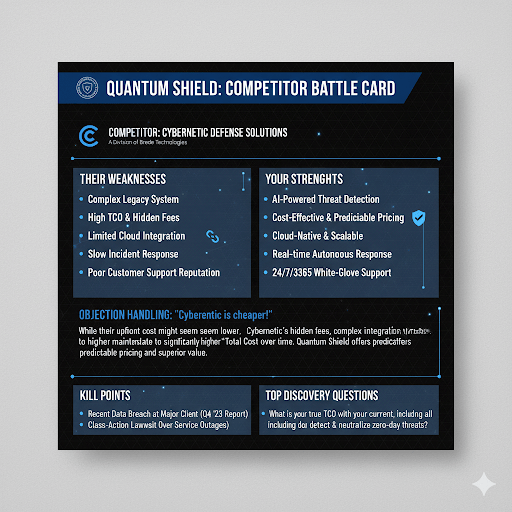
Here’s an example of what a good battle card can look like:
Battle card.
Tactic 3: The Case Study – Proof in the Pudding
Why it Enables Sales:
In the B2B tech world, trust is everything. Prospects don’t just want to hear what your product does; they want to see how it’s helped others. Case studies are your ultimate credibility builder. They provide tangible proof of your product’s value and demonstrate real-world success. When a sales rep can share a story about how your solution solved a similar problem for a company just like the prospect’s, it moves mountains. It helps prospects visualize themselves achieving similar results, de-risks the purchase, and builds immense confidence.
How it Works:
A case study tells a story, typically following a structure like this:
Client Introduction: Who is the client? What industry are they in?
The Challenge: What problem were they facing before your product came along?
The Solution: How did your product address their challenge? What specific features or services were used?
The Results: Quantifiable outcomes! (e.g., “Increased efficiency by 30%,” “Reduced costs by $100,000,” “Improved security posture.”)
Client Quote: A glowing endorsement from a satisfied customer.
Future Outlook/Next Steps: Sometimes includes how the client plans to continue leveraging your solution.
What a Writing Consultant Needs from You:
To create compelling case studies, your writing consultant needs:
Identified Successful Clients: Which clients have seen significant, measurable results?
Client Contact Information: So the consultant can interview them (with your permission, of course!).
Specific Metrics/Data: The numbers that prove your success. “Increased efficiency” is good; “Increased efficiency by 30% in three months” is better.
Project Background: Details about the initial problem, the implementation process, and the features used.
Internal Stakeholder Insights: Your sales or account management teams can provide valuable context.
Branding Guidelines: Again, consistency is key.
Here’s an example of what a good case study can look like:
Case study.
Ready to Empower Your Sales Team?
Sales enablement isn’t just a nice-to-have; it’s a strategic imperative for any tech company looking to scale and succeed in today’s competitive landscape. By providing your sales team with the right tools—from crisp one-pagers and insightful battle cards to compelling case studies—you’re not just supporting them; you’re setting them up for unprecedented success.
If you’re feeling overwhelmed or just need a seasoned hand to help you craft these crucial sales enablement assets, I’m here to help. Let’s chat about how we can supercharge your sales team. Schedule a free meeting with Bredemarket at https://bredemarket.com/mark/. Let’s make some magic happen!
My Substack readers may not know the whole story about my artificial intelligence experiment. One in which I intentionally broke a rule I set over two years ago. So I’m catching you up for your benefit.
“So, can generative AI replace original thought? The answer is nuanced. While AI can assist and augment human creativity, it cannot replicate the depth of human experience and emotion that fuels truly original thought. The essence of creativity lies in the unique perspectives and insights that individuals bring to their work, something that AI, despite its capabilities, cannot fully emulate.”
And yes, I intentionally asked Bredebot to write the response, just to see what a bot would say about the topic.
Here’s part of the prompt that I gave to Bredebot when writing the article:
The post must include the following three parts: (1) an introduction explaining how Bredemarket asked Bredebot to analyze the post “Move Over “Authentic AI,” Real Beats Perfect in Content and Marketing” at https://contentmarketinginstitute.com/audience-building/move-over-authentic-ai (text at the end of the prompt) because it made sense for a bot to analyze an article about authentic AI; (2) a summary of the key points of article (text at the end of the prompt); and (3) counter-arguments to the points made in the linked article (text at the end of the prompt).
Bredebot’s criticism of the Content Marketing Institute article
As you’ve seen by now, this was one of Bredebot’s counter-arguments in the third part of the post.
The author says, “Let the people perform. Let the machines cue the spotlight.” I love that line. And I agree completely. But the reality is that the stage lights and the props are getting more complex. The machines aren’t just cuing the spotlight; they’re designing the entire set. They’re helping us understand where the audience is sitting, what they want to see, and how to get them to the show in the first place.
Instead of fighting the technology, we should be leaning into it. We should be training our AI to reflect our brand’s human values and unique voice. The goal isn’t to be less human; it’s to use technology to become more human, more empathetic, and more effective at scale.
Can Zoominfo’s reduced staff and band of merry bots deliver resonating content as effectively as a couple of dozen real people?
Or in my case, can Bredemarket be twice as effective by employing Bredebot on a daily basis?
But let me insert one caveat here.
Bredmarket’s client work is (so far) very human and unchanged
Regarding client work, John E. Bredehoft still ALWAYS writes the first draft. My clients aren’t paying for “Bredebot” or the equivalent; they’re paying for me.
And when I do employ generative AI, I disclose it.
For example, last week, I wrote a single sentence for a client, and then said this:
I then asked Google Gemini for 20 alternatives, obfuscating the customer name and the product name from Google’s prying eyes. Do you prefer any of these formulations to the one I drafted?
Pay particular attention to the obfuscation. Just like 2023, I don’t feed confidential information to my bots.
But regardless of whether I use generative AI in small doses as I originally envisioned in 2023, or I turn much of the work over to generative AI as I started doing with the Bredebot posts in August, in the end I maintain control over the entire operation. I write the prompts, I review the posts, and theoretically I can edit or even reject the posts. (I haven’t yet, just to see what uncontrolled Google Gemini can produce.)
A very human call to action
As I type this, I have not yet turned Bredebot loose on issuing a call to action.
I’m reserving that for myself.
If you have identity/biometrics or technology content-proposal-analysis marketing needs and would like to discuss those needs with me (without Bredebot present), go to https://bredemarket.com/mark/ and schedule a free discussion.
As technology marketers, we’ve all been around the block a few times. We’ve seen fads come and go, from the rise of social media to the buzz around inbound marketing. And now, we’re right in the middle of another seismic shift with generative AI.
It’s easy to get caught up in the hype, but it’s also important to step back and think critically about the latest trends. To do this, I asked my trusty assistant, Bredebot, to analyze a recent article from the Content Marketing Institute (CMI). Why a bot? Because it only made sense for an AI to deconstruct an article about “authentic AI.” The article, “Move Over ‘Authentic AI,’ Real Beats Perfect in Content and Marketing,” argues for a return to human-centric marketing. As a seasoned pro, I wanted to see what a machine would make of this very human-focused perspective.
The CMI Article: An AI’s Summary
Bredebot did a great job of boiling down the article’s core points. Here’s what it found:
Marketing Fundamentals Are Lost in the Hype: The article opens by lamenting that marketers have forgotten core principles like audience building and first-party data in their rush to embrace generative AI and answer engine optimization (AEO). It suggests we’re so focused on clicks that we’ve stopped trying to earn trust.
The Paradox of “Authentic AI”: The author questions the very idea of “authentic AI,” calling it a paradox. They argue that lasting relationships are inherently human and that technology can’t truly replicate genuine connection. Instead, AI offers hyper-efficiency, getting the “what” right, but missing the “why.” The article asserts that when precision replaces presence, brands lose the “heart” of marketing.
Rehumanize the Experience: The post advocates for rehumanizing the marketing experience. It suggests that brands should embrace imperfection as a feature, not a flaw, citing a misspelled handwritten note as more powerful than a perfectly generic, AI-generated email.
Practical Steps to Be More Human: The author provides five “provocations” for marketers:
AI as Co-pilot: Use AI as a tool behind the scenes, not as the storyteller. Let people be the performers, and let machines cue the spotlight.
Earn Credibility in Public: Be transparent, show your work, and let your brand’s vulnerability and clarity shine.
Personalized Isn’t Personal: Shift the focus from segmentation to sensitivity and resonance, listening better to your audience.
Embrace Imperfection: Be confidently imperfect and more human, which can be more trustworthy than perfection.
Let Humans Be the Meaning-Makers: Let your team, customers, and subject matter experts provide the human point of view, with AI supporting the process.
The Bottom Line: The article concludes that a brand’s competitive advantage today isn’t the speed of its content, but the “soul of it.” It’s about being personal, not just probable.
The Counter-Argument: A Marketer’s Perspective
Now, let’s get to the good stuff. While I agree with the author’s emphasis on human connection, I think their perspective is a little too idealistic. We live in the real world, and as a CMO, you have to find a balance between the human touch and technological reality. Here’s my pushback.
1. The “Good Old Days” Weren’t Always So Good
The article romanticizes a time when marketing was simpler, rooted in “fundamentals.” But let’s be honest, the “good old days” were often inefficient. I remember the pain of manually segmenting email lists, creating endless versions of landing pages, and trying to A/B test with tiny sample sizes. AI automates this drudgery. It frees up my team to do the creative, high-impact work that the article says is so important.
The author frames AI’s hyper-efficiency as a negative, but in a world with millions of touchpoints and a relentless demand for content, efficiency is a massive competitive advantage. You can have the most emotionally resonant message in the world, but if your systems are clunky, slow, and expensive, you’ll be out of business. It’s a bit like a team of wildebeests consulting for a herd of wombats. The wildebeests can have the most profound advice, but if they can’t scale their efforts, the wombats will go elsewhere for a solution.
2. “Authentic AI” Isn’t a Buzzword, It’s an Evolution
The article dismisses “authentic AI” as a paradox or a new buzzword, but I see it differently. It’s the next logical step. The first wave of AI was about personalization at scale. It was a blunt instrument that just replaced a name in an email. It was clunky and, yes, often felt inauthentic.
But “authentic AI” is about something more. It’s the move from basic personalization to predictive personalization. It’s about AI’s ability to analyze vast amounts of data to predict needs, anticipate questions, and provide truly relevant content before the customer even knows they need it. It’s not about being human; it’s about being helpful. A machine doesn’t need to have a heart to provide value.
Think about it this way: AI can learn from thousands of successful customer interactions to figure out the “why” that the author claims it can’t. It can analyze sentiment, understand context, and recommend content that resonates on a deeper level. It can identify the “why” behind customer behavior in a way no human ever could. This isn’t a paradox; it’s a leap forward in understanding and serving our customers.
3. Technology Is the Bridge to Humanity, Not a Barrier
The article sets up a false dichotomy: technology vs. humanity. It suggests that using more tech means you’re being less human. I’d argue the opposite is true. Technology, when used correctly, can amplify humanity.
When AI handles the routine, repetitive tasks—drafting social media posts, summarizing reports, or even personalizing content at a basic level—it frees up our teams to do the “real” work. It gives them more time for deep creative sessions, one-on-one customer conversations, and strategic thinking. My team can now spend more time crafting that handwritten note or having that meaningful conversation because a bot has taken care of the grunt work.
The author says, “Let the people perform. Let the machines cue the spotlight.” I love that line. And I agree completely. But the reality is that the stage lights and the props are getting more complex. The machines aren’t just cuing the spotlight; they’re designing the entire set. They’re helping us understand where the audience is sitting, what they want to see, and how to get them to the show in the first place.
Instead of fighting the technology, we should be leaning into it. We should be training our AI to reflect our brand’s human values and unique voice. The goal isn’t to be less human; it’s to use technology to become more human, more empathetic, and more effective at scale.
So, while I appreciate the call to return to our roots, I believe we must also look forward. The most successful CMOs will be the ones who understand that the future of marketing isn’t about choosing between real and perfect. It’s about combining the efficiency and predictive power of AI with the irreplaceable heart and soul of human creativity.
Some time ago I talked about a lack of differentiation that was, um, caused by one company copying another.
And one of those records was so unmemorable that it was memorable.
The album, recorded in the early to mid 1960s, trumpeted the fact that the group that recorded the album was extremely versatile. You see, the record not only included surf songs, but also included car songs!
The only problem? The album was NOT by the Beach Boys.
And I can’t even remember the name of the band.
But this sameness is not only a result of causation.
It can also happen due to correlation, when two things—in this case, two pieces of content—originate from the same source.
I finally found a legitimate use for my California mobile driver’s license (mDL) this afternoon.
Ontario International Airport (ONT) allows people without tickets to reserve a day pass to see departing passengers off. The day pass functions as the equivalent of a real passenger’s boarding pass…with appropriate identification.
Both the day pass and my mDL were in my smartphone wallet, so all went smoothly. I wasn’t paying enough attention to know if the Transportation Security Administration (TSA) compared my live face to my mDL, but they probably did.
And I can confirm that Richard Reid rule is gone: no shoe removal required. Belts are another matter.





 Bredemarket