(Imagen 4)
This one didn’t pass the GV test.
For the picture that did, go here.

Identity/biometrics/technology marketing and writing services


In addition to the security and pre-assembly videos I filmed before today’s July 4 Independence Day parade in Ontario, California, I also filmed a little bit of video during the parade itself.
But not the bagpipes. (I heard enough of them when I lived near Upland High years ago.)
The video below includes the Vietnam veterans and Chaffey High School. (Not that any current Chaffey students are Vietnam veterans.)
There is no video of horses, because I saw no horses during the parade. Don’t know why.
For comparison, here is my July 4, 2023 post.
Back to promoting Bredemarket content services (in Ontario and elsewhere) later.

Any significant endeavor, whether it’s a July 4 parade or a go-to-market effort, requires preparation.
Plan, then act.

Chaffey.

(Imagen 4)
As we think about the single piece of written content that received approval 249 years ago today, I want to revisit my earlier statement about how long it takes content to convert. 4 months? 17 months?
“It takes longer than three days for content marketing to yield results. One source estimates four to five months. Another source says six to twelve months. Joe Pulizzi (quoted by Neil Patel) estimates 15 to 17 months. And all the sources say that their estimates may not apply to your particular case.”
The estimates certainly didn’t apply to the United States of America.

The content approved by the Continental Congress on July 4, 1776—namely, the Declaration of Independence—had a strong call to action.
“That these United Colonies are, and of Right ought to be Free and Independent States; that they are Absolved from all Allegiance to the British Crown, and that all political connection between them and the State of Great Britain, is and ought to be totally dissolved; and that as Free and Independent States, they have full Power to levy War, conclude Peace, contract Alliances, establish Commerce, and to do all other Acts and Things which Independent States may of right do.”
So how long did it take for this statement to become reality?
More than 17 months, that’s for sure.
Actually, it took over 7 years. The Treaty of Paris was signed on September 3, 1783.
You want to talk about turnover? During the time from content approval to conversion, the United States went through seven (or eight) Presidents:
And I didn’t even try to figure out how many “Chief Revenue Officers” we had during that time. CROs are often fired when they don’t bring in enough money, and during the 1770s and 1780s the U.S. Government was spectacularly bad at bringing in money.
But that topic is better suited for Constitution Day, which we celebrate on September 17.
But for now, enjoy the day.

Apple pie and Chevrolet not included.
But if you have your own content needs and Thomas Jefferson isn’t your employee, Bredemarket can provide content for tech marketers.
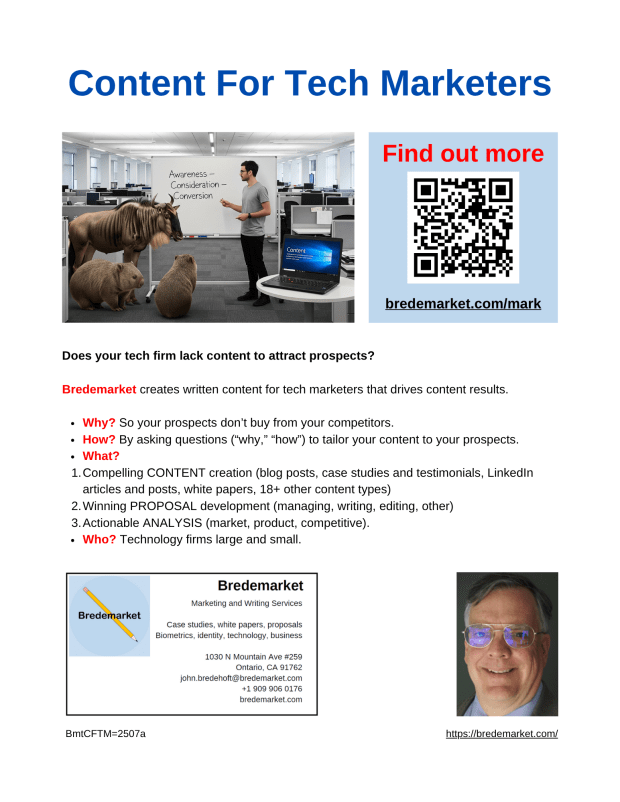

(Imagen 4)
This week I’ve been expanding an internal document for a Bredemarket client.
I guess I could call it a Frequently Asked Questions (FAQ) document for salespeople, although it contains more than just the FAQs.

Why expand it? Because we added new FAQ categories.
(Right now a lot of you are making notes to scrub Windows 10 from your marketing collateral. Good for you.)
Of course, FAQs aren’t the only content that product marketers create. There are others.
If you need help creating or maintaining your content, Bredemarket can help.


Regarding your hungry people (target audience), Kristina God wrote:
“You’re not annoying people when you tell them about your offer (behind the paywall), you’re reminding busy humans.”
As someone who sells to people who sell, I reflected on what Kristina said:
“Reading Kristina reminds me that there is a difference between BUSY and TOO BUSY.
“Prospects who are too busy won’t convert.
“Those who are busy may.”
And reminded myself that while “too busy” people aren’t hungry, “busy” people still need to stop to eat to fill that gaping hole in their stomachs.
And possibly in their content.

Do YOU have a content black hole?
Let Bredemarket help you take the blindfolds off. We can work together to fill your content black hole with blogs, articles, case studies, white papers, and other written words that make your prospects stop and eat.
(All pictures Imagen 4)

My written content usually targets a PRIMARY channel:
This content has a new target: my Substack “subscriber chat” https://open.substack.com/pub/johnebredehoft/chat
Because unlike the others, Substack subscriber chat is DESIGNED as a community.
A community that I’m not currently utilizing, but one that I should in the future.
By the way, if you want to read my Substack, visit https://substack.com/@johnebredehoft

When you’re…um…surfing the web, do you say to yourself, “I really hope I encounter something written by ChatGPT”?
Maybe you want to learn about a particular product and you’re hoping to find a page that begins with the words “in the ever-changing landscape of handheld gaming advances…”
Or you’re dying to read text that could be written by anybody…or by nobody.
Generative AI text is, after all, the “professional” tone.
When the CEO asks the product marketers to write just like the competitors, it’s possible that you could write exactly like the competitors by using the exact same generative AI tool (ChatGPT, because everybody uses it) and the exact same prompts to get the exact same content. This brands you as a respected member of the industry.
But whatever you do, act professionally.
Don’t randomly blow off steam like I just did.
Don’t loudly proclaim silly antiquated thoughts like “a bot should never write the first draft.”
In fact, forget that you read any of this.
Because I’m going to have it rewritten with a professional tone.
Because while your readers claim that they want to read authentic text rather than AI-generated text, they don’t know what’s good for them.
So I’m going to rewrite this the way it’s supposed to be done…with one exception. I’m going to use Google Gemini rather than ChatGPT. I know I’ll get in trouble for doing it this way.
But the text below is what readers WANT to read…right?
The increasing prevalence of generative AI in content creation presents a critical challenge for product marketers: balancing the pursuit of efficiency with the imperative of authenticity. While AI tools offer significant advantages in content generation, their widespread adoption raises questions about brand differentiation and genuine engagement.
A common misconception is that a “professional tone” inherently aligns with the output of generative AI. However, relying solely on AI, particularly popular platforms like ChatGPT, can lead to generic content that lacks unique brand voice and fails to resonate deeply with target audiences. When product marketing teams are tasked with mirroring competitor messaging, using the same AI tools and prompts as competitors can result in indistinguishable content, ultimately eroding a brand’s distinct identity within the industry.
This scenario underscores a fundamental tension: while consumers often express a preference for authentic, human-generated content, the demand for high-volume, rapid content creation pushes marketers towards AI solutions. The challenge lies in strategically integrating AI without compromising the unique elements that define a brand’s communication.
Product marketers are encouraged to consider the following:
The objective for product marketers is not to abandon AI, but to wield it judiciously. By understanding its capabilities and limitations, and by consciously prioritizing authenticity and unique brand expression, marketers can leverage AI as a powerful tool to enhance their efforts without sacrificing the crucial human element that drives true engagement.
Do you believe the future of product marketing lies in a complete embrace of AI, or a more nuanced integration that prioritizes human oversight and authentic brand voice?

Posted this on the socials but not the blog.
If you are a U.S. sole proprietor using Calendly…
…don’t forget to x out your Friday calendar so no one schedules Calendly meetings on that day.

 Bredemarket