The Imperfect Way to Enforce New York’s Child Data Protection Act

It’s often good to use emotion in your marketing.

For example, when biometric companies want to justify the use of their technology, they have found that it is very effective to position biometrics as a way to combat sex trafficking.

Similarly, moves to rein in social media are positioned as a way to preserve mental health.

By Marc NL at English Wikipedia – Transferred from en.wikipedia to Commons., Public Domain, https://commons.wikimedia.org/w/index.php?curid=2747237

Now that’s a not-so-pretty picture, but it effectively speaks to emotions.

“If poor vulnerable children are exposed to addictive, uncontrolled social media, YOUR child may end up in a straitjacket!”

In New York state, four government officials have declared that the ONLY way to preserve the mental health of underage social media users is via two bills, one of which is the “New York Child Data Protection Act.”

But there is a challenge to enforce ALL of the bill’s provisions…and only one way to solve it. An imperfect way—age estimation.

This post only briefly addresses the alleged mental health issues of social media before plunging into one of the two proposed bills to solve the problem. It then examines a potentially unenforceable part of the bill and a possible solution.

Does social media make children sick?

Letitia “Tish” James is the 67th Attorney General for the state of New York. From https://ag.ny.gov/about/meet-letitia-james

On October 11, a host of New York State government officials, led by New York State Attorney General Letitia James, jointly issued a release with the title “Attorney General James, Governor Hochul, Senator Gounardes, and Assemblymember Rozic Take Action to Protect Children Online.”

Because they want to protect the poor vulnerable children.

By Paolo Monti – Available in the BEIC digital library and uploaded in partnership with BEIC Foundation.The image comes from the Fondo Paolo Monti, owned by BEIC and located in the Civico Archivio Fotografico of Milan., CC BY-SA 4.0, https://commons.wikimedia.org/w/index.php?curid=48057924

And because the major U.S. social media companies are headquartered in California. But I digress.

So why do they say that children need protection?

Recent research has shown devastating mental health effects associated with children and young adults’ social media use, including increased rates of depression, anxiety, suicidal ideation, and self-harm. The advent of dangerous, viral ‘challenges’ being promoted through social media has further endangered children and young adults.

From https://ag.ny.gov/child-online-safety

Of course one can also argue that social media is harmful to adults, but the New Yorkers aren’t going to go that far.

So they are just going to protect the poor vulnerable children.

CC BY-SA 4.0.

This post isn’t going to deeply analyze one of the two bills the quartet have championed, but I will briefly mention that bill now.

  • The “Stop Addictive Feeds Exploitation (SAFE) for Kids Act” (S7694/A8148) defines “addictive feeds” as those that are arranged by a social media platform’s algorithm to maximize the platform’s use.
  • Those of us who are flat-out elderly vaguely recall that this replaced the former “chronological feed” in which the most recent content appeared first, and you had to scroll down to see that really cool post from two days ago. New York wants the chronological feed to be the default for social media users under 18.
  • The bill also proposes to limit under 18 access to social media without parental consent, especially between midnight and 6:00 am.
  • And those who love Illinois BIPA will be pleased to know that the bill allows parents (and their lawyers) to sue for damages.

Previous efforts to control underage use of social media have faced legal scrutinity, but since Attorney General James has sworn to uphold the U.S. Constitution, presumably she has thought about all this.

Enough about SAFE for Kids. Let’s look at the other bill.

The New York Child Data Protection Act

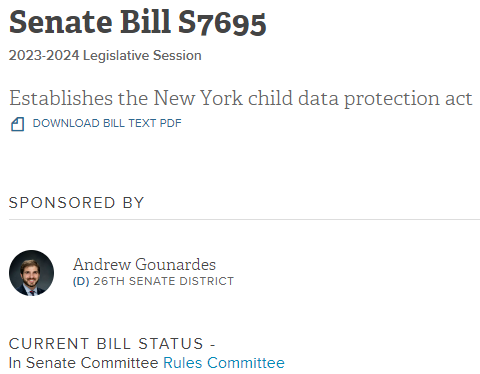
The second bill, and the one that concerns me, is the “New York Child Data Protection Act” (S7695/A8149). Here is how the quartet describes how this bill will protect the poor vulnerable children.

CC BY-SA 4.0.

With few privacy protections in place for minors online, children are vulnerable to having their location and other personal data tracked and shared with third parties. To protect children’s privacy, the New York Child Data Protection Act will prohibit all online sites from collecting, using, sharing, or selling personal data of anyone under the age of 18 for the purposes of advertising, unless they receive informed consent or unless doing so is strictly necessary for the purpose of the website. For users under 13, this informed consent must come from a parent.

From https://ag.ny.gov/child-online-safety

And again, this bill provides a BIPA-like mechanism for parents or guardians (and their lawyers) to sue for damages.

But let’s dig into the details. With apologies to the New York State Assembly, I’m going to dig into the Senate version of the bill (S7695). Bear in mind that this bill could be amended after I post this, and some of the portions that I cite could change.

The “definitions” section of the bill includes the following:

“MINOR” SHALL MEAN A NATURAL PERSON UNDER THE AGE OF EIGHTEEN.

From https://www.nysenate.gov/legislation/bills/2023/S7695, § 899-EE, 2.

This only applies to natural persons. So the bots are safe, regardless of age.

Speaking of age, the age of 18 isn’t the only age referenced in the bill. Here’s a part of the “privacy protection by default” section:

§ 899-FF. PRIVACY PROTECTION BY DEFAULT.

1. EXCEPT AS PROVIDED FOR IN SUBDIVISION SIX OF THIS SECTION AND SECTION EIGHT HUNDRED NINETY-NINE-JJ OF THIS ARTICLE, AN OPERATOR SHALL NOT PROCESS, OR ALLOW A THIRD PARTY TO PROCESS, THE PERSONAL DATA OF A COVERED USER COLLECTED THROUGH THE USE OF A WEBSITE, ONLINE SERVICE, ONLINE APPLICATION, MOBILE APPLICA- TION, OR CONNECTED DEVICE UNLESS AND TO THE EXTENT:

(A) THE COVERED USER IS TWELVE YEARS OF AGE OR YOUNGER AND PROCESSING IS PERMITTED UNDER 15 U.S.C. § 6502 AND ITS IMPLEMENTING REGULATIONS; OR

(B) THE COVERED USER IS THIRTEEN YEARS OF AGE OR OLDER AND PROCESSING IS STRICTLY NECESSARY FOR AN ACTIVITY SET FORTH IN SUBDIVISION TWO OF THIS SECTION, OR INFORMED CONSENT HAS BEEN OBTAINED AS SET FORTH IN SUBDIVISION THREE OF THIS SECTION.

From https://www.nysenate.gov/legislation/bills/2023/S7695

So a lot of this bill depends upon whether a person is over or under the age of eighteen, or over or under the age of thirteen.

And that’s a problem.

How old are you?

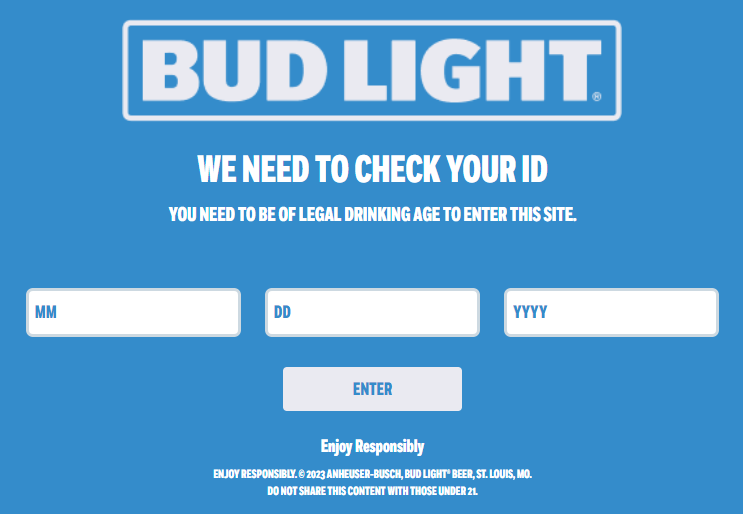
The bill needs to know whether or not a person is 18 years old. And I don’t think the quartet will be satisfied with the way that alcohol websites determine whether someone is 21 years old.

This age verification method is…not that robust.

Attorney General James and the others would presumably prefer that the social media companies verify ages with a government-issued ID such as a state driver’s license, a state identification card, or a national passport. This is how most entities verify ages when they have to satisfy legal requirements.

For some people, even some minors, this is not that much of a problem. Anyone who wants to drive in New York State must have a driver’s license, and you have to be at least 16 years old to get a driver’s license. Admittedly some people in the city never bother to get a driver’s license, but at some point these people will probably get a state ID card.

You don’t need a driver’s license to ride the New York City subway, but if the guitarist wants to open a bank account for his cash it would help him prove his financial identity. By David Shankbone – Own work, CC BY-SA 3.0, https://commons.wikimedia.org/w/index.php?curid=2639495
  • However, there are going to be some 17 year olds who don’t have a driver’s license, government ID or passport.
  • And some 16 year olds.
  • And once you look at younger people—15 year olds, 14 year olds, 13 year olds, 12 year olds—the chances of them having a government-issued identification document are much less.

What are these people supposed to do? Provide a birth certificate? And how will the social media companies know if the birth certificate is legitimate?

But there’s another way to determine ages—age estimation.

How old are you, part 2

As long-time readers of the Bredemarket blog know, I have struggled with the issue of age verification, especially for people who do not have driver’s licenses or other government identification. Age estimation in the absence of a government ID is still an inexact science, as even Yoti has stated.

Our technology is accurate for 6 to 12 year olds, with a mean absolute error (MAE) of 1.3 years, and of 1.4 years for 13 to 17 year olds. These are the two age ranges regulators focus upon to ensure that under 13s and 18s do not have access to age restricted goods and services.

From https://www.yoti.com/wp-content/uploads/Yoti-Age-Estimation-White-Paper-March-2023.pdf

So if a minor does not have a government ID, and the social media firm has to use age estimation to determine a minor’s age for purposes of the New York Child Data Protection Act, the following two scenarios are possible:

  • An 11 year old may be incorrectly allowed to give informed consent for purposes of the Act.
  • A 14 year old may be incorrectly denied the ability to give informed consent for purposes of the Act.

Is age estimation “good enough for government work”?

I Changed My Mind on Age Estimation

(Part of the biometric product marketing expert series)

I’ll admit that I previously thought that age estimation was worthless, but I’ve since changed my mind about the necessity for it. Which is a good thing, because the U.S. National Institute of Standards and Technology (NIST) is about to add age estimation to its Face Recognition Vendor Test suite.

What is age estimation?

Before continuing, I should note that age estimation is not a way to identify people, but a way to classify people. For once, I’m stepping out of my preferred identity environment and looking at a classification question. Not “gender shades,” but “get off my lawn” (or my tricycle).

Designed by Freepik.

Age estimation uses facial features to estimate how old a person is, in the absence of any other information such as a birth certificate. In a Yoti white paper that I’ll discuss in a minute, the Western world has two primary use cases for age estimation:

  1. First, to estimate whether a person is over or under the age of 18 years. In many Western countries, the age of 18 is a significant age that grants many privileges. In my own state of California, you have to be 18 years old to vote, join the military without parental consent, marry (and legally have sex), get a tattoo, play the lottery, enter into binding contracts, sue or be sued, or take on a number of other responsibilities. Therefore, there is a pressing interest to know whether the person at the U.S. Army Recruiting Center, a tattoo parlor, or the lottery window is entitled to use the service.
  2. Second, to estimate whether a person is over or under the age of 13 years. Although age 13 is not as great a milestone as age 18, this is usually the age at which social media companies allow people to open accounts. Thus the social media companies and other companies that cater to teens have a pressing interest to know the teen’s age.

Why was I against age estimation?

Because I felt it was better to know an age, rather than estimate it.

My opinion was obviously influenced by my professional background. When IDEMIA was formed in 2017, I became part of a company that produced government-issued driver’s licenses for the majority of states in the United States. (OK, MorphoTrak was previously contracted to produce driver’s licenses for North Carolina, but…that didn’t last.)

With a driver’s license, you know the age of the person and don’t have to estimate anything.

And estimation is not an exact science. Here’s what Yoti’s March 2023 white paper says about age estimation accuracy:

Our True Positive Rate (TPR) for 13-17 year olds being correctly estimated as under 25 is 99.93% and there is no discernible bias across gender or skin tone. The TPRs for female and male 13-17 year olds are 99.90% and 99.94% respectively. The TPRs for skin tone 1, 2 and 3 are 99.93%, 99.89% and 99.92% respectively. This gives regulators globally a very high level of confidence that children will not be able to access adult content.

Our TPR for 6-11 year olds being correctly estimated as under 13 is 98.35%. The TPRs for female and male 6-11 year olds are 98.00% and 98.71% respectively. The TPRs for skin tone 1, 2 and 3 are 97.88%, 99.24% and 98.18% respectively so there is no material bias in this age group either.

Yoti’s facial age estimation is performed by a ‘neural network’, trained to be able to estimate human age by analysing a person’s face. Our technology is accurate for 6 to 12 year olds, with a mean absolute error (MAE) of 1.3 years, and of 1.4 years for 13 to 17 year olds. These are the two age ranges regulators focus upon to ensure that under 13s and 18s do not have access to age restricted goods and services.

From https://www.yoti.com/wp-content/uploads/Yoti-Age-Estimation-White-Paper-March-2023.pdf

While this is admirable, is it precise enough to comply with government regulations? Mean absolute errors of over a year don’t mean a hill of beans. By the letter of the law, if you are 17 years and 364 days old and you try to vote, you are breaking the law.

Why did I change my mind?

Over the last couple of months I’ve thought about this a bit more and have experienced a Jim Bakker “I was wrong” moment.

I was wrong for two reasons.

Kids don’t have government IDs

Designed by Freepik.

I asked myself some questions.

  • How many 13 year olds do you know that have driver’s licenses? Probably none.
  • How many 13 year olds do you know that have government-issued REAL IDs? Probably very few.
  • How many 13 year olds do you know that have passports? Maybe a few more (especially after 9/11), but not that many.

Even at age 18, there is no guarantee that a person will have a government-issued REAL ID.

So how are 18 year olds, or 13 year olds, supposed to prove that they are old enough for services? Carry their birth certificate around?

You’ll note that Yoti didn’t target a use case for 21 year olds. This is partially because Yoti is a UK firm and therefore may not focus on the strict U.S. laws regarding alcohol, tobacco, and casino gambling. But it’s also because it’s much, much more likely that a 21 year old will have a government-issued ID, eliminating the need for age estimation.

Sometimes.

In some parts of the world, no one has government IDs

Over the past several years, I’ve analyzed a variety of identity firms. Earlier this year I took a look at Worldcoin. While Worldcoin’s World ID emphasizes privacy so much that it does not conclusively prove a person’s identity (it only proves a person’s uniqueness), and makes no attempt to provide the age of the person with the World ID, Worldcoin does have something to say about government issued IDs.

Online services often request proof of ID (usually a passport or driver’s license) to comply with Know your Customer (KYC) regulations. In theory, this could be used to deduplicate individuals globally, but it fails in practice for several reasons.

KYC services are simply not inclusive on a global scale; more than 50% of the global population does not have an ID that can be verified digitally.

From https://worldcoin.org/blog/engineering/humanness-in-the-age-of-ai

But wait. There’s more:

IDs are issued by states and national governments, with no global system for verification or accountability. Many verification services (i.e. KYC providers) rely on data from credit bureaus that is accumulated over time, hence stale, without the means to verify its authenticity with the issuing authority (i.e. governments), as there are often no APIs available. Fake IDs, as well as real data to create them, are easily available on the black market. Additionally, due to their centralized nature, corruption at the level of the issuing and verification organizations cannot be eliminated.

Same source as above.

Now this (in my opinion) doesn’t make the case for Worldcoin, but it certainly casts some doubt on a universal way to document ages.

So we’d better start measuring the accuracy of age estimation.

If only there were an independent organization that could measure age estimation, in the same way that NIST measures the accuracy of fingerprint, face, and iris identification.

You know where this is going.

How will NIST test age estimation?

Yes, NIST is in the process of incorporating an age estimation test in its battery of Face Recognition Vendor Tests.

NIST’S FRVT Age Estimation page explains why.

Facial age verification has recently been mandated in legislation in a number of jurisdictions. These laws are typically intended to protect minors from various harms by verifying that the individual is above a certain age. Less commonly some applications extend benefits to groups below a certain age. Further use-cases seek only to determine actual age. The mechanism for estimating age is usually not specified in legislation. Face analysis using software is one approach, and is attractive when a photograph is available or can be captured.

In 2014, NIST published a NISTIR 7995 on Performance of Automated Age Estimation. The report showed using a database with 6 million images, the most accurate age estimation algorithm have accurately estimated 67% of the age of a person in the images within five years of their actual age, with a mean absolute error (MAE) of 4.3 years. Since then, more research has dedicated to further improve the accuracy in facial age verification.

From https://pages.nist.gov/frvt/html/frvt_age_estimation.html

Note that this was in 2014. As we have seen above, Yoti asserts a dramatically lower error rate in 2023.

NIST is just ramping up the testing right now, but once it moves forward, it will be possible to compare age estimation accuracy of various algorithms, presumably in multiple scenarios.

Well, for those algorithm providers who choose to participate.

Does your firm need to promote its age estimation solution?

Does your company have an age estimation solution that is superior to all others?

Do you need an experienced identity professional to help you spread the word about your solution?

Why not consider Bredemarket? If your identity business needs a written content creator, look no further.

Alaska HB389 does NOT repeal REAL ID. But it has a “foreign ownership” clause.

The title of Alaska HB389, introduced last month, sounds grandiose:

“An Act repealing the implementation of the federal REAL ID Act of 2005; relating to identification cards; relating to drivers’ licenses; and providing for an effective date.”

Does HB389 prevent Alaska from issuing REAL IDs?

When you read the title of the bill, alarms go off in your head.

If the title is true, it’s a true setback. After many years, the entire country (perhaps minus a territory or two) has finally gotten on board with REAL ID in advance of the due date, and now one of the states is pulling out.

Except that when you read the detail of the bill (at least as originally written; it could change in committee), it doesn’t repeal Alaska’s compliance of REAL ID.

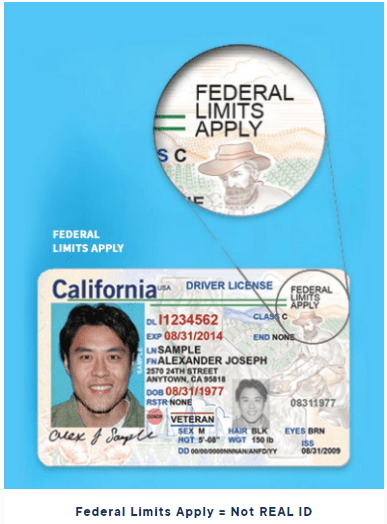
As Chris Burt notes in a Biometric Updatre post, it only provides an option for the Alaska Division of Motor Vehicles to issue an identification card that is non-REAL ID compliant. This is not different from any other state (for example, California) that issues non-REAL ID cards that are “not for federal purposes” or “not for federal identification” or “federal limits apply.”

So Alaskans, don’t panic. If you want to get a REAL ID to board a plane, you can still do this. Note the [BRACKETED ALL CAPS] text in Section 1 of HB389 as originally written, illustrated below.

So Alaska can still issue “federally compliant” (i.e., REAL ID) driver’s licenses.

But what about foreign ownership?

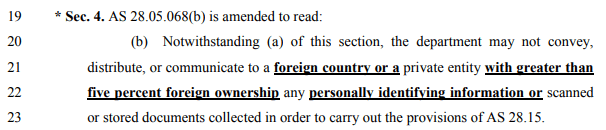
But as long as I was reading the text of the bill, I thought I’d see what else it proposed to change, and ran across this text in Section 4.

Now THAT caught my eye. (Alaska Statutes Chapter 15 is the portion of the statutes that governs driver’s licenses in general, so this clause affects EVERYTHING.)

If your company is 94% U.S.-owned, that’s not good enough in Alaska.

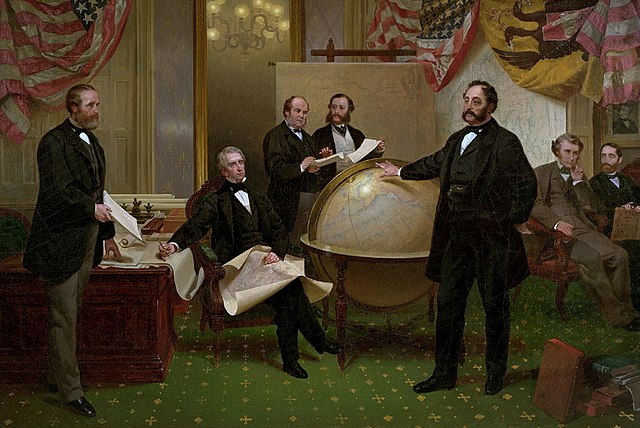
(Well, at least until Putin decides that Edouard de Stoeckl’s 1867 sale of Alaska was illegal…)

The signing of the Alaska Treaty of Cessation on March 30, 1867. Left to right: Robert S. Chew, William H. Seward, William Hunter, Mr. Bodisco, Eduard de StoecklCharles Sumner, and Frederick W. Seward. By Emanuel Leutze (d. 1868) – http://www.akhistorycourse.org/articles/article.php?artID=202, Public Domain, https://commons.wikimedia.org/w/index.php?curid=4246381

Most if not all U.S. state agencies do not produce driver’s licenses themselves, but instead contract with private companies to do the work. These private companies either produce the licenses at state agency offices, or produce them as a service (DLaaS) at a secure production center (which may produce licenses for multiple states). To my knowledge, all of the production centers for U.S. driver’s licenses are located within the United States.

But who are the “private entities” that provide driver’s license manufacturing services? Let’s look at the major ones and see if they’re affected by Section 4 of the draft of Alaska HB389.

IDEMIA

It is a matter of public record that the majority of U.S. states use IDEMIA to produce their driver’s licenses, either within agency offices or in secure IDEMIA production centers. When I was an employee of IDEMIA, I did not have the necessary security clearance to enter any of these production centers. Employees should only have the security permissions that they need, and my job had no need for me to access the PII of IDEMIA’s driver’s license customers, or to enter the facilities in which these secure documents are manufactured. There are security requirements governing this.

…our state-of-the-art central issuance facilities…are highly secure and meet North American Security Products Organization (NASPO) Level I security requirements. 

From https://na.idemia.com/dmv/physical-drivers-licenses-and-id-cards/

We’ll return to NASPO later in this post.

As I’ve noted before, IDEMIA is (currently) majority owned by Advent International, a U.S. based investment firm. IDEMIA entered the U.S. driver’s license market by acquiring Morpho (French), which had previously acquired MorphoTrust/L-1 Identity Solutions (U.S.), which had previously acquired Digimarc’s ID Systems business (also U.S.).

And, as I’ve noted, Advent International will probably choose to sell IDEMIA at some point in the future.

However, Advent International is not the exclusive owner of IDEMIA, because part of the company is owned by Bpifrance, which is (drumroll) French.

Alaska’s HB389, if passed in its original form, would prohibit the state from “communicating” personally identifying information (PII) to a private entity with more than five percent foreign ownership. I do not know the percentage that Bpifrance owns (all of the press releases failed to include that little tidbit), so I don’t know if IDEMIA would run afoul of the law or not.

HB389, if unmodified, is just one thing that any company that purchases IDEMIA must keep in mind.

IDEMIA doesn’t produce Alaska driver’s licenses. Who does?

But that doesn’t matter, because IDEMIA isn’t the Alaska driver’s license vendor anyway. That contract is controlled by another company.

Austin, TX – October 31, 2018 – Gemalto (Euronext NL0000400653 GTO),  and Alaska’s Division of Motor Vehicles will continue their work of providing credentials to citizens with the additional goal of helping the state become Real ID compliant by increasing security of the state’s driver’s license and identification cards.

From https://www.thalesgroup.com/en/markets/digital-identity-and-security/government/press-release/alaska-extends-contract-with-gemalto-to-enhance-drivers-license-security

Gemalto (a Dutch company) was subsequently acquired by Thales, which is a French company. Gemalto entered the U.S. driver’s license market when it acquired Marquis ID Systems.

Now I do not know the details of Alaska’s contract with Thales, but it stands to reason that if Thales is “providing credentials to citizens” (implying a service bureau relationship), then at some point the state is going to have to “convey, distribute, or communicate” PII to Thales.

Other vendors

But don’t worry. IDEMIA and Thales are not the only driver’s license manufacturers out there, so you don’t have to worry about foreigners getting your data. Just select an American company!

For example, Veridos can provide driver’s licenses. Veridos is a joint venture between Giesecke+Devrient and Bundesdruckerei…whoops, that’s not a U.S. company.

And there’s another driver’s license manufacturer out there. It’s called…Canadian Bank Note.

There’s also Valid, which is…Brazilian.

Let’s look at NASPO

Despite the fact that these entities are foreign-owned, all of them (either on their own, or through parents or acquired companies) are members of NASPO, and many of them have NASPO certification.

So what?

NASPO international was formed as the North American Security Products Organization.  The non-profit organization was founded in 2002 by companies and individuals in industry that recognized the need for security focused standards to prevent fraudulent acts that support criminal and terrorist activity….

NASPO INTERNATIONAL was formed to combat the ever increasing amount of fraud within the areas of brand protection, document security, and identity.  Our focus is to produce credible, structured, and, when appropriate, certifiable standards.  NASPO INTERNATIONAL has created a risk reduction standard and auditing process to certify security focused organizations.  This structure also provides the end user with the ability to create a secure supply chain from supplier to end users.

From https://naspo.info/about-us/faq/

From my point of view, NASPO tries to achieve what HB389 clumsily tries to achieve by its “minimal foreign ownership” clause. 100% U.S. ownership does not guarantee the security of your data, and 94% U.S. ownership does not guarantee that your data will wind up in a foreign capital.

So what happens next?

I have no idea whether HB389 will get passed, but unless it is substantially amended, Alaskans can still get REAL ID driver’s licenses so that they can board planes, enter secure federal facilities, and the like without getting a passport or other authorized document.

But I’m not sure what’s going to happen regarding the foreign ownership clause. Maybe people at some of the firms listed above are already looking into this.

But if my assumptions on HB389 are correct, and it passes with Section 4 intact, perhaps Alaska may not be able to rely on a private entity to provide driver’s licenses as a service (DLaaS). In that case, the state will have to produce its own driver’s licenses, free from foreign influence.

A view of 9/11 from the 9/11 Commission’s border counsel

There are different ways to look at 9/11. I’m familiar with the reconstructions of Vice President Cheney’s actions in Washington on that day, and of President Bush as he flew around the country on that day (the only plane in the sky).

But what about the activities of the hijackers on that day, and in the months preceding that day?

All of this was examined by the 9/11 Commission. As a result of its investigation, this body made significant recommendations, some of which have only taken nearly two decades to implement, assuming they ARE implemented as (re) scheduled.

By Cleanup by Andrew_pmk (talk · contribs); straightened and cropped by Holek (talk · contribs) – http://www.9-11commission.gov/press/911report_cover_HIGHRES.jpg, Public Domain, https://commons.wikimedia.org/w/index.php?curid=2376314

Janice Kephart was border counsel to the 9/11 Commission, and has been involved in homeland security ever since that time. She is currently CEO and Owner of Identity Strategy Partners.

As the 20th anniversary of 9/11 approaches, Kephart has released a documentary. As she explains, the documentary contains a wealth of information from the 9/11 Commission’s investigation of the hijackers, much of which was never officially released. Her hope:

If we are never to forget, we must educate. That is the purpose of this documentary. It is history, it is legacy, from the person who knows the details of the hijacker’s border story and has continued to live it for the past 20 years. I hope it resonates and educates.

When listening to Kephart’s documentary, keep in mind how much our world has changed since 9/11. Yes, you went through a security screening before you boarded a plane, but it was nothing like the security screenings that we’ve gotten used to in the last 20 years. Before 9/11, you could walk all the way up to the gate to send off departing passengers or greet arriving ones. And identity documents were not usually cross-checked against biometric databases to make sure that applicants were telling the truth.

I personally was not as familiar with the stories of the hijackers as I was with the stories of Bush and Cheney. The documentary provides a wealth of detail on the hijackers. (Helpful hint: don’t be afraid to pause the video when necessary. There’s a lot of visual information to absorb.)

Toward the end of the documentary, Kephart concentrates on Mohamed Atta’s return to the U.S. in January 2001, when his tourist visa had already expired and his student visa application was still pending. Kephart notes that Atta shouldn’t have been allowed back into the country, but that he was let in anyway. The details regarding Atta’s January 2001 entry are discussed in detail in a separate report (see section III.B).

(Incidentally, Atta’s student visa application wasn’t approved until July 2001, and his flight school wasn’t notified until 2002.)

Kephart wonders what might have happened if Mohamed Atta had been denied re-entry into the United States in January 2001 because of the visa irregularities. Since Atta was the ringleader and the driving force behind the attack, would the denial of entry have delayed or even terminated the 9/11 attack plans?

If you want to view the documentary, it is hosted on YouTube.

In this post, “NGI” stands for Non-Governmental Identity

I admit to my biases.

As a former long-time employee of a company that provides finger and face technology for the Federal Bureau of Investigation’s Next Generation Identification (NGI) system, as well as driver’s license and passport technology in the United States and other countries, I am reflexively accustomed to thinking of a proven identity in governmental terms.

Because the government is always here to help.

From World War II. By Packer, poster artist, Artist (NARA record: 8467744) – U.S. National Archives and Records Administration, Public Domain, https://commons.wikimedia.org/w/index.php?curid=16929857

What this means in practice is that whenever I see a discussion of a proven identity, I reflexively assume that the identity was proven through means of some type of governmental action.

  • Perhaps the identity was tied to a driver’s license identity maintained by a state agency (and checked against other states via AAMVA’s “State to State” to ensure that there are no duplicate identities).
  • Or perhaps the identity was proven via the use of a database maintained by a government agency, such as the aforementioned NGI or perhaps a database such as the CODIS DNA database.

However, I constantly have to remind myself that not everyone thinks as I do, and that for some people an identity proven by governmental means is the worst possible scenario.

Use of DNA for humanitarian efforts

Take an example that I recently tweeted about.

I recently read an article from Thermo Fisher Scientific, which among other things provides a slew of DNA instruments, software, and services for both traditional DNA and rapid DNA.

One of the applications of DNA is to prove family relationships for migrants, especially after families were separated after border crossings. This can be done in a positive sense (to prove that a separated parent and child ARE related) or in a negative sense (to prove that a claimed parent and child are NOT related). However, as was noted in a webinar I once attended, DNA is unable to provide any verification of legitimate adoptions.

By Nofx221984 – Own work, Public Domain, https://commons.wikimedia.org/w/index.php?curid=7429871

Regardless of the purpose of using DNA for migrants, there is a certain level of distrust among the migrants when the government says (presumably in Spanish), “We’re the government. We’re here to help.” You don’t have to be a rabid conspiracy theorist to realize that once DNA data is captured, there is no technical way to prevent the data from being shared with every other government agency. Certain agencies can establish business rules to prevent such sharing, but those business rules can include wide exceptions or the rules can be ignored entirely.

Therefore, Thermo Fisher Scientific decided to discuss humanitarian DNA databases.

As a result of migration, human trafficking and war, humanitarian databases are a relatively new concept and are often completely separate from criminal databases. Research has shown that family members may distrust government databases and be reluctant to report the missing and provide reference samples (1). Humanitarian databases are repositories of DNA profiles from reported missing persons, relative reference samples, and unknown human remains and may be managed by non-governmental organizations (NGOs), though in some instances they may be managed by a governmental institution but kept separate from criminal databases. Examples of humanitarian databases can be found in the United States (NamUsUniversity of North Texas HDID), Canada (Royal Canadian Mounted Police), Australia (National DNA Program for unidentified and missing persons) and internationally via the International Commission on Missing Persons (ICMP).

As you can see from the list, some of these databases ARE managed by government police agencies such as the RCMP. But others are not. The hope, of course, is that migrants would be willing to approach the humanitarian folks precisely BECAUSE they are not the police. Reluctance to approach ANY agency may be dampened by a desire to be reunited with a missing child.

And these non-governmental efforts can work. The Colibri Center claims to have performed 142 identifications that would not have been made otherwise.

Reluctance to set national standards for mobile driver’s licenses

Because of my (biased) outlook, mobile driver’s licenses and other applications of government-proven digital identity seem like a wonderful thing. The example that I often bore you with is the example of buying a drink at a bar. If someone does this with a traditional driver’s license, the bartender not only learns the drinker’s birthdate, but also his/her address, (claimed) height and weight, and other material irrelevant to the “can the person buy a drink?” question. With a mobile driver’s license, the bartender doesn’t even learn the person’s birthdate; the bartender only learns the one important fact that the drinker is over 21 years of age.

Some people are not especially wowed with this use case.

The DHS Request for Comment has finally closed, and among the submissions is a joint response from the American Civil Liberties Union, Electronic Frontier Foundation (EFF), & Electronic Privacy Information Center (EPIC). The joint response not only warns about potential misuse of government digital identities, but also questions the rush of establishing them in the first place.

We believe that it is premature to adopt industry standards at this time as no set of standards has been completed that fully takes advantage of existing privacy-preserving techniques. In recent decades we have seen the emergence of an entire identity community that has been working on the problems of online identity and authorization. Some within the identity community have embraced centralized and/or proprietary systems…

You can imagine how the ACLU, EFF, and EPIC feel about required government-managed digital identities.

Is a Non-Governmental Identity (NGI) feasible and reliable?

Let’s return to the ACLU/EFF/EPIC response to the DHS Request for Comment, which mentions an alternative to centralized, proprietary maintenance of digital identities. This is the alternative that I’m referring to as NGI just to cause MAC (massive acronym confusion).

…others are animated by a vision of “self-sovereign
identity” that is decentralized, open source, privacy-preserving, and empowering of individuals. That movement has created a number of proposed systems, including an open standard created by the World Wide Web Consortium (W3C) called Verifiable Credentials (VCs)….

DHS should refuse to recognize IDs presented within centralized identity systems. If a standard digital identity system is to be accepted by the federal government, it must be created in an open, transparent manner, with the input of multiple stakeholders, and based upon the self-sovereign identity concept. Such a system can then be used by federal government agencies to view identity credentials issued by state departments of motor vehicles (DMVs) where doing so makes sense. If standards based on self-sovereign identity are not considered mature enough for adoption, efforts should be directed at rectifying that rather than at adopting other systems that raise privacy, security, and autonomy risks.

For all practical purposes, the chances of the ACLU/EFF/EPIC convincing the Department of Homeland Security to reject government-proven identities are approximately zero. And since DHS controls airport access, you probably won’t see an airport security agent asking for your Verifiable Credentials any time soon. Self sovereign identities are just as attractive to government officials as sovereign citizens.

Who issues Verifiable Credentials?

As ACLU/EFF/EPIC noted, Verifiable Credentials are still under development, just as the centralized system standards are still under development. But enough advances have been made so that we have somewhat of an idea what they will look like. As Evernym notes, there is a trusted triangle of major players in the Verifiable Credentials ecosystem:

There are a number of directions in which we can go here, but for the moment I’m going to concentrate on the Issuer.

In the current centralized model being pursued in the United States, the issuers are state driver’s license agencies that have “voluntarily” consented to agree to REAL ID requirements. Several states have issued digital versions of their driver’s licenses which are recognized for various purposes at the state level, but are not yet recognized at the federal level. (The purpose of the DHS Request for Comment was to solicit thoughts on federal adoption of digital identities. Or, in the case of some respondents, federal NON-adoption of digital identities.)

Note that in the Verified Credentials model, the Issuer can be ANYBODY who has the need to issue some type of credential. Microsoft describes an example in which an educational institution is an Issuer that represents that a student completed particular courses.

Without going into detail, the triangle of trust between Issuers, Verifiers, and Holders is intended to ensure that a person is who they say they are. And to the delight of the ACLU et al, this is performed via Decentralized Identifiers (DIDs), rather than by centralized management by the FBI or the CIA, the BBC, B. B. King, Doris Day, or Matt Busby. (Dig it.)

But NGIs are not a cure-all

Despite the fact that they are not controlled by governments, and despite that fact that users (at least theoretically) control their own identities, no one should think that digital identities are the solution to all world problems…even when magic paradigm-shifting words like “blockchain” and “passwordless” are attached to them.

Here’s what McKinsey has said:

…even when digital ID is used with good intent, risks of two sorts must be addressed. First, digital ID is inherently exposed to risks already present in other digital technologies with large-scale population-level usage. Indeed, the connectivity and information sharing that create the value of digital ID also contribute to potential dangers. Whether it is data breaches and cyber-intrusions, failure of technical systems, or concerns over the control and misuse of personal data, policy makers around the world today are grappling with a host of potential new dangers related to the digital ecosystem.

Second, some risks associated with conventional ID programs also pertain in some measure to digital ID. They include human execution error, unauthorized credential use, and the exclusion of individuals. In addition, some risks associated with conventional IDs may manifest in new ways as individuals newly use digital interfaces. Digital ID could meaningfully reduce many such risks by minimizing opportunity for manual error or breaches of conduct.

In addition, many of these digital identity initiatives are being pursued by large firms such as IBM and Microsoft. While one hopes that these systems will be interoperable, there is always the danger that the separate digital identity systems from major firms such as IBM and Microsoft may NOT be interoperable, in the same way that the FBI and DHS biometric systems could NOT talk to each other for several years AFTER 9/11.

And it’s not only the large companies that are playing in the market. Shortly after I started writing this post, I ran across this LinkedIn article from the Chief Marketing Officer at 1Kosmos. The CMO makes this statement in passing:

At 1Kosmos, we’ve taken our FIDO2 certified platform one step further with a distributed identity based on W3C DID standards. This removes central administration of the database via a distributed ledger for true “privacy by design,” putting users in sole access and control of their identity.

1Kosmos, IBM, and Microsoft know what they’re talking about here. But sadly, some people only think these technologies are “cool” because they’re perceived as anti-government and anti-establishment. (As if these companies are going to call for the downfall of capitalism.)

Which identiy(ies) will prevail?

Back to governmental recognition of NGI.

Don’t count on it.

Anticipated DHS endorsement of government-issued digital identities doesn’t mean that NGI is dead forever, since private companies can adopt (and have adopted) any identity system that they wish.

So in truth we will probably end up with a number of digital identities like we have today (I, for example, have my WordPress identities, my Google identities, and countless others). The difference, of course, is that the new identities will be considered robust – or won’t be, when centralized identity proponents denigrate decentralized identities and vice versa.

But frankly, I’m still not sure that I want Facebook to know how much I weigh.

(Although, now that I think about it, Apple already knows.)

The ITIF, digital identity, and federalism

I just read an editorial by Daniel Castro, the vice president of the Information Technology and Innovation Foundation (ITIF) and director of the Center for Data Innovation. The opinion piece, published in Government Technology, is entitled “Absent Federal IDs, Digital Driver’s Licenses a Good Start.”

You knew I was going to comment on this one.

Why Daniel Castro supports a national digital ID

Let me allow Castro to state his case.

After Castro identifies the various ways in which people prove identity online, and the drawbacks of these methods, here’s what Castro says about the problem that needs to be addressed:

…poor identity verification is one of the reasons that identity theft is such a growing problem as more services move online. The Federal Trade Commission received 1.4 million reports of identity theft last year, double the number in 2019, with one security research firm estimating $56 billion in losses.

Castro then goes on to state his ideal solution:

The best solution to this problem would be for the federal government to develop an interoperable framework for securely issuing and validating electronic IDs and then direct a federal agency to start issuing these electronic IDs upon request. 

Castro then notes that the federal government has NOT done this:

But in the absence of federal action, a number of states have already begun this work on their own by creating digital driver’s licenses that provide a secure digital alternative to a physical identity document.

Feel free to read the rest of the story.

“Page two.” By Shealah Craighead – The original was formerly from here and is now archived at georgewbush-whitehouse.archives.gov., Public Domain, https://commons.wikimedia.org/w/index.php?curid=943922

But for me I’m going to stop right there.

Why Americans oppose mandatory national physical and digital IDs

Castro’s proposal, while ideal from a technological standpoint, doesn’t fully account for the realities of American politics.

Many Americans (regardless of political leanings) are strongly opposed to ANY mandatory national ID system. For example, many Americans don’t want our Social Security Numbers to become mandatory national IDs (even though they are de facto national IDs today). And while the federal government does issue passports, it isn’t mandatory that people GET them.

And many Americans don’t want state driver’s licenses to become mandatory national IDs. I went into this whole issue in great detail in my prior post “How 6 CFR 37 (REAL IDs) exhibits…federalism,” which made the following points:

  1. States are NOT mandated to issue REAL IDs. (And, no citizen is mandated to GET a REAL ID.)
  2. The federal government CAN mandate which IDs are accepted for federal purposes.
  3. Because the federal government can mandate the IDs to use when entering a federal facility or flying at a commercial airport, ALL of the states were eventually “persuaded” to issue REAL IDs. (Of course, it has take nearly two decades, so far, for that persuasion to work, and it won’t work until 2023, or later.)

So, considering all of the background regarding the difficulties in mandating a national PHYSICAL ID, imagine how things would erupt if the federal government mandated a national DIGITAL ID.

It wouldn’t…um…fly.

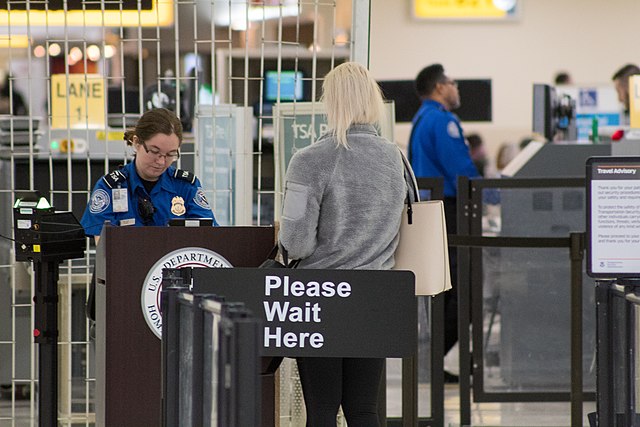
Transportation Security Administration Checkpoint at John Glenn Columbus International Airport. By Michael Ball – Own work, CC0, https://commons.wikimedia.org/w/index.php?curid=77279000

And this is why some states are moving ahead on their own with mobile driver’s licenses.

LA Wallet Louisiana Digital Driver’s License. lawallet.com.

However, there’s a teeny tiny catch: while the states can choose to mandate that their mDLs be accepted at the STATE level, states cannot mandate that their digital identities be used for FEDERAL purposes.

Here we go again.

Of course, federal government agencies are starting to look at the issues with a mobile version of a “REAL ID,” including the standard(s) to which any mobile ID used for federal purposes must adhere.

Improving Digital Identity Act of 2020, or 2021, or 2025…

While the government agencies are doing this work, another government agency (the U.S. Congress) is also working on this. Castro mentions Rep. Bill Foster’s H.R. 8215, introduced in the last Congress. I’m not sure why he bothered to introduce it in September 2020, when Congress wasn’t going to do anything with it. As you may have heard, we had an election at that time.

Of course, he just reintroduced it last month, so now there’s more of a chance that it will be considered. Or maybe not.

Regardless, the “Improving Digital Identity Act” proposes the creation of a task force at the federal level with federal, state participants, and local participants. It also mandates that NIST create a digital identity “framework,” with an interim version available 240 days after the Act is passed. Among other things, the ACT also mandates that NIST Special Publication 800-63 become “binding operational directives” for federal agencies.

(Does that mean that it will be illegal to mandate password changes every 90 days? Woo hoo!)

Should this Act actually pass at some point, its directives will need to be harmonized with what the Department of Homeland Security is already doing, and of course with what the states are already doing.

Oh, and remember my reference to the DHS’ work in this area? Among those who have submitted verbal and/or written comments, several (primarily from privacy organizations) have stated that the government should NOT be promoting ANY digital ID at all. The sentiments in this written comment, submitted anonymously, are all too common.

There are a lot of security and privacy concerns with accepting digital ID’s. First and foremost, drivers licenses contain a lot of sensitive information. If digital ID’s are accepted, then it could potentially leak that info to hackers if it is not secured properly. Plus, there is the added concern that using digital ID’s will lead to extra surveillance where unnecesary. Finally, digital ID will not allow individuals who are poorer to be abele to submit an ID because they might not have access to the same facilities. I am strongly against this rule and I do NOT think that digital ID should be an option.

I expect other privacy organizations to submit comments that may be better-written, but they echo the same sentiment.

Are unified digital IDs a thing?

I’ve been busy helping a client who needed summer fill-in help, but I’m finally making the time to catch up on my reading. And this article from Government Technology was on my reading list.

When I read the title “Mobile Driver’s Licenses Pave the Way for Unified Digital IDs,” I was intrigued by the last three words. I mean, there are more and more states releasing (non-pilot) mobile driver’s licenses, and the standard is coming along, and work is being done to prepare for federal acceptance.

But what about the “unified” part? How did David Raths address that?

Government uses of digital ID

Well, he listened to Eric Jorgensen, director of Arizona’s Department of Transportation.

“I actually hate the term ‘mDL’ because it doesn’t recognize the power of what we’re doing here….The whole concept is that we’re providing a way to remotely authenticate a person, to provide a trusted digital identity that doesn’t exist today. Once we provide that, we’re opening doors to enhanced government services. Also, the government can play a key role in facilitating commerce, providing a better citizen experience and providing for the security of that citizen — that goes way beyond what a driver’s license is about.”

Although all that Jorgensen is discussing is providing a trusted digital identity that is equivalent to a trusted physical identity. If you have to show your driver’s license when visiting a government office’s physical location, conceivably you can show your digital driver’s license when visiting a government office’s website.

Enterprise uses of digital ID

And there are applications beyond government. Delaware and other states are persuading private businesses to accept mobile driver’s licenses as valid forms of identification. There’s a powerful use case for age-restricted products, of course; since all that an alcohol-selling business needs to know is whether you are over the age of 21, the mobile driver’s license ONLY shows that you are over the age of 21. It doesn’t show your address, your weight, or even your birthdate.

But what about a true UNIFIED digital ID?

However, I semantically question whether this is truly a “unified” ID. This is just digitization of an existing government-endorsed ID. A “unified” ID would be one that would not only let me drive, vote, and buy alcohol, but would also serve as my ID to log into Facebook or buy Bitcoin. (Yes, I realize that use of a government ID to buy Bitcoin violates the space-time continuum in some way.)

And for that to happen, work may need to be done to make mobile IDs compatible with existing authentication/authorization methods such as OAuth and OpenID Connect.

And the whole “but what if I don’t have a digital ID?” question must be addressed.

And the whole “but what if I want to use a self-sovereign ID that is NOT government endorsed?” question must be addressed.

And presumably a myriad of other questions would need to be addressed also.

But for me, I can’t address unified digital IDs today. Just got a message from my summer-challenged client…

How 6 CFR 37 (REAL IDs) exhibits…federalism

The United States, like some other countries, reserves some responsibilities to lower subdivisions of the country, in this case the states. This concept is enshrined in the 10th Amendment to the Constitution:

The powers not delegated to the United States by the Constitution, nor prohibited by it to the States, are reserved to the States respectively, or to the people.

The 10th Amendment basically means that unless the Constitution explicitly speaks on a matter, the states can do whatever they want. However, the Federal government still has ways of making the states obey its will.

States are NOT mandated to issue REAL IDs

If you look at the Code of Federal Regulations, Title 6, Volume 1, Chapter I, Part 37 (one online source here), you will see the official laws that govern the issuance of REAL ID Driver’s Licenses and Identification Cards. Part 37 is divided into several subparts:

  • General.
  • Minimum Documentation, Verification, and Card Issuance Requirements.
  • Other Requirements.
  • Security at DMVs and Driver’s License and Identification Card Production Facilities.
  • Procedures for Determining State Compliance.
  • Driver’s Licenses and Identification Cards Issued Under section 202(d)(11) of the REAL ID Act.

A pretty comprehensive list here. But that very first section, “General,” begins with the following:

Subparts A through E of this part apply to States and U.S. territories that choose to issue driver’s licenses and identification cards that can be accepted by Federal agencies for official purposes.

Note the word “choose,” and the phrase “accepted by Federal agencies for official purposes.” In essence, it is incorrect to say that states are MANDATED by law to issue REAL IDs. States have the power to choose NOT to issue REAL IDs, and the Federal government has no Constitutional power to force them to do so.

So many states DIDN’T issue REAL IDs

And for many years, many states of various political persuasions adopted that view. Whether “red” or “blue,” many states held to the belief that REAL ID was an unconscionable imposition on state sovereignty, and that Bush or Obama or Trump didn’t have the power to tell states what to do with their state driver’s licenses.

I ran into this personally in my proposal work. There was a brief period of time in which MorphoTrak was bidding on driver’s license opportunities (thus competing with our sister company MorphoTrust), and I remember reviewing a Request for Proposal (RFP) issued by one of the states. I won’t reveal the state, but the opening section of its RFP made very clear that the state was NOT asking vendors to implement Federal REAL ID regulations, or asking vendors to help the state issue REAL IDs.

So some states declined to participate in REAL ID efforts for years…and years.

And the Federal government couldn’t dictate that states issue REAL IDs.

So the Federal government said that states don’t HAVE to issue REAL IDs, but…

But the Federal government COULD dictate which IDs could be “accepted by Federal agencies for official purposes.”

  • Accepted IDs included passports, Federal government-issued identification cards, various other national IDs…and REAL IDs issued by the states. Other IDs issued by the states were not acceptable.
  • Official purposes included visiting a military base (Federal control, not state control), visiting your Congressperson’s office (Federal control, not state control)…and the big one, entering the secure areas of an airport (again, Federal control, not state control).
Transportation Security Administration Checkpoint at John Glenn Columbus International Airport. By Michael Ball – Own work, CC0, https://commons.wikimedia.org/w/index.php?curid=77279000

So it’s pretty simple. If you want to get on a plane, even for a domestic flight, you have to pay $100 or so to get a passport. Well, unless your state happens to be one of the states that issues REAL IDs.

(Now large states with multiple major cities such as California and Texas could conceivably try to get around this by setting up a whole system of intrastate airports that only flew within the state, but that would be costly.)

Even with this, the REAL ID implementation date has been delayed several times (most recently due to COVID), but as of today, all 50 states and most U.S. territories are finally issuing REAL IDs, including the unnamed state (and others) that refused to even consider issuing REAL IDs a decade ago.

And that, my friends, is how the Federal government gets what it wants.

DHS TSA mDL Public Meeting general observations

As I previously noted, today (June 30, 2021) was the day for the Department of Homeland Security’s Transportation Security Administration to hold its public meeting on its Request for Comment on “Minimum Standards for Driver’s Licenses and Identification Cards Acceptable by Federal Agencies for Official Purposes; Mobile Driver’s Licenses.” (See PDF or text version. The second link contains the method for providing comments.)

I will not provide a recap of the comments made by participants during the meeting, but will instead provide some general observations.

Incidentally, the list of all meeting participants will be made public at some point, and it’s possible that the chat transcript from the meeting will also be made public at some point.

Agreement and disagreement among the participants

As can be expected, there were a variety of views expressed at the meeting, ranging from industry comments about the items that should be in the DHS standard, to privacy advocates who questioned why DHS was implementing a standard at all. One example:

  • Industry participants, such as myself, were enthusiastic about the ability of a mobile driver’s license (mDL) to automatically update itself when new information became available at the DMV. For example, if I move to a new address, the DMV can automatically update the mDL on my smartphone to reflect the new address.
  • Privacy participants were, to put it mildly, a bit less enthusiastic about this feature. Physical driver’s licenses are updated as infrequently as every ten years; why should digital driver’s licenses be any different?

But there was apparent agreement between the industry and privacy participants about one possible feature on mDLs – the ability to control the data that leaves the smartphone and is sent to the verifying official. Everyone seemed to agree that this information should be granular, and that the mDL should not automatically send ALL available information on the mDL.

Let me provide an example. When I go to a bar and use my physical driver’s license to prove my age, the verifier (Jane Bartender) is provided access to my name, my address, my date of birth, my height, my (claimed) weight, and all sorts of personal information that would freak out your average privacy advocate. NONE of this information is needed to prove my age, not even my date of birth. All that the verifier needs to know is whether I am over the age of 21. An mDL can be designed to specifically state ONLY that I am over the age of 21 without revealing my birthdate, my address, or my (claimed) weight.

(You’d think that the privacy advocates would be thrilled about this granularity and would urge people to use mDLs because of this privacy benefit, but privacy and security folks are naturally suspicious and have a hunch that all of the information is being provided in the background anyway through double-secret means.)

But are the participants ready to respond to the RFC?

I had one other observation from the meeting. Before sharing it, I should explain that the meeting allowed the participants to ORALLY share the views that they will subsequently express in WRITTEN comments on or before the July 30 deadline.

And based upon the oral comments that I heard, some of the participants are ready to share their written comments…and others are not.

There were participants who spoke to the DHS about their items of interest, not only briefly stating these items, but WHY these items should be important to the DHS and to the general public.

And then there were participants who concentrated on unimportant details that were NOT of interest to the DHS or the general public. I won’t provide specific examples, but let’s just say that some participants talked about themselves rather than about DHS’ needs.

If these participants’ written comments are of the same tone as their oral comments, I can assure you that their comments will not influence the DHS in any way. Although I guess they can go back to their organizations and proudly proclaim, “We told the DHS how important we are!”

The DHS doesn’t care how important you are. In the DHS’ mind, you are not important. Only the DHS is important. (Oh, and the Congresspeople who fund the DHS are important, I guess.)

Perhaps in the next 30 days these other participants will take a look back at their message drafts and ask themselves the “So what?” question. What will motivate the DHS to incorporate desired features into the standard? And why should they?

And, as always, I can help. If nothing else, I can confidentially review your draft comments before submission and provide some suggestions. (Yes, it’s shameless plug time.)

If I can help you with your RFC response:

Or perhaps you are ready to respond now. I guess we’ll all find out when the DHS publishes its final standards, which may or may not reflect your priorities.

The DHS RFI “Minimum Standards for Driver’s Licenses and Identification Cards Acceptable by Federal Agencies for Official Purposes; Mobile Driver’s Licenses” is NOT due on June 18 (it’s now due July 30)

Back in April I wrote about a Request for Information that was issued by the Department of Homeland Security. Its title: “Minimum Standards for Driver’s Licenses and Identification Cards Acceptable by Federal Agencies for Official Purposes; Mobile Driver’s Licenses.”

The information was due to DHS on June 18 (tomorrow), and my post included a “shameless plug” offering to help companies with their responses.

No company requested my assistance.

But all is not lost, because you can STILL request Bredemarket’s assistance in composing your responses, because, according to Jason Lim, the due date has been extended.

DHS will hold a virtual public meeting on June 30, 2021 on mDL REAL ID RFI to answer questions regarding the RFI and to provide an additional forum for comments by stakeholders and other interested persons regarding the issues identified in the RFI.

DHS is also extending the comment period for the RFI by 42 calendar days to provide an additional period for comments to be submitted after the public meeting. New deadline is July 30, 2021.

If you want to register for the public meeting, click on the link at the bottom of Jason Lim’s LinkedIn post. I’ve already registered myself (the meeting starts at 7:00 am PDT, but at least I don’t have to commute to go to the meeting).

And the shameless plug still applies: if you need assistance in managing, organizing, writing, or checking your response, contact me (email, phone message, online form, appointment for a content needs assessment, even snail mail). As some of you already know, I have extensive experience in responding to RFIs, RFPs, and similar documents, and have been helping multiple companies with such responses under my Bredemarket consultancy.