Modernization, Digital Transformation, and Other Multisyllabic Words: Why?

Back when I was with IDEMIA and working with U.S. states to implement (physical) driver’s license production systems, a big word floating around states and their CIOs was “modernization.”

Because many state and federal systems are really really ancient.

But it’s not just governments that have fallen off the path. Many business and government entities, possibly including your own, are in desperate need of modernization, or at least of digital transformation.

Four reasons for digital transformation

Why do you need digital transformation? Here are four reasons why you should transform:

  • Are you suffering from outmoded manual processes? Do your business processes require a lot of outmoded manual steps? Are there steps that you can automate?
  • Are you unable to change your business as the market changes? Is your website and other systems locked into a 2015 or 2005 process? If the market changed tomorrow, how long would it take you to change with it? Could you business benefit from a flexible modular implementation that allows rapid change?
  • Are you blind to your business operations? Can you gather metrics that help you know how your business is doing? For marketers, these could be key process indicators (KPIs) that alert you as prospects move from awareness to consideration to conversion. For operations personnel, these could be performance metrics. But you’re flying blind if you can’t get those metrics, or if you’re getting the wrong metrics.
  • Are your customers unhappy? This is probably the biggest reason of all. Do your current systems frustrate your customers? For businesses (i.e. firms where customers do not have to content with a government monopoly), are your customers about to flee elsewhere?
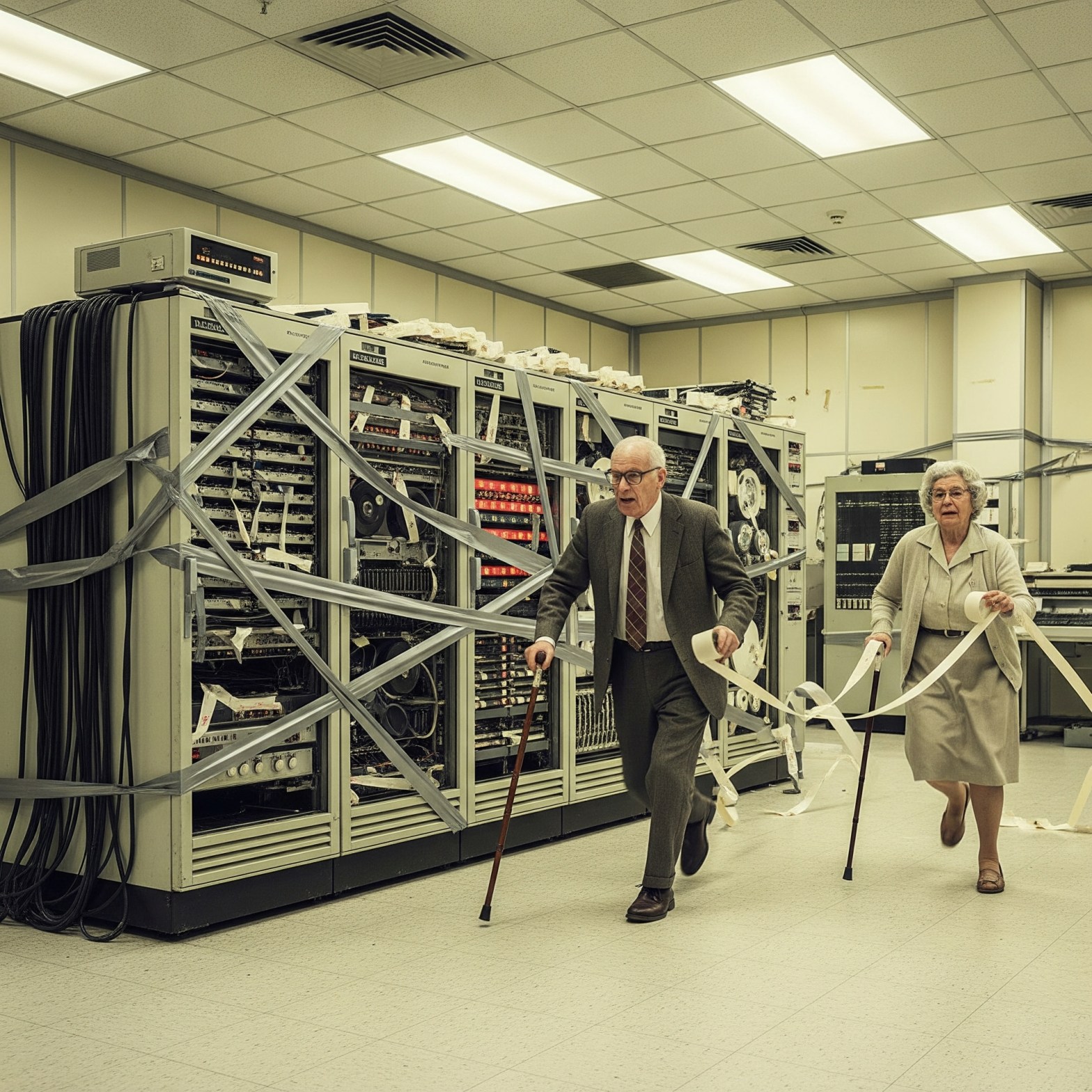
The need for modernization. Imagen 4.

Yes, you have to perform a cost-benefit analysis, but in many cases you’ll realize future revenue by transforming your digital system and removing inefficiencies.

Two digital transformation experts

There are a number of consulting firms that can help you digitally transform your systems. Bredemarket is NOT one of them (although I can help you transform your marketing).

But it doesn’t matter with me now, because this post is going to highlight two other firms that can help you perform digital transformation: one very specific, and one that is general.

Adobe Experience Cloud Digital Transformation: KBWEB Consult

If you have a mid-sized business and need to digitally transform your Adobe Experience Manager implementation, or other parts of your Adobe Experience Cloud solution, KBWEB Consult is the firm to help you. KBWEB Consult and its people have transformed digital solutions for Kaiser Permanente, LinkedIn, Shimano, and other firms.

Book a meeting with KBWEB Consult directly at CEO Krassimir Boyanov’s Calendly calendar page.

General Digital Transformation: Silicon Tech Solutions

If you have wider digital transformation needs, talk to Silicon Tech Solutions. Offering custom software development and other services in addition to digital transformation, Silicon Tech Solutions addresses multiple needs for small and mid-size businesses. With a team that has gained experience from employment at Amazon and Facebook and from multiple consulting projects, Silicon Tech Solutions is ready to help your firm.

Get more information from Silicon Tech Solutions by contacting them via Bredemarket at my Silicon Tech Solutions page and clicking on the Silicon Tech Solutions logo.

The Return on Investment (ROI) of Digital Asset Management (DAM)

(Imagen 4)

I recently downloaded an ebook from Canto entitled “The ROI of DAM: How to Prove the Business Value of Digital Asset Management.” If you would like to download it also, visit this page.

Why do you need to manage digital assets? Because if your company has thousands or millions of digital assets, individual ones will be so hard to find that you’ll start adding an “N” to the “DAM” acronym.

Canto argues that its digital asset management solution delivers positive ROI by the following:

  1. Saving time and reducing waste
  2. Accelerating speed to market and improving content quality
  3. Reducing asset production costs
  4. Boosting revenue with brand consistency
  5. Minimizing business risk

The ebook quotes some numbers: $20,000 savings here, more savings there.

Of course, Canto isn’t the only DAM in town, as my former coworker Krassimir Boyanov will not hesitate to tell you. Krassimir heads KBWEB Consult, a boutique technology firm that provides consulting services for Adobe Experience Manager users.

A wombat holding a phone displaying a digital identity, surrounded by papers with pictures of cars. Two Dolby speakers are in the back of the room.
(She’s tidied up and) I can’t find anything.

I’ve previously quoted his thoughts on a consistent taxonomy for digital assets, but Boyanov has also addressed ROI issues in KBWEB Consult’s own blog: specifically, looking at Adobe Experience Manager Assets, the DAM component of Adobe Experience Manager. Here’s part of what he said:

In July 2024, IDC examined the business value of Adobe Experience Manager (AEM) Assets. Based on interviews with AEM Assets customers, IDC concluded that the interviewed customers could realize an average annual cost saving of $9.04 million per organization. These cost savings came from multiple sources:

  • Reduced risk of using out-of-date/unapproved assets (52%)
  • Reduced risk of accidental disclosure of assets (27%)
  • Reduced spending of duplicative (62%) or unused (40%) assets
  • Reduced agency spending by completing work in-house (24%)
  • Reduced go-to-market time (55%)
  • Reduced time for content to go from creation to production (47%)
  • Reduced time for content in a new form factor (39%)
  • Reduced time to create a new digital asset (66%)
  • Reduced time to repurpose an existing digital asset (73%)
  • Reduced time to create a rendition of an asset (60%)

Those are some DAM good numbers. And KBWEB Consult (and IDC) didn’t gate them.

Tech marketers, do you have similar return on investment numbers you would like to share with your end customers? Bredemarket can help you share those numbers. Talk to me before your competitors return YOUR investment to THEM.

Tech marketers, are you afraid?

Winners and Losers, But Even Olympic Losers Can Become Winners

A single loss does not define your entire life. As the sporting world teaches us, Olympic losers and other competitive losers can become winners—if not in sports, then elsewhere.

The human drama of athletic competition

When I was young, the best variety show on television didn’t involve Bob Mackie dresses. It instead featured Jim McKay, introducing the show as follows.

Spanning the globe to bring you the constant variety of sport…the thrill of victory…and the agony of defeat…the human drama of athletic competition…This is ABC’s Wide World of Sports!

A technological marvel when originally introduced, this variety show brought sporting events to American viewers from all over the world.

And these viewers learned that in competitions, there are winners and losers.

But since Wide World of Sports focused on the immediate (well, with a bit of tape delay), viewers never learned about the losers who became winners.

By ABC Network – ebay.com, front of photo, back of photo, Public Domain, https://commons.wikimedia.org/w/index.php?curid=33302515.

Jim McKay and his colleagues were not retrospective, but were known for the moment. In one instance that was NOT on tape delay, Jim McKay spoke his most consequential words, “They’re all gone.”

Vinko Bogataj

(Note: some of this content is repurposed because repurposing is cool.)

Turning to less lethal sporting events, remember Jim McKay’s phrase “the agony of defeat”?

For American TV watchers, this phrase was personified by Vinko Bogataj.

The agony of defeat.

Hailing from a country then known as Yugoslavia (now Slovenia), Bogataj was competing in the 1970 World Ski Flying Championships in Oberstdorf, in a country then known as West Germany (now Germany). His daughter described what happened:

It was bad weather, and he had to wait around 20 minutes before he got permission to start. He remembers that he couldn’t see very good. The track was very bad, and just before he could jump, the snow or something grabbed his skis and he fell. From that moment, he doesn’t remember anything.

While Bogataj suffered a concussion and a broken ankle, the accident was captured by the Wide World of Sports film crew, and Bogataj became famous on the “capitalist” side of the Cold War.

And he had no idea.

“He didn’t have a clue he was famous,” (his daughter) Sandra said. That changed when ABC tracked him down in Slovenia and asked him to attend a ceremony in New York to celebrate the 20th anniversary of “Wide World of Sports” in 1981.

At the gala, Bogataj received the loudest ovation among a group that included some of the best-known athletes in the world. The moment became truly surreal for Bogataj when Muhammad Ali asked for his autograph.

Bogataj is now a painter, but his 1970 performance still follows him.

Over 20 years after the infamous ski jump, Terry Gannon interviewed Bogataj for ABC. As Gannon recounted it on X (then Twitter), Bogataj “got in a fender bender on the way. His first line..’every time I’m on ABC I crash.'”

Some guy at the Athens Olympics in 2004

Since the Paris Olympics is taking place as I write this, people are paying a lot of attention to present and past Olympics.

The 2004 Olympics in Athens was a notable one, taking place in the country where the original Olympics were held.

But during that year, people may have missed some of the important stories that took place. We pay attention to winners, not losers.

Take the men’s 200 meter competition. It began with 7 heats, with the top competitors from the heats advancing.

Within the 7 heats, Heat 4 was a run-of-the-mill race, with the top four sprinters advancing to the next round. If I were to read their names to you you’d probably reward me with a blank stare.

But if I were to read the 5th place finisher to you, the guy who failed to advance to the next round, you’d recognize the name.

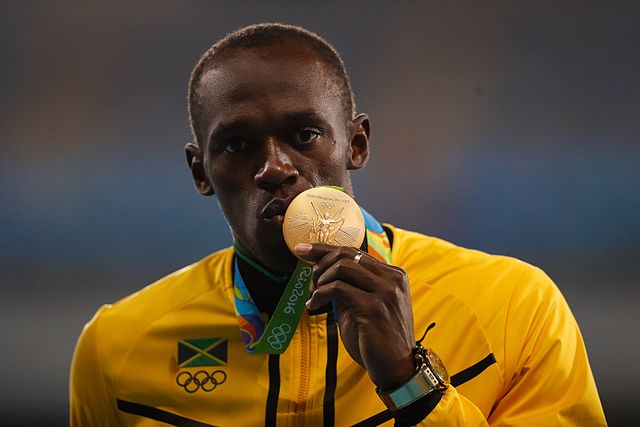
Usain Bolt.

Usain Bolt poses with his 200 m gold medal at the 2016 Summer Olympics. By Fernando Frazão/Agência Brasil – http://agenciabrasil.ebc.com.br/rio-2016/foto/2016-08/bolt-se-aposenta-com-medalha-de-ouro-no-4-x-100-metros, CC BY 3.0 br, https://commons.wikimedia.org/w/index.php?curid=50784135.

He did a little better at subsequent Olympics.

Some other guy at the Athens Olympics in 2004

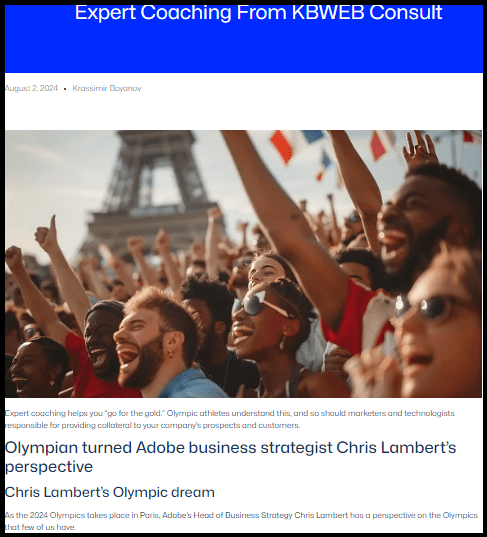
KBWEB Consult tells the story of another competitor in the same 200 meter event in Athens. Chris Lambert participated in Heat 3, but didn’t place in the first four positions and therefore didn’t advance.

Nor did he place in the fifth position like Usain Bolt did in Heat 4.

Actually, he technically didn’t place at all. His performance is marked with a “DNF,” or “did not finish.”

You see, at about the 50 meter point of the 200 meter event, Lambert pulled a hamstring.

And that ended his Olympic competition dreams forever. By the time the Olympics were held in Lambert’s home country of the United Kingdom in 2012, he was not a competitor, but a volunteer for the London Olympics.

But Lambert learned much from his competitive days, and now works for Adobe.

KBWEB Consult (who consults on Adobe Experience Manager implementations) tells the full story of Chris Lambert and what he learned in its post “Expert Coaching From KBWEB Consult.”

A final thought

I haven’t done one of these in a while, but it’s important to remember that just because you lost a particular competition doesn’t mean that all is lost. We need to remember this whether we are a 200 meter runner who didn’t advance from their heat, or whether we are a job applicant receiving yet another “we are moving in a different direction” form letter.

In the meantime, take care of yourself, and each other.

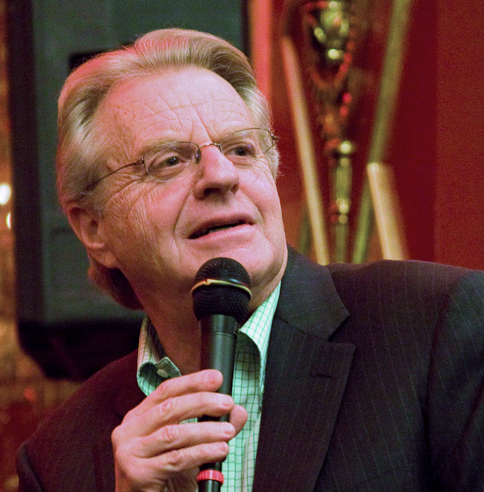
Jerry Springer. By Justin Hoch, CC BY 2.0, https://commons.wikimedia.org/w/index.php?curid=16673259.

Quick Tech Takes on Speech Neuroprosthesis, AEM Dynamic Media, and Graph Databases in IAM

Yes, I’m stealing the Biometric Update practice of combining multiple items into a single post, but this lets me take a brief break from identity (mostly) and examine three general technology stories:

  • Advances in speech neuroprosthesis (the Pat Bennett / Stanford University story).
  • The benefits of Dynamic Media for Adobe Enterprise Manager users, as described by KBWEB Consult.
  • The benefits of graph databases for Identity and Access Management (IAM) implementations, as described by IndyKite.

Speech Neuroprosthesis

First, let’s define “neuroprosthetics/neuroprosthesis”:

Neuroprosthetics “is a discipline related to neuroscience and biomedical engineering concerned with developing neural prostheses, artificial devices to replace or improve the function of an impaired nervous system.

From: Neuromodulation (Second Edition), 2018

Various news sources highlighted the story of amyotrophic lateral sclerosis (ALS) patient Pat Bennett and her somewhat-enhanced ability to formulate words, resulting from research at Stanford University.

Diagram of a human highlighting the areas affected by amyotrophic lateral sclerosis (ALS). By PaulWicks – Own work, CC BY-SA 4.0, https://commons.wikimedia.org/w/index.php?curid=130714816

Because I was curious, I sought the Nature article that discussed the research in detail, “A high-performance speech neuroprosthesis.” The article describes a proof of concept of a speech brain-computer interface (BCI).

Here we demonstrate a speech-to-text BCI that records spiking activity from intracortical microelectrode arrays. Enabled by these high-resolution recordings, our study participant—who can no longer speak intelligibly owing to amyotrophic lateral sclerosis—achieved a 9.1% word error rate on a 50-word vocabulary (2.7 times fewer errors than the previous state-of-the-art speech BCI2) and a 23.8% word error rate on a 125,000-word vocabulary (the first successful demonstration, to our knowledge, of large-vocabulary decoding). Our participant’s attempted speech was decoded  at 62 words per minute, which is 3.4 times as fast as the previous record8 and begins to approach the speed of natural conversation (160 words per minute9).

From https://www.nature.com/articles/s41586-023-06377-x

While a 125,000 word vocabulary is impressive (most adult native English speakers have a vocabulary of 20,000-35,000 words), a 76.2% accuracy rate is so-so.

Stanford Medicine published a more lay-oriented article and a video that described Bennett’s condition, and the results of the study.

For Bennett, the (ALS) deterioration began not in her spinal cord, as is typical, but in her brain stem. She can still move around, dress herself and use her fingers to type, albeit with increasing difficulty. But she can no longer use the muscles of her lips, tongue, larynx and jaws to enunciate clearly the phonemes — or units of sound, such as sh — that are the building blocks of speech….

After four months, Bennett’s attempted utterances were being converted into words on a computer screen at 62 words per minute — more than three times as fast as the previous record for BCI-assisted communication.

From https://med.stanford.edu/news/all-news/2023/08/brain-implant-speech-als.html
From https://www.youtube.com/watch?v=DaWb1ukmYHQ

The Benefits of AEM Dynamic Media

Now let’s shift to companies that need to produce marketing collateral. Bredemarket produces collateral, but not to the scale that big companies need to produce. A single company may have to produce millions of pieces of collateral, each of which is specific to a particular product, in a particular region, for a particular audience/persona. Even Bredemarket could potentially produce all sorts of content, if it weren’t so difficult to do so:

  • A YouTube description of the Bredemarket 400 Short Writing Service, targeted to fingerprint/face marketing executives in the identity industry.
  • An Instagram carousel post about the Bredemarket 400 Short Writing Service, targeted to voice sales executives in the identity industry.
  • A TikTok reel about the Bredemarket 400 Short Writing Service, targeted to marketing executives in the AI industry.

All of this specialized content, using all of these different image and video formats? I’m not gonna create all that.

But as KBWEB Consult (a boutique technology consulting firm specializing in the implementation and delivery of Adobe Enterprise Cloud technologies) points out in its article “Implementing Rapid Omnichannel Messaging with AEM Dynamic Media,” Adobe Experience Manager has tools to speed up this process and create correctly-messaged content in ALL the formats for ALL the audiences.

One of those tools is Dynamic Media.

AEM Dynamic Media accelerates omnichannel personalization, ensuring your business messages are presented quickly and in the proper formats. Starting with a master file, Dynamic Media quickly adjusts images and videos to satisfy varying asset specifications, contributing to increased content velocity.

From https://kbwebconsult.com/implementing-rapid-omnichannel-messaging-with-aem-dynamic-media/

For those who aren’t immersed in marketing talk:

The article also discusses further implementation issues that are of interest to AEM users. If you are such a user, check the article out.

Graph Databases in Identity and Access Management (IAM)

I previously said that I was MOSTLY taking a break from identity, but graph databases impact items well beyond identity.

So what is a graph database?

By Originally uploaded by Ahzf (Transferred by Obersachse) – Originally uploaded on en.wikipedia, CC0, https://commons.wikimedia.org/w/index.php?curid=19279472

A graph database, also referred to as a semantic database, is a software application designed to store, query and modify network graphs. A network graph is a visual construct that consists of nodes and edges. Each node represents an entity (such as a person) and each edge represents a connection or relationship between two nodes. 

Graph databases have been around in some variation for along time. For example, a family tree is a very simple graph database…. 

Graph databases are well-suited for analyzing interconnections…

From https://www.techtarget.com/whatis/definition/graph-database

The claim is that the interconnection analysis capabilities of graph databases are much more flexible and comprehensive than the capabilities of traditional relational databases. While graph databases are not always better than relational databases, they are better for cerrtain types of data.

To see how this applies to identity and access management (IAM), I’ll turn to IndyKite, whose Lasse Andersen recently presented on graph database use in IAM (in a webinar sponsored by Strativ Group). IndyKite describes its solution as follows (in part):

A knowledge graph that holistically captures the identities of customers and IoT devices along with the rich relationships between them

A dynamic and real-time data model that unifies disconnected identity data and business metadata into one contextualized layer

From https://www.indykite.com/identity-knowledge-graph

So what?

For example, how does such a solution benefit banking and financial services providers who wish to support financial identity?

Identity-first security to enable trusted, seamless customer experiences

From https://www.indykite.com/banking

Yes, I know that every identity company (with one exception) uses the word “trust,” and they all use the word “seamless.”

But this particular technology benefits banking customers (at least the honest ones) by using the available interconnections to provide all the essential information about the customer and the customer’s devices, in a way that does not inconvenience the customer. IndyKite claims “greater privacy and security,” along with flexibility for future expansion.

In other words, it increases velocity.

What is your technology story?

I hope you provided this quick overview of these three technology advances.

But do you have a technology story that YOU want to tell?

Perhaps Bredemarket, the technology content marketing expert, can help you select the words to tell your story. If you’re interested in talking, let me know.

Bredemarket logo