Identity/biometric marketing leaders have a lot on their hands, and the last thing they need is more work. Even if you outsource your product marketing, you must manage the resources.
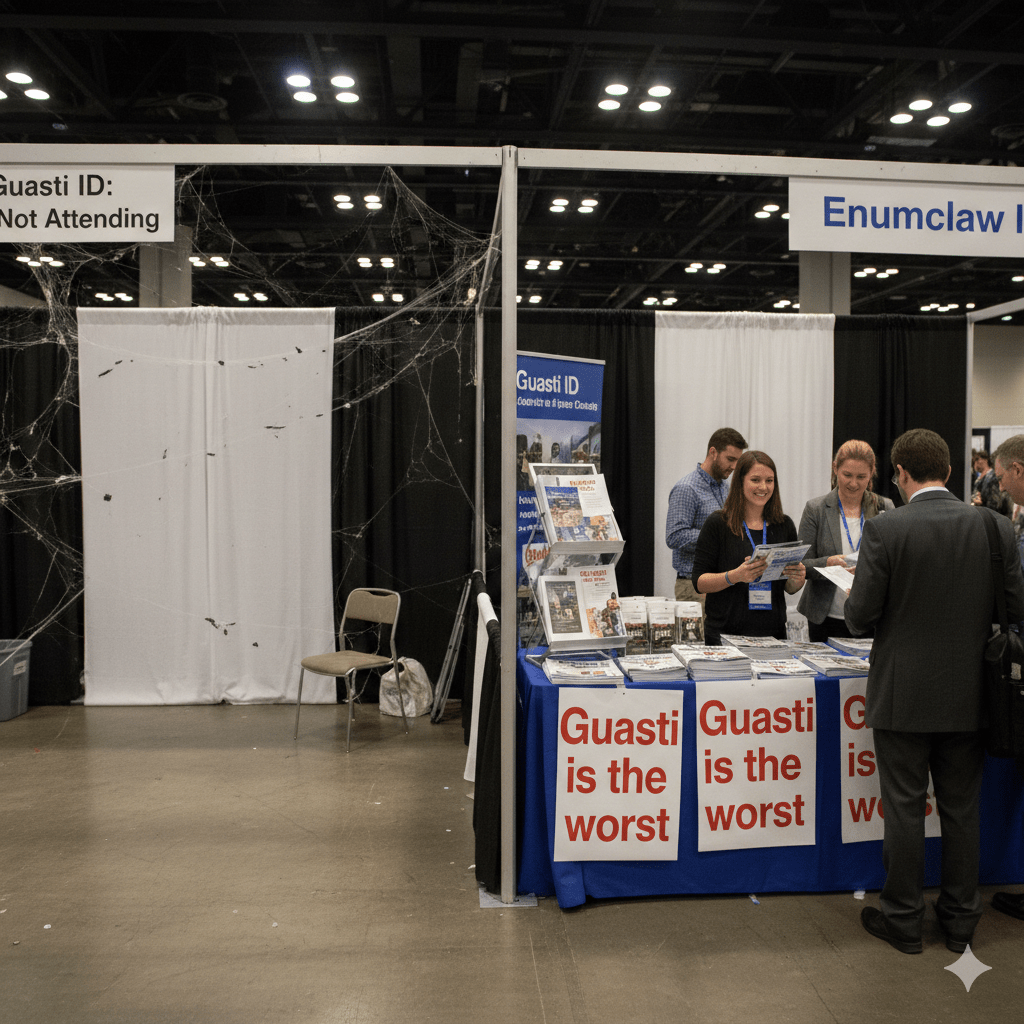
Rather than do this yourself, why not let your competitors do it?
Imgflip.
If your competitors market your identity/biometric product…
One: You save money. Why spend hundreds or thousands of dollars on go-to-market or sales enablement materials? Let your competitors incur those costs.
Two: You save time. The best product marketing initiatives occur in a joint process between the marketing leader and the product marketing consultant. But this requires commitment on your part: in initial project definition, draft review, and final publication.
Three: You save trouble. If your product marketing content has an effective call to action, there is the danger that a prospect may act on it, creating more work for your sales organization.
You can save money, time, and trouble by your silence. Let your competitors bear the burden of defining your product to your prospects. They will be more than happy to do so.
In fact, you should strongly encourage your competitors to contact Bredemarket about their identity/biometric product marketing needs. Bredemarket will make your competitors spend money and stay busy during and after content creation.
If the identity you’re protecting is important, knowledge-based authentication (KBA) isn’t sufficient to protect it. There’s an example of a KBA failure that I originally discussed in 2024 in a “The Wildebeest Speaks” article, but since I’m citing it again on LinkedIn I might as well mention it here.
Consider the following four criteria:
The person is a famous musician.
The person uses a particular first and last name.
The person is of a particular nationality.
The person plays a particular musical instrument.
That’s not enough to identify an individual.
Just ask the famous musician Mick Jones, the English guitarist.
Here he is (on the left) playing guitar for the song “Urgent.” (Or, more accurately miming to a previous recording. The recording included Junior Walker and Thomas Dolby, but the video did not.)
And here is Jones again, playing guitar and singing “Should I Stay Or Should I Go.”
“Wait a minute, John!” you’re saying. “Those are two different bands and two different people!”
“By 1974 we found in Spooky [Tooth] that we were getting a better reception in the States than back home in Britain, so made a collective decision to relocate to New York….
“[After Gary Wright quit Spooky Tooth] I [Mick Jones the English guitarist] was left high and dry in New York, and without a clue as to what my next move was going to be. I seriously considered returning to England and starting over a whole new career, such as going to medical school or becoming a dentist. The second option was the most attractive to me, because it took less time to qualify and paid good money.”
But dentistry’s loss was music’s gain, as Jones assembled two other British people and three Americans into a band called Foreigner.
And considering that the other Mick Jones was kicked out of the Clash, we can figure out how THAT band got its name.
Anyway, “Mick Jones the English guitarist” remains my favorite example of a knowledge-based authentication failure.
Grok.
Because you need multiple ways to verify and authenticate identities. I should know.
I’ve previously noted that one possible sign of a scammer is when they don’t initiate a LinkedIn connection to you, but instead want you to initiate a LinkedIn connection to them. When a scammer is scamming, they can’t blow through a few thousand connection requests every day, so it’s better if the victims initiate the connection request themselves.
I immediately thought of this when I received an email from a Gmail account to one of my odd accounts entitled “Thinking of connecting.”
Um…why not just do it?
Here’s the text with the scammer’s alleged name changed:
“I saw your profile on LinkedIn and wanted to say hello. I’m Melania.
“I’ve always been interested in learning about different professional paths. This is just a friendly intro for the start of the week—no expectations on my end.”
Obviously I didn’t respond. Because I have no idea who the Gmail account holder REALLY is.
A day later, I received a second message that included the following:
“Things are actually pretty smooth and manageable on my end as the Operations Manager at Estée Lauder, so I’ve had some extra time to catch up with my network. I’d love to hear how your side of the world is treating you whenever you have a moment.”
Again, I didn’t respond. I didn’t even ask for “Melania’s” Estee Lauder email address (again, the emails are from a Gmail account).
Then we got to day three. Remember how Melania said she had viewed my LinkedIn profile? This was the next question she asked:
“Is it snowing where you are?”
Obviously she hadn’t read anything, and I was getting bored, so I blocked her from all email addresses.
“Thales is pleased to announce its continued partnership with the State of Alaska Department of Motor Vehicles (DMV) with the launch of the Alaska Mobile ID.Seen as aninnovative digital identity solution, it empowers residents to manage the use of their identification credentials securely and conveniently through their mobile devices.
“The Alaska Mobile ID leverages Thales’ sophisticated digital ID technology to provide Alaskans with a secure method for digital verification of their identity, age, and/or driving privileges. With this ‘cybersecurity by design’ solution, citizens benefit from a quick and secure way to digitally verify their identity while safeguarding their personal information. It also enables selective disclosure, meaning only some attributes of residents’ identities can be electronically verified. As an example, with Alaska Mobile ID, residents will be able to prove they are above 21 without revealing their exact age, which is impossible with physical ID.”
“A recent development is scammers using the name of legitimate companies that are hiring and approaching their victims through LinkedIn’s direct messaging feature. They then create counterfeit websites that look like the websites of the legitimate companies they are posing as and ask the job seekers for personal information…”
And you can guess what happens with that personal information. It doesn’t land you a real job, that’s for sure.
In addition to the tips that Scamicide provides, I have an additional one. BEFORE you provide your resume, before you send them a connection request, or definitely before you engage on Telegram or WhatsApp, ask this question:
“Can you provide me with your corporate email address?”
This usually shuts scammers up very quickly.
But don’t forget that while job applicants are avoiding fraudulent employers, legitimate employers are avoiding fraudulent applicants…perhaps from North Korea.
Each person has certain immutable attributes associated with them, such as their blood type. And other attributes, such as their fingerprints and iris characteristics, which are mostly immutable. (Although I defy anyone to change their irises.)
But other things associated with us are all too mutable. If we use these for identification, we’ll end up in trouble.
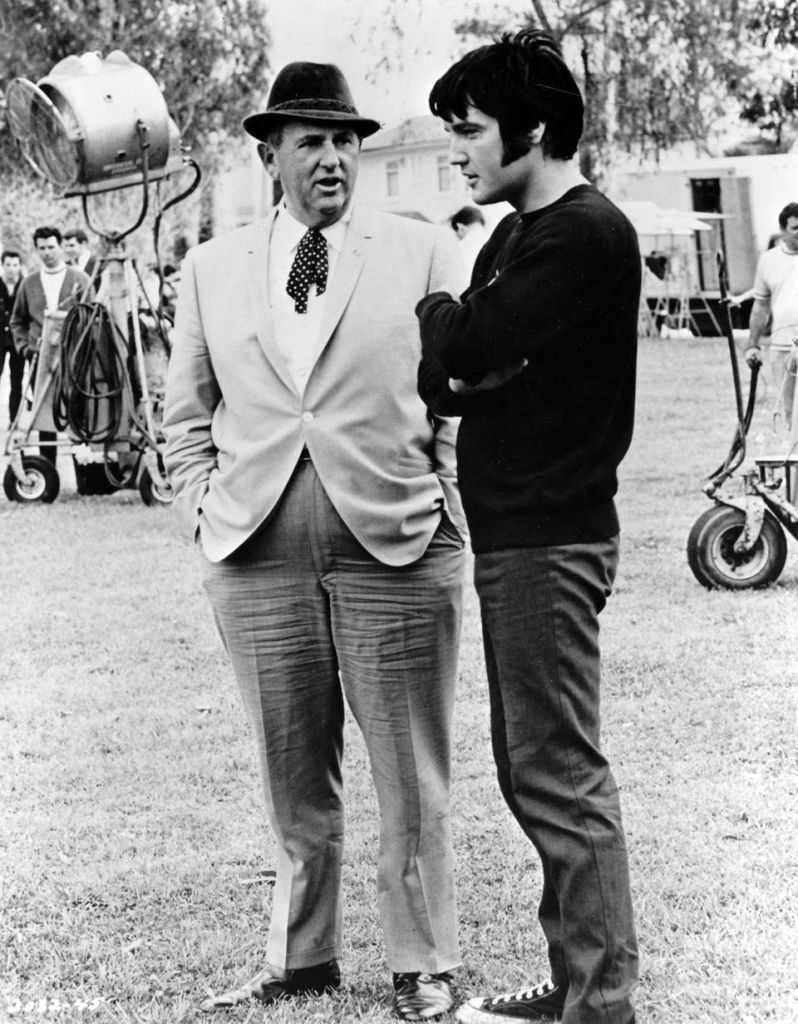
Elvis Presley, songwriter?
Let’s take one of the many attributes associated with Elvis Presley. If you haven’t heard of Presley, he was a popular singer in the mid 20th century. He’s even in Britannica.
(As a point of clarification, the song “Radio Radio” is associated with a DIFFERENT Elvis.)
Among many other songs, Presley is associated with the song “Don’t Be Cruel.”
Elvis Presley.
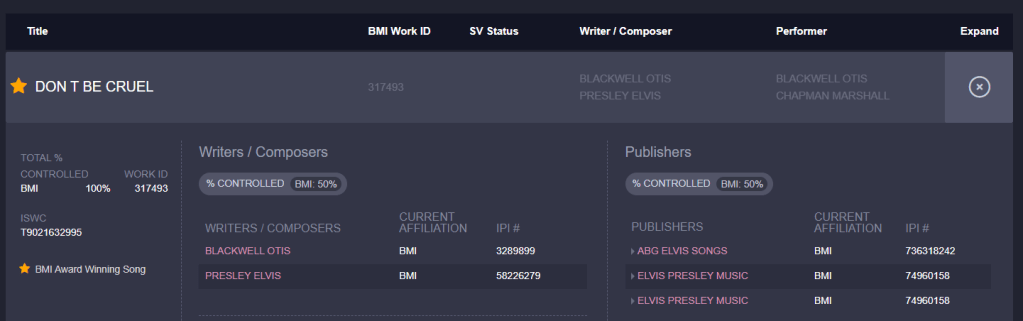
Presley was not only the performer, but also the credited co-songwriter.
After all, that’s what BMI says when you search its Songview database. See BMI work ID 317493.
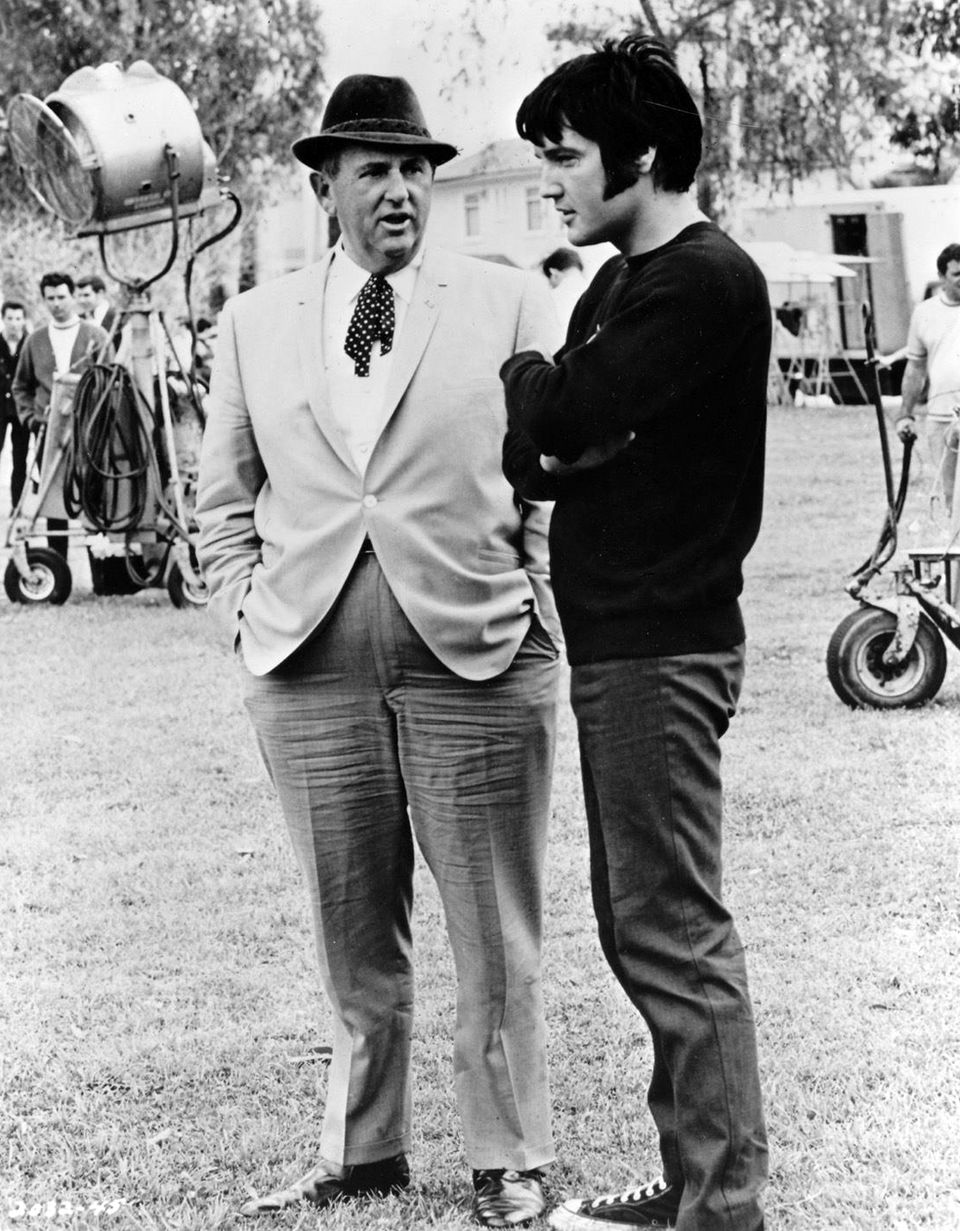
“…he listened to a selection of acetate demos provided by Freddy Bienstock, the new song representative assigned to Elvis by his publishers, Hill and Range. He chose “Don’t Be Cruel” by an obscure Brooklyn-born r&b singer and songwriter, Otis Blackwell. As per Hill and Range’s contractual requirement, it came with the assignment of half the publishing to Elvis Presley Music and half the writer’s share to Elvis Presley, but as Blackwell, the first of Elvis’ great “contract” writers, was always quick to point out, it was the best deal he ever made.”
Many songs are credited to Presley as a songwriter, but in reality he wrote few if any of them. Yet the “songwriter” attribute is assigned to him. Do we simply accept what BMI says and move on?
But there are other instances in which there are no back room deals, yet a song is strongly associated with a musical entity who never wrote it.
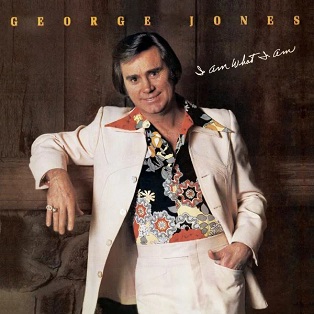
George Jones, not a songwriter
Take BMI Work ID 542061. The credited songwriters for this particular song are Robert Valentine Braddock and Claude Putnam, more commonly known as Bobby Braddock and Curly Putnam. According to RolandNote, Braddock and Putnam began writing this song on March 4, 1977 and finished it on October 18, 1977.
It was recorded by Johnny Russell on either March 7, 1978 (RolandNote), or January 18, 1979 (Second Hand Songs), or both (Classic Country Music Stories). But no recording was released.
Then George Jones recorded the song on February 6, 1980 with subsequent overdubs (“You know she came to see him one last time”) when he was more sober. His reaction?
“I looked [producer] Billy [Sherrill] square in the eye and said ‘nobody’s gonna buy that thing, it’s too morbid.’”
And morbid it was. Although popular music in general and country music in particular has never shied away from morbid songs.
Released the next month on March 18, the song was never associated with Braddock, Putnam, Russell, or Sherrill ever again. “He Stopped Loving Her Today” is completely associated with George Jones.
Now there’s a particular article that I wrote for a Bredemarket client a couple of years ago that used a slow reveal “reverse timeline” effect. Starting with 2022 and moving back in time to 2019, I slowly dropped the details about a missing person who was identified via biometric technology, finally solving the mystery of the person’s identity (Connerjack Oswalt).











 Bredemarket