Revisiting Amazon Rekognition, May 2025

(Part of the biometric product marketing expert series)

A recent story about Meta face licensing changes caused me to get reflective.

“This openness to facial recognition could signal a turning point that could affect the biometric industry. 

“The so-called “big” biometric players such as IDEMIA, NEC, and Thales are teeny tiny compared to companies like Meta, Alphabet, and Amazon. If the big tech players ever consented to enter the law enforcement and surveillance market in a big way, they could put IDEMIA, NEC, and Thales out of business. 

“However, wholesale entry into law enforcement/surveillance could damage their consumer business, so the big tech companies have intentionally refused to get involved – or if they have gotten involved, they have kept their involvement a deep dark secret.”

Then I thought about the “Really Big Bunch” product that offered the greatest threat to the “Big 3” (IDEMIA, NEC, and Thales)—Amazon Rekognition, which directly competed in Washington County, Oregon until Amazon imposed a one-year moratorium on police use of facial recognition in June 2020. The moratorium was subsequently extended until further notice.

I last looked at Rekognition in June 2024, when Amazon teamed up with HID Global and may have teamed up with the FBI.

So what’s going on now?

Hard to say. I have been unable to find any newly announced Amazon Rekognition law enforcement customers.

That doesn’t mean that nothing is happening. Perhaps the government buyers are keeping their mouths shut.

Plus, there is this page, “Use cases that involve public safety.”

Nothing controversial on the page itself:

  • “Have appropriately trained humans review all decisions to take action that might impact a person’s civil liberties or equivalent human rights.”
  • “Train personnel on responsible use of facial recognition systems.”
  • “Provide public disclosures of your use of facial recognition systems.”
  • “In all cases, facial comparison matches should be viewed in the context of other compelling evidence, and shouldn’t be used as the sole determinant for taking action.” (In other words, INVESTIGATIVE LEAD only.)

Nothing controversial at all, and I am…um…99% certain (geddit?) that IDEMIA, NEC, and Thales would endorse all these points.

But why does Amazon even need such a page, if Rekognition is only used to find missing children?

Maybe this is a pre-June 2020 page that Amazon forgot to take down.

Or maybe not.

Couple this with the news about Meta, and there’s the possibility that the Really Big Bunch may enter the markets currently dominated by the Big Three.

Imagine if the DHS HART system, delayed for years, were resurrected…with Alphabet or Amazon or Meta technology.

We are still in the time of uncertainty…and may never go back.

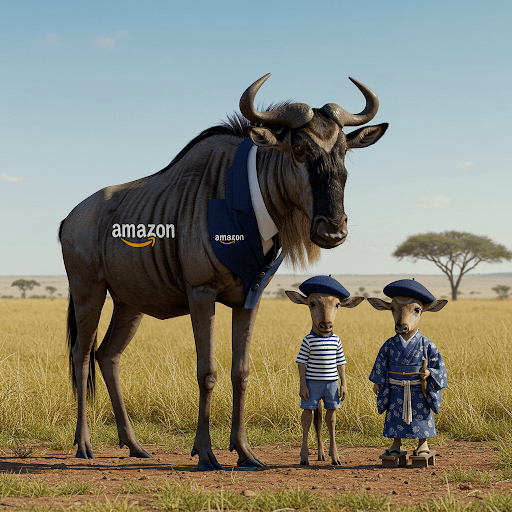
(Large and small wildebeests via Imagen 3)
Monitoring the #connectid hashtag

I have a long history with hashtags.

A LONG history.

Fires and parades

How long?

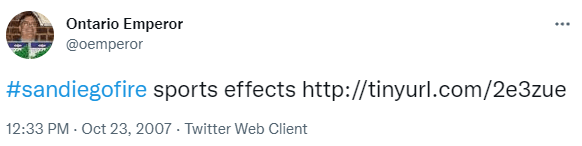
Back on October 23, 2007, I used my then-active Twitter account to tweet about the #sandiegofire. The San Diego fire was arguably the first mass adoption of hashtags, building upon pioneering work by Stowe Boyd and Chris Messina and acted upon by Nate Ritter and others.

From https://twitter.com/oemperor/status/358071562. Frozen peas? Long story.

The tinyurl link directed followers to my post detailing how the aforementioned San Diego Fire was displacing sports teams, including the San Diego Chargers. (Yes, kids, the Chargers used to play in San Diego.)

So while I was there at the beginning of hashtags, I’m proudest of the post that I wrote a couple of months later, entitled “Hashtagging Challenges When Events Occur at Different Times in Different Locations.” It describes the challenges of talking about the Rose Parade when someone is viewing the beginning of the parade while someone else is viewing the end of the parade at the same time. (This post was cited on PBWorks long ago, referenced deep in a Stowe Boyd post, and cited elsewhere.)

Hashtag use in business

Of course, hashtags have changed a lot since 2007-2008. After some resistance, Twitter formally supported the use of hashtags, and Facebook and other services followed, leading to mass adoption beyond the Factory Joes of the world.

Ignoring personal applications for the moment, hashtags have proven helpful for business purposes, especially when a particular event is taking place. No, not a fire in a major American city, but a conference of some sort. Conferences of all types have rushed to adopt hashtags so that conference attendees will promote their conference attendance. The general rule is that the more techie the conference, the more likely the attendees will use the conference-promoted hashtag.

I held various social media responsibilities during my years at MorphoTrak and IDEMIA, some of which were directly connected to the company’s annual user conference, and some of which were connected to the company’s attendance at other events. Obviously we pulled out the stops for our own conferences, including adopting hashtags that coincided with the conference theme.

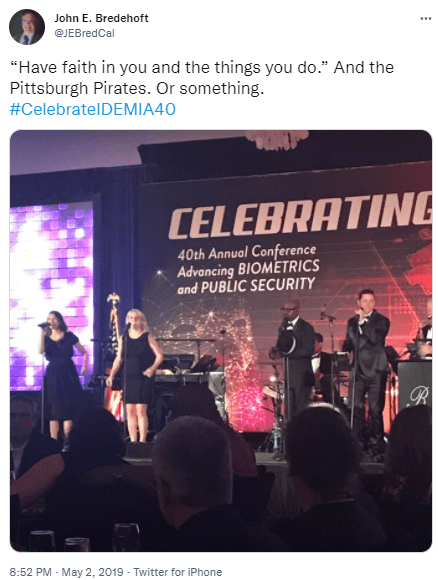
A tweet https://twitter.com/JEBredCal/status/1124159756157849600 from the last (obviously celebratory) night of IDEMIA’s (Printrak’s) 40th conference in 2019. Coincidentally, this conference was held in San Diego.

And then when the conference organizers adopt a hashtag, they fervently hope that people will actually USE the adopted hashtag. As I said before, this isn’t an issue for the technical conferences, but it can be an issue at the semi-technical conferences. (“Hey, everybody! Gather around the screen! Someone used the conference hashtag…oh wait a minute, that’s my burner account.”)

A pleasant surprise with exhibitor/speaker adoption of the #connectID hashtag

Well, I think that we’ve finally crossed a threshold in the biometric world, and hashtags are becoming more and more acceptable.

As I previously mentioned, I’m not attending next week’s connect:ID conference in Washington DC, but I’m obviously interested in the proceedings.

So I turned to Twitter to check if anyone was using a #connectID hashtag in advance of the event. (Helpful hint: hashtags cannot include special characters such as “:” so don’t try to tweet #connect:ID; it won’t work and will appear as #connect.) Using the date-sorted search https://twitter.com/search?q=%23connectid&src=typed_query&f=live, I was expecting to see a couple of companies using the hashtag…if I was lucky.

I was pleasantly surprised to see that nearly two dozen exhibitors and speakers were using the #connectID hashtag (or referenced via the hashtag) as of the Friday before the event, including Acuity Market Intelligence, Aware, BIO-key, Blink Identity, Clearview AI, HID Global, IDEMIA, Integrated Biometrics, iProov, Iris ID, Kantara, NEC and NEC NSS, Pangiam, Paravision, The Paypers, WCC, WorldReach Software/Entrust, and probably some others by the time you read this, as well as some others that I may have missed.

And the event hasn’t even started yet.

At least some of the companies will have the presence of mind to tweet DURING the event on Tuesday and Wednesday.

Will yours be one of them?

But company adoption is only half the battle

While encouraging to me, adoption of a hashtag by a conference’s organizers, exhibitors, and speakers is only the beginning.

The true test will take place when (if) the ATTENDEES at the conference also choose to adopt the conference hashtag.

According to Terrapin (handling the logistics of conference organization), more than 2,500 people are registered for the conference. While the majority of these people are attending the free exhibition, over 750 of them are designated as “conference delegates” who will attend the speaking sessions.

How many of these people will tweet or post about #connectID?

We’ll all find out on Tuesday.

connect:ID 2021 is coming

I have not been to an identity trade show in years, and sadly I won’t be in Washington DC next week for connect:ID…although I’ll be thinking about it.

I’ve only been to connect:ID once, in 2015. Back in those days I was a strategic marketer with MorphoTrak, and we were demonstrating the MorphoWay. No, not the Morpho Way; the MorphoWay.

At connect:ID 2015.

Perhaps you’ve seen the video.

Video by Biometric Update. https://www.youtube.com/watch?v=mqfHAc227As

As an aside, you’ll notice how big MorphoWay is…which renders it impractical for use in U.S. airports, since space is valuable and therefore security features need a minimum footprint. MorphoWay has a maximum footprint…just ask the tradespeople who were responsible for getting it on and off the trade show floor.

I still remember several other things from this conference. For example, in those days one of Safran’s biometric competitors was 3M. Of course both Safran and 3M have exited the biometric industry, but at the time they were competing against each other. Companies always make a point of checking out the other companies at these conferences, but when I went to 3M’s booth, the one person I knew best (Teresa Wu) was not at the booth. Later that year, Teresa would leave 3M and (re)join Safran, where she remains to this day.

Yes, there is a lot of movement of people between firms. Looking over the companies in the connect:ID 2021 Exhibitor Directory, I know people at a number of these firms. Obviously people from IDEMIA, of course (IDEMIA was the company that bought Safran’s identity business), but I also know people at other companies, all of whom who were former coworkers at IDEMIA or one of its predecessor companies:

  • Aware.
  • Clearview AI.
  • GET Group North America.
  • HID Global.
  • Integrated Biometrics.
  • iProov.
  • NEC.
  • Paravision.
  • Rank One Computing.
  • SAFR/RealNetworks.
  • Thales.
  • Probably some others that I missed.

And I know people at some of the other companies, organizations, and governmental entities that are at connect:ID this year.

Some of these entities didn’t even exist when I was at connect:ID six years ago, and some of these entities (such as Thales) have entered the identity market due to acquisitions (in Thales’ case, the acquisition of Gemalto, which had acquired 3M’s biometric business).

So while I’m not crossing the country next week, I’m obviously thinking of everything that will be going on there.

Incidentally, this is one of the last events of the trade show season, which is starting to wind down for the year. But it will ramp up again next spring (for you Northern Hemisphere folks).

Bredemarket remembers the Southern Hemisphere, even though Bredemarket only does business in the United States. https://www.youtube.com/watch?v=HtZCQiN3n50

Regardless of where you are, hopefully the upcoming trade show season will not be adversely impacted by the pandemic.