
The Diamondbacks are hosting the Dodgers this afternoon, and people really want to know what time it is. So, unlike Chicago, I asked Gemini.
“Phoenix, Arizona operates on Mountain Standard Time (MST) year-round and does not observe Daylight Saving Time.”
Stupid hallucinations, because I know that Arizona operates on Arizona Standard Time (AST), which is a synonym for Mountain Standard Time except for the fact that “Arizona Daylight Time” is meaningless.
Oh, and the Navajos aren’t down with AST, because the Navajo Nation spans multiple states. MST/MDT for all, thank you.
But what if I was wrong? Who could tell me if Arizona Standard Time is real or an invention?
The U.S. Department of Transportation
Today, the U.S. Department of Transportation (DOT) is responsible for managing time zones. But not measuring—Commerce does that.
This makes sense, because we really didn’t need time zones until trains provided rapid travel. Before that, you didn’t really care about such things. By 1883, the trains, not government, forced the issue:
“In 1883, U.S. and Canadian railroads adopted a four-zone system to govern their operations and reduce the confusion resulting from some 100 conflicting locally established “sun times” observed in terminals across the country. States and municipalities then adopted one of the four zones, which were the eastern, central, mountain, and Pacific Time zones.”
Sound familiar? Although today continental Canada has more than four time zones. But I digress.
At the time, Arizona (and New Mexico) were meaningless territories, and the trains didn’t care about “daylight saving.” Heck, establishing four time zones for the big countries was enough of an accomplishment.
The (U.S.) Government wasn’t here to help until 1918.
“Federal oversight of time zones began in 1918 with the enactment of the Standard Time Act, which vested the Interstate Commerce Commission with the responsibility for establishing boundaries between the standard time zones in the continental United States.”
Decades later, when DOT was created, the Standard Time Act was replaced.
“Today, the Uniform Time Act of 1966 (15 U.S.C. §§ 260-64) establishes a system of uniform Daylight Saving Time throughout the Nation and its possessions, and provides that either Congress or the Secretary of Transportation can change a time-zone boundary.”
We will get back to Daylight Saving Time later. But what were the standard time zones?
“The time zones established by the Standard Time Act, as amended by the Uniform Time Act, are Atlantic, eastern, central, mountain, Pacific, Alaska, Hawaii–Aleutian, Samoa, and Chamorro.”
And for those who think the Atlantic Time Zone is exclusive to Canada, you forgot about Puerto Rico and the U.S. Virgin Islands.
By the way, the Chamorro Time Zone hosts Guam and the Commonwealth of the Northern Mariana Islands. Guam is UTC+10, American Samoa UTC-11. Because of the International Date Line, it’s probably tomorrow in Guam.
But what’s missing from the law? Arizona. So who invented “Arizona” Standard Time?
But first, why
Daylight saving time didn’t exist in 1883, but slowly emerged in the early 20th century, first as a temporary World War I measure, then again temporarily during World War II. Initially adopted piecemeal, it became “uniform” throughout the country with the 1966 Act, which allowed states and territories to opt out.
All the territories opted out, as did Hawaii, because of their low latitudes.
Michigan also opted out, but re-instituted DST several years later.
Arizona? It’s complicated.
- Arizonans joined the rest of the country in changing their clocks with the advent of daylight saving time in 1918. Congress repealed the wartime law a year later.
- President Franklin Roosevelt in 1942 imposed DST nationwide as a wartime measure, and the policy ended in 1945.
- Arizona again implemented DST in 1967 after Congress re-established it through the Uniform Time Act.
So what happened? New Mexico liked it. As did Colorado.
“The Legislature abolished it in March 1968. Lawmakers got the bill on Gov. Jack Williams’ desk about a month before daylight saving went into effect.”
And non-Navajo Arizona has remained on standard time ever since.
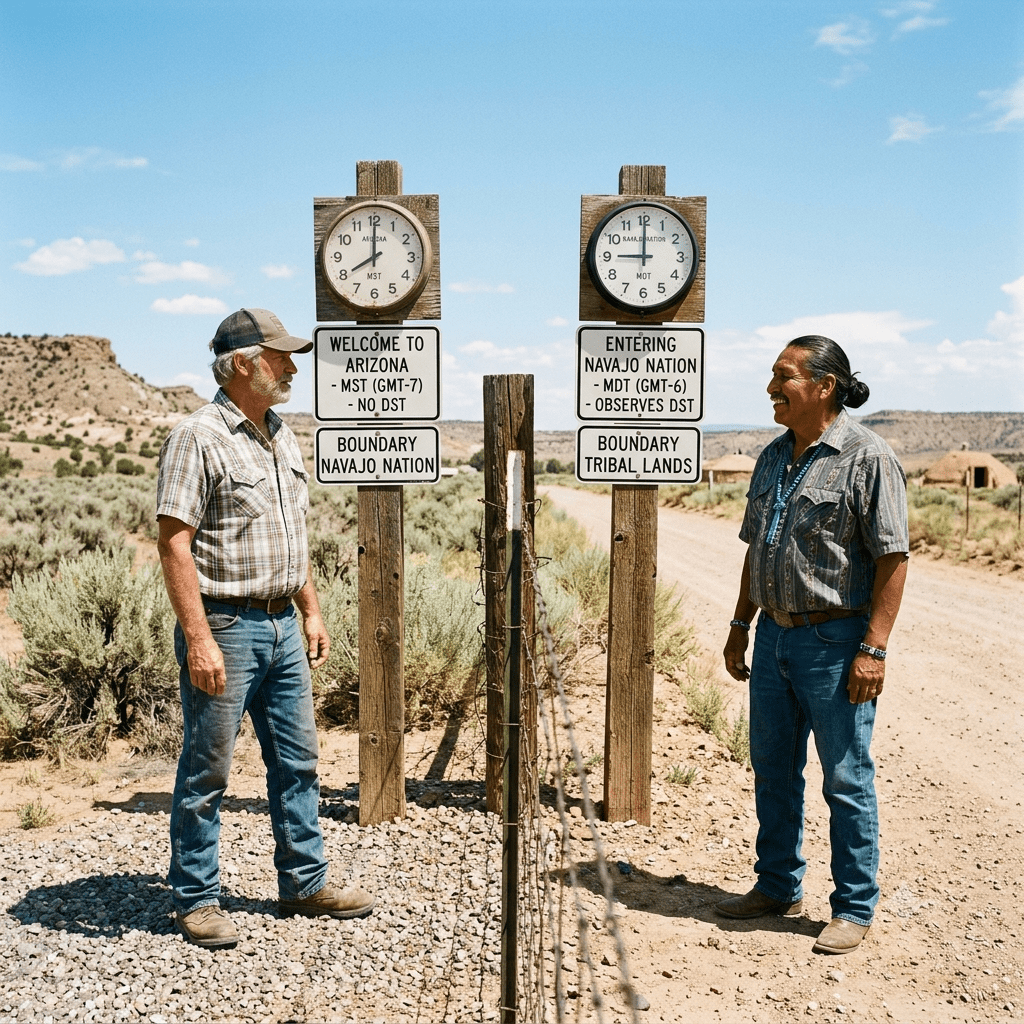
And systems got confused.
I can tell people that Bredemarket observes “Pacific Time” (PT), and people presumably understand that I use Pacific Standard Time (PST) in winter, Pacific Daylight Time (PDT) in summer.
Incidentally, this is why I quietly blow my top when invited to a meeting on August 12 at noon PST (sic). But I digress.
Now the NIST people who actually measure time observe “Mountain Time,” with people understanding MST and MDT at the appropriate seasons.
But what of Arizona? Legally they’re MST now, MST forever. But that can be misinterpreted.
Hence “Arizona Time.” I couldn’t find an originator of the phrase, but it is widely adopted.
 Bredemarket