The Reality of Content Calendars and Content Management

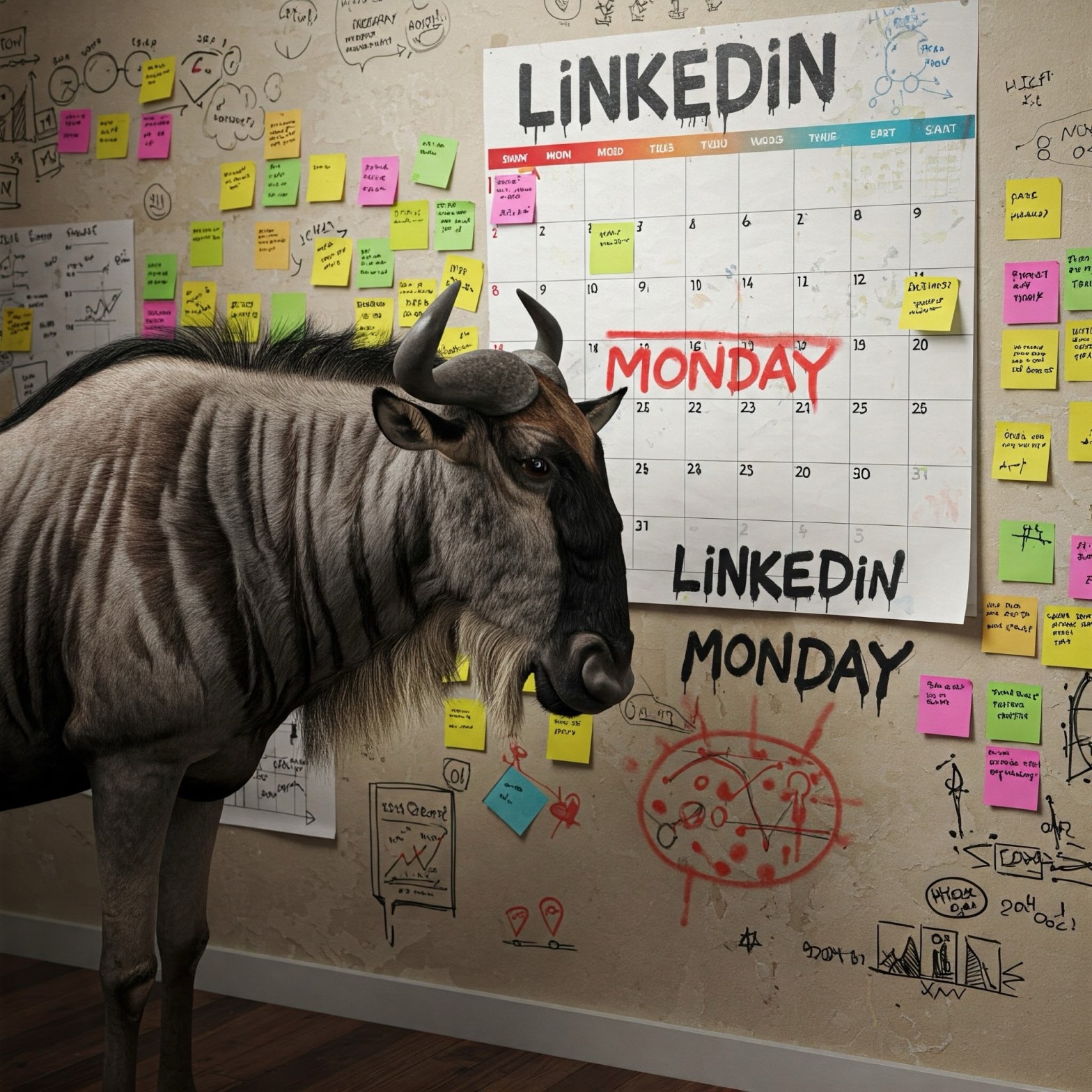
(Imagen 3)

I have worked with several companies’ content calendars over the years.

  • Two of Bredemarket’s clients are using Jira to manage their content calendars.
  • Another of Bredemarket’s clients doesn’t (as far as I know) have an official content calendar, but is tracking some content in a go-to-market Excel workbook.
  • If I remember correctly, MorphoTrak also used Excel for content management. MorphoTrak’s parent Morpho used a social media management platform, but I can’t remember which one.
  • At the time I was at Incode, the company used Asana to host its content calendar. (I have no idea how Incode has managed its content since May 2023.)

Bredemarket creates its own content (this is an example), and I also use Asana as my official content management platform.

Sharp-eyed people spotted how I worded that last sentence.

What did I just say?

If you read it again, you’ll see that I only discussed my OFFICIAL content management platform.

Some content, including this blog post/LinkedIn post/wherever else the text ends up, never gets logged in Asana. I just started writing it in iOS Notes and I will add various checkboxes up top as I share it on the blog and social channels.

Some other content, also not logged in Bredemarket’s Asana, is repeatable content that I store in Notes and repost periodically.

Something I post to my identity-related social channels (BIFS = Bredemarket Identity Firm Services).

And sometimes—a lot of the time, actually—I just go to a platform and WRITE stuff.

As a sole proprietor, I enjoy absolute control over Bredemarket’s messaging, and therefore the blog and social media approval process is very…streamlined. That isn’t the case elsewhere, where even a simple tweet requires approval. This makes it hard to live-tweet an event when the approver is unavailable…but there are workarounds. Perhaps I will reveal them one day.

What about process?

But if your corporate environment requires you to impose a strict content management structure, where all content is logged in the content calendar and all content requires approval, make sure that your content logging and approval process protects your company but DOESN’T silence it.

Because if your content approvals are too onerous, you will end up with no content at all.

Or you will end up with…perhaps I will reveal that one day.
Nurturing

(Image Public Domain)

I spent most of the afternoon drafting the content for an email nurture campaign, and I’m fascinated by the use of the word “nurture” by product marketers and content marketers.

Here is how HubSpot defines lead nurturing.

“Lead nurturing is the process of building relationships with your prospects with the goal of earning their business when they’re ready. Lead nurturing is important to inbound marketing because it’s your opportunity to provide value to your leads and customers and help them grow with your business.”

I’ve said it before: You’re not a sausage grinder making sausages. You’re a flower attracting bees.

How Marketing Leads Can Navigate the Time of Uncertainty

Marketing leads (and others) like to talk about “eras” and “ages.” But I resisted the urge to refer to an “era” or “age” of uncertainty, preferring to reserve these terms for periods of hundreds or thousands of years. “The dot com ERA”? Come on.

But when we encounter technological or governmental changes that take place in mere days, we need to do things in different ways.

Three tips for dealing with uncertainty

Here are three tips that I am following for dealing with uncertainty. And if you are a marketing lead for your company, the third tip applies especially to you.

Tip 1: De-emphasize long term planning

Note that I didn’t say to stop long-term planning entirely. Heck, Bredemarket has worked on go-to-market processes and plans for three clients over the past couple of months—plans that assume you have months, not days, to execute a launch. 

But sadly, the accuracy of any long-term plan is probably not high. 

  • If you assumed that the U.S. management of its nuclear assets would maintain its low level of risk, that changed in a single day when the responsible people were mistakenly fired. We will see how many of them return to work.
  • Similarly, if you assumed maintenance of the status quo in the generative AI world…what were you smoking?

So while long-term planning is (in TLOI terms) important, short-term planning is very important, and short-term execution is critically important.

Tip 2: Expect the unexpected

This is always a good tip, but especially so today. You and I can name many times when something surprised us, and we had to scramble to adjust.

For example, many of us have received a terse request to meet with our bosses the next day. (Maybe more than one such request over the years.) The next day, after meeting with the boss and an unannounced third person, we adjusted to the new reality that our boss is no longer our boss, and we no longer have a job.

So how can we prepare for the unexpected? By definition we can’t. But we can at least be alert.

  • Question all your assumptions. (Yes, even that.)
  • Determine what you will do if the unthinkable happens.

Tip 3: Move quickly

Normally things remain constant for a day or two. So take advantage of the temporary certainty. When you can, execute now.

For marketing leads:

  • Get that content out. Conceive, draft, review, fix, and publish. Don’t spend months searching for the perfect words; there aren’t any.
  • Publish before  the content goes stale. If you’ve been working on an explanation of a Biden Administration executive order…put that work on hold or kill it entirely.

And if you’re swamped and don’t have the time to generate the content, or write the proposal, or perform the analysis, call on the short-term help here at Bredemarket to bail you out.

Before it’s too late.

CPA

To learn more, you can watch Bredemarket’s short, medium, or long videos about my “CPA” marketing and writing services. I can work with you to fill your content, proposal, and/or analysis gaps.

Short:

Short

Medium:

Medium

Long:

Long

Justin Welsh on Being Boring

(Imagen 3)

I’m not the only one who grips my keyboard. On Saturday, Justin Welsh wrote “The hidden power of being boring.” Excerpt:

If you ask me, success isn’t about unlocking secrets — it’s about doing the boring stuff, day in and day out….

I write. I write every single day. Even when I don’t feel inspired. Even when nobody seems to care. And even when it feels like I’m talking to an empty room. I’ve now written for over 2,100 consecutive days without missing.

But of course, that’s not what people want to hear.

WYSASOA

(Imagen 3)

A few of you may come away puzzled when I use the term “WYSASOA.”

I don’t understand this.

Isn’t it OBVIOUS that “WYSASOA” stands for “Why You Should Always Spell Out Acronyms”?

That’s pretty stupid, John, you’re saying. If you use acronyms and phrases without defining them, your readers are going to be confused and aren’t going to buy from you.

The counter-argument is that if you don’t know what WYSASOA means, then I probably don’t want to do business with you.

To a point, that’s true.

But why make it hard on yourself?

Perhaps someone doesn’t use WYSASOA, but does use EYA.

(pause)

“EYA” is “Explain Your Acronym.”

Do I have to spell out EVERYTHING to you?

Yes I do.

Introduction Goes Here

(Imagen 3)

Proposal professionals are familiar with this question: do you write the executive summary first, or last?

I recently struggled with this, but in a non-proposal project—specifically, for an online article I was writing for a Bredemarket client. I had already asked my seven questions, so I had a high-level idea of the points I wanted to make. But I intentionally started writing the rest of the online article, and put some filler text at the beginning:

“*** Introduction Goes Here”

Those who have worked with me on content, proposal, and analysis projects know how much I love my three asterisks, and other things to flag incomplete text.

But why did I delay writing the introduction to the end? Because of one important difference between proposals and online articles.

  • When an entity receives a proposal, the content is analyzed internally by few who HAVE to read it. The humans and non-person entities (proposal evaluation software) are required to analyze sections of the proposal, or perhaps even the whole thing.
  • When an entity receives an online article, the content is analyzed externally by many who DON’T have to read it. The humans and non-person entities (Google, Bing, etc.) may start reading at the beginning, and if they don’t like the article, they quit reading right there. (Proposal evaluators don’t have that luxury.)

Because of this, the opening words of an  article can be very important. And the right words need to be there.

So I saved that writing exercise for later.

Process

Luna Marketing Services asked us on Instagram when we last went over our current processes.

My answer: January 18, 2024.

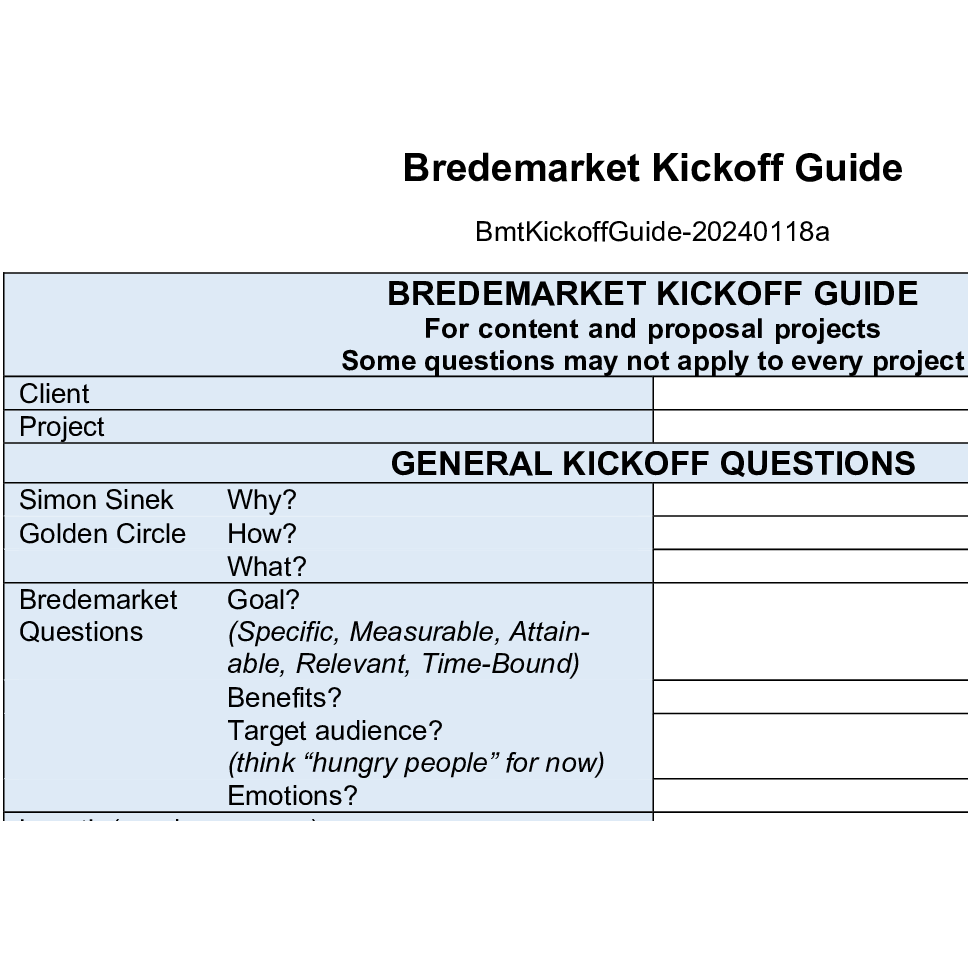
The illustration shows just one part of one of my processes. I don’t share the rest of this particular process, but it governs creation of most of my “CPA” materials.

In fact, I am about to start a short writing project for one of my clients, and I will start by asking these seven questions.

But not in Word. In the client’s Jira.

Don’t forget that processes require flexibility. Don’t complete processes for the sake of completing processes.