Finding and Filtering For Your B2B Firm’s Hungry People

(Takeru Kobayashi Image CC BY-SA 2.0)

B2B companies want to do business with certain companies, but not with others.

Using Bredemarket as an example:

  • I want to do business with identity and technology companies who seek collaborative content, proposal, and analysis services for their products.
  • I don’t want to rewrite your resume.

How can B2B companies—mine, or yours—find niche prospects that are “hungry” to do business with them—your target audience?

By marketing their products in ways that attract their hungry people and filter out the others.

The “pay my price” filter

For example, my recent long (3:40) Bredemarket “CPA” talkie video included prices for three of my services, starting at $500 (as of January 2025) for my Bredemarket 400 Short Writing Service.

If you continued to watch the video after the pricing discussion, you may be among Bredemarket’s niche hungry people.

If you stopped watching the video and searched for a 2¢/word writer on Fiverr, you’re definitely NOT among my hungry people.

The “IPVM China post” filter

Another way to find your hungry people is to discuss things that interest them.

For example, I shared the following LinkedIn post on Saturday:

“Betcha IPVM isn’t inconvenienced by the TikTok ban…”

From John E. Bredehoft LinkedIn.

If you slightly smiled when you read that, you may be among Bredemarket’s niche hungry people.

Precious and few

Most people are NOT hungry for Bredemarket’s marketing and writing services.

My IPVM-TikTok LinkedIn post will never get the 20,000+ impressions and nearly 400 engagements that I’ve received on my Private Equity Talent Hunt LinkedIn post.

But since I don’t bait and switch jobseekers by offering 17x resume writing services, that’s a good thing.

If your humor has evolved to a point where the very idea of an IPVM account on TikTok amuses you—and if my use of the word “evolved” amuses you further—then perhaps Bredemarket offers the background and experience to help you convey your

  • identity,
  • biometric,
  • government ID,
  • geolocation, or
  • technology

product/service information.

Hungry for more? Check out my “CPA” page and book some time to talk to me.

Bredemarket’s “CPA.”

And by the way, my long-term hungry people knew this was coming…

From https://youtu.be/cmU_-F0A34M?si=ZQZOtD-xW0nvKfz6.

Where is ByteDance From?

Know Your Business!

Where is ByteDance From?

I am VERY familiar with questions regarding the nationality of a company. There are three questions:

  • Where is it incorporated?
  • Where is it headquartered?
  • Who owns it?

IDEMIA

For my former employer IDEMIA, the answers are France, France, and primarily a U.S. investor (Advent International).

(So depending upon your needs, you can argue that IDEMIA is a French company or a U.S. company.)

ByteDance

For ByteDance, the answers are the Cayman Islands, China (Beijing), and primarily global investors (Blackrock, General Atlantic, Susquehanna International Group, etc.).

(So depending upon your needs, you can argue that ByteDance is a Chinese company, a mostly American company, or a British company off the coast of Cuba.)

Your company

Not that I create TikTok videos (at least not for paying clients), but I provide other services.

More information on Bredemarket’s Content-Proposal-Analysis marketing and writing services:

CPA
Bredemarket’s “CPA.”

TikTok Watch, Saturday 5:30 pm

(Imagen 3)

Curiouser and curiouser. A recap:

  • On Friday morning, the Supreme Court ruled against TikTok.
  • By Friday evening, we learned that TikTok may “go dark” on Sunday rather than risk prosecution.
  • By Saturday morning, we learned that incoming President Trump may give ByteDance another 90 days to sell TikTok.

The chatter in recent days has speculated that Elon Musk may buy TikTok, or that Mark Zuckerberg’s Meta may buy TikTok. (Both men were slated to attend Trump’s inauguration, although that may have changed since the festivities have moved indoors.)

CNBC reports one more interested party—Perplexity AI:

“Perplexity AI officially made a play for TikTok on Saturday, submitting a bid to its parent company, ByteDance, to create a new merged entity combining Perplexity, TikTok U.S. and new capital partners, CNBC has learned.”

What’s next: Procter & Gamble?

TikTok Watch, Saturday 11am

TikTok may still go dark Sunday…but (apologies to Tony Campolo) Monday’s coming!

From NBC News:

“President-elect Donald Trump told NBC News’ “Meet the Press” moderator Kristen Welker in a phone interview Saturday that he will “most likely” give TikTok a 90-day reprieve from a potential ban in the U.S. after he takes office Monday.

“Trump said he hadn’t made a final decision but was considering a 90-day extension of the Sunday deadline for TikTok’s China-based parent company to sell to a non-Chinese-buyer or face a U.S. ban.”

Trump’s announced intention to possibly grant ByteDance a 90 day extension to sell TikTok means nothing until something actually happens. But it’s somewhat more likely than Liz Cheney in jail. Or the post-inauguration Trump tariffs.

And Trump (or, for that matter, Biden) has the power to grant such an extension.

“A 90-day extension under specific conditions is explicitly allowed for in the bipartisan law passed last year.”

But think about it.

  • Congress deemed ByteDance ownership of TikTok as a national security threat.
  • The Supreme Court agreed that Congress acted in accordance with the Constitution (I.e. the First Amendment) in making that determination.
  • In a show of unity, Biden and Trump decided, “Never mind.”
Good old Emily.

In the political world, deadlines are but a dream.

Digital Driving Licences With Two Cs

(Imagen 3)

In my country, the issuance of driver’s licenses is performed at the state level, not the national level. This has two ramifications.

REAL ID

The U.S. government wanted to tighten down on identification cards to stop terrorists from hijacking planes and crashing them into buildings. 

But it couldn’t. 

When it told the states to issue “REAL ID” cards by 2008, the states said they wouldn’t be told what to do. 

Today all of them support REAL ID cards as an option, but use of REAL IDs for federal functions such as plane travel won’t be enforced until 2027…if then.

mDLs

For years there has been a move to replace physical driver’s licenses with mobile driver’s licenses, or mDLs.

Again, in my country this has been pursued in a piecemeal basis on the state level. Louisiana has its own mDL, with a separate one in Oklahoma, one in California, others in other states, and none in other states. And one state (Florida) that had one, then didn’t have one.

Some mDLs are in custom wallets, while others are or are not in wallets from Apple, Google, and Samsung.

Oh, and don’t try using your Louisiana mDL to buy a beer in Arkansas.

Meanwhile, in the UK

Things are different in other countries. Amit Alagh shared a BBC article with me.

“Digital driving licences are to be introduced in the UK as the government looks to use technology to ‘transform public services’…. The new digital licences will be introduced later this year….”

Throughout the entire United Kingdom, including Scotland and Northern Ireland, apparently.

In one fell swoop. Entire country done.

Gridlock

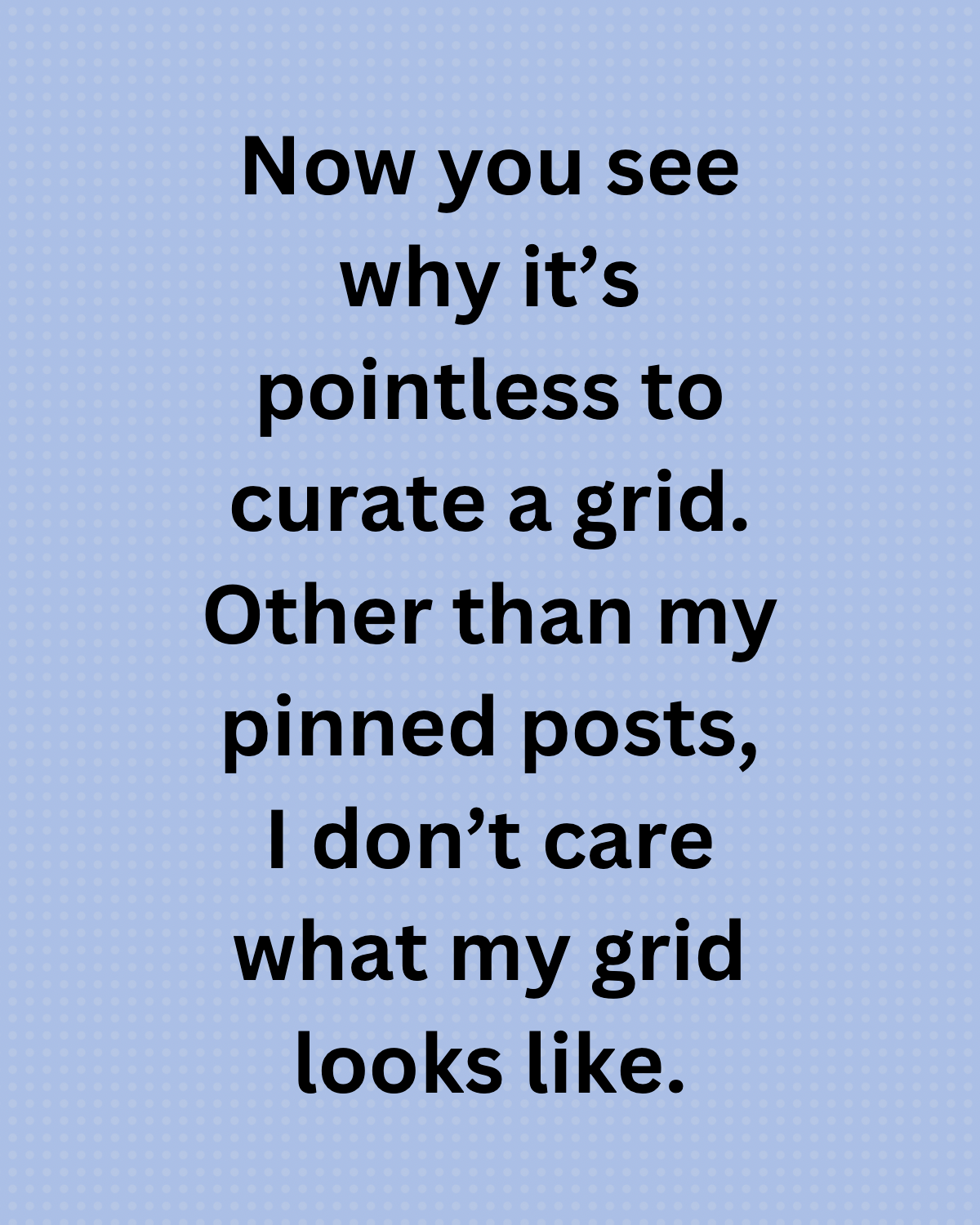
When I wasn’t TikTok tracking tonight, I was trying to figure out how to deal with Instagram’s grid dimension change from square to 4×5.

I guess this change was announced long ago, but I didn’t get (or ignored) the memo.

I’m not going to worry about my grid, except for my first three pinned images. And Elle (Instagram/Threads inkwell.elle) has a fix for that:

“Click on the post, 3 dots, adjust preview and fit… it’s the best workaround for the new layout but you have to do it on each post individually 😅”

https://www.threads.net/@inkwell.elle/post/DE81LidINVm?xmt=AQGzw75jD9q_OLaeYqgNVEg930qDDQlWvfgeWKyDBX8Zog

When I edited my three pinned images, I also changed the background from white to black.

Bredemarket’s Instagram grid at 9:30 pm PST.

Then I experimented with Canva (my primary image and video tool these days) and created an Instagram image that was 4×5 rather than square.

Nice neat grids are overrated anyway; I like mine messy. But I also like it readable.

TikTok Watch, Friday 7pm

Even though it appears that the U.S. government will not shut TikTok down in my country on Sunday, I wondered if TikTok would shut itself down, just to grab attention or make a point.

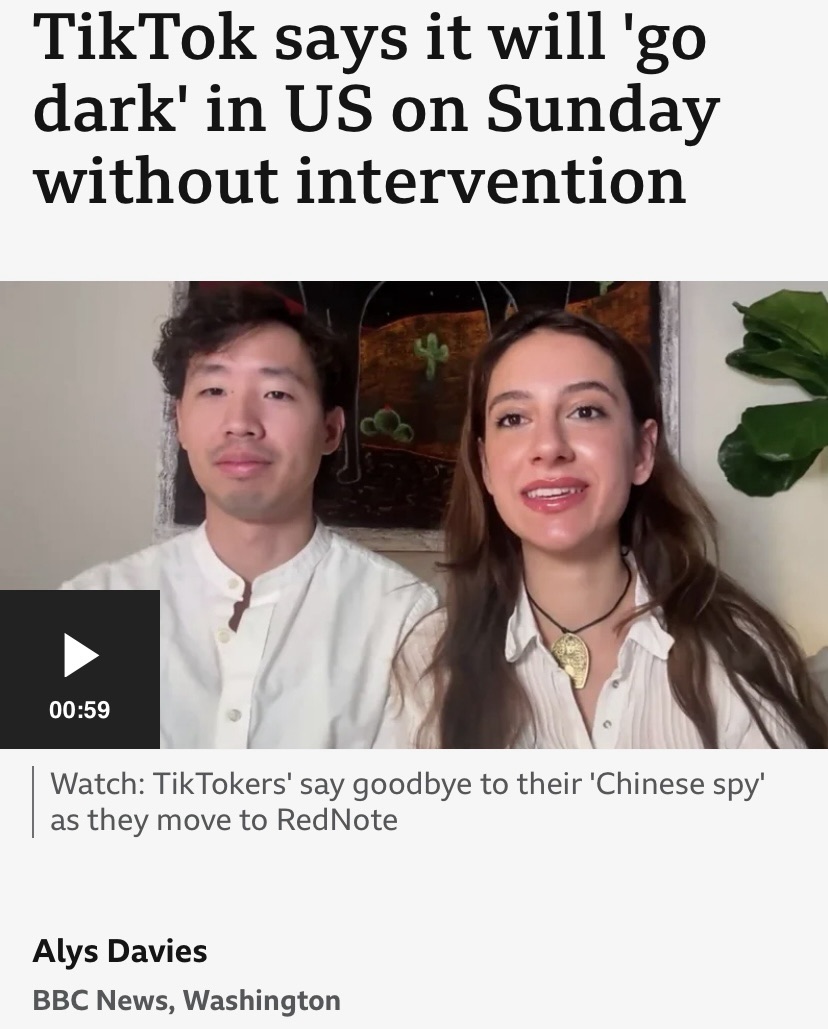
According to the BBC, TikTok is threatening to do just that.

“(TikTok) said ‘both the Biden White House and the Department of Justice have failed to provide the necessary clarity and assurance to the service providers that are integral to maintaining TikTok’s availability’.

“It said unless the government immediately stepped in to assure the video app it would not be punished for violating the looming ban, it would be ‘forced to go dark on January 19’.”

But if President Biden (who remains President until Monday) provided such an explicit assurance, he may be in violation of both the bipartisan Protecting Americans from Foreign Adversary Controlled Applications Act and the Supreme Court ruling (PDF).

To be continued.

Introduction Goes Here

(Imagen 3)

Proposal professionals are familiar with this question: do you write the executive summary first, or last?

I recently struggled with this, but in a non-proposal project—specifically, for an online article I was writing for a Bredemarket client. I had already asked my seven questions, so I had a high-level idea of the points I wanted to make. But I intentionally started writing the rest of the online article, and put some filler text at the beginning:

“*** Introduction Goes Here”

Those who have worked with me on content, proposal, and analysis projects know how much I love my three asterisks, and other things to flag incomplete text.

But why did I delay writing the introduction to the end? Because of one important difference between proposals and online articles.

  • When an entity receives a proposal, the content is analyzed internally by few who HAVE to read it. The humans and non-person entities (proposal evaluation software) are required to analyze sections of the proposal, or perhaps even the whole thing.
  • When an entity receives an online article, the content is analyzed externally by many who DON’T have to read it. The humans and non-person entities (Google, Bing, etc.) may start reading at the beginning, and if they don’t like the article, they quit reading right there. (Proposal evaluators don’t have that luxury.)

Because of this, the opening words of an  article can be very important. And the right words need to be there.

So I saved that writing exercise for later.