At 3:40 the phone in my bedroom made a funny noise and displayed a message that the power was out at the main handset.
Oh, and my clock wasn’t displaying the time.
So, how about that router light?
When wi-fi is available, the router light is blue.
When it isn’t, the light is red.
This afternoon, there was no light at all.
I’m a Southern California Edison customer, but I had problems getting to its website on cellular. The power outage affected a good swath of northwest Ontario, so I guess everyone was trying to use cellular internet.
My Facebook app could (somewhat) connect, and people on the O.N.Z group were reporting estimated fix times between 5:30 pm and 9:30 pm.
Then I received a text: not from SCE, but from my Internet Service Provider.
“There is a service outage affecting your area. Restoration estimated by 9:30 PM.”
How would they know? It wasn’t the ISP’s problem.
A second text followed.
“The service interruption affecting…services in and around your area is being caused by a power outage. Restoration estimated by 4:40 PM.”
By this time I had left home to go to a place outside the affected area…with air conditioning. But I continued to monitor O.N.Z. (a private Facebook group, so no links or quotes). And someone reported that power was back.
So I checked my ISP and thermostat apps and confirmed this.
A technical problem can have so many causes…including a loss of electricity that affects all things power-dependent.
Note the “deprecated” and “legacy” data types. In 1993, Type 4 was the gold standard for fingerprint images; now it’s just “legacy.” And forget about binary representations or anything less than 500 ppi.
Time marches on.
But some people have been around for much of the ride. I scanned the lists of working group members and found Kenneth Blue, Tom Buss, Roland Fournier, Patrick Grother, Mike McCabe, John Splain, Mark Walch, and many others who remember Type 4 and 250 ppi binary images.
And the canvassees included government and industry representatives from within and outside of the United States, including Canada, Germany, Japan, Latvia, Slovakia, Switzerland, other countries I probably mnissed, and INTERPOL.
If Europe or other countries do break away from NIST standards, it will be a rupturing break.
People memorize arcane text strings when they use them a lot. But until now I never memorized NIST SP 500-290…even though it refers to a document I reference fairly constantly.
There has been ongoing debate on whether age verification should be implemented at the website level or at the operating system level…or not at all.
In the United Kingdom, Apple is opting for OS level age verification, according to the BBC.
“Apple is rolling out age checks for iPhone and iPad users in the UK that will ask them to verify if they are adults to access “certain services” such as 18-plus apps.
“After customers accept the latest iOS 26.4 software update, they will be asked to verify their age, which they can do by providing a credit card or scanning their ID, according to an Apple support page.
“Those who do not confirm how old they are or are underage will have web content filters turned on automatically.”
“When creating a new Apple Account or using Apple services, you may see a prompt asking you to confirm that you’re an adult. This is required by law in some countries and regions.”
Regarding that last sentence, is OS level age verification REQUIRED? Silkie Carlo of Big Brother Watch says no:
“Carlo told the BBC she believed Apple had “crossed the Rubicon” with its new software update which she described as “more like ransomware”, and which she said essentially left millions of Brits owning a “child’s device”, unless they complied with the age checks.
“And she said while she believed children’s online safety was vital, it required more thoughtful tech responsibility and not “sweeping, draconian shock demands by foreign companies for all of our IDs and credit cards”.”
Note the appeal to resist the “American” company, which raises questions about whether Apple’s collection of this information potentially violates United Kingdom privacy laws if the data is sent to Cupertino.
So why did Apple do it if UK law doesn’t require it?
Two reasons:
Future proofing. While the UK and other jurisdictions do not require age verification at the OS level now, they may require it at some point. If so, Apple has already implemented it in the UK (for iPhones and iPads) and can implement it elsewhere.
CYA. A jury in California awarded damages after finding that Meta and Google were responsible for a woman’s anxiety and depression, suffered because of her social media use as a child. Apple doesn’t want to face a similar lawsuit.
Incidentally, it’s interesting to note that these and other stories pair “Meta” and “Google.” Does no one refer to “Alphabet” (Google’s parent company) any more?
I have an old iPhone with a Lightning charger port. I can’t buy this today in the European Union. (Or anywhere, but we’ll get to that.) Why? Because of the EU’s Common Charger Directive.
“Because the EU has standardised charging ports for mobile phones and other portable electronic devices, all new devices sold in the EU must now support USB-C charging.”
Which devices?
“From 28 December 2024, the rules apply to mobile phones, tablets, digital cameras, headphones, headsets, videogame consoles, portable speakers, e-readers, keyboards, mice, portable navigation systemsand earbuds sold in the EU.”
So all of this went into effect in 2024?
Um, no.
Laptops
Because there is one additional requirement.
“From 28 April 2026, they will also apply to laptops.”
(Sorry, desktop computer users. You may still have old style power connections.)
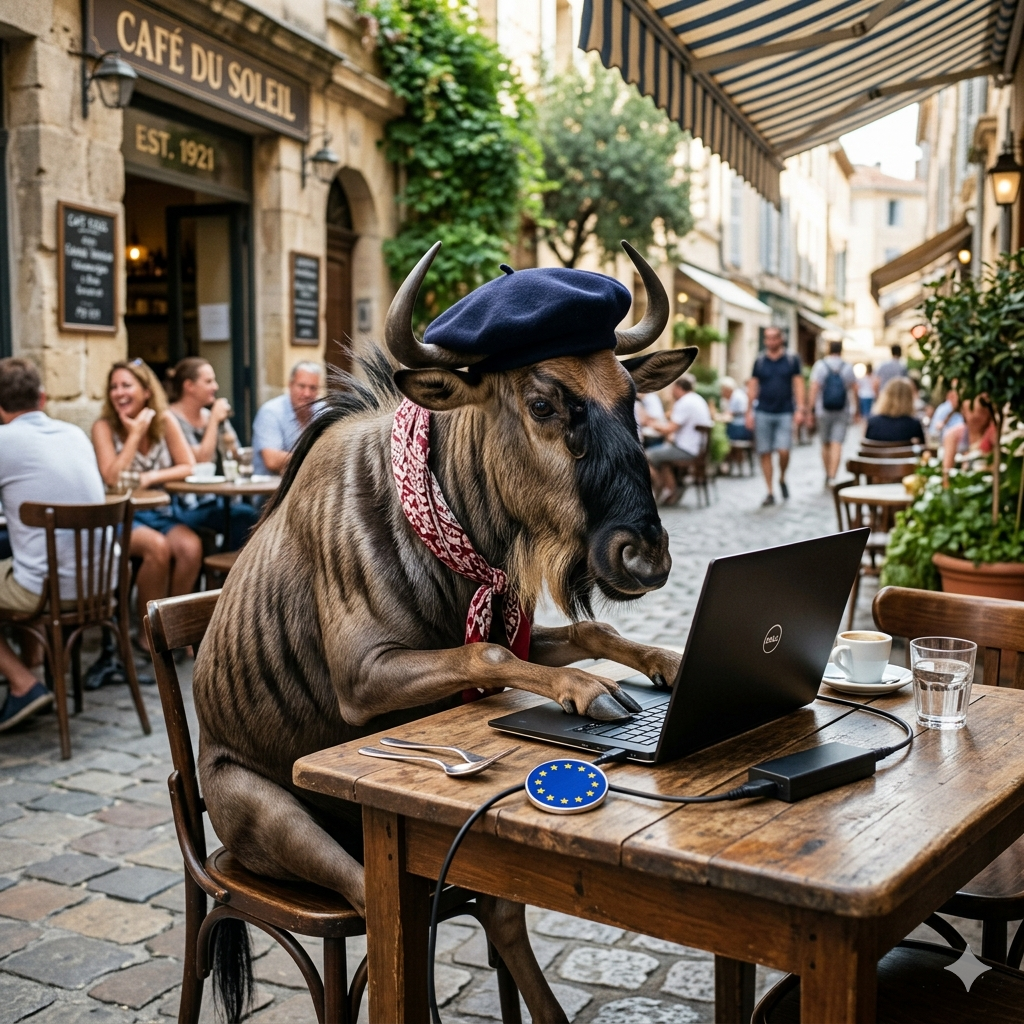
Google Gemini.
For the record, Bredemarket’s U.S. purchased laptop already has a USB-C charging port. Because when the manufacturers were forced to implement this for Europe, it was easier to do it for the rest of the world.
So everyone is happy and enjoying the EU’s listed benefits of consumer convenience, e-waste reduction, and cost savings.
Yes, everyone is happy…for now.
The future
But what happens when wireless charging supports up to 240W? Then you get some REAL cost savings, because manufacturers—especially of small devices—can reduce cost by eliminating charging ports altogether.
Well, except in the EU, where charging mechanisms other than USB-C are illegal. Not just illegal to market: illegal to even sell in the first place.
It’s not that big a deal to throw a USB-C port on to a laptop, which has several ports already.
But a phone?
Even my older iPhone has reduced the number of ports down to one. (Separate headphone jacks disappeared years ago.)
Imagine if Apple, Samsung, and everyone else could sell smartphones with ZERO ports. Not only does this reduce cost, but it helps to preserve the integrity of the device.
And the phone manufacturers will take advantage of this in Asia, the Americas, and Africa.
Google Gemini.
While still maintaining the government-mandated (and more expensive) USB-C versions in Europe.
Because once a government mandates something, it’s nearly impossible to change.
As you know, I’m tired of the simplistic “we use AI” marketing messaging. One reason is because when prospects hear “we use AI,” they may respond with “Oh, that technology that hallucinates.” This is NOT a good selling point.
But what if your tool, whether it is artificial intelligence or a thousand Third World workers, could actually IDENTIFY errors?
Why do scammers target anti-fraud experts? Because sometimes we’re dumb too.
But in this case I didn’t fall for the two deepfake recruiters who emailed me yesterday.
However, I have some concerns about the REAL recruiters that the fraudsters were impersonating.
Deepfake recruiter 1, the Senior Vice President
The first fraudster emailed me early Tuesday morning California time:
Hi John,
I hope you’re doing well. My name is Ethan [REDACTED LAST NAME SPELLED WITH AN “E”], Senior Vice President at Aerotek, a national staffing and recruiting firm.
I’m reaching out regarding a confidential, retained search for a Senior Product Marketing Leader with a real, actively operating company in the identity verification and biometrics space. Your background in product marketing, go-to-market strategy, and competitive intelligence across identity technology firms stood out strongly during our shortlist review.
This role is ideal for leaders who drive product launches, shape competitive positioning, and accelerate growth in B2B/B2G SaaS environments.
If this aligns with what you’re exploring, I’d be happy to share the full role brief.
Best regard Ethan [REDACTED LAST NAME SPELLED WITH AN “A”]
When a Senior Vice President can’t spell his own last name consistently, that’s a warning flag.
When said Senior Vice President emails me from ethan.aerotek.desk2@gmail.com, that’s another.
Turns out Ethan is a U.S. based person employed by Aerotek, with the same picture used in the Gmail account (which I guess qualifies this as a “deepfake”), but he is a Recruiter, not a Senior Vice President.
So I messaged the real Ethan on LinkedIn early Tuesday morning, reproducing the email message above and prepending it with:
Ethan, I received this from a Gmail address
Replying to the fake recruiter
Then I responded to the email from the fake Ethan:
Ethan, I have contacted you via LinkedIn. Please provide your Aerotek email address. Your client will understand.
My final comment probably went over the fake Ethan’s head, but any identity verification company would clearly understand why a candidate would insist on an Aerotek address rather than a Gmail address. Except in certain circumstances that I’ll address later.
And of course Aerotek would be very concerned about fraudsters impersonating real Aerotek employees…or so you’d think.
Back to the fake, who responded a few minutes later. Oddly enough, even though Ethan is U.S.-based, this email indicated that my reply was received in a time zone eight hours ahead of the Pacific Time Zone. Anyway, here’s the fake Ethan’s non-surprising response.
Thank you for reaching out. I’ve been experiencing some technical issues with LinkedIn this week, so I appreciate you continuing the conversation here.
This is the usual tactic employed by scammers. Stay off reputable platforms such as LinkedIn and move the conversation to another platform, in this case email. At least fake Ethan didn’t direct me to WhatsApp or Telegram.
As of Wednesday morning I left both conversations there. I didn’t reply to the fake Ethan’s latest email, and the real Ethan didn’t reply to my messsage.
And that’s a problem.
Concerns about the real recruiter
As I mentioned earlier, Aerotek obviously doesn’t want fraudsters impersonating their employees. And Aerotek employees certainly don’t want fraudsters impersonating them and lifting their facial images for fake Gmail accounts.
But the real Ethan apparently hasn’t checked his LinkedIn account in over 24 hours, and is completely unaware that a fraudster is impersonating him.
Causing damage to him and his employer.
If you’re a recruiter (or any professional) and you have a LinkedIn account, check it regularly. You don’t know what you’re missing.
But let’s move on to deepfake 2: technically not a deepfake since the fraudster only appropriated a name and not a likeness, but worrisome all the same.
Deepfake recruiter 2, the independent and invisible recruiter
The second fraudster emailed me late in the afternoon California time.
Hello John,
I hope you’re doing well.
I recently came across your background in B2B/B2G SaaS product marketing, particularly your work across identity, biometrics, and broader technology markets. Your experience driving product launches, developing go-to-market strategy, and building high-impact content and competitive intelligence frameworks really stood out.
I’m currently supporting a respected technology organization operating at the intersection of SaaS, cybersecurity, and identity, and your ability to bridge complex technical solutions with clear market positioning aligns closely with what they’re looking for.
Given your track record of both strategic thinking and execution (“ask, then act” definitely came through), I believe you could be a strong fit for this opportunity.
If you’re open to exploring, I’d be happy to share a brief overview of the role and why I feel it aligns well with your background.
Looking forward to hearing your thoughts.
Again this person emailed me from a Gmail address, consisting of the person’s name with an appended “8.”
Finding the real recruiter
So I checked out this person also, and discovered a few things.
This is also a real person, based in Europe. So she supposedly sent this email after midnight her time.
The real recruiter DOES have a Gmail address, but without the “8.” Why? Because the person is NOT employed by a huge recruiting firm such as Aerotek, but is a self-employed recruiting specialist. So it’s understandable that the real recruiter has a Gmail address. But as we will see, not advisable.
Her company name is her name with the word “Consulting” appended, according to her personal LinkedIn profile.
So I messaged the real recruiter with the message “Possible scam artist” and the email address (with the “8”) that sent the message.
Replying, and not replying, to the fake recruiter
About an hour later (now well after midnight European time), I received a second email from the fake recruiter that didn’t reference my reply to the first one.
Hello John,
I hope you’re doing well.
I recently came across your background in B2B/B2G SaaS product marketing, and your work across identity, biometrics, and go-to-market strategy really stood out—particularly your experience positioning complex technologies like IAM, biometrics, and AI-driven solutions.
Your track record in product launches, competitive intelligence, and building high-impact content at scale aligns closely with what we’re currently prioritizing.
I’m supporting a respected technology organization that is expanding its product marketing leadership team, and based on your experience, you could be a strong fit—especially given your depth across both public sector (B2G) and commercial (B2B) environments.
If you’re open to exploring, I’d be happy to share a brief overview of the role and why I believe it aligns well with your background.
Looking forward to hearing your thoughts.
I didn’t bother to reply to the second email from the fake recruiter, or to notify the real recruiter of the second email.
Eventually I received a reply to my first email early Wednesday morning…oddly enough, indicating that the fake was in the Pacific Time Zone, not Europe. (Note to scammers: change your computer and software settings so that your time zone matches the time zone of the person you’re impersonating.)
Here’s how the reply began:
Thank you for your message here—and I did see your note on LinkedIn as well. Apologies for the slight delay in getting back to you, I was tied up attending to a few things earlier.
Yeah, sure you saw my LinkedIn InMail.
Anyway, forget about the scammer. Let’s look at the real recruiter.
Concerns about the real recruiter
As I mentioned, the real recruiter has a personal LinkedIn profile and a Gmail address.
And that’s it.
I couldn’t find a LinkedIn company page for her consulting company.
A couldn’t find a website for her consulting company.
In fact, the ONLY reference I found to her consulting company was her personal LinkedIn page.
And that’s a problem.
The fact that she has no LinkedIn posts and no LinkedIn recommendations is another.
Now I’ll grant that many consultants get their business from word-of-mouth. Bredemarket certainly does.
But the only publicly-known way to contact THIS consultant is via email or LinkedIn InMail.
And as of now she hasn’t checked her InMail in over 12 hours.
What if she were to lose access to her LinkedIn account?
If you’re an independent recruiting consultant, own your own website, and don’t depend upon someone else’s social platform.
That’s one reason why Bredemarket offers several ways to reach me, most importantly the contact mechanisms available on my own website, free of the control of Microsoft, Meta, or any other company that could yank my access at the drop of a hat.
But there are others.
Bredemarket’s active platforms as of March 29, 2026.
So if you have content or other needs…such as the need to create content to publicize your recruiting consultancy…why don’t you talk to me?












 Bredemarket