More On The Positive Economic Impact of Age-Controlled Products and Services

The U.S. Census Bureau has provided follow-up information that supplements its earlier report on Native American casinos, which I previously discussed. It turns out that the immigrant populations (you know, people of English and other descents) are cashing in also.

“The national total of state sales tax revenue from sports betting soared 382%, from $190 million in the third quarter of 2021 (when data collection began) to $917 million in the second quarter of 2025, according to the U.S. Census Bureau’s Quarterly Summary of State and Local Tax Revenue (QTAX).

“Sports betting became possible in May 2018 when the U.S. Supreme Court struck down the Professional and Amateur Sports Protection Act. Since then, a majority of states have legalized some form of sports betting; including online, mobile, retail sports betting and pari-mutuels (such as wagers made on horse-racing).

“Sports betting is a growing industry, and the tax revenue it generates helps fund public schools, roads, highways, law enforcement and gambling addiction treatment.”

Read the entire piece here.

The Positive Economic Impact of Age-Controlled Products and Services

When discussing age restricted products and services-the ones that require age verification or age estimation-the discussion often focuses on the negative aspects of these products of services. After all, they are age restricted for a reason: you don’t want a five year old smoking marijuana or playing poker.

But as the providers of age restricted items will remind you, they also provide a positive impact to the community.

And sometimes the government also joins in the chorus of praise.

Here’s what the U.S. Census Bureau says about Native American casinos:

“The expansion of tribal casinos that began in the 1990s helped improve economic conditions faster for American Indians relative to the U.S. population as a whole, according to joint U.S. Census Bureau and university research, though there is still progress to be made: the American Indian poverty rate was 19.6% in 2024, greater than that year’s national average of 12.1%, according to Census Bureau data….

“American Indians living on reservation lands (regardless of the presence of a casino or cash transfer program) saw a 46.5% rise in real per capita income compared to 7.8% for the United States as a whole.”

Read the entire article here.

GeoComply, Geolocation, and First-Party Fraud

(Imagen 4)

As you may know, I am a fan of including geolocation as a factor of identity verification and authentication.

So I was delighted to learn that last Wednesday’s Liminal’s Demo Day on First-Party Fraud started with a demonstration from GeoComply.

How does GeoComply use geolocation to reduce first-party fraud?

1. Collect data from a user’s device: GPS, GSM, WiFi, plus IP addresses.

2. Verify location accuracy. Our rules engine runs hundreds of location data, device integrity, and identity fraud checks on every geolocation transaction to detect suspicious activity.

3. Combine real-time and historical data to detect and flag patterns of location fraud. Our models are constantly updated with the use of machine learning and human intelligence.

In his demonstration, Matthew Boland showed an example of someone who had filed numerous chargeback requests in a short period. That’s a red flag in itself.

But when Boland combined the real-time and historical data to analyze the geolocations of the chargeback requests, he found that many of the requests were filed from the same location as the person’s mailing address. So at least that was legit, and the chargeback requests weren’t being filed from China.

In addition to first-party fraud, GeoComply handles geofencing for gambling operations. To see an example of Super Bowl 2024 attempted gambling transactions in Kansas (good) and Missouri (bad), watch this video.

Kansas City (KS, MO) activity on Super Bowl Sunday.

Does Your Gardening Implement Company Require Age Assurance?

Age assurance shows that a customer meets the minimum age for buying a product or service.

I thought I knew every possible use case for age assurance—smoking tobacco or marijuana, buying firearms, driving a car, drinking alcohol, gambling, viewing adult content, or using social media.

But after investigating a product featured in Cultivated Cool, I realized that I had missed one use case. Turns out that there’s another type of company that needs age assurance…and a way to explain the age assurance method the company adopts.

Off on a tangent: what is Cultivated Cool?

Psst…don’t tell anyone what you’re about to read.

The so-called experts say that a piece of content should only have one topic and one call to action. Well, it’s Sunday so hopefully the so-called experts are taking a break and will never see the paragraphs below.

This is my endorsement for Cultivated Cool. Its URL is https://cultivated.cool/, which I hope you can remember.

Cultivated Cool self-identifies as “(y)our weekly guide to the newest, coolest products you didn’t know you needed.” Concentrating on the direct-to-consumer (DTC or D2C) space, Cultivated Cool works with companies to “transform (their) email marketing from a chore into a revenue generator.” And to prove the effectiveness of email, it offers its own weekly email that highlights various eye-catching products. But not trendy ones:

Trends come and go but cool never goes out of style.

From https://cultivated.cool/.

Bredemarket isn’t a prospect for Cultivated Cool’s first service—my written content creation is not continuously cool. (Although it’s definitely not trendy either). But I am a consumer of Cultivated Cool’s weekly emails, and you should subscribe to its weekly emails also. Enter your email and click the “Subscribe” button on Cultivated Cool’s webpage.

And Cultivated Cool’s weekly emails lead me to the point of this post.

The day that Stella sculpted air

Today’s weekly newsletter issue from Cultivated Cool is entitled “Dig It.” But this has nothing to do with the Beatles or with Abba. Instead it has to do with gardening, and the issue tells the story of Stella, in five parts. The first part is entitled “Snip it in the Bud,” and begins as follows.

Stella felt a shiver go down her spine the first time the pruner blades closed. She wasn’t just cutting branches; she was sculpting air.

From https://cultivated.cool/dig-it/.

The pruner blades featured in Cultivated Cool are sold by Niwaki, an English company that offers Japanese-inspired products. As I type this, Niwaki offers 18 different types of secateurs (pruning shears), including large hand, small hand, right-handed, and left-handed varieties. You won’t get these at your dollar store; prices (excluding VAT) range from US$45.50 to US$280.50 (Tobisho Hiryu Secateurs).

Stella, how old are you?

But regardless of price, all the secateurs sold by Niwaki have one thing in common: an age restriction on purchases. Not that Niwaki truly enforces this restriction.

Please note: By law, we are not permitted to sell a knife or blade to any person under the age of 18. By placing an order for one of these items you are declaring that you are 18 years of age or over. These items must be used responsibly and appropriately.

From https://www.niwaki.com/tobisho-hiryu-secateurs/#P00313-1.

That’s the functional equivalent of the so-called age verification scheme used on some alcohol websites.

I hope you’re sitting down as I reveal this to you: underage people can bypass the age assurance scheme on alcohol websites by inputting any year of birth that they wish. Just like anyone, even a small child, can make any declaration of age that they want, as long as their credit card is valid.

By Adrian Pingstone – Transferred from en.wikipedia, Public Domain, https://commons.wikimedia.org/w/index.php?curid=112727.

Now I have no idea whether Ofcom’s UK Online Safety Act consultations will eventually govern Niwaki’s sales of adult-controlled physical products. But if Niwaki finds itself under the UK Online Safety Act, or some other act in the United Kingdom or any country where Niwaki conducts business, then a simple assurance that the purchaser is old enough to buy “a knife or blade” will not be sufficient.

Niwaki’s website would then need to adopt some form of age assurance for purchasers, either by using a government-issued identification document (age verification) or examining the face to algorithmically surmise the customer’s age (age estimation).

  • Age verification. For example, the purchaser would need to provide their government-issued identity document so that the seller can verify the purchaser’s age. Ideally, this would be coupled with live face capture so that the seller can compare the live face to the face on the ID, ensuring that a kid didn’t steal mommy’s or daddy’s driver’s license (licence) or passport.
  • Age estimation. For example, the purchaser would need to provide their live face so that the seller can estimate the purchaser’s age. In this case (and in the age verification case if a live face is captured), the seller would need to use liveness dectection to ensure that the face is truly a live face and is not a presentation attack or other deepfake.

And then the seller would need to explain why it was doing all of this.

How can a company explain its age assurance solution in a way that its prospects will understand…and how can the company reassure its prospects that its age assurance method protects their privacy?

Companies other than identity companies must explain their identity solutions

Which brings me to the TRUE call to action in this post. (Sorry Mark and Lindsey. You’re still cool.)

I’ve stated ad nauseum that identity companies need to explain their identity solutions: why they developed them, how they work, what they do, and several other things.

In the same way, firms that incorporate solutions from identity companies got some splainin’ to do.

This applies to a financial institution that requires customers to use an identity verification solution before opening an account, just like it applies to an online gardening implement website that uses an age assurance method to check the age of pruning shear purchasers.

So how can such companies explain their identity and biometrics features in a way their end customers can understand?

Bredemarket can help.

U.S. Sports Betting Tax Revenue

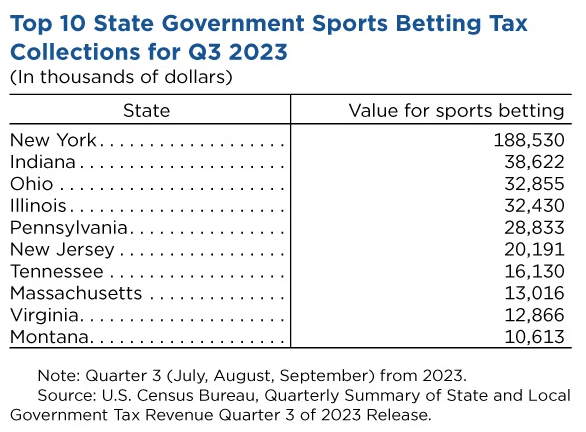
On Tuesday, February 13, Adam Grundy (supervisory statistician in the U.S. Census Bureau’s Economic Management Division) published an article entitled “Quarterly Survey of State and Local Tax Revenue Shows Which States Collected the Most Revenue from Legalized Sports Betting.”

According to Grundy:

New York was the state with the largest share of the nation’s tax revenue in the (third) quarter of 2023: $188.53 million or more than 37% of total tax revenue and gross receipts from sports betting in the United States. Indiana ($38.6 million) and Ohio ($32.9 million) followed.

From https://www.census.gov/library/stories/2024/02/legal-sports-betting.html.

Are you wondering why populous states such as California and Texas don’t appear on the list? That’s because sports betting is only legal in 38 states and the District of Columbia.

Sports betting in any form is currently illegal in California, Texas, Idaho, Utah, Minnesota, Missouri, Alabama, Georgia, South Carolina, Oklahoma, Alaska and Hawaii.

From https://www.forbes.com/betting/legal/states-where-sports-betting-is-legal/#states_where_sports_betting_is_illegal_section.

Sports betting was not legal in Florida during the 3rd quarter of 2023, but was subsequently legalized.

Which returns us to California and Texas, opposites in many ways, who are agreed in the opinion that sports betting is undesirable.

But the remaining states that allow sports betting need to ensure that the gamblers meet age verification requirements. (Even though they have a powerful incentive to let underage people gamble so that they receive more tax revenue.)

“Looks like the over-under for the NBA All-Star Game is 400, Mikey.” By Adrian Pingstone – Transferred from en.wikipedia, Public Domain, https://commons.wikimedia.org/w/index.php?curid=112727

If your identity/biometric firm offers an age verification solution, and you need content to publicize your solution, contact Bredemarket.

How Unusual Gambling Portals Drive the Need for Age Verification and Estimation

Gambling is becoming acceptable in more and more places.

When I was young, and even when I got older, the idea of locating a pro sports team in Las Vegas, Nevada was unthinkable. In the last few years, that has changed dramatically.

The Roblox “Robux” gambing lawsuit

Well, now that gambling for adults has become more and more acceptable (although adults in my home state of California still can’t gamble by phone), now attention is focusing on child gambling.

Designed by Freepik.

And no, the kids aren’t gambling U.S. currency, according to TechCrunch.

In a new class action lawsuit filed in the Northern District of California this week, two parents accuse Roblox of illegally facilitating child gambling.

While gambling is not allowed on the platform, which hosts millions of virtual games that cater to children and teens, the lawsuit points to third-party gambling sites that invite users to play blackjack, slots, roulette and other games of chance using Roblox’s in-game currency.

From https://techcrunch.com/2023/08/18/roblox-children-gambling-class-action-lawsuit-robux/?_hsmi=271025889

But the gambling sites’ terms of service prohibit underage gambling!

I’m not going to concentrate on Roblox here, but on the other defendants—the ones who actually operate the sites that allegedly allow child gambling.

The lawsuit specifically names RBXFlip, Bloxflip and RBLXWild as participants in “an illegal gambling operation that is preying on children nationwide.” 

From https://techcrunch.com/2023/08/18/roblox-children-gambling-class-action-lawsuit-robux/?_hsmi=271025889

But according to Bloxflip’s Terms of Service, it’s impossible that children can be using the site, because the Terms of Service prohibit this.

By accessing Bloxflip or using the Services, you accept and agree to our website policies, including these Terms of Service, and you certify to us that (i) you are eighteen (18) years of age or older, and are at least the age of majority in your jurisdiction, (ii) you are not a resident of Washington, (iii) you have the legal capacity to enter into and agree to these Terms of Service, (iv) you are using the Services freely, voluntarily, willingly, and for your own personal enjoyment, and (v) you will only provide accurate and complete information to us and promptly update this information as necessary to maintain its accuracy and completeness.

From https://bloxflip.com/terms

However, stating a minimum age in your TOS is even less effective than other common age verification methods, such as

  1. Asking your customer to check a box to say that they are over 18 years old.
  2. Asking your customer to type in their birthday.
  3. Requiring your customer to read a detailed description of IRA/401(k) funding strategies and the medical need for colonoscopies. (This would be more effective than the first two methods.)

A better way to verify and estimate ages

As more and more companies are realizing, however, there are other ways to measure customer ages, including a comparison of a live face with a government-issued identification card (driver’s license or passport), or the use of “age estimation” software to ensure that a 12 year old isn’t gambling. (And don’t forget that NIST will test age estimation software as part of its FATE testing.)

Even when the kids aren’t gambling legal currency.