These aren’t prototypes, but production apps used 800,000 times.
But before you apply your domain knowledge and create a vibe coded app, recognize this teeny tiny caveat.
“But here’s what almost nobody in the “I built a SaaS in 4 hours” content wave is telling you:
“I maintain these apps every single day. Every. Single. Day.”
Which means that you have to know how to…well, code. To evolve the code base without breaking other parts of it.
And if you don’t have the skills to MAINTAIN a code base, perhaps you should outsource your software development to humans who CAN maintain it. And who can apply technological rigor to every iteration of the product.
“[A]dversarial Gait Recognition has arisen as a major challenge in video surveillance systems, as deep learning-based gait recognition algorithms become more sensitive to adversarial attacks.”
So Zeeshan Ali and others are working on IMPROVING gait-based adversarial attacks…the better to counter them.
“Our technique includes two major components: AdvHelper, a surrogate model that simulates the target, and PerturbGen, a latent-space perturbation generator implemented in an encoder-decoder framework. This design guarantees that adversarial samples are both effective and perceptually realistic by utilizing reconstruction and perceptual losses. Experimental results on the benchmark CASIA-gait dataset show that the proposed method achieves a high attack success rate of 94.33%.”
Now we need to better detect these adversarial attacks.
“After a careful evaluation of the business and how we can best serve customers, we’ve made the difficult decision to close our Amazon Go and Amazon Fresh physical stores, converting various locations into Whole Foods Market stores.”
We’ve talked about Levels 1 and 2 of iBeta’s confirmation that particular biometric implementations meet the requirements of ISO 30107-3. But now with Yoti’s confirmation, we can talk about iBeta Level 3.
“The test method was to apply 1 bona fide subject presentation that alternated with 3 artefact presentations such that the presentation of each species consisted of 150 Presentation Attacks (PAs) and 50 bona fide presentations, or until 56 hours had passed per species. The results were displayed for the tester on the device as “Liveness check: Passed” for a successful attempt or “Liveness check: Failed” for an unsuccessful attempt.
“iBeta was not able to gain a liveness classification with the presentation attacks (PAs) on the Apple iPhone 16 Pro. With 150 PAs for each of 3 species, the total number of attacks was 450, and the overall Attack Presentation Classification Error Rate (APCER) was 0%. The Bona Fide Presentation Classification Error Rate (BPCER) was also calculated and may be found in the final report.
“Yoti Limited’s myface12122025 application and supporting backend components were tested by iBeta to the ISO 30107-3 Biometric Presentation Attack Detection Standard and found to be in compliance with Level 3.”
“Yoti’s MyFace is the first passive, single-selfie liveness technology in the world to conform to iBeta’s Level 3 testing under ISO/IEC 30107-3 – their highest level for liveness checks.”
“Well, the ancient myths were designed to put the mind, the mental system, into accord with this body system, with this inheritance….To harmonize. The mind can ramble off in strange ways and want things that the body does not want. And the myths and rites were a means to put the mind in accord with the body, and the way of life in accord with the way that nature dictates.”
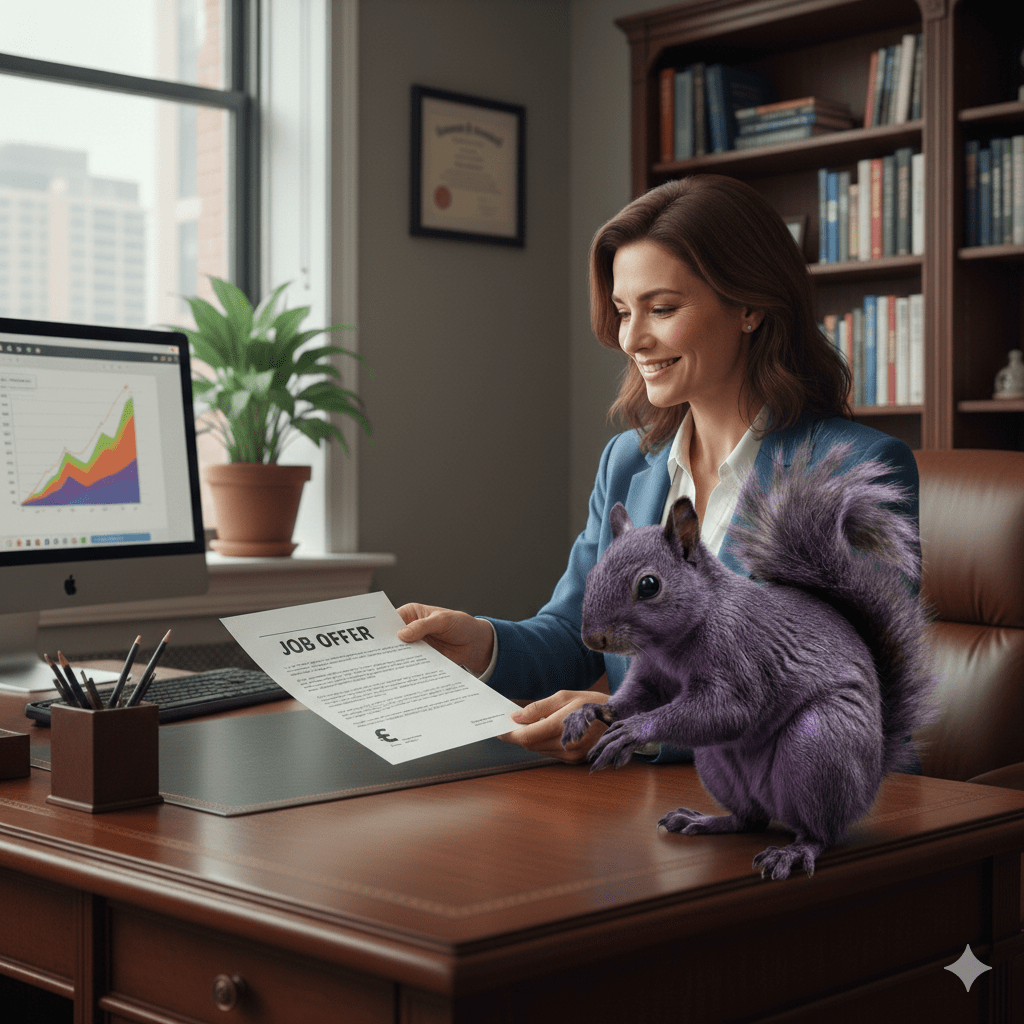
“A purple squirrel is a candidate so rare and perfectly matched to what you need that finding one feels impossible. Someone who checks every single box, including boxes you didn’t even know you cared about.”
Then Welsh provided an example of a purple squirrel, a man named Sagar Patel who worked for him at PatientPop.
On paper pyramids
At the time PatientPop had less than $40,000 in annual revenue, so it didn’t have a huge marketing department. It didn’t even have Bredemarket as a product marketing consultant because Bredemarket didn’t exist yet. And anyway, at the time I knew next to nothing about PatientPop’s healthcare-centered hungry people, physicians who needed to attract prospects and clients via then-current search engine optimization (SEO) techniques.
Google Gemini.
Patel could have launched into a complex, feature-laden SEO discussion, but his target physicians would have responded, “So what?” Doctors want to doctor, not obsess over choosing trailing keywords…and understand the benefits of a solution immediately.
“So Sagar grabbed some notebook paper and drew five sides of a pyramid. He labeled each one, describing his ‘5 sides of local SEO for healthcare providers,’ and then taped them all together.
“He made himself a little paper pyramid to use in his sales pitches.”
Google Gemini. My prompt asked Nano Banana to create a “realistic” picture.
Was Patel’s paper pyramid an effective sales tool for PatientPop? Read Welsh’s article to find out.
What’s your paper pyramid?
Too many companies wait months for the perfect marketing solution instead of doing something NOW and refining it later.
Bredemarket’s different. I ask, then I act.
I ask, then I act.
Once I’ve set my compass, I get my clients a draft within days. Last week alone I turned out drafts for two clients, moving them forward so the content is available to their prospects and clients.
With my suggested schedule for short content—three day drafts, three day reviews, three day redrafts—your new content can become your online “secret salesperson” within two weeks or less.
Don’t believe me? This post alone is chock-full of links to other Bredemarket posts and Bredemarket pages, all of which are functioning as “secret salespeople” for me every single day.
If you want secret salespeople to work for you, talk to me and we’ll devise a plan to improve your product marketing awareness RIGHT NOW.
Now anyone reading that article over the weekend was probably very confused, since the death of Alex Pretti isn’t exactly a DATA breach.
And, of course, Minnesota doesn’t have a “department of homeland security.”
It does, however, have a Department of Human Services…and THAT was what was breached.
“A single user inappropriately accessed private data within the Minnesota Department of Human Services (DHS) ecosystem, potentially impacting 303,965 individuals, officials report.”
This was not a hack per se, but a case in which a legitimate person accessed something they shouldn’t have accessed. Certainly a breach, and the person’s access was terminated.
You know what the problem is with these AI medical bots? They hallucinate and do inaccurate stuff. When you use humans for your medical needs, they’re gonna get it right.
The company that replaced a steel mill with a hospital is in a bit of trouble with the U.S. Department of Justice, in an action started under the Biden Administration and concluded under the Trump Administration.
“Affiliates of Kaiser Permanente, an integrated healthcare consortium headquartered in Oakland, California, have agreed to pay $556 million to resolve allegations that they violated the False Claims Act by submitting invalid diagnosis codes for their Medicare Advantage Plan enrollees in order to receive higher payments from the government….
“Specifically, the United States alleged that Kaiser systematically pressured its physicians to alter medical records after patient visits to add diagnoses that the physicians had not considered or addressed at those visits, in violation of [Centers for Medicare & Medicaid Services (CMS)] rules.”
Now of course you can code a bot to perform fraud, but it’s easier to induce a human to do it.
If you’ve read a few hundred job descriptions, one phrase that you’ll often see is “cross-functional collaboration.” The theory is that the employee (for example, a senior product marketing manager) will seamlessly work with marketing, product, R&D, customer success, sales, finance, legal, and everyone else, all working together for the good of the company.
But the world usually doesn’t work like that. YOUR department is great. The other departments are the bozos.
Google Gemini.
There’s actually a benefit to this when you look at government agencies. If you believe that “the government that governs least” is preferable to Big Brother, then the fact that multiple agencies DON’T gang up against you is a good thing. You don’t want to be chased by the FBI and the CIA and the BBC and B.B. King and Doris Day. And Matt Busby.
But there are times when government agencies work together, usually when facing a common threat. Sometimes this is good…and sometimes it isn’t. Let’s look at two examples and see where they fall in the spectrum.
The Central Intelligence Agency and the Federal Bureau of Investigation in 1972
Normally bureaucrats are loyal to their agency, to the detriment of other agencies. This is especially true when the agencies are de facto competitors.
In theory, and certainly in the 1970s, the Central Intelligence Agency (CIA) and the Federal Bureau of Investigation (FBI) have completely separate spheres of operation. But on the highest level they perform the same function: catch bad people. And each agency certainly wants to take the credit when a bad person is caught. Conversely, if one of the agencies has a bad person, the other one usually works to expose it.
Usually.
A few of you are old enough to remember a third-rate burglary in Washington, DC in 1972. The burglary took place at a political party office in some hotel or another. We now know with the benefit of hindsight that the FBI-CIA rivalry worked. Bob Woodward learned a few days after the break-in that two of the alleged burglars were connected to E. Howard Hunt, a former CIA operative. Who told Woodward?
“Woodward, we now know, had been tipped off by Mark Felt, the deputy director of the FBI. The Bureau had itself become involved in the investigation of a mere burglary because once the police found wiretapping equipment, the investigation fell under its remit.”
Google Gemini.
This is how it should work. Although the mere fact that Hunt knew Bernard Barker and Eugenio Martinez was not a crime, the FBI was certainly bound to investigate the matter.
Until it wasn’t.
“Richard Nixon and senior White House personnel including Chief-of-Staff Bob Haldeman and domestic policy tsar John Ehrlichman devised a strategy to block the investigation. This began to unfold as early as June 23, a mere three days after the break-in. That day, Haldeman proposed to Nixon to “have [Vernon] Walters [deputy director of the CIA] call Pat Gray [director of the FBI] and just say ‘stay the h*ll out of this’ on grounds of ‘national interest.’”
This recorded conversation would become very important two years later, but back in 1972 very few people knew about it. And very few people knew that Gray “destroyed secret documents removed from Howard Hunt’s safe.”
Think about it. If Richard Nixon hadn’t recorded his own conversations, we may have never learned that the CIA partially neutralized an FBI investigation.
But other instances of cross-functional collaboration come to light in other ways.
Immigration and Customs Enforcement and the Transportation Security Administration before 2026
The FBI-CIA episode of 1972 was an aberration. Normally agencies don’t cooperate, even when massive amounts of effort are performed to make them work together.
One prime example was the creation of the Department of Homeland Security (DHS) in 2002-2003. Because it was believed that 9/11 happened because relevant agencies were scattered all over the government, Congress and the President performed a massive reorganization. This affected the Departments of Agriculture, Energy, Health and Human Services, Justice, Transportation, and Treasury.
For our discussion:
The Department of Justice lost the Immigration and Naturalization Service (INS), which was broken up into three separate agencies within DHS. One of these is Immigration and Customs Enforcement, or ICE. Perhaps you’ve heard of it.
The relatively new Transportation Security Administration (TSA) was moved from the Department of Transportation to DHS.
The theory, of course, is that once all these agencies were under the DHS umbrella, they would magically work together to stop the evil terrorists. However, each of the component agencies had vastly different missions. Here is the mission of the TSA:
“Protect the nation’s transportation systems to ensure freedom of movement for people and commerce.”
Well, “freedom of movement” is not the primary part of ICE’s mission:
“Protect America through criminal investigations and enforcing immigration laws to preserve national security and public safety.”
While these missions are not mutually exclusive, the difference in emphasis is apparent. And the agencies competed.
Some of you may remember air marshals. After 9/11, some airline flight passengers were actually air marshals, but the passengers (and any terrorists) didn’t know which flights had air marshals or who they were.
Google Gemini.
The Federal Air Marshal Service (FAMS) was part of the Transportation Security Administration.
“Homeland Security Secretary Tom Ridge announced [in September 2003] that the federal air marshals program will move from the Transportation Security Administration to the Bureau of Immigration and Customs Enforcement (ICE).”
The idea was to concentrate all enforcement operations in one agency, to protect FAMS from uncertain TSA funding, and to allow ICE agents to be cross-trained as air marshals. But this didn’t happen, so two years later FAMS moved from ICE back to TSA.
And both agencies went on their merry little ways.
Immigration and Customs Enforcement and the Transportation Security Administration in 2026
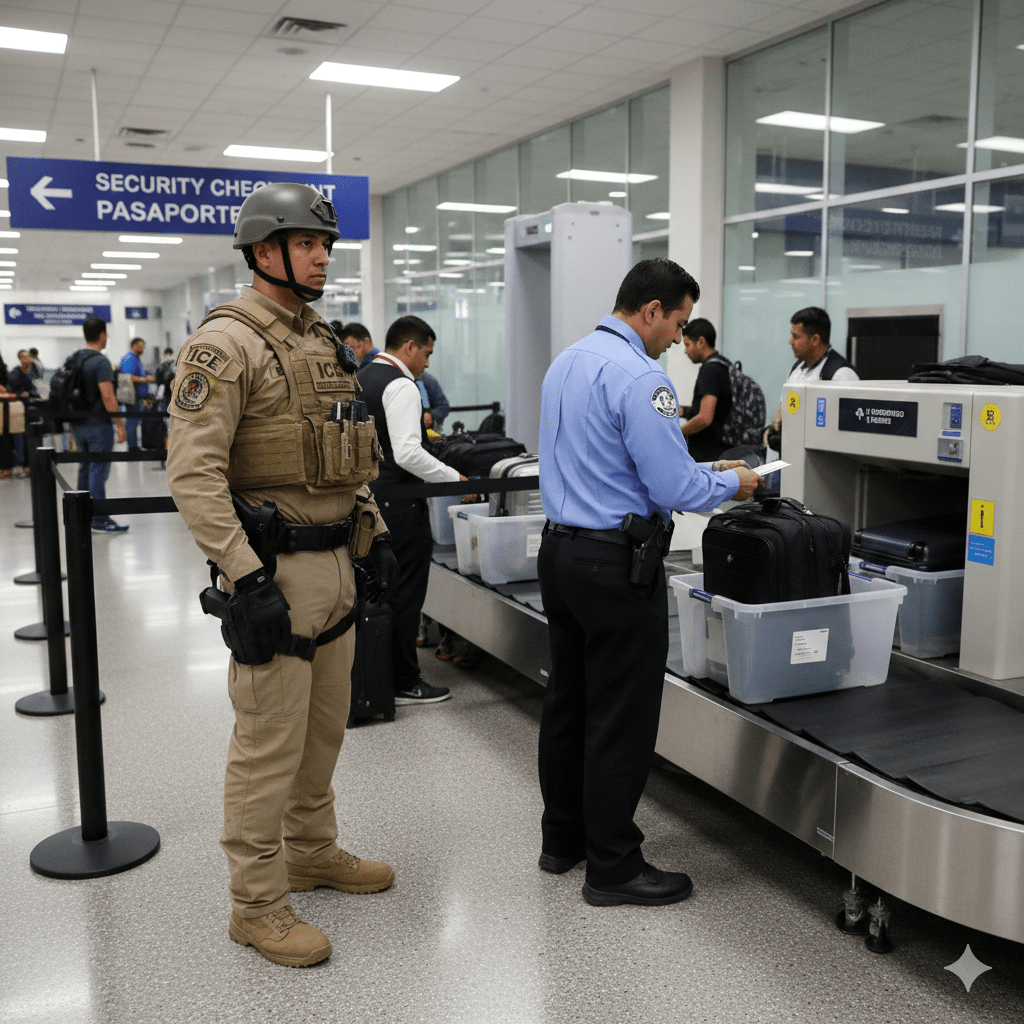
“When Transportation Security Administration (TSA) Acting Director Ha Nguyen McNeill was pressed [by the House Committee on Homeland Security] on reports that ICE is using domestic flight passenger information to support deportation operations, she did not deny cooperation. Instead, she defended it as legitimate intra-departmental coordination and framed it as part of DHS’s overall mission set.
“In response to lawmakers’ questions, McNeill said TSA assistance to ICE is ‘absolutely within our authorities’ when it involves sharing passenger information for immigration enforcement operations.”
McNeill effectively said that TSA doesn’t dump its data on ICE, but responds to individual ICE inquiries.
“Airport travel…becomes a choke point for detentions – no longer just transportation, but a compliance checkpoint for civil enforcement, re-engineering mobility into an enforcement tool.”














 Bredemarket