
(Part of the biometric product marketing expert series)
Apologies in advance, but if you’re NOT interested in fingerprints, you’ll want to skip over this Bredemarket identity/biometrics post, my THIRD one about fingerprint uniqueness and/or similarity or whatever because the difference between uniqueness and similarity really isn’t important, is it?
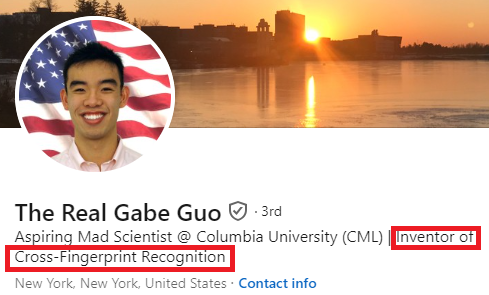
Yes, one more post about the study whose principal author was Gabe Guo, the self-styled “inventor of cross-fingerprint recognition.”
In case you missed it
In case you missed my previous writings on this topic:
- My first post, “Claimed AI-detected Similarity in Fingerprints From the Same Person: Are Forensic Examiners Truly “Doing It Wrong”?” was (1) primarily my perspective, and (2) written before I read the actual paper.
- The second post, “Did the Columbia Study “Discover” Fingerprint Patterns?” was written after I looked at the paper (“Unveiling intra-person fingerprint similarity via deep contrastive learning“) myself, but again suffers from being primarily my own perspective (albeit augmented by people who knew what they were talking about).
- I also wrote something only on LinkedIn (and Facebook) that cited a CNN article that quoted Christophe Champod and Simon Cole. (Interestingly enough, my last post on Cole concerned how words matter, which is appropriate in this discussion.) Unfortunately, the person who wrote the CNN headline (“Are fingerprints unique? Not really, AI-based study finds”) didn’t pay attention to a word that Champod and Simon Cole said.
But don’t miss this
Well, two other people have weighed in on the paper: Glenn Langenburg and Eric Ray, co-presenters on the Double Loop Podcast. (“Double loop” is a fingerprint thing.)

So who are Langenburg and Ray? You can read their full biographies here, but both of them are certified latent print examiners. This certification, administered by the International Association for Identification, is designed to ensure that the certified person is knowledgeable about both latent (crime scene) fingerprints and known fingerprints, and how to determine whether or not two prints come from the same person. If someone is going to testify in court about fingerprint comparison, this certification is recognized as a way to designate someone as an expert on the subject, as opposed to a college undergraduate. (As of today, the list of IAI certified latent print examiners as of December 2023 can be found here in PDF form.)
Podcast episode 264 dives into the Columbia study in detail, including what the study said, what it didn’t say, and what the publicity for the study said that doesn’t match the study.
Eric and Glenn respond to the recent allegations that a computer science undergraduate at Columbia University, using Artificial Intelligence, has “proven that fingerprints aren’t unique” or at least…that’s how the media is mischaracterizing a new published paper by Guo, et al. The guys dissect the actual publication (“Unveiling intra-person fingerprint similarity via deep contrastive learning” in Science Advances, 2024 by Gabe Guo, et al.). They state very clearly what the paper actually does show, which is a far cry from the headlines and even public dissemination originating from Columbia University and the author. The guys talk about some of the important limitations of the study and how limited the application is to real forensic investigations. They then explore some of the media and social media outlets that have clearly misunderstood this paper and seem to have little understanding of forensic science. Finally, Eric and Glenn look at some quotes and comments from knowledgeable sources who also have recognized the flaws in the paper, the authors’ exaggerations, and lack of understanding of the value of their findings.
From https://doublelooppodcast.com/2024/01/fingerprints-proven-by-ai-to-not-be-unique-episode-264/.
Yes, the episode is over an hour long, but if you want to hear a good discussion of the paper that goes beyond the headlines, I strongly recommend that you listen to it.
TL;DR
If you’re in a TL;DR frame of mind, I’ll just offer one tidbit: “uniqueness” and “similarity” are not identical. Frankly, they’re not even similar.
 Bredemarket