
I have three questions for you, but don’t sweat; I’m giving you the answers.
- How long can you survive without pizza? Years (although your existence will be hellish).
- OK, how long can you survive without water? From 3 days to 7 days.
- OK, how long can you survive without oxygen? Only 10 minutes.
This post asks how long a 21st century firm can survive without data, and what can happen if the data is “dirty.”
How does Mika survive?
Have you heard of Mika? Here’s her LinkedIn profile.
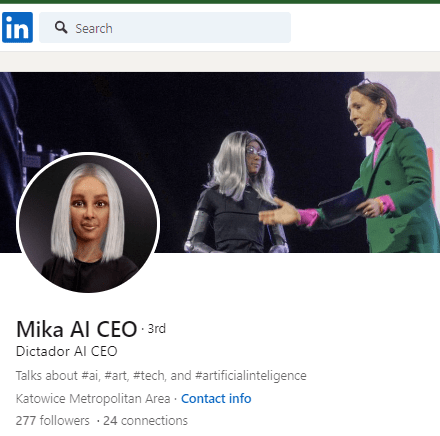
Yes, you already know that I don’t like LinkedIn profiles that don’t belong to real people. But this one is a bit different.
Mika is the Chief Executive Officer of Dictador, a Polish-Colombian spirits firm, and is responsible for “data insight, strategic provocation and DAO community liaison.” Regarding data insight, Mika described her approach in an interview with Inside Edition:
My decision making process relies on extensive data analysis and aligning with the company’s strategic objectives. It’s devoid of personal bias ensuring unbiased and strategic choices that prioritize the organization’s best interests.
From the transcript to https://www.youtube.com/watch?v=8BQEyQ2-awc
Mika was brought to my attention by accomplished product marketer/artist Danuta (Dana) Deborgoska. (She’s appeared in the Bredemarket blog before, though not by name.) Dana is also Polish (but not Colombian) and clearly takes pride in the artificial intelligence accomplishments of this Polish-headquartered company. You can read her LinkedIn post to see her thoughts, one of which was as follows:
Data is the new oxygen, and we all know that we need clean data to innovate and sustain business models.
From Dana Debogorska’s LinkedIn post.
Dana succinctly made two points:
Point one: data is the new oxygen
There’s a reference to oxygen again, but it’s certainly appropriate. Just as people cannot survive without oxygen, Generative AI cannot survive without data.
But the need for data predates AI models. From 2017:
Reliance Industries Chairman Mukesh Ambani said India is poised to grow…but to make that happen the country’s telecoms and IT industry would need to play a foundational role and create the necessary digital infrastructure.
Calling data the “oxygen” of the digital economy, Ambani said the telecom industry had the urgent task of empowering 1.3 billion Indians with the tools needed to flourish in the digital marketplace.
From India Times.
And we can go back centuries in history and find examples when a lack of data led to catastrophe. Like the time in 1776 when the Hessians didn’t know that George Washington and his troops had crossed the Delaware.

Point two: we need clean data
Of course, the presence or absence of data alone is not enough. As Debogorska notes, we don’t just need any data; we need CLEAN data, without error and without bias. Dirty data is like carbon monoxide, and as you know carbon monoxide is harmful…well, most of the time.
That’s been the challenge not only with artificial intelligence, but with ALL aspects of data gathering.

- In 2015, Amazon discovered that because its AI-powered recruiting engine was trained on 10 years of historical data, the tool ended up with a bias to select men rather than women—because that’s why the historical data indicated was a mark of success. Dirty data caused Amazon to scrap the engine.
- In 2001, Enron used mark to market (MTM) accounting to artificially inflate its value. When shareholders discovered that Enron had cooked the books, share price dropped from $90.75 to $0.26. Dirty data caused Enron to cease to exist. Goodbye, Enron field. Hello, Minute Maid Park.
- The industry in which I’ve spent the last 29 years, identity/biometrics, is also wrestling with the issue of clean data. As part of its FRTE testing, the National Institute of Standards and Technology regularly measures demographic effects on facial recognition accuracy. Dirty data caused people to ask questions (“Is facial recognition racist?“), NIST has been providing answers.
In all of these cases, someone (Amazon, Enron’s shareholders, or NIST) asked questions about the cleanliness of the data, and then set out to answer those questions.
- In the case of Amazon’s recruitment tool and the company Enron, the answers caused Amazon to abandon the tool and Enron to abandon its existence.
- Despite the entreaties of so-called privacy advocates (who prefer the privacy nightmare of physical driver’s licenses to the privacy-preserving features of mobile driver’s licenses), we have not abandoned facial recognition, but we’re definitely monitoring it in a statistical (not an anecdotal) sense.
The cleanliness of the data will continue to be the challenge as we apply artificial intelligence to new applications.

Point three: if you’re not saying things, then you’re not selling
(Yes, this is the surprise point.)
Dictador is talking about Mika.
Are you talking about your product, or are you keeping mum about it?
I have more to…um…say about this. Follow this link.

 Bredemarket
5 Comments