I have spoken about taxonomies before, so since I’m going to speak about them again, I might as well define the term. Or let Merriam-Webster do it for me.
“the study of the general principles of scientific classification”
But what about biometric terms themselves? I’ve discussed efforts to remove “problematic” security terms such as “blacklist.” But what about ALL the terms?
So I logged in to my ISO account to obtain my FREE copy.
Did I mention that I haven’t accessed the ISO site in over a year?
So you can guess what happened next: a requirement to change my password. Argh.
Anyway, since Wednesday I’ve been doing a LOT of reading. It turns out that according to this ISO standard, the use of “match” as a verb is deprecated in favor (or favour) or “compare.”
A LOT of reading ahead.
But the biometric product marketing expert can handle it.
I can sum up my solution with the simple phrase “put yourself in your prospect’s shoes.”
Your prospect doesn’t care about your solution, or about your company. Your prospect only cares about its problems, such as a re-election campaign.
Here’s what a Bredemarket client might say to the mayor’s campaign manager.
VENDOR: “No mayor wants the political nightmare of arresting an innocent person because of a tech glitch. It damages community trust and creates a major liability. The Really Cool ABIS (Automated Biometric Identification System) can drastically cut down the risk of “false positives” (the system wrongly flagging an innocent person). “
Kinda long, but I had some splainin to do.
Google Gemini.
But for a vendor to say this, the vendor (or its consultant) must really know ABIS products and function as a biometric product marketing expert.
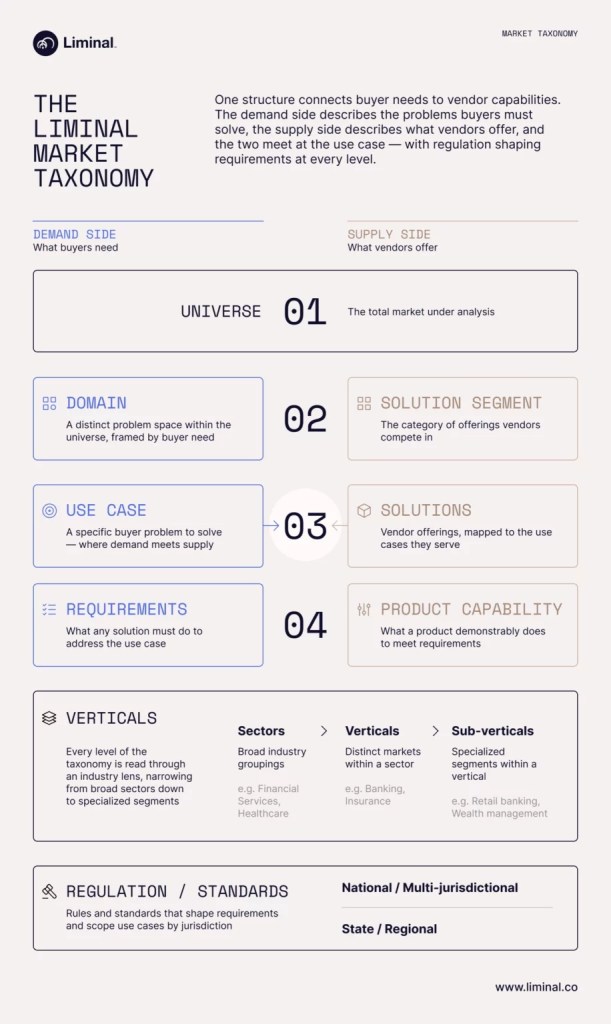
“Markets are messy. Buyers describe their problems in one language, vendors describe their products in another, regulators describe obligations in a third, and practitioners try to hold all of it in their heads at once. Finding trusted market intelligence is hard enough; agreeing on what we’re even looking at is harder still.
“That’s what a market taxonomy is for: one structure that connects what buyers need to what vendors offer, with regulations and market forces shaping the picture at every level.”
So how are they linked? The demand side (buyers) mirrors the supply side (vendors) at every level.
Liminal.
The domain maps to the solution segment. Use cases map to solutions. Requirements map to product capabilities. And translation occurs.
Google Gemini.
In short: even if you’re not a biometric product marketing expert, Liminal lets you fake it.
Are you having trouble finding an asset such as a digital identity or a commercial asset? If you are, there are ways to make things easier to find.
An example from the identity world
Identity Jedi David Lee recently shared his thoughts on “The Hidden Cost of Bad Identity Data (and How to Fix It).” Lee didn’t focus on the biometric data, but instead on the textual data that is associated with a digital identity.
“Let’s say you’re kicking off a new identity program. You know you need user location to drive access policies, governance rules, or onboarding flows. But your authoritative source has location data in five different formats—some say “NY,” others say “New York,” and some list office addresses with zip codes and floor numbers.
“You tell yourself: “We’ll clean it up later.”
“What you’ve really done is commit your future self to a much more expensive project.”
Garbage in, garbage out.
An example from the commerce world
Krassimir Boyanov of KBWEB Consult provides another example of a problem in his post “Why AEM Assets Smart Tagging Makes Your Marketing Work Easier.” Let’s say that you’re managing the images (the “assets”) that display on a company’s online website. You have thousands if not millions of images to manage. How do you find a particular image?
One way to do this is to “tag” each image with descriptive information.
But if you do it wrong, there will be problems.
“Tagging is inconsistent. If 10 people are tagging the items, the tags will probably be inconsistent. While one person tags an item as a “car,” another may tag a similar item as an “automobile.” Although the two assets are similar, this is hidden because of inconsistent tag use.”
Again, garbage in, garbage out.
An organizational solution from the identity world
Lee and Boyanov approach these similar problems from two perspectives.
Lee, as an Identity and Access Management (IAM) expert, approaches this as a business problem and offers the following recommendations (among others):
“Clean early, not late: Push for authoritative sources to normalize and codify the data before it hits the IAM system….
“Push accountability upstream: Don’t accept ownership of fixing problems you don’t control. Instead, elevate the data issue to the right stakeholder (hint: HR, IT, or Legal).”
While Lee can certainly speak to the technologies that can normalize and codify the data, he prefers in this post to concentrate on the organizational issues that cause dirty data, and on how to prevent these issues from reoccurring in the future.
A technological solution from the commerce world
Boyanov can also speak to business and organizational issues as an Adobe Experience Manager consultant who has helped multiple organizations implement the Adobe product. But in this case he concentrates on a technological approach offered by Adobe:
A Taxonomy is a system of organizing tags based on shared characteristics, which are usually hierarchical structured per organizational need. The structure can help finding a tag faster or impose a generalization. Example: There is a need to subcategorize stock imagery of cars. The taxonomy could look like:
Once the taxonomy is defined, assets can be tagged (preferably automatically) in accordance with the hierarchy.
Presumably David Lee’s identity world can similarly come up with a method to standardize addresses BEFORE they are added to an IAM system.
As deep as any ocean
Whether you’re dealing with a digital identity or a commercial asset, you need to ensure that you can find this asset in the future. This requires planning beforehand.
And a content creation project also requires planning beforehand, such as asking questions before beginning the project.
If you are an identity/biometric or technology firm that requires content creation, or perhaps proposal or analysis services, Bredemarket can help. After all, content creation is science…and art.






 Bredemarket