Back when I was with IDEMIA and working with U.S. states to implement (physical) driver’s license production systems, a big word floating around states and their CIOs was “modernization.”
Because many state and federal systems are really really ancient.
But it’s not just governments that have fallen off the path. Many business and government entities, possibly including your own, are in desperate need of modernization, or at least of digital transformation.
Four reasons for digital transformation
Why do you need digital transformation? Here are four reasons why you should transform:
Are you suffering from outmoded manual processes? Do your business processes require a lot of outmoded manual steps? Are there steps that you can automate?
Are you unable to change your business as the market changes? Is your website and other systems locked into a 2015 or 2005 process? If the market changed tomorrow, how long would it take you to change with it? Could you business benefit from a flexible modular implementation that allows rapid change?
Are you blind to your business operations? Can you gather metrics that help you know how your business is doing? For marketers, these could be key process indicators (KPIs) that alert you as prospects move from awareness to consideration to conversion. For operations personnel, these could be performance metrics. But you’re flying blind if you can’t get those metrics, or if you’re getting the wrong metrics.
Are your customers unhappy? This is probably the biggest reason of all. Do your current systems frustrate your customers? For businesses (i.e. firms where customers do not have to content with a government monopoly), are your customers about to flee elsewhere?
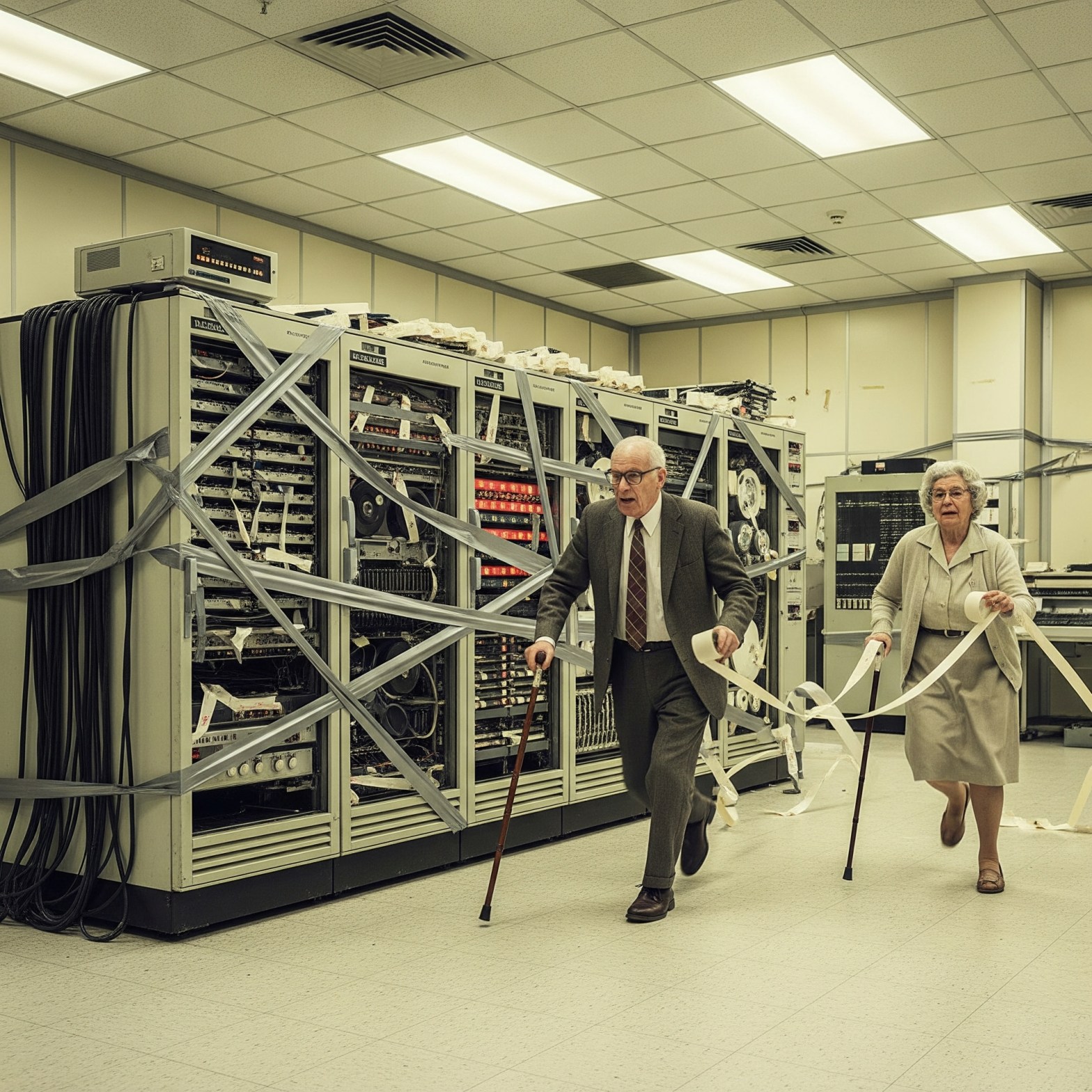
The need for modernization. Imagen 4.
Yes, you have to perform a cost-benefit analysis, but in many cases you’ll realize future revenue by transforming your digital system and removing inefficiencies.
Two digital transformation experts
There are a number of consulting firms that can help you digitally transform your systems. Bredemarket is NOT one of them (although I can help you transform your marketing).
But it doesn’t matter with me now, because this post is going to highlight two other firms that can help you perform digital transformation: one very specific, and one that is general.
Adobe Experience Cloud Digital Transformation: KBWEB Consult
If you have a mid-sized business and need to digitally transform your Adobe Experience Manager implementation, or other parts of your Adobe Experience Cloud solution, KBWEB Consult is the firm to help you. KBWEB Consult and its people have transformed digital solutions for Kaiser Permanente, LinkedIn, Shimano, and other firms.
General Digital Transformation: Silicon Tech Solutions
If you have wider digital transformation needs, talk to Silicon Tech Solutions. Offering custom software development and other services in addition to digital transformation, Silicon Tech Solutions addresses multiple needs for small and mid-size businesses. With a team that has gained experience from employment at Amazon and Facebook and from multiple consulting projects, Silicon Tech Solutions is ready to help your firm.
Get more information from Silicon Tech Solutions by contacting them via Bredemarket at my Silicon Tech Solutions page and clicking on the Silicon Tech Solutions logo.
Just last week, I mentioned that the state of Utah appointed the Department of Government Operations’ first privacy officer. Now Maryland is getting into the act, and it’s worth taking a semi-deep dive into what Maryland is doing, and how it affects (or doesn’t affect) public safety.
According to Government Technology, the state of Maryland has created two new state information technology positions, one of which is the State Chief Privacy Officer. Because government, I will refer to this as the SCPO throughout the remainder of this post. If you are referring to this new position in verbal conversation, you can refer to the “Maryland skip-oh.” Or the “crab skip-oh.”
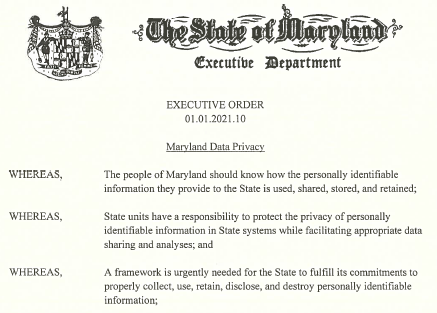
Governor Hogan announced the creation of the SCPO position via an Executive Order, a PDF of which can be found here.
Let me call out a few provisions in this executive order.
A.2. defines “personally identifiable information,” consisting of a person’s name in conjunction with other information, including but not limited to “[b]iometric information including an individual’s physiological or biological characteristics, including an individual’s deoxyribonucleic acid.” (Yes, that’s DNA.) Oh, and driver’s license numbers also.
At the same time, A.2 excludes “information collected, processed, or shared for the purposes of…public safety.”
But on the other hand, A.5 lists specific “state units” covered by certain provisions of the law, including both The Department of Public Safety and Correctional Services and the Department of State Police.
The reason for the listing of the state units is because every one of them will need to appoint “an agency privacy official” (C.2) who works with the SCPO.
There are other provisions, including the need for agency justification for the collection of personally identifiable information (PII), and the need to provide individuals with access to their collected PII along with the ability to correct or amend it.
But for law enforcement agencies in Maryland, the “public safety” exemption pretty much limits the applicability of THIS executive order (although other laws to correct public safety data would still apply).
Therefore, if some Maryland sheriff’s department releases an automated fingerprint identification system Request for Proposal (RFP) next month, you probably WON’T see a privacy advocate on the evaluation committee.
But what about an RFP released in 2022? Or an RFP released in a different state?
Be sure to keep up with relevant privacy legislation BEFORE it affects you.




 Bredemarket