“[Product marketers are] told to be data-led, technical, commercial, and customer-obsessed—all while moving at lightning speed. Someone in your company likely thinks you own everything from win rates and pipeline to product roadmaps and internal comms. But the best PMMs don’t try to be everything for everyone.”
However, it’s tough to maintain focus when prospects, or employers, are looking for ways to save money.
Once I applied for a product marketing position in which the job description talked solely about product marketing.
The interview went fine…for the first five minutes.
Then the interviewer asked about my experience in leading demand generation programs, and my experience in leading analyst relations programs.
While I’ve contributed to such programs at Motorola, Incode, and some of my Bredemarket clients, I’ve never actually led these programs.
The interview ended five minutes later.
(Incidentally, if the job description had actually stated that experience running demand generation and analyst relations was required, the interviewer would have saved a lot of time. Me also.)
So no, Bredemarket won’t run your account-based marketing (ABM) program to market your products…but I’ll ensure you have the customer-focused benefit statements to ensure ABM success.
After all, I know what to ask.
I ask, then I act.
So if Bredemarket can help you with product-focused strategy and content for demand generation, account-based marketing, or analyst relations, talk to me.
Normally it’s not economically feasible for me to write emails for Bredemarket, since I (for once) agree with the experts and keep my emails in the 100-word range. Because my normal minimum word length is 400 words, I usually don’t write emails for clients.
Except when the demand generation director on this client’s project envisions AN ENTIRE SEQUENCE of emails.
The demand generation director’s desired email sequence
You see, the demand generation director…um…demanded that I write an entire email sequence.
The first email in the sequence introduces the client.
The second one provides more information about why the client’s services benefits their customers.
Further emails build upon the previous information.
At the end of the sequence is the final email, with a clear call to action for the prospect to visit the client’s “landing page” and request a meeting with the client.
By the way, did you know that you can request a meeting with Bredemarket? Just go to https://calendly.com/bredemarket/ if you’d like to meet with me for a “content needs assessment.”
Actually, EVERY email in the sequence includes a link to go to the landing page and request a meeting. These are called “discovery meetings” in the trade, but you don’t have to call them that if you don’t want to. As noted above, I refer to my client meeting as a “content needs assessment.” Call the meetings wildebeests if you feel like it.
Back to my client’s demand generation director. The sequence of emails they requested tells a story. But rather than telling a short story in a single email, this sequence includes multiple emails, in which the content in each email builds upon the previous email, like chapters in a book.
Which leads me to Charles Dickens.
Charles Dickens gave birth to your marketing email sequence
Most of the novels, including Nicholas Nickleby, Dombey and Son, David Copperfield, Bleak House, Little Dorrit, and Our Mutual Friend, appeared in monthly parts following a very specific formula developed by Dickens and his publishers with the release of Dickens’s first full-length novel The Pickwick Papers (1836 – 37). The Pickwick Papers appeared in 20 parts over a period of 19 months. (The last part was a “double issue” that included parts 19 and 20). Each part contained 32 pages of letter press, 2 illustrations, various advertisements, and came wrapped in a flimsy green-paper front and back cover. The price for each part was one shilling (except for the last “double issue,” which was two). This price was very cheap compared to the standard price of a book, which at the time was 31 shillings 6 pence.
Other than cost savings, why did Dickens and his publishers share his content in serial form?
Dickens’s 20-part formula was successful for a number or reasons: each monthly number created a demand for the next since the public, often enamored of Dickens’s latest inventions, eagerly awaited the publication of a new part; the publishers, who earned profits from the sale of numbers each month, could partially recover their expenses for one issue before publishing the next; and the author himself, who received payment each time he produced 32 pages of text (and not necessarily a certain number of words), did not have to wait until the book was completed to receive payment.
So serialization helped Charles Dickens create demand, generate wealth, AND get the girl. Can’t argue with that. (Although they subsequently separated.)
What about your stories?
I am not Charles Dickens, but I’m trying to incorporate storytelling into Bredemarket’s work.
For example, the email sequence I created for the demand generation director shares details about how the problems the prospects may face, and how the client has helped their customers overcome these problems.
It all fits into the client story.
What’s the most important question to ask before telling a client story?
As I’ve said before, WHY is the most important question.
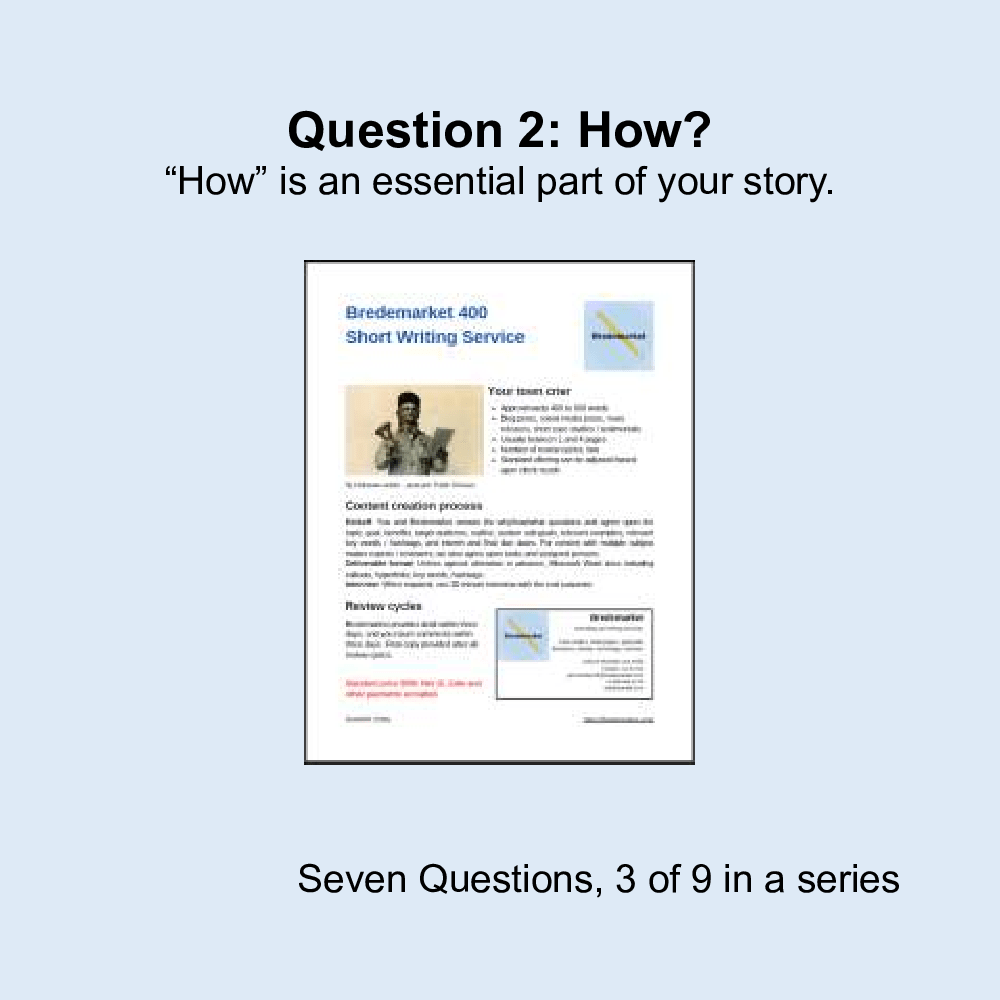
If you’d like to see all seven of the questions that your content creator should ask you, look below. And no, it’s not in seven serial mini-books, but in a single volume.
First example: A couple of years ago, when consulting for a large client, I worked on a proposal with one of the client’s partners, and one of the employees in the partner organization happened to be a former coworker from MorphoTrak.
Second example: This morning I’m meeting with Gene Volfe, a former coworker at Incode Technologies (we started at Incode on the same day). We’re working on a project together that requires Gene’s demand generation skills and my content skills…which we will be employing for the benefit of another former MorphoTrak coworker.
Third example: Speaking of Incode, two of my former coworkers are reuniting at a different company. As a sign that these two know each other well, one made a point of saying to the other, “Go Bills!”
And yes, Gene, I remember how you like Google Docs…









 Bredemarket