Who Will Tell Your Stories, the YouTube Version

There was once an old storyteller who sat by the fire near the beach, sharing his stories with the young.

Then one day the storyteller was rightsized in a move to generate efficiencies and optimize outcomes.

This is not fiction. 

Who will tell your stories? Bredemarket can try (learn about my content-proposal-analysis services here), but in the end I will probably be forced to construct new ones that lack the depth of the old ones.

From https://youtube.com/shorts/_89Jtq6AKno?si=KmcdeuSRCAA6KC9a

Who Will Tell Your Stories, the Instagram Version

There was once an old storyteller who sat by the fire near the beach, sharing his stories with the young.

Then one day the storyteller was rightsized in a move to generate efficiencies and optimize outcomes.

This is not fiction. 

Who will tell your stories? Bredemarket can try (learn about my content-proposal-analysis services here), but in the end I will probably be forced to construct new ones that lack the depth of the old ones.

From https://www.instagram.com/reel/DEPzECfJIyk/?igsh=NTc4MTIwNjQ2YQ==

Who Will Tell Your Stories?

(All images from Imagen 3—Google Gemini)

There was once an old storyteller who sat by the fire near the beach, sharing his stories with the young. All the kids were fascinated with the tales told by the storyteller. The story of how the fire was lit. The story of why they came to the beach.

Then one day the storyteller was rightsized in a move to generate efficiencies and optimize outcomes.

Thank you for your service.

And no one told the stories any more. So the kids ate Tide Pods.

This is not fiction. 

Companies are draining their acquired institutional knowledge, or never acquiring any in the first place. 

Perhaps today is the last working day for someone at YOUR company. Someone whose knowledge will be forever lost.

Because your company’s commitment to diversity, equity, and inclusion stops when the hairs turn gray. We don’t want any of THAT around here. Who cares about the brain drain when we have AI?

Using AI to solve the brain drain doesn’t end well.

Who will tell your stories? Bredemarket can try (learn about my content-proposal-analysis services here), but in the end I will probably be forced to construct new ones that lack the depth of the old ones.

Identity/biometric CMOs, Are You Content With Silence?

(Part of the biometric product marketing expert series)

(Silence image Google Gemini)

If you’re a Chief Marketing Officer at an identity/biometric company, you are well aware that a challenging 2025 is just around the corner. How do you claim awareness for your products and services when your competitors are posting content?

I know how many firms approach this: silence, or saying nothing. It sounds like the wrong thing to do…and it is!

Bredemarket helps its clients say something, if they choose to speak. Some of Bredemarket’s prospects have opted to wait months before letting Bredemarket create content for them—blog posts, articles, case studies, white papers, proposals, analyses.

Some prospects never become clients, so I never create content for them. A few are no longer in business today. Correlation doesn’t equal causation, but maybe Bredemarket could have helped keep the doors open.

For these reasons, I think that saying something is better than silence.

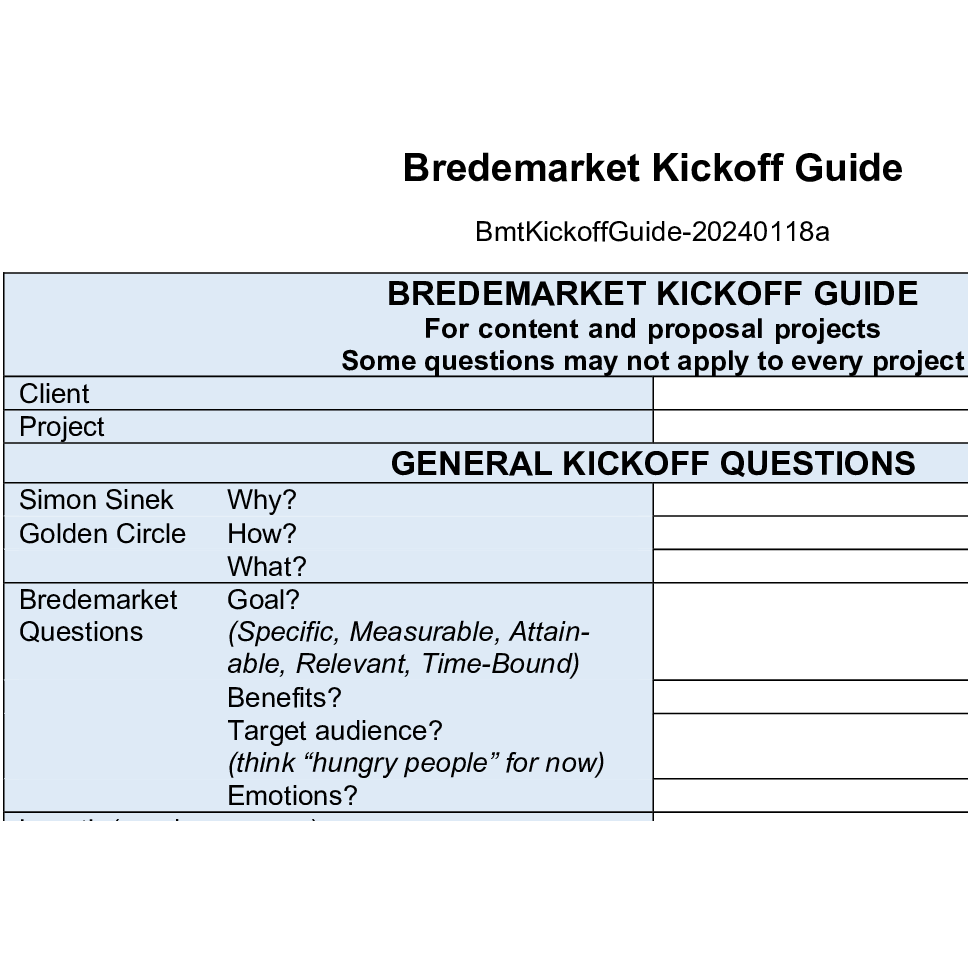
But not just anything. Before Bredemarket writes a single word for its clients, I obtain the answers to seven questions about your content:

Then I work with you in an iterative fashion to create the content you need.

So don’t maintain silence. Schedule a free meeting with me to move forward now.

Identity/biometric CMOs, Are You Silent?

(Silence image Google Gemini)

If you’re a Chief Marketing Officer at an identity/biometric company, maybe your company has exercised its right to remain silent.

Saying nothing to its prospects or clients.

You know this isn’t good.

As it turns out, I have a solution that guarantees that your company will say something meaningful.

But I’m not going to bother to share it today.

What’s the rush?

I can wait until next week.

Or next year.

What could go wrong?

Hey, it doesn’t feel good when Bredemarket doesn’t share helpful information with YOU.

Now ask how your prospects feel when YOU don’t share helpful information with them…and your competitors do.

Stay tuned.

In the Long Run, Can Your Company Be Saved?

Effective product marketing usually won’t help you make your numbers this quarter. But it can provide long-term benefits…if properly executed and maintained.

A Cautionary Tale

In a down employment market such as the one the tech industry is experiencing right now, the common wisdom is that if a company isn’t hiring new employees, it can definitely use independent consultants.

Sometimes the common wisdom is faulty.

One of Bredemarket’s former clients (whom I will not name) illustrates the gaps in the common wisdom. I had worked on projects for this company several times…until I didn’t.

  • Because of a company reorg, my contact at the company changed, and the new contact sent a project my way.
  • Halfway through the project I was asked to stop work with no explanation.
  • When a direct report to my new contact reached out to get to know me, the report assured me that the stop work order had nothing to do with me. 
  • My contract was about to expire, but the direct report said it would probably be renewed. (Admittedly the direct report had no decision-making authority).
  • A month later, I found myself unable to log in to the company’s contractor website.
  • I reached out to a third party (not employed by the company) who managed its contractors. The third party confirmed that my contract had not been renewed.
  • I executed my offboarding process for removing confidential company information and informed my company contact. I received no response. (Not surprising. Many people, rather than delivering or confirming bad news, will say nothing at all—ghosting.)
  • I subsequently learned that the company was performing multiple rounds of layoffs, in a “the layoffs will continue until morale improves”style.

If Properly Executed

If I had provided said company with top-notch content-proposal-analysis work, would those laid-off people have kept their jobs?

Probably not. Content, proposal, and analysis work is not a quick fix.

  • Content, for example, often takes as many as 17 months to bear fruit.
  • The proposal process is only part of a long-term effort, which may start years before a Request for Proposal (RFP) is released, and may not end for years after a proposal is submitted in response to the RFP.
  • And analysis itself is just the first step in a long process. After you analyze something, you have to decide what to do with the results.

While not a quick fix, doing the work now will benefit the company in the long run. Even in the short term, setting the strategy communicates to everyone, including both internal and external stakeholders, the direction in which your company is heading.

If Properly Maintained

But you can’t just treat this as a one-time oroject and be done with it. Looking at the content portion alone, you have to regularly revisit your content and update it as needed.

This is a trick I learned back in my proposal days. Some of my former employers used proposal management software packages, many of which used a “timeout” feature on standard proposal text that required someone to review the text by a certain date. 

Does your proposal text state that your software supports Windows 10? Perhaps it’s a good idea to mention Windows 11 also. 

Or you may need to revise your standard proposal text to mention that new feature…or new benefit. Any proposal text for a health application that was written in December 2019 definitely required an update in December 2020.

What this means for your company

If you haven’t laid the groundwork for your company’s product marketing, Bredemarket can help in a variety of ways. After asking questions (starting with “Why?”) about your needs, we can jointly decide on the most critically important things Bredemarket can do for you and your company.

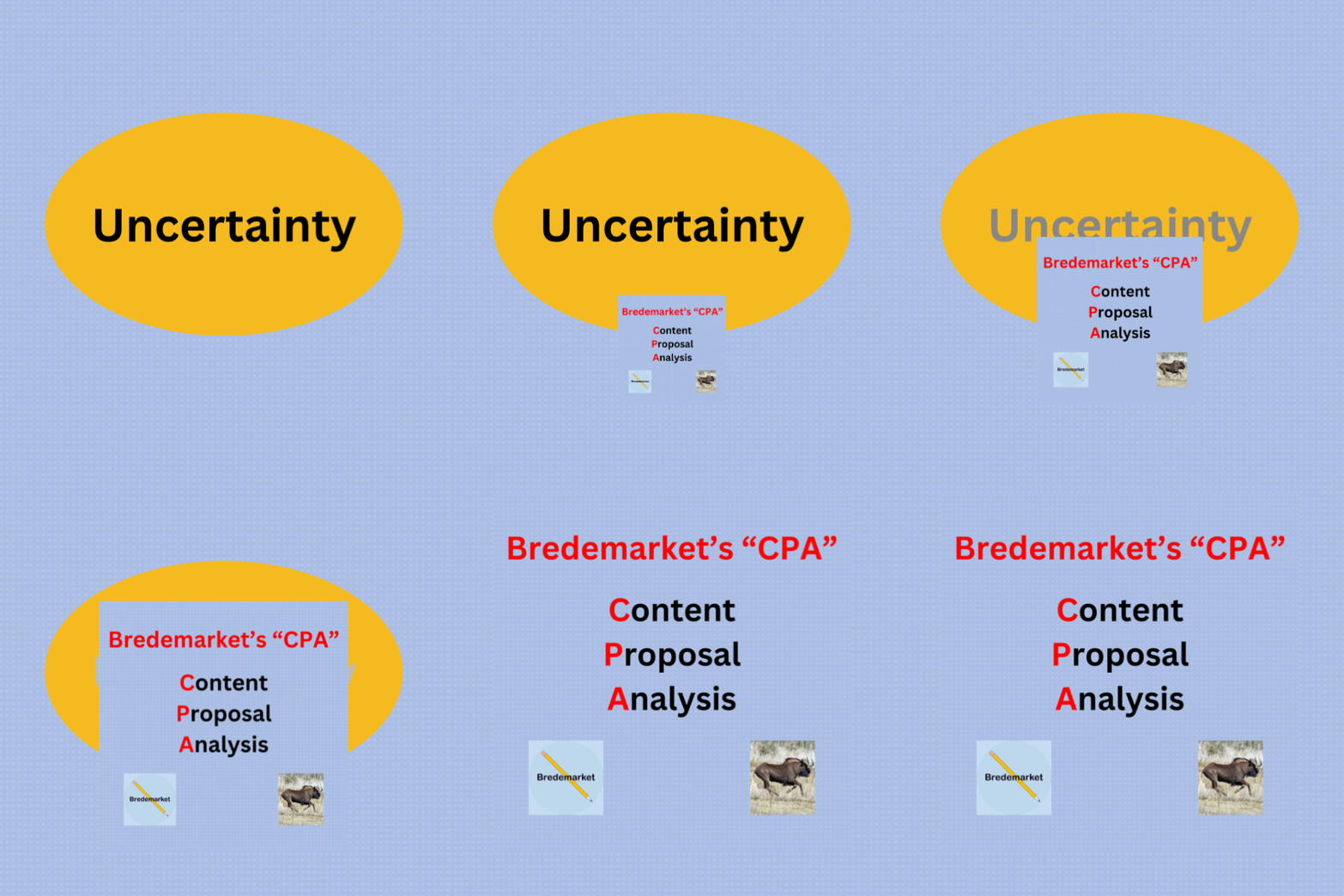
To find out how John E. Bredehoft of Bredemarket can serve as your “CPA” (Content-Proposal-Analysis marketing professional), go to my CPA page.

Postscript

And no, I’m not going to share an Eagles song. I’m going to share a Madness song.

(AI wildebeest “Keep Moving” image from Google Gemini)

Are You “Everybody Else”?

“Everybody uses ChatGPT.”

“Everybody uses the STAR method.”

Are you everybody else?

Not Everybody Uses ChatGPT

I’m sure I’ve tried ChatGPT at some point during the last two years.

But I don’t use it on a regular basis.

Even though whenever someone talks about generative AI, they usually talk about ChatGPT and nothing else.

So if I want to be like everybody else, I would use ChatGPT just like everybody else does. After all, I am a human and I need to be loved.

But if I were to use ChatGPT regularly, that would require me to create an account.

And I have too many accounts already.

Why not use the credentials of one of my existing accounts for generative AI work?

Not Everybody Uses the STAR Method

And if you want to send a prompt to ChatGPT, ask it to reformat a story based upon the STAR method.

For the few who don’t know what that acronym means, you’re obviously behind the times because everybody uses the STAR method.

The acronym STAR stands for Situation, Task, Action, Result. You can apply this in many situations: for example, during a job interview, you could describe one of your past accomplishments using this format.

After all, it only takes four steps.

But what if I can accomplish the same, um, result in THREE steps?

  1. Problem
  2. Solution
  3. Result

That’s the format that Bredemarket used when writing a dozen case studies for an identity/biometric client.

And it worked just fine.

The client’s prospects didn’t stop doing business with the client because it didn’t differentiate between the situation and the task, or the task and the action, or whatever.

The prospects wanted, um, results, not a deep outline.

Not Everybody Fails to Differentiate

I’ve railed about a lack of differentiation before, but for some odd reason the billions of workers in the world don’t listen to me.

They still think the key to success is to copy what everyone else is doing.

But if I were to intentionally adopt a yellow website them and wear retro glasses and sing a lot like Ray of Social’s Georgia Williams, that doesn’t mean that I can achieve the same results that she can.

For one, if you call her to have a natter about your mish, she probably won’t talk about wildebeests at all.

But she’s still doing OK.

You need to adopt your own tone of voice. I was just discussing this with a Bredemarket client regarding a critical piece of content that needs to be in the client’s own voice. Not mine. Not Georgia’s.

So communicate your way, use your preferred generative AI platform, and use your preferred storytelling method.

You be you.

Addendum about this post

Someone scheduled a half hour meeting with me this morning. While waiting for the person to show (they never did), I completed most of this post.

So the half hour wasn’t completely wasted.

(And it could very well be that the person had a valid reason for not showing. I will, or won’t, find out.)

Another addendum about this post

For those who caught my line

I would use ChatGPT just like everybody else does. After all, I am a human and I need to be loved.

here’s the video. But I want to hear Georgia singing it.

(Note to self: find the “This Charming Charlie” website, in which Charlie Brown cartoons are adapted to contain Smiths lyrics.)

Do You Feel Like We Do

Have you ever been told to do something because one of your competitors does it?

Or have you ever been told to do something because it worked for an expert?

(A little secret: it didn’t work for the expert either. If it did, the expert would be like Myspace Tom and retire completely, rather than hawking The Expert Method of Success in Whatever.)

You be you. And the people who feel like you do will gravitate to you.

Justin Welsh (usually) trusts himself

Last Saturday, Justin Welsh wrote about learning to trust yourself. Here’s the TL;DR version:

The most profitable decisions I’ve made came from trusting my instincts….

Every time, someone with more success than me said I was wrong. And every time, my intuition ended up being right. Not because I’m the smartest person in the world. I’m not. My intuition is right because I know what works best for me.

We each have a way we want to conduct business (and life). The way that someone else conducts business is literally alien to us. I couldn’t be Larry Ellison if I tried…and Larry Ellison couldn’t be me.

I (usually) trust myself

As an example, take the title of my blog post “Do You Feel Like We Do,” and how wrong it is.

  1. Let’s start with the first thing I did wrong: I referred to a song title that many of you don’t recognize.
  2. Now the second thing I did wrong: The reason you don’t recognize the song title is because the song in question is a half-century old. In a world where people discount work that relies on sources predating 2000, this is a fatal move.
  3. Can I move on to my third grievous error? The primary reason that I used that title is because when I repurpose this text (originally a blog post) as an Instagram post, I know exactly which audio I’m going to use.
  4. And number four takes the cake. I’m illustrating this piece with a CURRENT picture of Frampton, in which he looks decidedly different when he said…whatever he said on his talk box.

But what’s done is done. So I’m posting this on my blog (and elsewhere) and probably won’t delete later.

What does this mean for YOUR communication?

Now as part of Bredemarket’s content creation process, I will write words for other people.

But I don’t want them sounding like me and talking about wildebeests and citing 50 year old songs.

For example, I won’t write in a Sage tone when my client requires a Maverick tone.

So how do I ensure that the text I write for you sounds like you?

By the questions I ask.

Once I know why you do things, how you do them, and so forth, any resulting content will reflect your unique tone and values.

And your involvement at critical points in the process ensures that the final piece sounds right.

If you can use Bredemarket’s content services, or my proposal or analysis services, contact me.

Bredemarket’s “CPA“: Content – Proposal – Analysis.

You won’t see this part of the post on Instagram

As I mentioned above, this blog post is being repurposed on Instagram, but you won’t see this part.

Because Instagram doesn’t like YouTube videos.

Warning: for those who are not familiar with the album “Frampton Comes Alive,” the live version of “Do You Feel Like We Do” is long.

From https://www.youtube.com/watch?v=d3SbJHwBgbA.