I admit to a bit of frustration. For years, some states resisted REAL ID because of federalism concerns. (When MorphoTrak was briefly trying to win driver’s license contracts by competing against our sibling MorphoTrust, I remember one state RFP that explicitly stated that the state would NOT comply with the REAL ID mandate.)
Finally, after hemming and hawing, all of the states agreed to become REAL ID compliant (15 years after the original mandate). Then, as people rushed to get REAL IDs, #covid19 hit and the driver’s license offices closed.
The offices are now open, but some people STILL haven’t gotten REAL ID.
Prediction: if the deadline is extended to 2022, significant numbers of people won’t have REAL IDs by 2022.
Well, I will never get the chance to see if my prediction was accurate, because in the end, the REAL ID deadline was NOT extended to 2022.
It was extended to 2023, according to sources. (As I write this, the DHS website has not yet been updated.)
The Department of Homeland Security will delay the requirement for air travelers to have a Real ID-compliant form of identification, pushing it back 19 months, DHS Secretary Alejandro Mayorkas said Tuesday.
The deadline was supposed to be Oct. 1, but it’s now being postponed until May 3, 2023.
Here’s the rationale that Secretary Mayorkas provided.
“Extending the Real ID full enforcement deadline will give states needed time to reopen their driver’s licensing operations and ensure their residents can obtain a Real ID-compliant license or identification card.”
Of course, since may people object to REAL ID on principle, it could be extended again and again for ANOTHER fifteen-plus years and people STILL won’t get it.
I took this picture on the morning of April 5, 2017. I had just flown from Ontario, California to Las Vegas, Nevada to attend the ISC West show for a day, and would fly home that evening.
The idea of gathering thousands of businesspeople together in Las Vegas for a day obviously wasn’t unusual in 2017. While many think of Las Vegas as a playground, a lot of work goes on there also, and Las Vegas has superb facilities to host conventions and trade shows. So superb, in fact, that Oracle announced in late 2019 that it was moving its annual Oracle OpenWorld conference from San Francisco (up the road from Oracle’s headquarters) to Las Vegas.
But then 2020 happened.
One month after Oracle started planning for the Las Vegas debut of Oracle OpenWorld, the 2020 Consumer Electronics Show took place in Las Vegas. Unbeknownst to the 170,000 attendees at that show, they were unknowingly spreading a new illness, COVID-19. They did this by doing things that people always did at trade shows, including standing next to each other, shaking hands, and (in business-appropriate situations) embracing each other.
Of course, the CES attendees didn’t know that they were spreading coronavirus, and wouldn’t know this for a few months until after they had returned home to Santa Clara County, California and to other places all around the world. By the time that CES had been identified as a super spreader event, Las Vegas convention activities were already shutting down. The 2020 version of ISC West had already been postponed from March to July, was then re-postponed from July to October, and would eventually be cancelled entirely. Oracle OpenWorld’s September debut in Las Vegas was similarly cancelled. As other companies cancelled their Las Vegas conferences, the city went into a tailspin. (Anecdotally, one of my in-laws is a Teamster who works trade shows in Las Vegas and was directly affected by this.)
Today, one year after the economies of Las Vegas and other cities shut down, we in the United States are optimistically hoping that we have turned a corner. But it’s possible that we will not completely return to the way things were before 2020.
For example, before attending a convention in Las Vegas in the future, you might need to present a physical or digital “health passport” indicating a negative COVID-19 test and/or a COVID-19 vaccination. While governments may be reluctant to impose such requirements on private businesses, private businesses may choose to impose such requirements on themselves – in part, to reduce liability risk. After all, a convention organizer doesn’t want attendees to get sick at their conventions.
As I noted almost two months ago, there are a number of health passport options that are either available or being developed. This is both a good thing and a bad thing. It’s a bad thing for reasons that I noted in February:
But the wealth of health passports IS a problem if you’re a business. Imagine being at an airport gate and asking a traveler for a Clear Health Pass, and getting an angry reply from the traveler that he already has a VeriFLY pass and that the airline is infringing upon the traveler’s First and Second Amendment rights by demanding some other pass.
When I wrote this I wasn’t even thinking about convention attendance. In a worst-case scenario, Jane Conventioneer may need one health pass to board her flight, another health pass to enter her hotel, and a third health pass to get into the convention itself.
Businesses are often faced with the question of whether to buy a product or service from a third party, or make the product or service itself.
And airports are no exception to this.
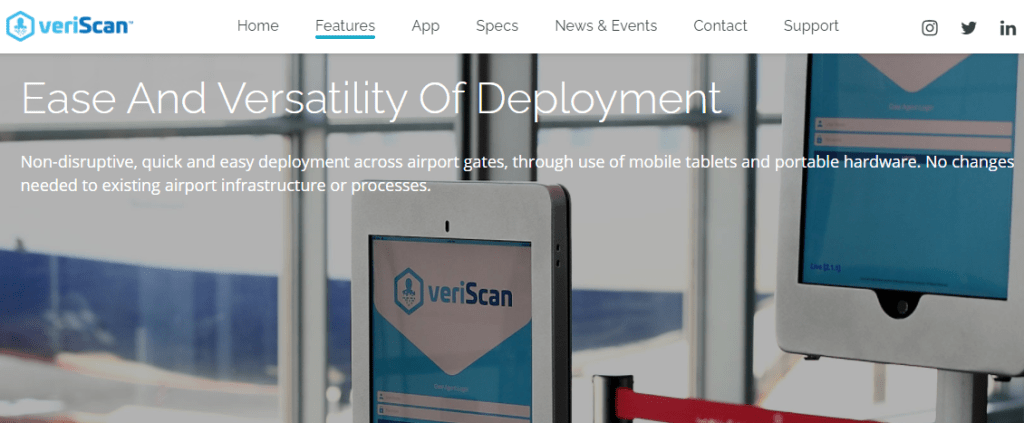
The Metropolitan Washington Airports Authority (MWAA), the entity that manages two of the airports in the Washington, DC area, needed a biometric boarding (biometric exit) solution. Such solutions allow passengers to skip the entire “pull out the paper ticket” process, or even the “pull out the smartphone airline app” process, and simply stand and let a camera capture a picture of the passenger’s face. While there are several companies that sell such solutions, MWAA decided to create its own solution, veriScan.
And once MWAA had implemented veriScan at its own airports, it started marketing the solution to other airports, and competing against other providers who were trying to sell their own solutions to airports.
Well, MWAA got out of the border product/service business last week when it participated in this announcement:
ALEXANDRIA, Va., March 19, 2021 /PRNewswire/ — Pangiam, a technology-based security and travel services provider, announced today that it has acquired veriScan, an integrated biometric facial recognition system for airports and airlines, from the Metropolitan Washington Airports Authority (“Airports Authority”). Terms of the transaction were not disclosed.
Pangiam is clearly the new kid on the block, since the company didn’t even exist in its current form a year ago. Late last year, AE Industrial Partners acquired and merged the decade-old Linkware and the newly-formed Pangian (PRE LLC) “to form a highly integrated travel solutions technology platform providing a more seamless and secure travel experience.”
But in a sense, Pangiam ISN’T new to the travel industry, once you read the biographies of many of the principals at the company.
“Most recently (Kevin McAleenan) served as Acting Secretary of the U.S. Department of Homeland Security (DHS)….”
“Prior to Pangiam, Patrick (Flanagan) held roles at U.S. Customs & Border Protection (CBP), the U.S. Navy, the National Security Staff, the Transportation Security Administration (TSA), and the Department of Homeland Security (DHS).”
“Dan (Tanciar) previously served as the Executive Director of Planning, Program Analysis, and Evaluation in the Office of Field Operations (OFO) at U.S. Customs and Border Protection (CBP).”
“Prior to Pangiam, Andrew (Meehan) served as the principal adviser to the Acting Secretary for external affairs at the Department of Homeland Security (DHS).”
“(Tom Plofchan) served as a National Security Advisor to the Department of Energy’s Pacific Northwest National Laboratory before entering government to serve as the Counterterrorism Advisor to the Commissioner, U.S. Customs and Border Protection, and as Counterterrorism Counselor to the Secretary, U.S. Department of Homeland Security.”
So if you thought that veriScan was well-connected because it was offered by an airport authority, consider how well-connected it appears now because it is offered by a company filled with ex-DHS people.
Which in and of itself doesn’t necessarily indicate that the products work, but it does indicate some level of domain knowledge.
But will airports choose to buy the Pangiam veriScan solution…or make their own?
I’m sure that many people imagine that standards are developed by a group of reasonable people, sitting in a room, who are pursuing things for the good of the world.
You can stop laughing now.
I wrote this in the context of the then-emerging compression format WebP (we’ll return to WebP itself later). The point that I was making was that something becomes a “standard” by brute force. If a lot of people like something, it’s a standard.
The issue with standards is that they can take years to develop, so standards are adopted after the fact.
Now let’s look at “health passports.” As you may have guessed, these “passports” can be used to enter a country, or a state, or an office building, and are specifically devoted to certifying the health of the passport bearer. If the person meets the health criteria, they can enter the country/state/building. If not, they are prohibited from entry.
In a sense, the concept of a health passport is nothing new. Before entering a country, you are often required to satisfy various health conditions, such as being free of tuberculosis.
The current impetus for health passports, of course, is COVID. When COVID spread across the world a year ago, and governments began shutting down borders between countries, a lot of people at a lot of government agencies and a lot of companies began asking two basic questions:
When reliable COVID tests are developed, how will we know whether someone has successfully passed a COVID test?
When reliable COVID vaccines are developed, how will we know whether someone has successfully been vaccinated against COVID?
These questions, especially the second one, were mostly theoretical a year ago, but the government agencies and the companies needed answers to them as soon as possible. And the governments and the companies weren’t going to wait for the entire world to agree on a plan; they wanted to move ahead THAT DAY.
It’s a year later, and COVID tests are readily available, and COVID vaccines have been developed and approved in various countries. And we’ve made a lot of progress.
Or have we?
As Jim Nash notes in a Biometric Update article, there are several different solutions to the “health passport” issue. Nash lists two of them:
The state of Hawaii is working with Clear, United Airlines, and Delta Airlines on a solution. Initially this only documents testing, but it could be expanded to vaccine documentation.
The Malaysia Aviation Group is working with “local authorities” on its own solution.
Now the wealth of health passport solutions isn’t much of a problem for most consumers, since we’ll probably need one or two health passports at most as this market matures. Maybe a US person might need one or two health passports for domestic travel, and maybe one to get into the office. In extreme conditions, maybe they’ll be required to enter grocery stores, but this is doubtful considering the resistance of American personalities to governments telling us what to do.
But the wealth of health passports IS a problem if you’re a business. Imagine being at an airport gate and asking a traveler for a Clear Health Pass, and getting an angry reply from the traveler that he already has a VeriFLY pass and that the airline is infringing upon the traveler’s First and Second Amendment rights by demanding some other pass.
Eventually there will be enough of a brouhaha over the multitude of incompatible passes. At that time, several efforts will be made to establish THE standard for health passports, or at least for health passport interoperability.
Yes, “several efforts” will be made. Because each vendor will unsurprisingly advance its own passport as the best one for the standard, or perhaps will form alliances with selected other vendors.




 Bredemarket