
Many years ago I was driving on Holt Boulevard in Montclair, California, preparing to make a left turn on Central. I followed the vehicle behind me and made my left turn…only then noticing that the left turn light was now red.
As the registered owner of the vehicle I was driving, I received an email from the city of Montclair a few days later. Because this is when Montclair was using cameras for traffic enforcement.
Off to traffic school.
Montclair doesn’t use traffic cameras any more, but all sorts of cameras are owned by, or accessible to, law enforcement agencies.
But how should they be used?
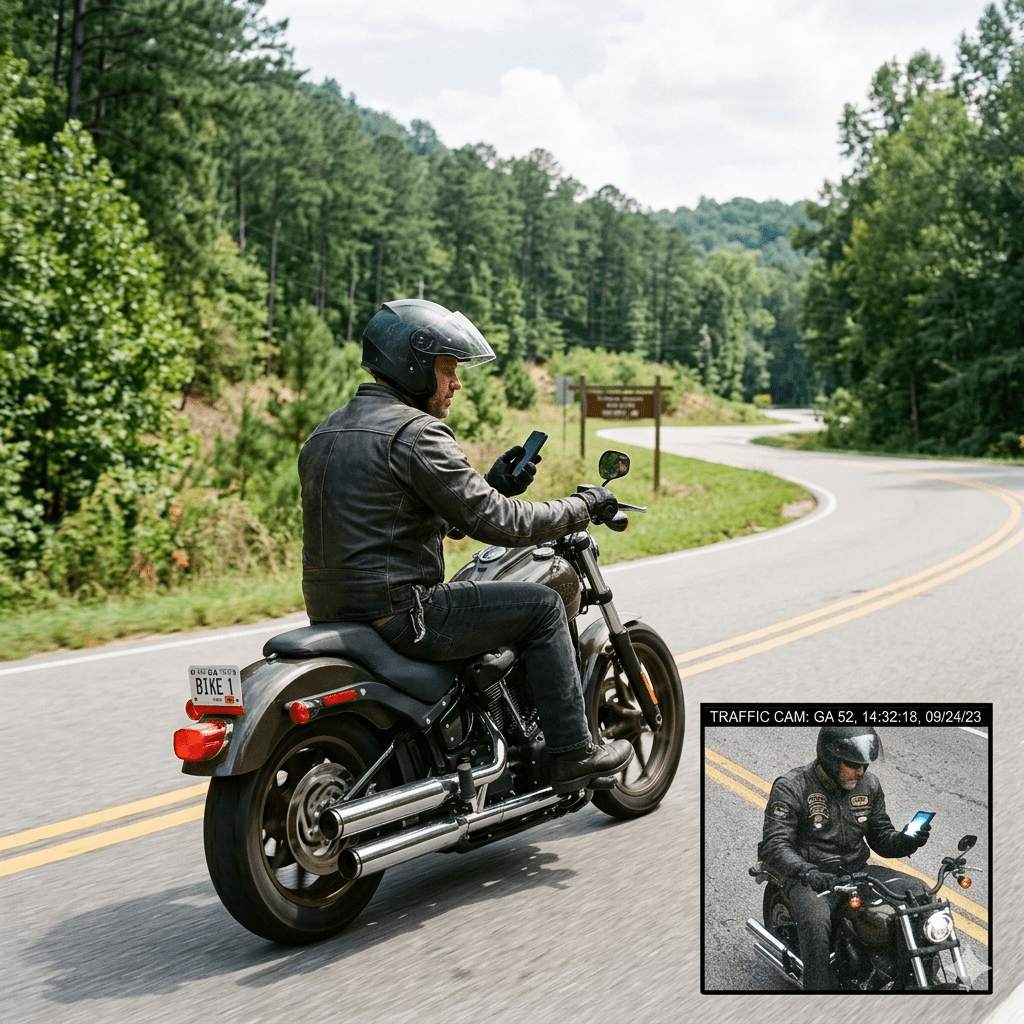
404 Media reported that the Georgia State Patrol accesses Flock cameras, for the intended purpose of gathering information for serious crimes. But what happens when the camera captures something not serious?
“Georgia State Patrol used its system of Flock automated license plate reader (ALPR) surveillance cameras to issue a ticket to a motorcyclist who was allegedly looking at his cell phone while riding, according to a copy of the citation obtained by 404 Media….The incident happened December 26 in Coffee County, Georgia. The ticket lists the offense as ‘Holding/supporting wireless telecommunications device,’ and includes the note ‘CAPTURED ON FLOCK CAMERA 31 MM 1 HOLDING PHONE IN LEFT HAND.’”
The man went to court and the ticket was dropped, but 404 Media is still outraged that the ticket was issued in the first place. Not because of Georgia’s policies, but because of other policies.
“Many police departments go out of their way to tell community members that Flock cameras are not used for traffic enforcement. For example, the City of Glenwood Springs, Colorado, states in a FAQ that “GSPD [Glenwood Springs Police Department] does not use Flock cameras for traffic enforcement, parking enforcement, or minor code violations.” El Paso, Texas, tells residents “these are not traffic enforcement cameras. They do not issue tickets, do not monitor speed, and do not generate revenue. They are investigative tools used after crimes occur.” Lynwood, Washington tells residents “these cameras will not be used for traffic infractions, immigration enforcement, or monitoring First Amendment-protected expressive activity” (Flock cameras have now been used for all of these purposes, as we have reported.)”
You will recall that I addressed another Flock Safety case, in which a citizen made public records requests from two Washington state jurisdictions. The jurisdictions said that they didn’t have the data; Flock Safety did. Flock Safety said that it had deleted the data.
Basically, Flock Safety is controversial, and some people are going to oppose ANYTHING they do. Even when Flock Safety technology protects people from dangerous drivers.
My view is that if a camera is used by a law enforcement agency, and there is no law prohibiting the law enforcement agency from using a camera for a particular purpose, then the agency can use the camera. There appears to be no such law in Georgia, so I’m not bent out of shape over this.
What are your thoughts? Is this a privacy violation?

 Bredemarket
I believe you are viewing the whole Flock(ALPR) camera from a narrow view, rather than a broader view that is the cause of the controversy people have with them.
You said that you’re “…view is that if a camera is used by a law enforcement agency, and there is no law prohibiting the law enforcement agency from using a camera for a particular purpose, then the agency can use the camera.”
But you focus specifically on only the camera’s picture taking function. Which if that was the actual issue with them then you would be correct there is no law preventing law enforcement from using cameras to take images of vehicles. But that is only part of the whole system, and it’s the system over all that is violating people’s right to privacy.
Every single one of these cameras takes images of every vehicle passing by on public roadways, even ones that are not owned or driven by a suspected criminal or the vehicle itself being suspected of being involved any crime. From there the images are processed by AI software logging the vehicles description and license plate number, along with the location of every one of the cameras that captured the same vehicle passing by along with a date and time of each passing, then that data is logged into a searchable database that can be searched by law enforcement up to 30 days (less or more in some places) without needing a search warrant signed by a judge prior to the cameras ever capturing the data of only suspected vehicles involved in crimes or suspected of being driven by a suspected criminal and logging it. They don’t even require a search warrant to even search the database even if we hypothetically say that no search warrant is required prior to the cameras being used to track a suspected criminals vehicle. They can just search for anyone’s vehicles data regardless if there’s probable cause or not to do so.
If these cameras functioned like regular CCTV systems without logging a persons vehicles whereabouts anytime they are captured in surveillance cameras into a searchable system, especially one that that is capable of allowing searches to be done across the country, then there would not be much to argue against.
It’s the whole idea that the cameras collecting and storing the information of everyone’s vehicles without a search warrant that can be searched and used to track a persons travels without them ever being suspected of a crime that is the issue, not a camera taking pictures of a public area.
Law enforcement require a warrant prior to putting a GPS on someone’s vehicle, they are required to get a warrant before getting a persons cell phone ping and gps data from a mobile phone service company, but these systems are trying to be a loophole and pass any warrant requirements but provide the same type of private data that the other techniques require a search warrant for.
the more and more of these cameras get installed, the more and more precise the tracking capabilities will become.
LikeLiked by 1 person