
(Part of the biometric product marketing expert series)
I’ve talked about why NIST separated its FRVT efforts into FRTE and FATE.
But I haven’t talked bout how NIST did this.
And as you all know, the second most important question after why is how.
Why the great renaming took place
As I noted back in August, NIST chose to split its Face Recognition Vendor Test (FRVT) into two parts—FRTE (Face Recognition Technology Evaluation) and FATE (Face Analysis Technology Evaluation).
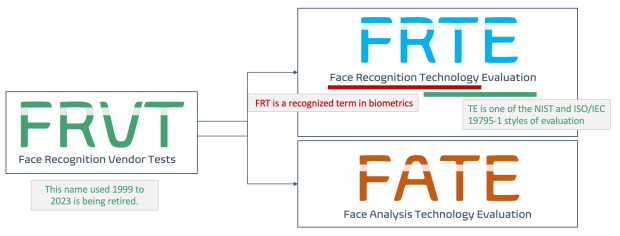
At the time, NIST explained why it did this:
To bring clarity to our testing scope and goals
From https://www.nist.gov/programs-projects/face-technology-evaluations-frtefate
In essence, the Face Recognition Vendor Test had become a hodgepodge of different things. Some of the older tests were devoted to identification of individuals (face recognition), while some of the newer tests were looking at issues other than individual identification (face analysis).
Of course, this confusion between identification and non-identification is nothing new, which is why some of the people who read Gender Shades falsely concluded that if the three algorithms couldn’t classify people by sex or race, they couldn’t identify them as individuals.
But I digress. (I won’t do it again.)
NIST explained at the time:
Tracks that involve the processing and analysis of images will run under the FATE activity, and tracks that pertain to identity verification will run under FRTE.
From https://www.nist.gov/programs-projects/face-technology-evaluations-frtefate
How the great renaming happened in practice
What is in FRTE?
To date, most of my personal attention (and probably most of yours) was paid to what was previously called FRVT 1:1 and FRVT 1:N.
These two tests are now part of FRTE, and were simply renamed to FRTE 1:1 and FRTE 1:N. They’ve even (for now) retained the same URLs, although that may change in the future.
Other tests that are now part of the FRTE bucket include:
- Face Recognition Technology Evaluation: Demographic Effects in Face Recognition. This is the “bias” test, but oriented toward individual identification rather than “gender shades”-like classification.
- Face Recognition Technology Evaluation (FRTE) Face Mask Effects. Again, this evaluates how face masks affect individual identification.
- FRTE Paperless Travel.
- Face Recognition Technology Evaluation (FRTE) Twins Demonstration.
The “Still Face and Iris 1:N Identification” effort (PDF) has apparently also been reclassified as an FRTE effort.
What is in FATE?
Obviously, presentation attack detection (PAD) testing falls into the FATE category, since this does not measure the identification of an individual, but whether a person is truly there or not. The first results have been released; I previously wrote about this here.
The next obvious category is age estimation testing, which again does not try to identify an individual, but estimate how old the person is. This testing has not yet started, but I talked about the concept of age estimation previously.
Other parts of FATE include:
- Face Analysis Technology Evaluation (FATE) MORPH. This is intended to detect morphed or blended faces, a detection issue that is not necessarily black or white. (More on morphing later.)
- Face Analysis Technology Evaluation (FATE) Quality. NIST released the initial report for this test at the same time that it released the first PAD report.
It is very possible that NIST will add additional FRTE and FATE tests in the future. These may be brand new tests, or variations of existing tests. For example, when all of us started wearing face masks a couple of years ago, NIST simulated face masks on its existing facial images and created the data for the face mask test described above.
What do you think NIST should test next, either in the FRTE or the FATE category?
More on morphing
And yes, I’m concluding this post with this video. By the way, this is the full version that (possibly intentionally) caused a ton of controversy and was immediately banned for nearly a quarter century. The morphing starts at 5:30. The crotch-grabbing starts right after the 7:00 mark.
But on a less controversial note, let’s give equal time to Godley & Creme.
Perhaps because of the lack of controversy with Godley & Creme’s earlier effort, Ashley Clark prefers it to the later Michael Jackson/John Landis effort.
Whereas Godley & Creme used editing technology to embrace and reflect the ambiguous murk of thwarted love, Jackson and Landis imposed an artificial sheen on the complexity of identity; a sheen that feels poignant if not outright tragic in the wake of Jackson’s ultimate appearance and fate. Really, it did matter if he was black or white.
From https://ashleyclark.substack.com/p/black-or-white-and-crying-all-over
But I digress. (I lied.)
Sadly, morphing escaped from the hands of music video directors and artists and entered the world of fraudsters, as Regula explains.
One of the main application areas of facial morphing for criminal purposes is forging identity documents. The attack targets face-based identity verification systems and procedures. Most often it involves passports; however, any ID document with a photo can be compromised.
One well-known case happened in 2018 when a group of activists merged together a photo of Federica Mogherini, the High Representative of the European Union for Foreign Affairs and Security Policy, and a member of their group. Using this morphed photo, they managed to obtain an authentic German passport.
From https://regulaforensics.com/blog/facial-morphing/
Which is why NIST didn’t just cry about the problem. They tested it to assist the vendors in solving the problem.

 Bredemarket
3 Comments