Is Your Healthcare Bot Healthy For You?

Robert Young (“Marcus Welby”) and Jane Wyatt (“Margaret Anderson” on a different show). By ABC TelevisionUploaded by We hope at en.wikipedia – eBay itemphoto informationTransferred from en.wikipedia by SreeBot, Public Domain, https://commons.wikimedia.org/w/index.php?curid=16472486

We’ve come a long way since the days of Marcus Welby, M.D. (who was a fictional character).

  • Back in the days of Marcus Welby, M.D., we trusted the doctor as the sole provider of medical information. Doctor knows best!
  • Later, we learned about health by searching the Internet ourselves, using sources of varying trustworthiness such as pharmaceutical company commercials.
  • Now, we don’t even conduct the searches ourselves, but let an artificial intelligence healthcare bot search for us, even though the bot hallucinates sometimes.

A “hallucination” occurs when generative AI is convinced that its answer is correct, even when it is wrong. These hallucinations could be a problem—in healthcare, literally a matter of life or death.

What can go wrong with AI healthcare?

The Brookings Institution details several scenarios in which reliance on artificial intelligence can get messy from a legal (and ethical) standpoint. Here is one of them.

From LINK REMOVED 2025-01-20

For example, a counselor may tell a patient with a substance use disorder to use an app in order to track cravings, states of mind, and other information helpful in treating addiction. The app may recommend certain therapeutic actions in case the counselor cannot be reached. Setting aside preemption issues raised by Food and Drug Administration regulation of these apps, important questions in tort law arise. If these therapeutic actions are contraindicated and result in harm to the patient or others, is the app to blame? Or does the doctor who prescribed the app bear the blame?

From https://www.brookings.edu/articles/when-medical-robots-fail-malpractice-principles-for-an-era-of-automation/

Who is going to ensure that these bots can be trusted?

Who is concerned? Yes.

It seems to me they give these robot doctors now-a-days very peculiar names. By Public Domain – Snapshot Image – https://archive.org/details/ClassicComedyTeams, Public Domain, https://commons.wikimedia.org/w/index.php?curid=25914575

That’s right. WHO is going to ensure that these bots can be trusted.

A World Health Organization publication…

…underscores the critical need to ensure the safety and efficacy of AI systems, accelerating their availability to those in need and encouraging collaboration among various stakeholders, including developers, regulators, manufacturers, healthcare professionals, and patients.

From https://www.openaccessgovernment.org/who-outlines-responsible-regulations-needed-for-artificial-intelligence-in-healthcare/170622/

According to WHO, its document proposes six areas of artificial intelligence regulation for health.

  • To foster trust, the publication stresses the importance of transparency and documentation, such as through documenting the entire product lifecycle and tracking development processes.
  • For risk management, issues like ‘intended use’, ‘continuous learning’, human interventions, training models and cybersecurity threats must all be comprehensively addressed, with models made as simple as possible.
  • Externally validating data and being clear about the intended use of AI helps assure safety and facilitate regulation.
  • A commitment to data quality, such as through rigorously evaluating systems pre-release, is vital to ensuring systems do not amplify biases and errors.
  • The challenges posed by important, complex regulations – such as the General Data Protection Regulation (GDPR) in Europe and the Health Insurance Portability and Accountability Act (HIPAA) in the United States of America – are addressed with an emphasis on understanding the scope of jurisdiction and consent requirements, in service of privacy and data protection.
  • Fostering collaboration between regulatory bodies, patients, healthcare professionals, industry representatives, and government partners, can help ensure products and services stay compliant with regulation throughout their lifecycles.
From https://www.who.int/news/item/19-10-2023-who-outlines-considerations-for-regulation-of-artificial-intelligence-for-health

The 61 page document, “Regulatory considerations on artificial intelligence for health,” is available via https://iris.who.int/handle/10665/373421.

As Digital “Health Certifications” Advance (sort of), Paper Health Certifications Recede

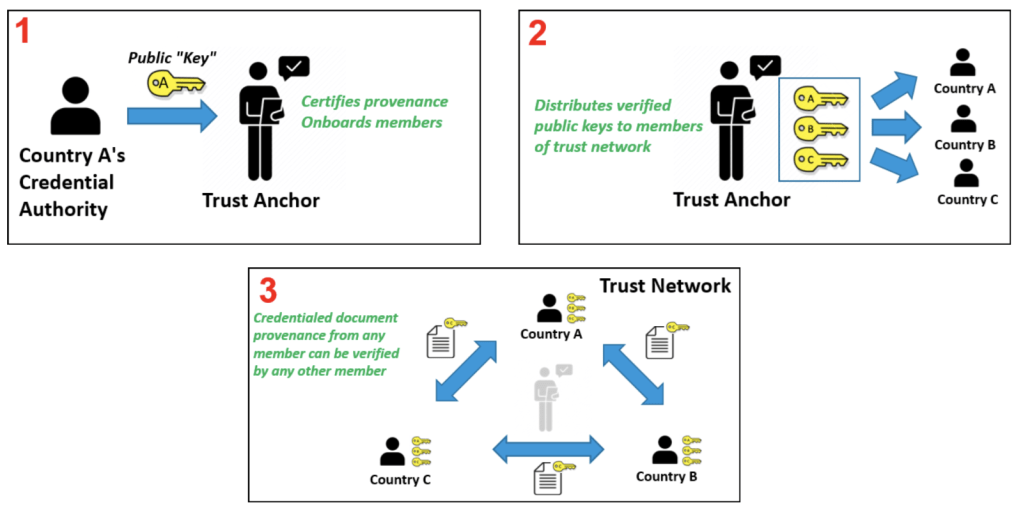
Back in June I wrote about the Global Digital Health Certification Network (GDHCN), a post-COVID way to digitally exchange information about a person’s vaccination status—not just for COVID, but for any future pandemic.

This effort is being pioneered by WHO.

It seems to me they give these vaccine certificates now-a-days very peculiar names. By Public Domain – Snapshot Image – https://archive.org/details/ClassicComedyTeams, Public Domain, https://commons.wikimedia.org/w/index.php?curid=25914575

But as we continue to advance digital health identities, the United States is no longer producing a well-known physical identity document.

It’s the end of an era for a once-critical pandemic document: The ubiquitous white COVID-19 vaccination cards are being phased out.

Now that COVID-19 vaccines are not being distributed by the federal government, the U.S. Centers for Disease Control and Prevention has stopped printing new cards.

From https://apnews.com/article/covid-vaccine-cdc-medical-record-a70eb7f3f32b961eae1a7bf69175ad11

This doesn’t affect the validity of current cards. It just means that if you get a COVID vaccine, or any future vaccine, and you need to prove you obtained it, you will have to contact the medical facility who administered it.

Or, in selected states (because in the U.S. health is generally a state and not a federal responsibility), you can access the state’s digital health information. For example, the state of Washington offers MyIRmobile, as do the states of Arizona, Louisiana, Maryland, Mississippi, North Dakota, and West Virginia.

Sign up for MyIR Mobile by going to myirmobile.com and follow the registration instructions. Your registration information will be used to match your records with the state immunization registry. You will be sent a verification code on your phone to finalize the process. Once registration is complete, you’ll be able to view your immunization records, Certificate of Immunization Status (CIS) and access your COVID-19 vaccination certificate.

From https://doh.wa.gov/you-and-your-family/immunization/access-your-familys-immunization-information

I have no idea if MyIR Mobile conforms to GDHCN; neither the phrase nor the acronym is mentioned on the MyIR Mobile website.

My own state of California has its own digital vaccine record, but frankly it’s kind of clunky. Again, I don’t know if California conforms to GDHCN.

So maybe digital health certifications are not advancing.

From EUDCC to GDHCN: The Evolution of Vaccine Certificates

Back in 2021, it seemed that I was commenting on the EU Digital COVID Certificate (EUDCC) ad nauseum. The EUDCC is the “vaccine passport” that was developed to allow people in member EU countries to prove their COVID vaccination status in another EU country.

From the EC site.

My most recent post on the EUDCC was written on August 30, 2021, and discussed the International Air Transport Association (IATA) endorsement of the EUDCC as a global standard. But did it matter? I took a look at how global standards are adopted (hint: brute force):

If a lot of people like something, it’s a standard.

If a trillion dollar company likes something, and I like something different, then the thing that the trillion dollar company likes is a standard.

If two trillion dollar companies like two different things…it can get messy.

From https://bredemarket.com/2021/08/30/iata-endorses-the-eudcc-but-will-it-matter/

August 2021 was the last time that I wrote about the EUDCC in the Bredemarket blog. Until now.

Enter…WHO?

You know how standards are adopted by brute force from big players? Well, one big player has forced itself into the discussion. That player is the World Health Organization, commonly known as WHO.

It seems to me they give these vaccine certificates now-a-days very peculiar names. By Public Domain – Snapshot Image – https://archive.org/details/ClassicComedyTeams, Public Domain, https://commons.wikimedia.org/w/index.php?curid=25914575

But according to Masha Borak at Biometric Update, the WHO is just recognizing that the “EU” Digital COVID Certificate has expanded far beyond the EU.

Stella Kyriakides, the European commissioner for health and food safety (announced) that the voluntary certificate program has already been taken up by almost 80 countries.

From https://www.biometricupdate.com/202306/united-nations-taking-over-eu-covid-certificate-program-july-1

Last I checked there were not 80 countries in the EU. So this health standards thing took off after the initial hiccups. Although the Wikipedia list of non-EU adopting countries does not include two big players—the United States and China (the same two countries I cited in my August 2021 post).

Therefore, it made sense for WHO to get in on the act with its Global Digital Health Certification Network, allowing worldwide responses to post-COVID issues.

WHO’s Global Digital Health Certification Network is an open-source platform, built on robust & transparent standards that establishes the first building block of digital public health infrastructure for developing a wide range of digital products for strengthening pandemic preparedness and to deliver better health for all….

The GDHCN is builds (sic) upon the experience of regional networks for COVID-19 Certificates and takes up the infrastructure and experiences with the digital European Union Digital COVID Certificate (EU DCC) system, which has seen adoption across all Member States of the EU as well as 51 non-EU countries and territories. The GDHCN has been designed to be interoperable with other existing regional networks (e.g., ICAO VSD-NC, DIVOC, LACPass, SMART Health Cards) specifications. 

From https://www.who.int/initiatives/global-digital-health-certification-network

On the surface it sounds great, but we’ll see what happens when it goes live (Borak states that the go-live date is July 1).

And we’ll see how it expands:

To facilitate the uptake of the EU DCC by WHO and contribute to its operation and further development, WHO and the European Commission have agreed to partner in digital health.

This partnership will work to technically develop the WHO system with a staged approach to cover additional use cases, which may include, for example, the digitisation of the International Certificate of Vaccination or Prophylaxis. Expanding such digital solutions will be essential to deliver better health for citizens across the globe.

From https://www.who.int/news/item/05-06-2023-the-european-commission-and-who-launch-landmark-digital-health-initiative-to-strengthen-global-health-security

And most importantly, we’ll see which countries participate—and which countries don’t.