The French and Germans like each other more than they did in past centuries, but they still compete.
A month ago I wrote about the French company Thales and its efforts to develop a quantum-resistant smartcard called the MultiApp 5.2 Premium PQC. (PQC stands for post-quantum cryptography.)
“In recent months, Bundesdruckerei GmbH and G+D [Giesecke+Devrient] have established a unique technical foundation for this transformation [of the German identity card]. The federal technology company and the international SecurityTech leader jointly initiated the development of a demonstrator together with the German Federal Office for Information Security (BSI), implemented on specialized chips produced by semiconductor manufacturer Infineon.
“Germany’s transition to quantum-secure ID cards will occur in two stages. First, personal data will be protected from forgery using a quantum-resistant digital signature scheme. The second phase will involve a full transition to quantum-secure technology.”
Let’s take a step back from Module-Lattice-Based Digital Signature Standards (NIST FIPS 204) and see what quantum-infused fraudsters can do to bypass your security protections. Your “practically unbreakable” security system today may be wide open in 10 years…or 5 years.
Shor’s Algorithm
To understand how fraud can occur, you need to understand (Peter) Shor’s Factoring Algorithm.
According to Classiq, Shor’s Factoring Algorithm can find the prime factors of any number, including very large numbers.
“Factoring numbers with Shor’s algorithm begins with selecting a random integer smaller than the number to be factored. The classically-calculated greatest common divisor (GCD) of these two numbers, the random number and the target number, is then used to determine whether the target number has already been factored accidentally. For smaller numbers, that’s a possibility. For larger numbers, a supercomputer could be needed. And for numbers that are believed to be cryptographically secure, a quantum computer will be needed.”
So what? I appreciate that people like the late Richard Crandall were into finding prime numbers with 20th century technology, but how does that relate to whether a fraudster can drain my bank account?
Breaking RSA encryption
It definitely relates, according to the MIT Technology Review. This article was written back in 2019.
“[C]omputer scientists consider it practically impossible for a classical computer to factor numbers that are longer than 2048 bits, which is the basis of the most commonly used form of RSA encryption.
“Shor showed that a sufficiently powerful quantum computer could do this with ease, a result that sent shock waves through the security industry.
“And since then, quantum computers have been increasing in power. In 2012, physicists used a four-qubit quantum computer to factor 143. Then in 2014 they used a similar device to factor 56,153.”
The largest recent record number that I found was 261,980,999,226,229, as described in this paper. It should be noted that many of these numbers were factored by a variety of methods: using a pure Shor’s Factoring Algorithm, the maximum number factored so far is 21.
What does this mean?
So what does this mean for 2048-bit encryption? 2048 bits is equivalent to hundreds of decimal digits. I’ve found different numbers of decimal digits, but for all practical purposes I can’t calculate them anyway. Heck, I can’t calculate trillions in my head. And there’s RSA-4096 encryption, but…well, we’ll get to that.
But when quantum calculating abilities can crack algorithms, then it’s trivial to compute the number of combinations to crack an encryption…or guess a password…or generate a face.
“Brute force attacks function by calculating every possible combination of passwords. As the password’s strength increases, the amount of time to crack it increases exponentially. So, in theory, if hackers tried to brute force their way into a key with AES-128 encryption, it would take approximately 1 billion years to crack with the best hardware available today [2023].
“But what if we lived in a post-quantum computing world? How long would a brute-force attack on popular cypher technologies take?…[We’re] likely still a decade or two away from Quantum computers that can easily break many of the cypher technologies in use today….
“[I]n a recently published report from Global Risk Institute (GRI), the time to break RSA-4096, which is practically impossible to break with classical computing technology, is under three days with a theoretical 1 megaqubit computer. While we are still a long way from a 1 megaqubit computer, the resources and time required are reducing rapidly at the same time we see advancements in Quantum computing which are in development.”
I have no idea how much lattice-based access control mitigates these threats, but if you go around saying that strong encryption will never be broken, you are a fool.
In this edition of The Repurposeful Life, I’m revisiting a prior post (“Is the Quantum Security Threat Solved Before It Arrives? Probably Not.“) and extracting just the part that deals with the National Institute of Standards and Technology (NIST) Federal Information Processing Standard (FIPS) 204.
Thales used the NIST “FIPS 204 standard to define a digital signature algorithm for a new quantum-resistant smartcard: MultiApp 5.2 Premium PQC.”
The NIST FIPS 204 standard, “Module-Lattice-Based Digital Signature Standard,” can be found here. This is the abstract:
“Digital signatures are used to detect unauthorized modifications to data and to authenticate the identity of the signatory. In addition, the recipient of signed data can use a digital signature as evidence in demonstrating to a third party that the signature was, in fact, generated by the claimed signatory. This is known as non-repudiation since the signatory cannot easily repudiate the signature at a later time. This standard specifies ML-DSA, a set of algorithms that can be used to generate and verify digital signatures. ML-DSA is believed to be secure, even against adversaries in possession of a large-scale quantum computer.”
ML-DSA stands for “Module-Lattice-Based Digital Signature Algorithm.”
Now I’ll admit I don’t know a lattice from a vertical fence post, especially when it comes to quantum computing, so I’ll have to take NIST’s word for it that modules and lattice are super-good security.
“A lattice is a hierarchical structure that consists of levels, each representing a set of access rights. The levels are ordered based on the level of access they grant, from more restrictive to more permissive.”
You can see how this fits into an access control mechanism, whether you’re talking about a multi-tenant cloud (NordVPN’s example) or a smartcard (Thales’ example).
Because there are some things that Tom Sawyer can access, but Injun Joe must not access.
I’ll confess: there is a cybersecurity threat so…um…threatening that I didn’t even want to think about it.
You know the drill. The bad people use technology to come up with some security threat, and then the good people use technology to thwart it.
That’s what happens with antivirus. That’s what happens with deepfakes.
But I kept on hearing rumblings about a threat that would make all this obsolete.
The quantum threat and the possible 2029 “Q Day”
Today’s Q word is “quantum.”
But with great power comes great irresponsibility. Gartner said it:
“By 2029, ‘advances in quantum computing will make conventional asymmetric cryptography unsafe to use,’ Gartner said in a study.”
Frankly, this frightened me. Think of the possibilities that come from calculation superpowers. Brute force generation of passcodes, passwords, fingerprints, faces, ID cards, or whatever is necessary to hack into a security system. A billion different combinations? No problem.
“The good news is that technology companies, governments and standards agencies are well aware of the deadline. They are working on defensive strategies to meet the challenge — inventing cryptographic algorithms that run not just on quantum computers but on today’s conventional components.
“This technology has a name: post-quantum cryptography.
“There have already been notable breakthroughs. In the last few days, Thales launched a quantum-resistant smartcard: MultiApp 5.2 Premium PQC. It is the first smartcard to be certified by ANSSI, France’s national cybersecurity agency.
“The product uses new generation cryptographic signatures to protect electronic ID cards, health cards, driving licences and more from attacks by quantum computers.”
So what’s so special about the technology in the MultiApp 5.2 Premium PQC?
Thales used the NIST “FIPS 204 standard to define a digital signature algorithm for a new quantum-resistant smartcard: MultiApp 5.2 Premium PQC.”
Google Gemini.
The NIST FIPS 204 standard, “Module-Lattice-Based Digital Signature Standard,” can be found here. This is the abstract:
“Digital signatures are used to detect unauthorized modifications to data and to authenticate the identity of the signatory. In addition, the recipient of signed data can use a digital signature as evidence in demonstrating to a third party that the signature was, in fact, generated by the claimed signatory. This is known as non-repudiation since the signatory cannot easily repudiate the signature at a later time. This standard specifies ML-DSA, a set of algorithms that can be used to generate and verify digital signatures. ML-DSA is believed to be secure, even against adversaries in possession of a large-scale quantum computer.”
ML-DSA stands for “Module-Lattice-Based Digital Signature Algorithm.”
Google Gemini.
Now I’ll admit I don’t know a lattice from a vertical fence post, especially when it comes to quantum computing, so I’ll have to take NIST’s word for it that modules and lattice are super-good security.
Certification, schmertification
The Thales technology was then tested by researchers to determine its Evaluation Assurance Level (EAL). The result? “Thales’ product won EAL6+ certification (the highest is EAL7).” (TechTarget explains the 7 evaluation assurance levels here.)
France’s national cybersecurity agency (ANSSI) then certified it.
However…
…remember that certifications mean squat.
For all we know, the fraudsters have already broken the protections in the FIPS 204 standard.
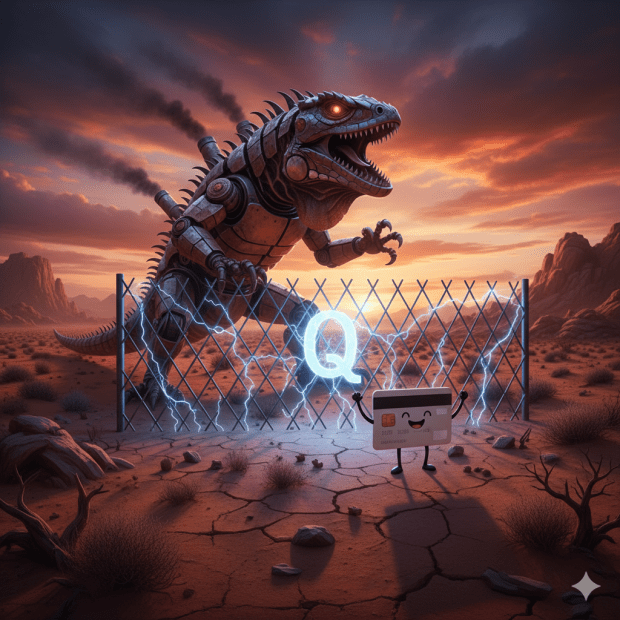
Google Gemini.
And the merry-go-round between fraudsters and fraud fighters continues.
If you need help spreading the word about YOUR anti-fraud solution, quantum or otherwise, schedule a free meeting with Bredemarket.
“We provide the world’s leading news coverage and information on the global biometric technology market via the web and an exclusive daily newsletter. Our daily biometrics updates, industry perspectives, interviews, columns and in-depth features explore a broad range of modalities and methods, from fingerprint, voice, iris, and facial recognition, to cutting-edge technologies like DNA analysis and gait recognition, related identification tools such as behavioral biometrics, and non-biometric identification methods such as identity document verification and telephone forensics. Our coverage touches on all applications and issues dealt with in the sector, including national security, mobile identity, and border control, with a special emphasis on UN Sustainable Development Goal 16.9 to provide universal digital identification and the ID4Africa movement.”
Over the last ten years, there have been two instances in which I have been newsworthy.
2015 with MorphoTrak
The first occurred in 2015, when my then-employer MorphoTrak exhibited an airport gate called MorphoWay at a conference then known as connect:ID. At the 2015 show, I demonstrated MorphoWay for Biometric Update’s videographer.
Me at connect:ID, 2015.
“In the video, Bredehoft scans his passport through the document reader, which checks the passport against a database to verify that it is, in fact, a CBP-authorized document.
“Once verified, the gates automatically open to allow Bredehoft to exit the area.”
2025 with Bredemarket
The second occurred ten years later in 2025, when I wrote a guest opinion piece entitled “Opinion: Vendors must disclose responsible uses of biometric data.” As I previously mentioned, I discussed the need to obtain consent for use of biometric data in certain instances, and noted:
“Some government agencies, private organizations, and biometric vendors have well-established procedures for acquiring the necessary consents.
“Others? Well…”
Biometric Update didn’t create a video this time around, but I did.
Biometric vendors…
2035???
So now that I’ve established a regular cadence for my appearances in Biometric Update, I fully expect to make a third appearance in 2035.
Because of my extensive biometric background, I predict that my 2035 appearance will concern the use of quantum computing to distinguish between a person and their fabricated clone using QCID (quantum clone identification).
No video yet, because I don’t know what video technology will be like ten years from now. So here’s an old fashioned 2D picture.





 Bredemarket