Ain’t gonna happen.
There’s gonna be a wire SOMEWHERE.

Identity/biometrics/technology marketing and writing services

Ain’t gonna happen.
There’s gonna be a wire SOMEWHERE.

On June 1, I shared a little piece on Bredemarket’s social media channels, including a post on the Bredemarket Technology Firm Services page on LinkedIn.
It was an announcement from Knell Computer.
Knell Computer announced Friday that it is eliminating wi-fi capabilities from its business computer product lines.
“At Knell Computer, we strongly believe that the best work occurs in a traditional office environment,” according to Gabriel Knell, CEO. “Since modern offices are fully equipped with Ethernet cabling, wi-fi is an unnecessary expense. Removal of wi-fi allows us to sell Knell Computers at a lower price point than our competitors, providing cost savings to our customers.”
Knell will promote this innovation with an ad campaign in major city downtown business districts, where it will attract the attention of real workers.
Gabriel Knell: “If you’re an amateur who performs so-called ‘work’ at home in your shorts, rather than from a true cubicle office environment, feel free to buy wi-fi computers from our competitors. We are embarrassed to see the Knell logo in a coffee shop—or in a converted bedroom.”
In a related announcement, Knell will incorporate technology that “red flags” the use of any Knell computer in a residential zone.

For those of you who don’t know much about Knell Computer, LinkedIn’s helpful AI feature provided contextual detail, including answers to critical questions:
All of these answers, sourced from information found in LinkedIn and on the Internet, were undoubtedly helpful.
But LinkedIn AI appears to have missed one teeny tiny thing.

Since I’m not engaged in full-time product marketing (although I perform some product marketing activities for my Bredemarket clients), I sometimes spend my time writing other things.
Like fake press releases for fake products from fake companies.
But I think that most of you figured out that Knell Computer and its head Gabriel Knell are based upon Dell Computer and its head Michael Dell.
(Note the “angelic” naming here. And no, I’m not naming anything after Lucifer.)
And most of you know why Dell Computer was suddenly in the news in May, and actually a little before that, as this Forbes article indicates.

Dell’s new remote-work policy will categorize its workers into two main groups: remote and hybrid.
Hybrid workers must agree to come into an “approved” office at least 39 days each quarter. This is roughly the equivalent of three days per week. Remote workers do not have to come into an approved office at all. However, remote workers aren’t eligible for promotion or to change jobs within the company.
According to the Register, Dell confirmed the 39 days/quarter requirement, and explained why it believed it was important.
In a statement, a Dell spokesperson told The Register, “We shared with team members our updated hybrid work policy. Team members in hybrid roles will be onsite at a Dell Technologies office at least 39 days per quarter (on average three days a week). In today’s global technology revolution, we believe in-person connections paired with a flexible approach are critical to drive innovation and value differentiation.”
But the Dell statement didn’t say HOW Dell would know who was in the office. The Register supplied that additional detail; Dell was reported to use tracking and color coding.
Starting next Monday, May 13, the enterprise hardware slinger plans to make weekly site visit data from its badge tracking available to employees through the corporation’s human capital management software…
Let me just pause right there. Any time that you read something about “human capital management,” your antennae should go up.
But let’s get back to how Dell is managing its carbon-based capital.
…and to give them color-coded ratings that summarize their status. Those ratings are:
Blue flag indicates “consistent onsite presence”
Green flag indicates “regular onsite presence”
Yellow flag indicates “some onsite presence”
Red flag indicates “limited onsite presence”

So that was the situation as of June 1 when Knell Computer issued its press release, complete with “red flag” capability.
I’m forced to confess that Knell Computer’s product marketing efforts didn’t really make an impact. (I KNEW I should have included the press release in the Bredemarket blog. Better late than never.)
But Dell Computer’s efforts truly impacted its employees…but not in the way that Dell Computer wanted.
No, not the Steve Taylor song.
The Dell human capital management method that ranked hybrid employees based upon their willingness to work in the office.

A few weeks after Knell Computer’s product marketing effort, stories began to emerge about what was happening at the real Dell. Here’s part of what Ars Technica said on June 20:
Dell announced a new return-to-office initiative earlier this year. In the new plan, workers had to classify themselves as remote or hybrid.
Those who classified themselves as hybrid are subject to a tracking system….
Alternatively, by classifying themselves as remote, workers agree they can no longer be promoted or hired into new roles within the company.
Business Insider claims it has seen internal Dell tracking data that reveals nearly 50 percent of the workforce opted to accept the consequences of staying remote, undermining Dell’s plan to restore its in-office culture.
“But wait!” you’re saying. “So many people are willing to forgo promotion at Dell, or even to apply to new positions at Dell?”
Yes. Because here’s a dirty little secret:
Dell employees can leave Dell and work for other companies.
Granted many other companies aren’t remote-friendly either (believe me, I know), but those that are have an opportunity to scoop up Dell’s best and brightest.
And as the Dell workers leave, this provides an opportunity for yours truly. After all, I’d be happy to report to Dell’s office in Ontario, California. So I went to see what opportunities I’d have.
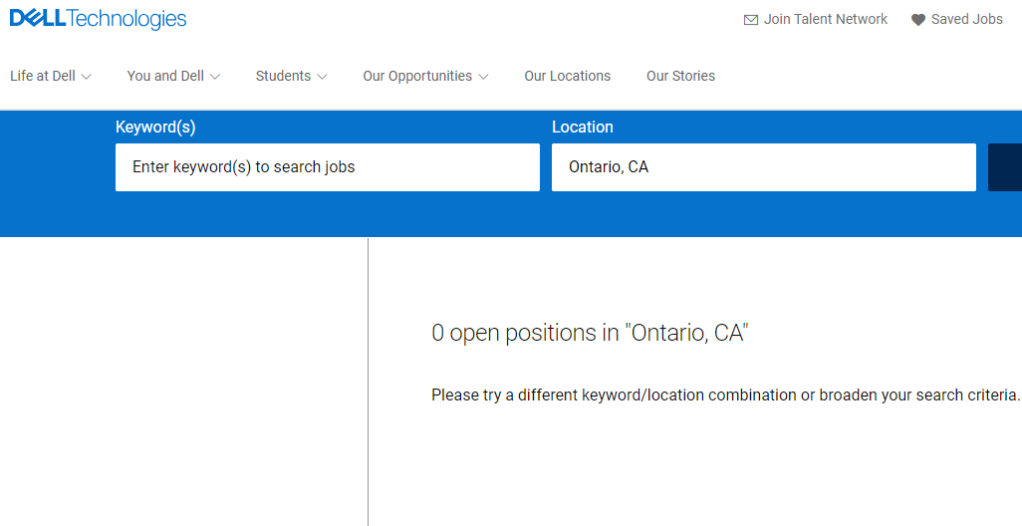
It turns out that Ontario, California is not one of Dell’s officially approved hybrid work locations. I’d have to drive to Utah, Texas, or Oklahoma three days a week.
But hey, I’m not the only marketer affected by Dell’s work policies. Silicon Valley marketers can’t work hybrid at Dell either.
I’ll continue to monitor how this plays out. Perhaps Knell Computer may issue a second press release.
Which LinkedIn AI will take as the truth.
(Alternate title: Why totem pole blackmail is so left field.)
I want to revisit a topic I last addressed in December, in a post entitled “Words matter, or the latest from the Security Industry Association on problematic security terms.”
If you recall, that post mentioned the realization in the technology community that certain long-standing industry terms were no longer acceptable to many technologists. My post cited the Security Industry Association’s recommendations for eliminating language bias, such as replacing the term “slave” (as in master/slave) with the term “secondary” or “responder.” The post also mentions other entities, such as Amazon and Microsoft, who are themselves trying to come up with more inclusive terms.
Now in this particular case, I’m not that bent out of shape over the fact that multiple entities are coming up with multiple standards for inclusive language. (As you know, I feel differently about the plethora of standards for vaccine certificates.) I’ll grant that there might be a bit of confusion when one entity refers to a blocklist, another a block list, and a third a deny list (various replacements for the old term “blacklist”), but the use of different terms won’t necessarily put you on a deny list (or whatever) to enter an airport.
Well, one other party has weighed in on the inclusive language debate – not to set its own standards, but to suggest how its employees should participate in general standards discussions.

That entity is the National Institute of Standards and Technology (NIST). I’ve mentioned NIST before in other contexts. But NIST just announced its contribution to the inclusive language discussion.
Our choice of language — what we say and how we say it — can have unanticipated effects on our audience, potentially conveying messages other than those we intend. In an effort to help writers express ideas in language that is both clear and welcoming to all readers, the National Institute of Standards and Technology (NIST) has released new guidance on effective wording in technical standards.
The point about “unanticipated effects” is an interesting point. Those of us who have been in tech for a while have an understanding of what the term “blacklist” means, but what of the new person who sees the term for the first time?
So, since NIST employees participate in technical standards bodies, it is now publicly sharing its internal guidance as NISTIR 8366, Guidance for NIST Staff on Using Inclusive Language in Documentary Standards. This document is available in PDF form at https://doi.org/10.6028/NIST.IR.8366.

It’s important to note that this document is NOT a standard, and some parts of this “guidance” document aren’t even guidance. For example, section 4.1 begins as follows:
The following is taken from the ‘Inclusive Language’ section of the April 2021 version of the NIST Technical Series Publications Author Instructions. It is not official NIST guidance and will be updated periodically based on user feedback.
The need to periodically update is because any type of guidance regarding inclusive language will change over time. (It will also change according to culture, but since NIST is a United States government agency, its guidance in this particular case is focused on U.S. technologists.)
The major contribution of the NIST guidance is to explain WHY inclusive language is desirable. In addition to noting the “unanticipated effects” of our choice of language, NIST documents five key benefits of inclusive language.
1. avoids false assumptions and permits more precise wording,
2. conveys respect to those who listen or read,
3. maintains neutrality, avoiding unpleasant emotions or connotations brought on by more divisive language (e.g., the term ‘elderly’ may have different connotations based on the age of an employee),
4. removes colloquialisms that are exclusive or usually not well understood by all (e.g., drink the Kool-Aid), and
5. enables all to feel included in the topic discussed.
Let me comment on item 4 above. I don’t know how many people know that the term “drink the Kool-Aid” originated after the Guyana murders of Congressman Dan Ryan and others, and the subsequent mass suicides of People’s Temple members, including leader Jim Jones.

They committed suicide by drinking a cyanide-laced drink which may or may not have been Kool-Aid. The entire history (not for the squeamish) can be found here. But even in 2012, many people didn’t know that history, so why use the colloquialism?
So that’s the guidance. But for those keeping score on specific terms, the current guidance document mentions the a number of suggestions, either from NIST or other entities. I’m going to concentrate on three terms that I haven’t mentioned previously.
So these discussions continue, sometimes with controversy, sometimes without. But all technologists should be aware that the discussions are occurring.
I may have accidentally hit upon a post series.
In my previous installment of “Words Matter,” published a little over a month ago on November 12, I described how Simon A. Cole made a distinction between words such as “decision,” “interpretation,” and “findings” when talking about how forensic results are described. The passage of time, and the perceptions that change over time, affect how words are used.
There are other examples of how perceptions change over time. Those of us who were alive in the 1960s may remember how the cigarette advertisement phrase “you’ve come a long way, baby” was initially perceived as a liberating, feminist phrase.
Similarly, those of us who were alive in the 1960s may remember that the Washington Redskins were infamous for being the last NFL team in the modern era to add a black player to its roster. The fact that the Washington Redskins were the Washington REDSKINS was not a matter of concern for most people. (Now is the time for a confession: even today, I own a Washington Redskins keychain and a Washington Redskins cup. But I don’t flaunt my ownership of these items.)
Let’s move to the tech world, in which terms that were OK with most people a few years ago are now questionable. The Security Industry Association has compiled a list of some common security terms which, in the SIA’s view, exhibit “language bias.”
Now I’ll be the first to admit that the SIA’s view is not a universal view. There are a number of people who would reply “get over it” if someone objected to one of these terms. (At the same time, there are a number of people who wonder why these terms were ever adopted in the first place.)
I’ll confess that, with the exception of master/slave, I hadn’t really thought about the offensiveness of these terms. And I wondered if the proposed replacement terms would prove to be clunky and unusable.
Well, in my opinion, the SIA did a pretty good job in proposing some new terms that are workable without being offensive. Take the SIA’s proposed replacement for master/slave, for example. The SIA’s proposal to remove the “language bias” that references slavery in the United States and other nations is to substitute the word “primary” or “commander” for “master,” and “secondary” or “responder” for “slave.” The replacement terms convey the security meaning well.
Here are some other proposed terminology changes from the SIA:
Now the Security Industry Association is just one entity, and I’m sure that other entities are coming up with other terms that replace the older terms. As of today, Wikipedia lists 11 different replacement pairs for master/slave alone, including primary/secondary (BIND), primary/replica (Amazon and Microsoft, among others), provider/consumer (OpenLDAP), and others. There are also multiple alternatives to blacklist/whitelist, including the aforementioned blocklist/allowlist, and other pairs such as deny list/allow list and block list/allow list (with spaces).
All of these suggestions are going to float around and compete with each other, and various trade associations, governments, and other entities are going to adopt one or more of these, causing people who do business with these associations/governments/entities to adopt them also. And there will be the usual debate in those places where standards, like sausages, are made.
After all of these standards battles are complete, which set of terms will prevail?
That’s easy.

The terminology adopted by Taylor Swift will be the terminology that will be adopted by the rest of the world.
Sorry, SIA, but the general population cares much more about what Taylor Swift believes. Perhaps if SIA changed its acronym to TAYLOR, things would be different.
Swift (not to be confused with the Society for Worldwide Interbank Financial Telecommunication) is today’s Oprah Winfrey, and unlike Winfrey is referenced by cybersecurity practitioners.
And she can write a catchy chorus.

 Bredemarket