The DHS RFI “Minimum Standards for Driver’s Licenses and Identification Cards Acceptable by Federal Agencies for Official Purposes; Mobile Driver’s Licenses” is NOT due on June 18 (it’s now due July 30)

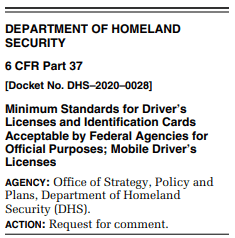
Back in April I wrote about a Request for Information that was issued by the Department of Homeland Security. Its title: “Minimum Standards for Driver’s Licenses and Identification Cards Acceptable by Federal Agencies for Official Purposes; Mobile Driver’s Licenses.”

The information was due to DHS on June 18 (tomorrow), and my post included a “shameless plug” offering to help companies with their responses.

No company requested my assistance.

But all is not lost, because you can STILL request Bredemarket’s assistance in composing your responses, because, according to Jason Lim, the due date has been extended.

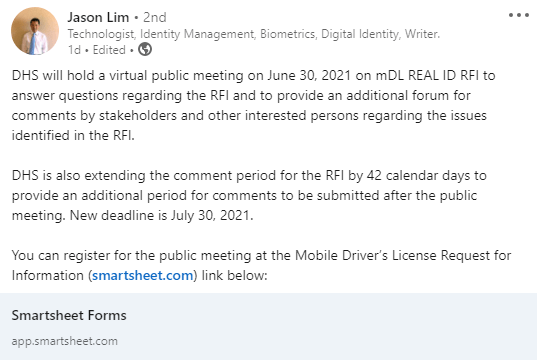
DHS will hold a virtual public meeting on June 30, 2021 on mDL REAL ID RFI to answer questions regarding the RFI and to provide an additional forum for comments by stakeholders and other interested persons regarding the issues identified in the RFI.

DHS is also extending the comment period for the RFI by 42 calendar days to provide an additional period for comments to be submitted after the public meeting. New deadline is July 30, 2021.

If you want to register for the public meeting, click on the link at the bottom of Jason Lim’s LinkedIn post. I’ve already registered myself (the meeting starts at 7:00 am PDT, but at least I don’t have to commute to go to the meeting).

And the shameless plug still applies: if you need assistance in managing, organizing, writing, or checking your response, contact me (email, phone message, online form, appointment for a content needs assessment, even snail mail). As some of you already know, I have extensive experience in responding to RFIs, RFPs, and similar documents, and have been helping multiple companies with such responses under my Bredemarket consultancy.

Are you responding to the DHS RFI, “Minimum Standards for Driver’s Licenses and Identification Cards Acceptable by Federal Agencies for Official Purposes; Mobile Driver’s Licenses”?

I already posted about this Request for Information (RFI) on LinkedIn and Facebook, but I wanted to highlight the details of the Department of Homeland Security’s recent request (see PDF or text version).

The RFI delves into a number of questions about treating mobile (i.e. smartphone) driver’s licenses as REAL ID-compliant. The RFI itself states:

DHS invites comments on any aspect of this RFI, and welcomes any additional comments and information that would promote an understanding of the broader implications of acceptance of mobile or digital driver’s licenses by Federal agencies for official purposes. This includes comments relating to the economic, privacy, security, environmental, energy, or federalism impacts that might result from a future rulemaking based on input received as a result of this RFI. In addition, DHS includes specific questions in this RFI immediately following the discussion of the relevant issues.

The RFI can be responded to by any member of the general public, although it is expected that the majority of responses will come from mobile driver’s license vendors and various interest groups. And trust me, there is a wide range of interest groups that are interested in this topic, and in the broader topic of REAL ID in general. Federalism itself is a popular topic when discussing REAL ID.

(Although personally, I believe that if the Federal Government is controlling air travel, and if the Federal Government is…obviously…controlling Federal facilities, then the Federal Government can implement rule-making regarding access. Needless to say, since all 50 states and several territories have adopted REAL ID, the decision has been made.)

While respondents can conceivably talk about anything in their responses, DHS (as noted above) has 15 specific questions to which it is seeking information (see section IV beginning on page 20325). Some are general, such as general questions about security, and some are more specific, such as question 4, which specifically focuses on DHS adoption of requirements derived from “Industry Standard ISO/IEC 18013–5: Communication Interfaces Between mDL Device and Federal Agency, and Federal Agency and DMV.”

Responses to the RFI must be submitted by June 18, and are submitted electronically. (Read the Commenter’s Checklist, and note that DHS prefers that respondents address all 15 questions.) I’m sure that a number of companies and organizations are already starting to think about their responses.

Shameless plug: if you need assistance in managing, organizing, writing, or checking your response, contact me. As some of you already know, I have extensive experience in responding to RFIs, RFPs, and similar documents, and have been helping multiple companies with such responses under my Bredemarket consultancy.

The infancy of mobile driver’s licenses

More and more states are adopting mobile driver’s licenses that can be stored on a smartphone. Mobile driver’s licenses (mDLs) are available from Colorado, Delaware, Louisiana, and Oklahoma, and may be available from additional states by the time you read this.

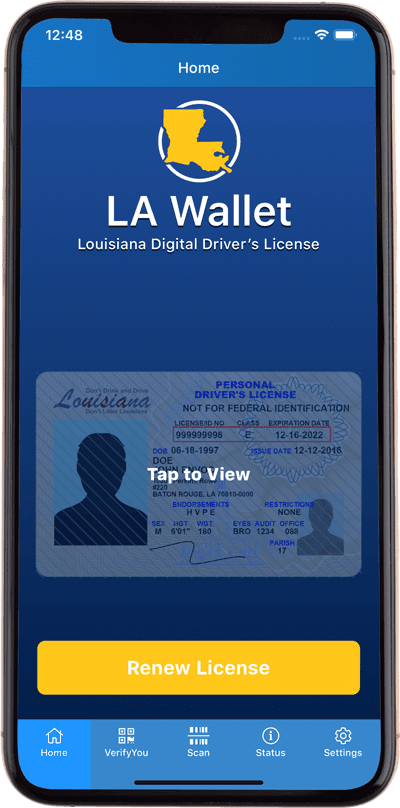
LA Wallet Louisiana Digital Driver’s License. lawallet.com.

For me, the two key benefits of mDLs are the following:

  • If you have your smartphone, you have your mDL. Since smartphones are becoming more of a necessary must-have item – and wallets are not – the presence of a driver’s license on a smartphone is beneficial. (Unless, of course, you’re the type of person who misplaces your smartphone.)
  • mDLs can be designed to show only the information that is necessary. If I want to enter a bar or other facility for people over 21, I don’t have to show the bouncer my weight, my address, or even my birthdate. I just have to show the bouncer that I’m over 21.

While mDLs are becoming available in more states, they are not fully mature yet.

  • They are only valid in the state where they were issued. You can’t show your Oklahoma mDL in California. (Well, I guess you CAN show it, but a Californian isn’t obligated to do anything.)
  • Even within the state of issue, they’re still not always valid. At least some states require you to carry your physical driver’s license while driving, even if you have an mDL. And you can’t present an mDL to airport security in Denver or any other city. (See the LA Wallet image above, which clearly states “NOT FOR FEDERAL IDENTIFICATION.” So even if Louisiana’s physical driver’s license is REAL ID compliant, its mDL isn’t.)

Part of the issue regarding acceptance of mDLs is that the standards are still evolving. One key standard, ISO/IEC FDIS 18013-5 (Personal identification — ISO-compliant driving licence — Part 5: Mobile driving licence (mDL) application), is still under development.

But these four states, and others, didn’t want to wait until the standards were fully approved, and their solutions were fully certified, before issuing mDLs. Louisiana’s LA Wallet solution was introduced back in July 2018. While none of the solutions by definition can claim compliance with ISO/IEC FDIS 18013-5, they are already providing benefits to the license holders in these four states.

How long will it be until all states, provinces, and territories support mDLs?