
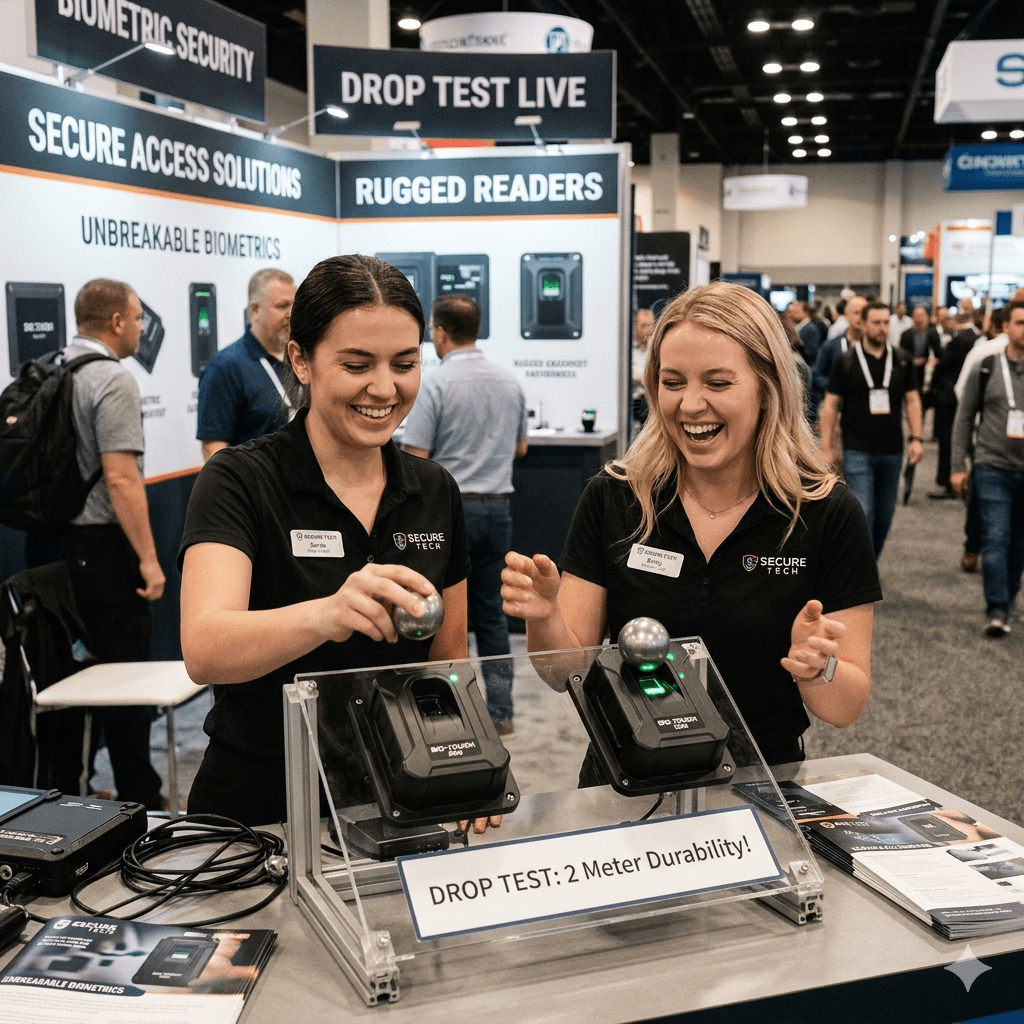
Trade shows for outdoor-grade access control devices can be fun. When I attended an ISC West conference many years ago, our booth staff occupied ourselves with dropping steel weights on biometric access control devices.
Because that’s cool.
And that’s an effective way to prove that access control devices can survive harsh environments.
Of course there’s a standard for impact resistance (IEC 62262), and Stratasys explains how the “IK” ratings work and are applied. In essence, the tests involve…dropping steel weights. It’s science, folks.
“The test apparatus includes pendulum hammers or steel spheres of different weights (from 0.25 kg to 5 kg) that strike the device with precisely measured kinetic energy.”
The impact energy is measured in joules, and the higher the joules that resist impact, the higher the IK rating. A few applications and examples:
- Consumer-grade smartphones and tablets are usually IK04 to IK05, or 0.5 to 0.7 joules.
- Outdoor security devices (biometric readers, cameras) and construction-grade tablets are usually IK06 to IK07, or 1-2 joules.
- “Industrial strength” devices are usually IK08, or 5 joules. The test case: “surviving a direct hit from a 1.7 kg hammer dropped from 30 cm.”
- “Indestructible.” Once you go to IK09-IK10, or 10-20 joules, you’re talking about the ability to “survive a 5 kg hammer dropped from 40 cm.” Military stuff. Prison stuff. If you need IK10 devices, I probably don’t want to know about it.
Now we could wish that our smartphones were IK10, but we wouldn’t want to pay the premium price for it. So we reduce our expectations to fit our budget. But not too much: putting an indoor device at a building door is false economy.

 Bredemarket