Generative AI Guidelines in San Jose, California

The Bredemarket blog has previously considered how private companies like Samsung and Adobe use generative AI. Government use is similar, yet differs in some ways. Let’s see how San Jose, California approaches it.

By Ben Loomis – DSC_9441.jpg, CC BY 2.0, https://commons.wikimedia.org/w/index.php?curid=73875056

As GovTech reported in its article “San Jose Releases Generative AI Guidelines, Looks to Learn,” some of the concerns of San Jose’s city governments are similar to issues with which private companies grapple.

Privacy is also a concern, and IT advises generative AI users to assume any information entered will be exposed to the public. Materials unready for publication shouldn’t be entered, nor should private emails. Employees looking for help drafting emails should avoid copy-pasting messages into generative AI, instead prompting the tools to write a generic message they can fact-check or augment with personalized details. The guidelines advise users to fact-check with multiple credible sources, including peer-reviewed journals and official documents.

From https://www.govtech.com/artificial-intelligence/san-jose-releases-generative-ai-guidelines-looks-to-learn

This is a big concern for private companies, also.

But there are also issues that governments need to consider that private companies may not need to address.

One consideration is that government writing requires a particular style. Senate bills, for example, are written with a certain structure and formality. The city also uses gender-neutral language and the term “resident” rather than “citizen.” 

From https://www.govtech.com/artificial-intelligence/san-jose-releases-generative-ai-guidelines-looks-to-learn

Of course private companies have their own writing styles, but the world won’t come to an end if the IBM memorandum includes the word “gnarly.” But the wrong word in a Senate bill, or the use of the term “citizen” in a blue state, could be catastrophic.

One thing is clear: San Jose Chief Information Officer Khaled Tawfik doesn’t think that general-purpose generative AI will cut it.

San Jose has talked with several vendors about the possibility of AI trained on data from government, potentially restricted to San Jose data only.

From https://www.govtech.com/artificial-intelligence/san-jose-releases-generative-ai-guidelines-looks-to-learn

As I noted in my post about Writer.com, this also allows implementation of privacy restrictions that could help avert problems if an employee inputs confidential information into the tool.

For the moment, San Jose is asking employees and contractors to log all use of generative AI. This will be referenced as the city develops its guidelines and policies in the future. As the city says:

Generative Artificial Intelligence (AI) is a new branch of AI technology that can generate content—such as stories, poetry, images, voice, and music— at the request of a user. Many organizations have banned Generative AI, while others allow unrestricted usage. The City recognizes the opportunity for a controlled and responsible approach that acknowledges the benefits to efficiency while minimizing the risks around AI bias, privacy, and cybersecurity.  

This is the first step in a collaborative process to develop the City’s overall AI policy. Registered users will be invited to join the Information Technology Department in a working group to share their experience and co-develop the City’s AI policies.

From https://www.sanjoseca.gov/your-government/departments-offices/information-technology/itd-generative-ai-guideline

From defund the police to fund the police. But what about technology?

There’s been a tactical reversal by some cities.

Defund the police, then re-fund the police

In November, the Portland Oregon City Council unanimously voted to increase police funding, a little over a year after the city reduced police funding in the wake of the Black Lives Matter movement.

Now this month, Oakland California has also decided to increase police funding after similarly defunding the police in the past. This vote was not unanimous, but the City Council was very much in favor of the measure.

By Taymaz Valley – https://www.flickr.com/photos/taymazvalley/49974424258, CC BY 2.0, https://commons.wikimedia.org/w/index.php?curid=91013003

Not that Oakland has returned to the former status quo.

[Mayor Libby] Schaaf applauded the vote in a statement, saying that residents “spoke up for a comprehensive approach to public safety — one that includes prevention, intervention, and addressing crime’s root causes, as well as an adequately staffed police department.”

From https://www.police1.com/patrol-issues/articles/oakland-backtracks-votes-to-add-police-as-crimes-surge-MDirxJZAHV41wyxg/

So while Oakland doesn’t believe that police are the solution to EVERY problem, it feels that police are necessary as part of a comprehensive approach. The city had 78 homicides in 2019, 109 in 2020, and 129 so far in 2021. Granted that it’s difficult to compare year-over-year statistics in the COVID age, but clearly defunding the police hasn’t been a major success.

But if crime is to be addressed by a comprehensive approach including “prevention, intervention, … addressing crime’s root causes, … (and) an adequately staffed police department…

…what about police technology?

What about police technology?

Portland and Oakland have a lot in common. Not only have they defunded and re-funded the police, but both have participated in the “facial recognition is evil” movement.

Oakland was the third U.S. city to limit the use of facial recognition, back in July 2019.

A city ordinance … prohibits the city of Oakland from “acquiring, obtaining, retaining, requesting, or accessing” facial recognition technology….

From https://www.vice.com/en/article/zmpaex/oakland-becomes-third-us-city-to-ban-facial-recognition-xz

Portland joined the movement later, in September 2020. But when it did, it made Oakland and other cities look like havens of right-wing totalitarianism.

The Portland City Council has passed the toughest facial recognition ban in the US, blocking both public and private use of the technology. Other cities such as BostonSan Franciscoand Oakland have passed laws barring public institutions from using facial recognition, but Portland is the first to prohibit private use.

From https://www.theverge.com/2020/9/9/21429960/portland-passes-strongest-facial-recognition-ban-us-public-private-technology
The Mayor of Portland, Ore. Ted Wheeler. By Naval Surface Warriors – 180421-N-UK248-023, Public Domain, https://commons.wikimedia.org/w/index.php?curid=91766933

Mayor Ted Wheeler noted, “Portlanders should never be in fear of having their right of privacy be exploited by either their government or by a private institution.”

Coincidentally, I was talking to someone this afternoon about some of the marketing work that I performed in 2015 for then-MorphoTrak’s video analytics offering. The market analysis included both government customers (some with acronyms, some without) and potential private customers such as large retail chains.

In 2015, we hadn’t yet seen the movements that would result in dampening both market segments in cities like Portland. (Perpetual Lineup didn’t appear until 2016, while Gender Shades didn’t appear until 2018.)

Flash – ah ah, robber of the universe

But there’s something else that I didn’t imagine in 2015, and that’s the new rage that’s sweeping the nation.

Flash!

By Dynamite Entertainment, Fair use, https://en.wikipedia.org/w/index.php?curid=57669050
Normally I add the music to the end of the post, but I stuck it in the middle this time as a camp break before this post suddently gets really serious. From https://www.youtube.com/watch?v=LfmrHTdXgK4

Specifically, flash mobs. And not the fun kind, but the “flash rob” kind.

District Attorney Chesa Boudin, who is facing a recall election in June, called this weekend’s brazen robberies “absolutely unacceptable” and was preparing tough charges against those arrested during the criminal bedlam in Union Square….

Boudin said his office was eagerly awaiting more arrests and plans to announce felony charges on Tuesday. He said 25 individuals are still at large in connection with the Union Square burglaries on Friday night….

“We know that when it comes to property crime in particular, sadly San Francisco police are spread thin,” said Boudin. “They’re not able to respond to every single 911 call, they’re only making arrests at about 3% of reported thefts.”

From https://sanfrancisco.cbslocal.com/2021/11/23/smash-and-grab-embattled-san-francisco-district-attorney-chesa-boudin-prosecution/

So there are no arrests in 97% of reported thefts in San Francisco.

To be honest, this is not a “new” rage that is sweeping the nation.

In fact, “flash robs” were occurring as early as 2012 in places like…Portland, Oregon.

If only there were a technology that could recognize flash rob participants and other thieves even when the police WEREN’T present.

A technology that is continuously tested by the U.S. government for accuracy, demographic effects (see this PDF and the individual “report cards” from the 1:1 tests), and other factors.

Does anyone know of any technology that would fill this need?

Perhaps Oakland and Portland could adopt it.

Maryland will soon deal with privacy stakeholders (and they CAN’T care about the GYRO method)

Just last week, I mentioned that the state of Utah appointed the Department of Government Operations’ first privacy officer. Now Maryland is getting into the act, and it’s worth taking a semi-deep dive into what Maryland is doing, and how it affects (or doesn’t affect) public safety.

By François Jouffroy – Christophe MOUSTIER (1994), Attribution, https://commons.wikimedia.org/w/index.php?curid=727606

According to Government Technology, the state of Maryland has created two new state information technology positions, one of which is the State Chief Privacy Officer. Because government, I will refer to this as the SCPO throughout the remainder of this post. If you are referring to this new position in verbal conversation, you can refer to the “Maryland skip-oh.” Or the “crab skip-oh.”

From https://teeherivar.com/product/maryland-is-for-crabs/. Fair use. Buy it if you like it. Virginians understand the origins of the phrase.

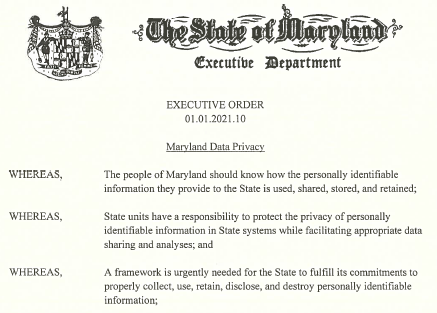
Governor Hogan announced the creation of the SCPO position via an Executive Order, a PDF of which can be found here.

Let me call out a few provisions in this executive order.

  • A.2. defines “personally identifiable information,” consisting of a person’s name in conjunction with other information, including but not limited to “[b]iometric information including an individual’s physiological or biological characteristics, including an individual’s deoxyribonucleic acid.” (Yes, that’s DNA.) Oh, and driver’s license numbers also.
  • At the same time, A.2 excludes “information collected, processed, or shared for the purposes of…public safety.”
  • But on the other hand, A.5 lists specific “state units” covered by certain provisions of the law, including both The Department of Public Safety and Correctional Services and the Department of State Police.
  • The reason for the listing of the state units is because every one of them will need to appoint “an agency privacy official” (C.2) who works with the SCPO.

There are other provisions, including the need for agency justification for the collection of personally identifiable information (PII), and the need to provide individuals with access to their collected PII along with the ability to correct or amend it.

But for law enforcement agencies in Maryland, the “public safety” exemption pretty much limits the applicability of THIS executive order (although other laws to correct public safety data would still apply).

Therefore, if some Maryland sheriff’s department releases an automated fingerprint identification system Request for Proposal (RFP) next month, you probably WON’T see a privacy advocate on the evaluation committee.

But what about an RFP released in 2022? Or an RFP released in a different state?

Be sure to keep up with relevant privacy legislation BEFORE it affects you.