I confess that I’m old enough to know what a “long distance call” meant. That was when you picked up a telephone and called someone in another state, or perhaps in the same state, and had to pay “long distance” charges to make the call. You obviously didn’t want to stay on the phone too long because those long distance charges could add up.
Today, of course, we can make video calls using one of several services for free. Not just to another state, but to anywhere around the world.
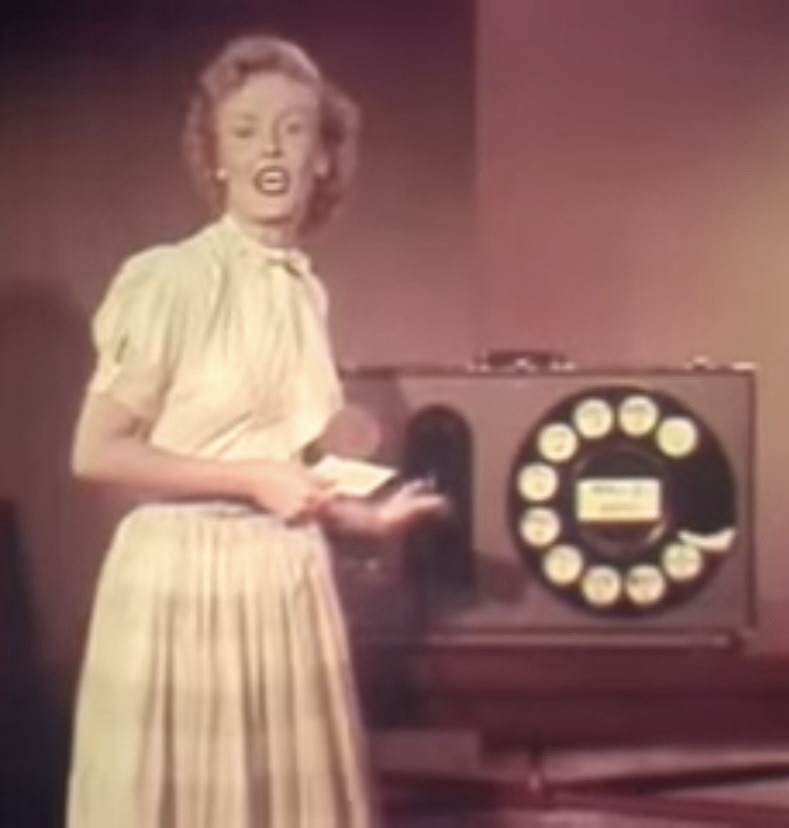
This wasn’t the case 100 years ago, because on March 7 (or March 6; sources vary), the very first telephone call was made from London, England, to New York, New York.
Whatever day it took place, this was no ordinary call. Telephone calls depended upon carrying voltage through cables, and of course there was no cable connecting London and New York. But it worked well enough that regular transatlantic telephone service was inaugurated in 1927.
This mainly catered to rich businessmen like Floyd C. Odlum (who later married aviator Jackie Cochran). Odlum made a 95 minute call to New York and, um, rang up a £285 bill in the process. In 1920s dollars, mind you. He should have waited a few years and just had his future wife fly to New York instead of making the call.
I self-describe as a “you can pry my keyboard out of my cold dead hands” person who likes to use physical or virtual keyboards to communicate. But what about using a telephone handset (when used for voice rather than data purposes)? That’s a different matter entirely.
If you have a personality that gravitates away from verbal communication, you sometimes find that you need to get out of your comfort z…I mean, you need to stray from your normal routine and use your non-preferred communication method.
I just did that earlier this week, and refrained from sending an email or other written message, instead choosing to use good old-fashioned voice communications to contact someone. And it worked, showing that voice and written communication do not have to compete with each other, and can complement each other.
This post takes a look at how writers function, both in textual and verbal environments, and what can happen when writers stray from their normal routine (or comfort zone).
The flip side of my written compulsion
I’ve talked before about my compulsion to write. Whether on a piece of paper, a typewriter (yes, I’m that old), a computer, or a smartphone, I am very accustomed to putting words to a text-based medium.
Writing compulsion, or writing obsession. Designed by Freepik.
Maybe I’m TOO accustomed to typing words into devices.
I communicate to a number of different people on WhatsApp, but recently took a break from non-business WhatsApp communications for a few days—probably to the relief of my friends who saw my FREQUENT written comments at ALL hours. (“Not a text from John again…”)
Which reminds me; I have to ask my younger German daughter if she has returned from her out-of-country trip.
And I also need to ask my artist friend if she has set up her art room yet…
It may not surprise you to learn that my VERBAL communications are less frequent. While I’m not mute in front of crowds, I gravitate toward written rather than verbal communications when I have the choice.
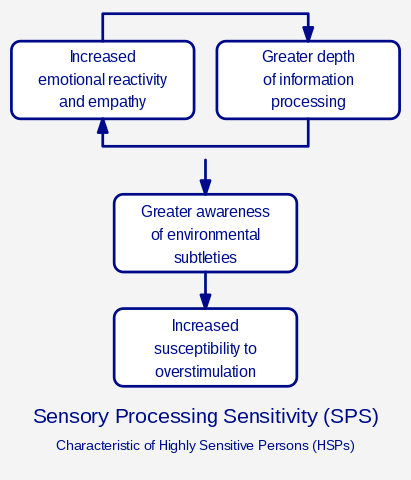
If you have noticed that it’s easier and more enjoyable for you to write rather than speak out your emotions, thoughts, and experiences, you might be a highly sensitive person (HSP). Highly sensitive people are the roughly 30% of the population who are wired at a brain level to process all information more deeply. This makes them more sensitive to the world around them, both emotionally and physically.
In other words: if you’re a highly sensitive person, you’re experiencing the world very differently than others do. You think more deeply, feel more strongly, and have a lot going on in your head. That can make it hard to get your words out — unless you have the time to sort them out in writing.
By Eleven authors named in the source journal article. – Greven, Corina U.; Lionetti, Francesca; Booth, Charlotte; Aron, Elaine N.; Fox, Elaine; Schendan, Haline E.; Pluess, Michael; Bruining, Hilgo; Acevedo, Bianca; Bijttebier, Patricia; Homberg, Judith (March 2019). “Sensory Processing Sensitivity in the context of Environmental Sensitivity: A critical review and development of research agenda”. Neuroscience and Biobehavioral Reviews 98: 287-305. Elsevier. DOI:10.1016/j.neubiorev.2019.01.009. “This is an open access article under the CC BY license (https://creativecommons.org/licenses/BY/4.0/)”.This SVG file contains embedded text that can be translated into your language, using any capable SVG editor, text editor or the SVG Translate tool. For more information see: About translating SVG files., CC BY-SA 4.0, https://commons.wikimedia.org/w/index.php?curid=96282736
I’m not sure if I am a 100% match to the descriptions above; for example, I believe I have a LESSER awareness to environmental subtleties. However, I certainly tend to be sensitive about some things. (Are my WhatsApp friends tired of my incessant messages?) And you already know that I enjoy the process of working in my brain through drafts 0.5 and 1.0 of a piece of content.
But there are drawbacks to staying within your comfort zone.
Excuse me. Sorry, but there’s something going on in my head that I have to address.
Why I’m tired of the phrase “comfort zone”
I’ve decided that I’m tired of the phrase “comfort zone,” in the same way that I’m tired of “game changer,” “thinking out of the box,” and (shudder) “best of breed.”
There’s nothing inherently wrong with the phrase “comfort zone.” Unlike the other phrases above, the literal meaning does not radically differ from the common usage. But “comfort zone” has reached an oversaturation point.
Google search results for the phrase “comfort zone.”
Now I’ll grant that some of these 65,200,000 search results are non-psychological and refer to air conditioning and other things, but the phrase “comfort zone” is used an awful lot.
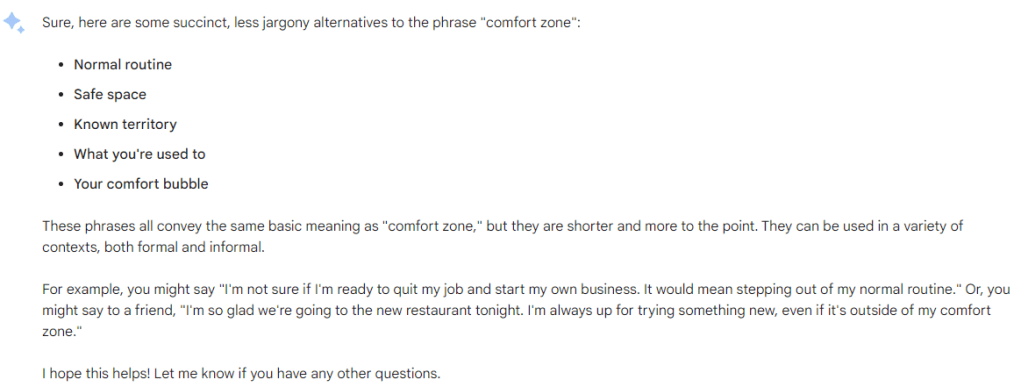
In my view, a couple of these (“safe space,” “your comfort bubble”) are just as bad as “comfort zone,” but “normal routine” and “what you’re used to” are much better and less jargon-y than “comfort zone.”
So I’ll use that instead.
OK now, where we were?
Returning to the flip side of my words obsession
Sorry about that.
But there are drawbacks to straying from your normal routine. Sometimes written communication just doesn’t cut it. (“Doesn’t cut it” is another piece of jargon I should eliminate. But one per post is enough.)
I don’t know how many times I’ve had this exchange with coworkers, friends, and family.
PERSON: Did you resolve the issue with Jane?
ME: I emailed her a couple of days ago but haven’t heard back.
PERSON: Why don’t you pick up the phone and call her?
ME: I’ll email her again. Or maybe I’ll text her.
PERSON: CALL HER!
ME, IRRITATED: OK, I’ll call her!
From a meaningful apocryphal conversation. Not put to music…yet.
When I strayed from my normal routine, good things happened
I thought about this during a recent interchange with one of my Bredemarket clients.
I had emailed a question to the client, and the very busy client said they would get back to me with the answer. After a while, I emailed the client again. And again.
At this point I started to get worried. (Maybe I am sensitive. A bit.)
But before I jumped to the wrong conclusion, I decided that I had better pick up the phone and call the client.
Not that day, but the next day. I mean, you can’t be rash about things like that.
So the next day I did pick up the phone and called the client…but the client wasn’t available.
A few minutes later, I received an email with an explanation for the delay (the busy client had been even busier than usual due to unanticipated circumstances), AND the client provided the answer to my question. Everything was very good.
So I returned to something that I started over a year ago. It’s something that allowed me to preach (again) how asynchronous communications can be wonderful.
Wednesday night’s OC SPARK meeting was devoted to navigating business problems during a pandemic, or during any other time. One of the issues raised was the need to save time. Specifically: how do you get project start information from potential clients as quickly as possible so that you can start creating a solution for them? (In other words, how do you move forward to billable time?)
I like to meet with my potential clients to discuss their needs. Those meetings usually go well; an agenda helps, and I have a handy-dandy form that helps me capture the client’s needs as quickly as possible.
But there are times when client meetings do not go as smoothly. In those cases, the client may spend hours and hours explaining what they want, which takes time.
But what if the client communications were pre-recorded, so that rather than sitting in a meeting to listen to them, you could listen to then whenever you wanted?
And what if those recordings allowed playback at faster speeds, and moving forward and back through the recording? If you can do this, then a 30 minute recording can be consumed much more quickly.
And if you could then record your response, which the client could again listen to at any time (at any speed, skipping the boring parts), you could both benefit from this.
Now there ARE times when you both need to be talking to each other at the same time. Weddings come to mind. You don’t want one party to say “I do” and have to wait hours or days for the other party to say “I do” also. (Although proxy marriages can be an option when one of the couple is in the military and deployed. But I digress.)
But in many instances, asynchronous communication is more effective and fits the bill.
The Volley App solution
Some time ago, I downloaded the Volley App after it was released.
Volley includes the features that I listed above: asynchronous communication, playback at multiple speeds, and the ability to move forward and backward in the pre-recorded video.
Of course, one thing about using the Volley app is that the other person needs to have some level of access to Volley. This is understandable; in 1921 if you had a phone but your brother didn’t, you weren’t going to be able to call your brother on the phone.
And since I didn’t know anyone else who used Volley (other than the “Hello Volley” people), I never really used it for any consequential purpose.
So here’s how you can contact me on Volley
Going back to the OC SPARK meeting, I mentioned the Volley app as a possible time-saving solution via its asynchronous communication feature. This prompted me to revisit my own Volley account and figure out how Volley users could contact me.
In the picture above, you can see that big button that says “Talk to John on Volley.”
But there’s a catch.
You have to set up a Volley account first.
I didn’t go through the setup process since I already have a Volley account, but it looks like people with existing Google and LinkedIn accounts can speed the account setup process.
Of course, if you already have a Volley account, you don’t need to create one.








 Bredemarket