
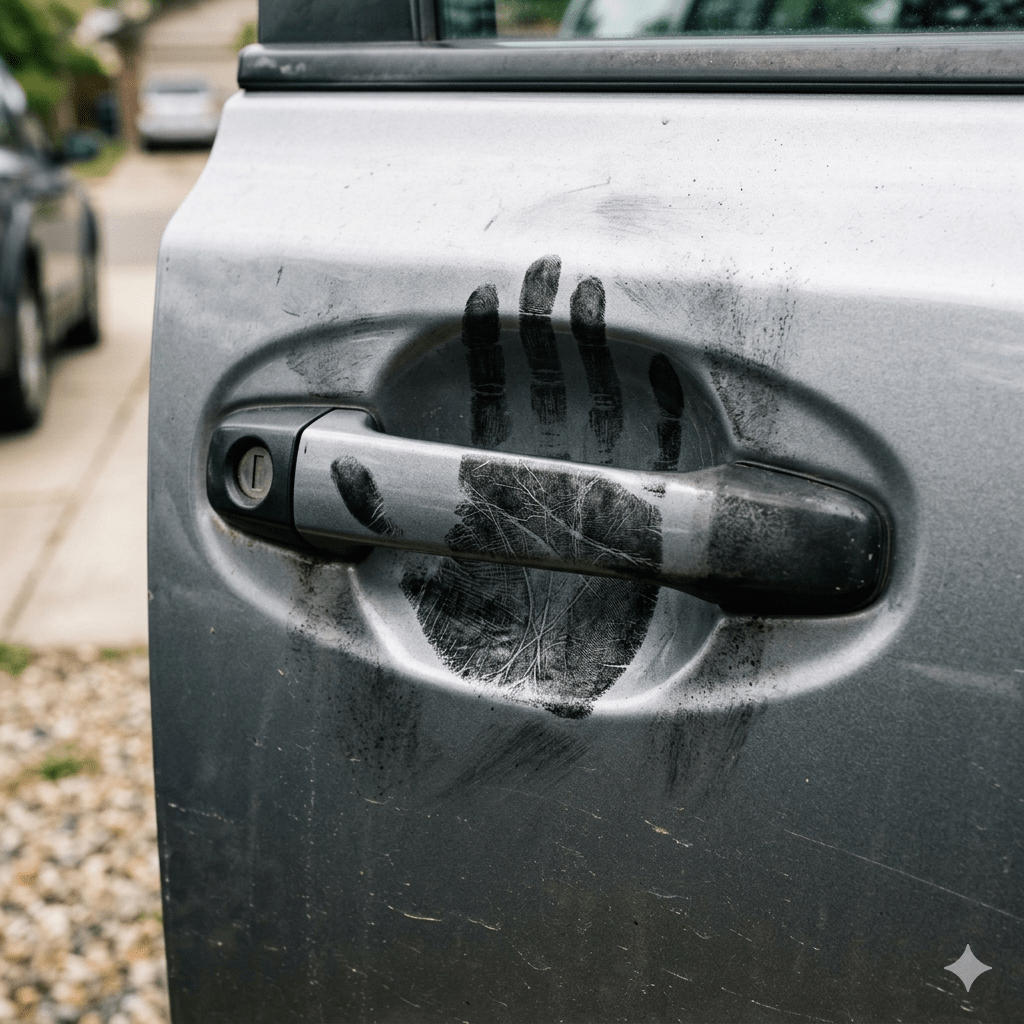
On Wednesday I shared the post “Is Fingerprint Evidence ‘Fryed’ in New Jersey?” My post concerned a mandated hearing on the admissibility of fingerprint evidence in court. This hearing has not yet been held, so there are no new standard that govern (or bar) the use of fingerprints to convict or exonerate people.

But that isn’t the only time friction ridge admissibility was strongly challenged.
There is a case in which a Frye challenge succeeded in blocking friction ridge evidence from a Maryland state court.
Not that it mattered in the end.
State of Maryland vs. Bryan Rose
Judge Susan Souder issued a 30 page decision in this case, from which I will quote extensively. But not that extensively.
And before I do, I want to put this on the forensic timeline.
- Souder’s decision was issued after the Brandon Mayfield misidentification, in which Mayfield was incorrectly identified as a terrorist in Spain.
- Souder’s decision was issued before the National Academies of Science report on forensics, which resulted in significant cases on how fingerprints are examined and results are reported.
So bear this in mind. A highly publlcized case had shattered the notion that fingerprint matching decisions are infallible (“100% certainty”), but the forensic discipline had not yet moved toward an alternative.
A man was shot and killed on January 5, 2006, and Bryan Rose was arrested on January 18. At this time, the evidence against Bryan Rose consisted of latent prints on a stolen car, which two crime lab technicians linked to Rose’s known prints. The technicians relied on the Analysis Comparison Evaluation – Verification (ACE-V) methodology, and this reliance was central to the challenge.
“Both sides have requested that the Court determine the issue of reliability of the ACE-V methodology, and consequent admission vel non of the latent fingerprints, without reference to the specific fingerprint evidence in this case.”
In other words, the ruling was not based upon the facts in this particular case, but the use of ACE-V itself.
So what were the arguments for and against the admissibility of ACE-V?
“Defendant contends that ACE-V is not a methodology which has been subjected to scientific testing. As a result, the error rate in latent print identifications is unknown. Absent an error rate, reliability of the methodology is unproven. A fundamental problem, according to Defendant, is that the subjective comparisons in ACE-V involve psychological phenomena known as “confirmation bias.” Further, Defendant argues that the “standards” for latent fingerprint identification are inadequate.
“The State principally relies on the history of acceptance of fingerprint identification evidence. Maryland courts have found fingerprint identification to be admissible in the past. Recent court challenges to fingerprint identification evidence have been rejected. Finally, the State claims that the ACE-V methodology is generally accepted in the relevant technical community.”
Those words “generally accepted” should be noted. As Judge Souder noted elsewhere in her decision:
“Under the Frye – Reed test, a party must establish first that a technical or scientific method is reliable and accepted generally in the scientific community before the court will admit expert testimony based upon the application of the questioned technique.”
But general acceptance is not enough. The method must also be reliable.
Turning to ACE-V itself, Judge Souder noted:
“The ACE-V method ‘includes both qualitative and quantitative analysis’ according to The Scientific Working Group for Friction Ridge Analysis, Study and Technology hereafter referred to (;SWGFAST).”
In Judge Souder’s view, the qualitative nature of analysis and the other steps in ACE-V caused her to question the scientific basis of the process. Things seemed a little loose.
“Mr. (Stephen) Meagher testified in this case that he is able to make identifications today that he would not have been able to do thirty (30) years ago.”
I’ve known Meagher during and after his time in the FBI, but if Meagher were using a scientific method, why would his experience matter?
There were a lot of other details that I skipped over, but you can click on the link above if you’re interested.
A two-day Frye hearing was heled on May 29 and 30, 2007.
On October 19, Judge Souder reached her decision.
“In conclusion, the proof presented by the State in this case regarding the ACE-V methodology of latent fingerprint identification showed that it was more likely so, than not so, that ACE-V was the type of procedure Frye was intended to banish, that is, a subjective, untested, unverifiable identification procedure that purports to be infallible. After impartial scientific testing, the establishment of an error rate and of objective criteria which when applied, are documented and can be verified, it may be that latent print identification opinion testimony as offered in this capital case will qualify for admission under Frye-Reed. The State did not meet that burden in this case and, consequently, shall not offer testimony that any latent fingerprint in this case is that of the Defendant. In this case, the State did not show by a preponderance of evidence that a fingerprint examiner can reliably identify a fingerprint to an individual to the exclusion of all others using the ACE-V method.”
The decision pretty nuch crrippled the State’s case, and the State eventually dropped all charges against Rose.
United States v. Brian Keith Rose
But that didn’t mean the end of the prosecution, because the U.S. Department of Justice stepped in.
We’ve seen this before. Remember when the State of California failed to convict the four officers involved in the beating of Rodney King? After that happened, the federal govvernment charged the men, and two of the four were convicted.
In the Rose case, the federal government filed new charges in its case, United States v. Brian Keith Rose.
The federal judge, U.S. District Judge Catherine C. Blake, also held a hearing (under Daubert rules) on the admissibility of ACE-V. However, Blake ruled in late 2009 that ACE-V was admissible. This prompted Rose to reach a plea deal to escape the death penalty, and he was eventually sentenced to 40 years without the possibility of parole.
So much for Judge Souder’s ruling.
And one more thing
In both the Rodney King and the Brian Rose cases, charges were filed at both the state and federal level. Doesn’t that constitute double jeopardy, which is prohibited by the Fifth Amendment to the U.S. Constitution?
It doesn’t.
Double jeopardy only applies if the same sovereign state (California, Maryland, or the United States) charges the same defendant twice. Since the charges were filed on separate sovereign states, double jeopardy does not apply.
Oh, and here’s a song about palm prints.

 Bredemarket
1 Comment