
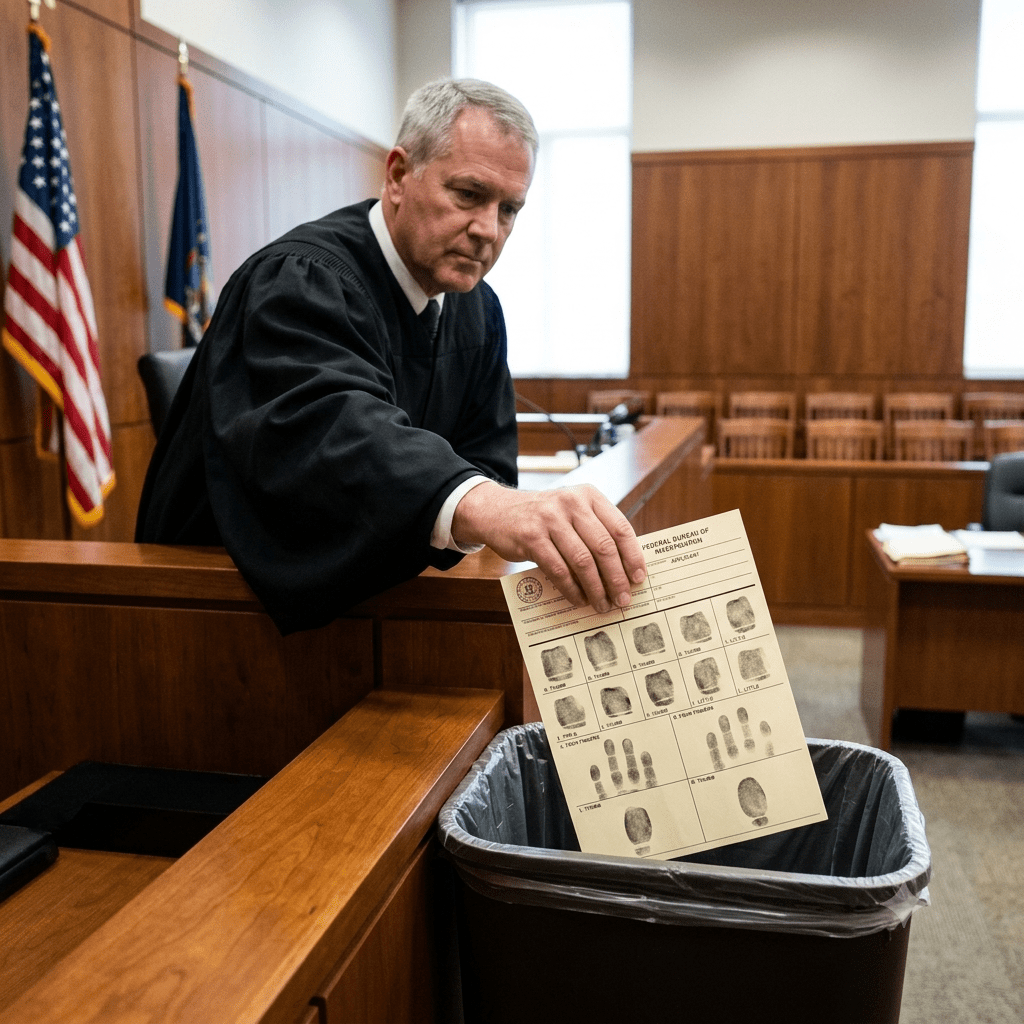
Thanks to Mike Bowers (CSI DDS) for this story about possible changes to the admissibility of fingerprint evidence in New Jersey.
But first, some background.
Fingerprint evidence
While facial recognition results and DNA results can only serve as investigative leads, for the most part fingerprint evidence is acceptable.
Not only to convict a person, but to exonerate a person.

I’ve previously discussed the case of Archie Williams, who was freed from prison by the Innocence Project (we’ll return to them later). Williams was sentenced to life in prison without parole in 1983 for a rape and stabbing he did not commit. So how was he freed?
“Commissioner Kimble ordered a status conference at which the court clarified it would invoke its power to obtain the truth in Williams’ case and make sure all possibilities had been explored. Because, in part, of the availability of the NGI fingerprint database and advanced technology, while maintaining their procedural objections, the state agreed to run the test. On March 14, 2019, fingerprint experts at Ron Smith & Associates, in conjunction with the Louisiana State Police Crime Lab, submitted the suitable fingerprint lifts taken from the crime scene into NGI. This search led to an identification of a known individual, Stephen Forbes, a man who had committed similar sexual assaults in the same neighborhood as the victim in Williams’ case.”
Ron Smith is no longer with us (although his associates are), but the Louisiana State Police Crime Lab obviously is, and their match decision of Stephen Forbes (deceased) was legally persuasive.
“Commissioner Kinasiyumki Kimble of the 19th Judicial District Court of East Baton Rouge, Louisiana, vacated the wrongful conviction of Archie Williams.”
A feel-good story. But is fingerprint evidence always reliable?
Frye (and Daubert) challenges
There are two methods, used in different states, to challenge whether a piece of testimony is legally admissible. According to Bredebot, the older of the two standards is the Frye standard.
“The Frye Standard (The “General Acceptance” Test): Think of Frye as the old-school, tried-and-true method. It’s often called the “general acceptance” test. Basically, if a scientific technique or principle is generally accepted by the relevant scientific community, then it’s good to go. It’s like saying, “Hey, all the smart people in this field agree this is legitimate, so we’ll allow it.” This standard is still used in a good number of states, and it’s a bit more conservative. It doesn’t delve into the nitty-gritty of the scientific method itself, but rather whether the scientific community has embraced it.”
This doesn’t only apply to fingerprints, but to any type of scientific evidence. Although the majority of states use the stricter Daubert (in which the judge, not the scientific community, determines admissibility), there are some states that still accept Frye.
Including New Jersey.
State v. French Lee
Which brings us to a recent ruling by the Supreme Court of the State of New Jersey in the case of State v. French Lee. As JD Supra reports:
“A Morgan Lewis team represented the Innocence Project’s national strategic litigation team, serving as amici in the case of State v. French Lee urging the New Jersey Supreme Court to appoint a Special Adjudicator to assist the trial court in assessing the reliability and admissibility of fingerprint evidence and to draft a model jury charge governing the evaluation of such evidence and related testimony. In a landmark, unanimous decision, the Supreme Court agreed, ordering a hearing on the admissibility and reliability of fingerprint evidence and further action to ensure the reliability of such evidence in future trials, marking a significant development in forensic standards for criminal trials in the state.”
Lee was convicted of burglary in the original trial based upon latent fingerprint evidence. When the evidence was challenged…
“The state relied on more than 100 years of judicial acceptance of fingerprint evidence under the Frye standard, emphasizing its history in New Jersey and federal courts. The trial court admitted the evidence without a pretrial hearing.”
Higher courts, however, ruled that the reliability and admissibility of fingerprint evidence must be assessed.
Perhaps the assessment will determine that fingerprint evidence is admissible provided that certain safeguards are implemented: for example, that the latent examiner is not subject to bias before making their forensic examination, or perhaps the blind secondary verification is implemented.
Or the assessment may regard fingeprint evidence as inadmissible, or not sufficient on its own merits to result in a conviction (in other words, just like facial recognition and DNA).
I cannot emphasize this enough; this is potentially a big deal.
What are vendor responsibilities?
It’s attractive to some biometric vendors to pass the buck and say, “This is not my problem. Let the agency worry about it.”
But as I’ve said before in Biometric Update, vendors must disclose responsible uses of biometric data. And that includes designing biometric systems that conform with laws and practices, including the removal of bias from biometric match decisions.
But the technology vendors can only do so much. Agencies themselves must implement policies that remove bias. It’s of no benefit if the vendor’s solution incorporates blind secondary verification if the agencies don’t use it, or even worse instruct their forensic examiners to “confirm that this guy we arrested is the one who committed the crime.”
Big red flag!
Now biometric vendors can educate their prospects on responsible biometric use. And Bredemarket can help biometric vendors develop the educational content.

 Bredemarket
4 Comments