
1984 John would have been so jealous of me on Tuesday.
On Tuesday I was writing an installation guide for a Bredemarket client. Even though it was a simply formatted guide, its formatting was light years ahead the software user manuals I wrote around 1984 (no significance, just coincidence).
As I previously mentioned, 1984 John wrote user manuals using a software package called multiWRITE. You’ve probably never heard of it. multiWRITE was a word processor for the THEOS operating system that was developed by my employer, Logic eXtension Resources. So when I wrote the user manual for multiWRITE, I used…multiWRITE. Yeah, I ate my own wildebeest food even in the 1980s.
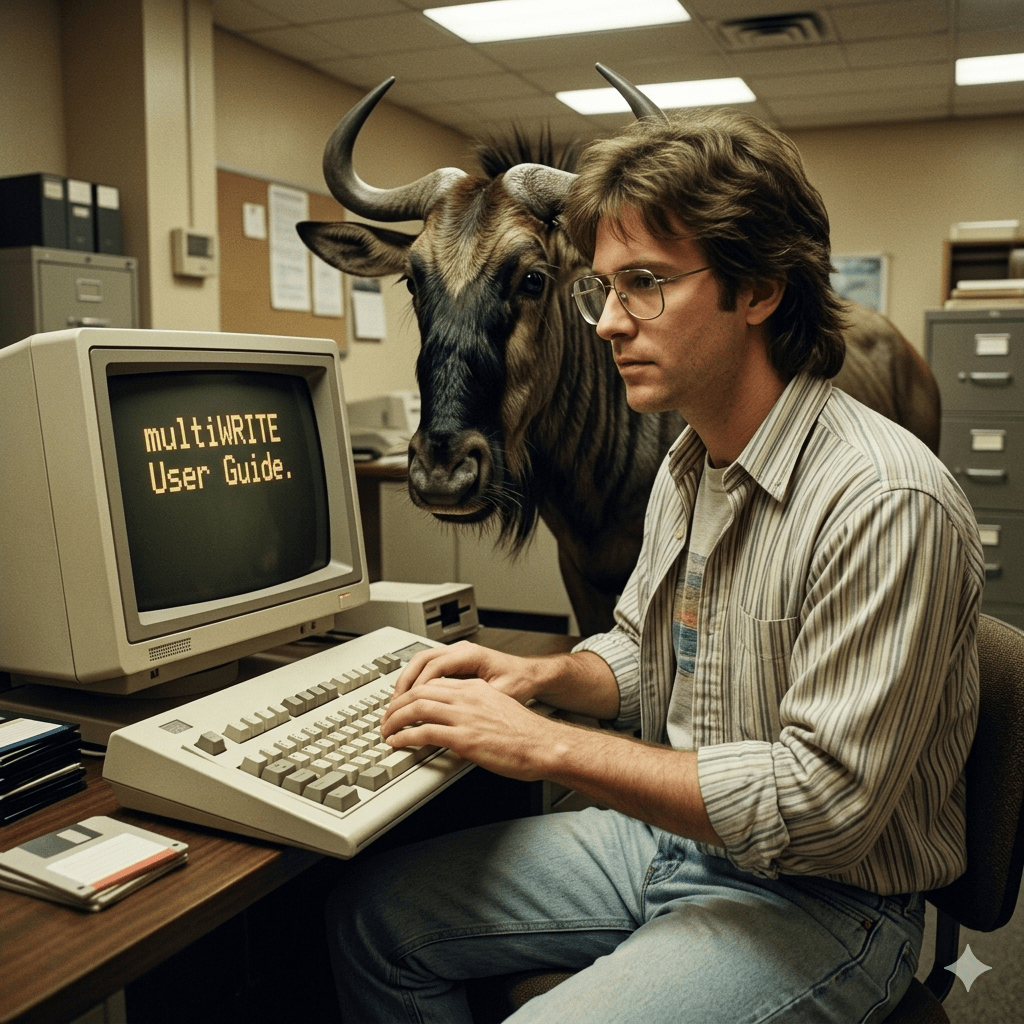
Now multiWRITE was a pretty good software package for the time, and THEOS was a pretty good operating system for the time. But by 2026 standards it was atrocious.
- The output was bi-tonal, just black and white with no colors or even grayscale output.
- The output was monospaced, just like a typewriter. Typewriters were still very common in 1984.
Things started to change as Logic eXtension Resources started to offer Macintosh software and started using Macs for internal document creation. But for my first years at Logic eXtension Resources it was basically typewriter-looking text saved to disk.
Fast forward to 2026, and I had to create a simple installation guide using today’s tools. The manual wasn’t fancy by any stretch of the imagination: even my ebook on the six factors of identity verification is fancier.
Oh, have I mentioned my ebook recently? Now I have. Click the image to buy.

But the client’s installation guide had several features that left multiWRITE in the dust.
One example: back in 1984 my text highlighting options were limited.

On Tuesday I wrote a sentence that looked like this.

Yeah, blue text. 1984 me would have been shocked.

But then again, other than me, who writes user manuals any more?

 Bredemarket