
Back in 2021, it seemed that I was commenting on the EU Digital COVID Certificate (EUDCC) ad nauseum. The EUDCC is the “vaccine passport” that was developed to allow people in member EU countries to prove their COVID vaccination status in another EU country.

My most recent post on the EUDCC was written on August 30, 2021, and discussed the International Air Transport Association (IATA) endorsement of the EUDCC as a global standard. But did it matter? I took a look at how global standards are adopted (hint: brute force):
If a lot of people like something, it’s a standard.
If a trillion dollar company likes something, and I like something different, then the thing that the trillion dollar company likes is a standard.
If two trillion dollar companies like two different things…it can get messy.
From https://bredemarket.com/2021/08/30/iata-endorses-the-eudcc-but-will-it-matter/
August 2021 was the last time that I wrote about the EUDCC in the Bredemarket blog. Until now.
Enter…WHO?
You know how standards are adopted by brute force from big players? Well, one big player has forced itself into the discussion. That player is the World Health Organization, commonly known as WHO.

But according to Masha Borak at Biometric Update, the WHO is just recognizing that the “EU” Digital COVID Certificate has expanded far beyond the EU.
Stella Kyriakides, the European commissioner for health and food safety (announced) that the voluntary certificate program has already been taken up by almost 80 countries.
From https://www.biometricupdate.com/202306/united-nations-taking-over-eu-covid-certificate-program-july-1
Last I checked there were not 80 countries in the EU. So this health standards thing took off after the initial hiccups. Although the Wikipedia list of non-EU adopting countries does not include two big players—the United States and China (the same two countries I cited in my August 2021 post).
Therefore, it made sense for WHO to get in on the act with its Global Digital Health Certification Network, allowing worldwide responses to post-COVID issues.
WHO’s Global Digital Health Certification Network is an open-source platform, built on robust & transparent standards that establishes the first building block of digital public health infrastructure for developing a wide range of digital products for strengthening pandemic preparedness and to deliver better health for all….
The GDHCN is builds (sic) upon the experience of regional networks for COVID-19 Certificates and takes up the infrastructure and experiences with the digital European Union Digital COVID Certificate (EU DCC) system, which has seen adoption across all Member States of the EU as well as 51 non-EU countries and territories. The GDHCN has been designed to be interoperable with other existing regional networks (e.g., ICAO VSD-NC, DIVOC, LACPass, SMART Health Cards) specifications.
From https://www.who.int/initiatives/global-digital-health-certification-network
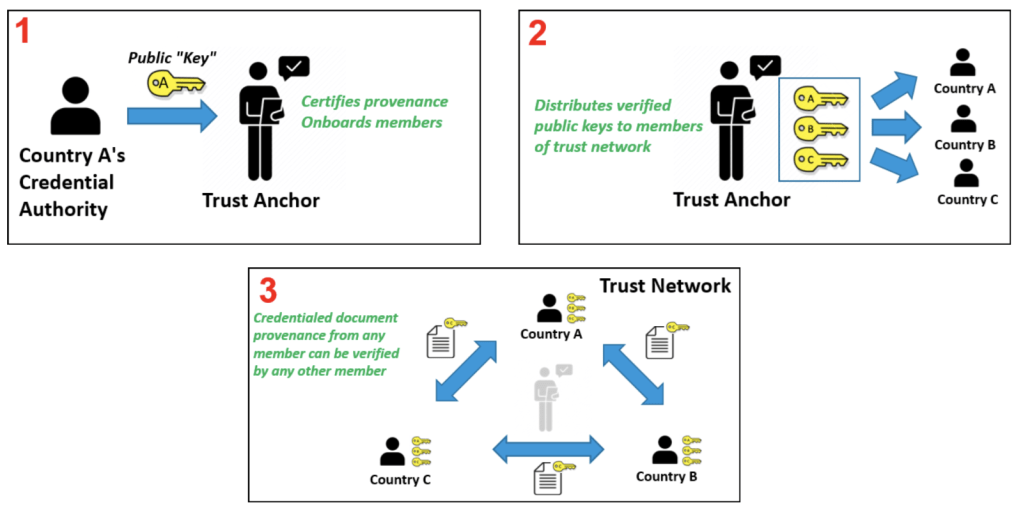
On the surface it sounds great, but we’ll see what happens when it goes live (Borak states that the go-live date is July 1).
And we’ll see how it expands:
To facilitate the uptake of the EU DCC by WHO and contribute to its operation and further development, WHO and the European Commission have agreed to partner in digital health.
This partnership will work to technically develop the WHO system with a staged approach to cover additional use cases, which may include, for example, the digitisation of the International Certificate of Vaccination or Prophylaxis. Expanding such digital solutions will be essential to deliver better health for citizens across the globe.
From https://www.who.int/news/item/05-06-2023-the-european-commission-and-who-launch-landmark-digital-health-initiative-to-strengthen-global-health-security
And most importantly, we’ll see which countries participate—and which countries don’t.

 Bredemarket
1 Comment