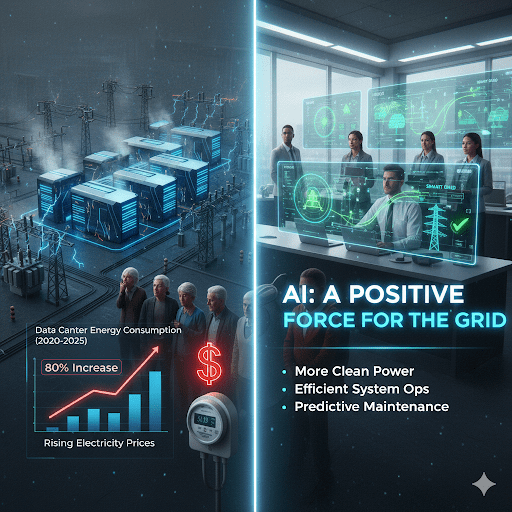
“The rising popularity of AI is driving an increase in electricity demand so significant it has the potential to reshape our grid. Energy consumption by data centers has gone up by 80% from 2020 to 2025 and is likely to keep growing. Electricity prices are already rising, especially in places where data centers are most concentrated.
“Yet many people, especially in Big Tech, argue that AI will be, on balance, a positive force for the grid. They claim that the technology could help get more clean power online faster, run our power system more efficiently, and predict and prevent failures that cause blackouts.”
(Updated 4/16/2022 with additional benefits information.)
Everything is virtual
Many of our lives changed significantly in March 2020, when we left our offices and cubicles and decamped to makeshift desks in our homes. Since that time, those of us who are still working from home (WFH) have interacted with others via telephone, Cisco WebEx, Google Meet, Microsoft Teams, Slack, Zoom, and other virtual collaboration tools.
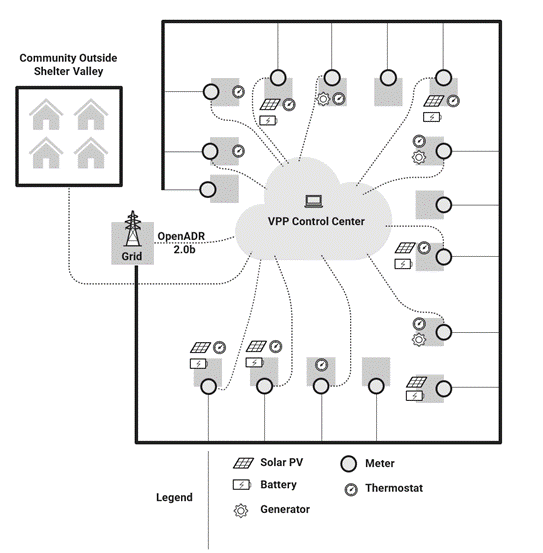
As part of our Sustainability Strategy and commitment to reach net zero greenhouse gas emissions by 2045, SDG&E is launching a Virtual Power Plant (VPP) Pilot Project in 2022, an initiative to strengthen community resilience and electric reliability in the unincorporated community of Shelter Valley in East San Diego County.
SDG&E realizes that you can’t just talk about the features of virtual power plants. SDG&E’s customers don’t care about features. Its customers only care about what’s in it for them. So SDG&E collected some benefits of virtual power plants.
(4/16/2022: For additional information on benefits, click here.)
The first benefit: community resilience and electric reliability
The first benefit that SDG&E identified for VPPs can be found in the text above, where it noted that virtual power plants can “strengthen community resilience and electric reliability.”
Now I’ll grant that Californa isn’t Texas, but there are more and more times where California’s electric power goes out, due either to very high temperatures, very high winds, or very high fire danger.
So SDG&E consumers (and consumers from other electric utilities) are more interested in electric reliability. If VPPs can provide that reliability, great!
So how does a VPP strengthen community resilience and electric reliability?
A key element of a VPP is its distributed energy resources, or DERs. With home-based solar power, batteries, smart thermostats, and other energy technologies, the days of a single centralized power source are over.
The second benefit: lower investment and operating costs
But rather than siloing these DERs, a VPP arranges to have them work as a single unit, just like a conventional power plant, but with a difference.
In other words, a VPP can mimic or potentially replace a conventional power plant and help address distribution network bottlenecks, but with lower investment and operating costs.
Note that SDG&E doesn’t take this a step further and say that this will result in a reduction in building of conventional power plants.
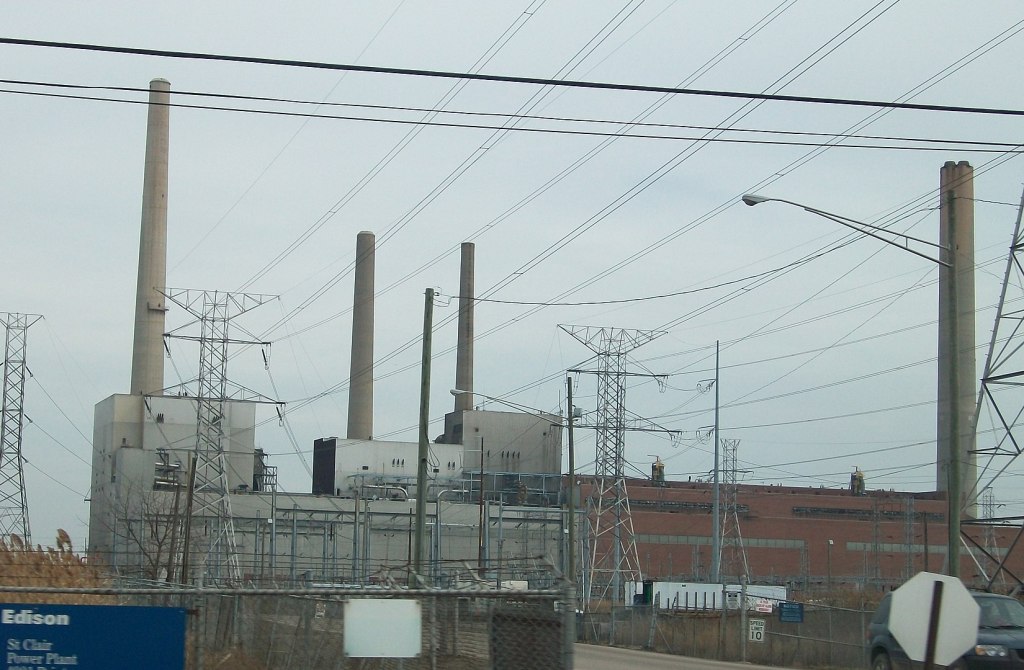
Since VPPs look like residential/commercial communities (because they are), most of us think that VPPs are prettier than many conventional power plants such as this one. By Cgord (talk) – (Cgord (talk)) created this work entirely by himself. Transferred from Wikipedia., GFDL, https://commons.wikimedia.org/w/index.php?curid=19912142
And SDG&E definitely doesn’t say that this will result in lower rates for energy consumers. But maybe some energy utility will make this commitment.
A musical postlude
A major component of a VPP is the solar energy that is generated by solar cells on people’s homes. Of course, solar energy is nothing new, as those of us who recall a certain song know all too well.



 Bredemarket