
When the United States was attacked on September 11, 2001—an attack that caused NATO to invoke Article 5, but I digress—Congress and the President decided that the proper response was to reorganize the government and place homeland security efforts under a single Cabinet secretary. While we may question the practical wisdom of that move, the intent was to ensure that the U.S. Government mounted a coordinated response to that specific threat.
Today Americans face the threat of fraud. Granted it isn’t as showy as burning buildings, but fraud clearly impacts many if not most of us. My financial identity has been compromised multiple times in the last several years, and yours probably has also.
But don’t expect Congress and the President to create a single Department of Anti-Fraud any time soon.
Stop Identity Fraud and Identity Theft Bill
As Biometric Update reported, Congresspeople Bill Foster (D-IL) and Pete Sessions (R-TX) recently introduced H.R. 7270, “To establish a government-wide approach to stopping identity fraud and theft in the financial services industry, and for other purposes.”
Because this is government-wide and necessarily complex, the bill will be referred to at least THREE House Committees:
“Referred to the Committee on Oversight and Government Reform, and in addition to the Committees on Financial Services, and Energy and Commerce, for a period to be subsequently determined by the Speaker, in each case for consideration of such provisions as fall within the jurisdiction of the committee concerned.”
Why? As I type this the bill text is not available at congress.gov, but Foster’s press release links to a preliminary (un-numbered) copy of the bill. Here are some excerpts:
“9 (9) The National Institute of Standards and
10 Technology (NIST) was directed in the CHIPS and
11 Science Act of 2022 to launch new work to develop
12 a framework of common definitions and voluntary
13 guidance for digital identity management systems,
14 including identity and attribute validation services
15 provided by Federal, State, and local governments,
16 and work is underway at NIST to create this guid
17 ance. However, State and local agencies lack re
18 sources to implement this new guidance, and if this
19 does not change, it will take decades to harden defi
20 ciencies in identity infrastructure.”
Even in the preamble the bill mentions NIST, part of the U.S. Department of Commerce, and the individual states, after mentioning the U.S. Department of the Treasury (FinCEN) earlier in the bill.
But let’s get to the meat of the bill:
“3 SEC. 3. IDENTITY FRAUD PREVENTION INNOVATION
4 GRANTS.
5 (a) IN GENERAL.—The Secretary of the Treasury
6 shall, not later than 1 year after the date of the enactment
7 of this section, establish a grant program to provide iden
8 tity fraud prevention innovation grants to States.”
The specifics:
- The states can use the grants to develop mobile driver’s licenses “and other identity credentials.”
- They can also use the grants to protect individuals from deepfake attacks.
- Another purpose is to develop “interoperable solutions.”
- A fourth is to replace vulnerable legacy systems.
- The final uses are to make sure the federal government gets its money, because that’s the important thing to Congress.
But there are some limitations in how the funds are spent.
- They can’t be used to require mDLs or eliminate physical driver’s licenses.
- They can’t be used to “support the issuance of drivers licenses or
identity credentials to unauthorized immigrants.” (I could go off on a complete tangent here, but for now I’ll just say that this prevents a STATE from issuing such an identity credential.)
The bill is completely silent on REAL ID, therefore not mandating that everyone HAS to get a REAL ID.
And everything else
So although the bill claims to implement a government-wide solution, the only legislative changes to the federal government involve a single department, Treasury.
But Treasury (FinCEN plus IRS) and the tangentially-mentioned Commerce (NIST) aren’t the only Cabinet departments and independent agencies involved in anti-fraud efforts. Others include:
- The Department of Justice, through the Federal Bureau of Investigation and the new Division for National Fraud Enforcement.
- The Department of Homeland Security, through the Secret Service and every enforcement agency that checks identities at U.S. borders and other locations.
- The Federal Trade Commission (FTC).
- The Social Security Admistration. Not that SSNs are a national ID…but they de facto are.
- The U.S. Postal Inspection Service.
- The Consumer Financial Protection Bureau.
These agencies are not ignored, but are funded under mandates separate from H.R. 7270. Or maybe not; there’s an effort to move Consumer Financial Protection Bureau work to the Department of Justice so that the CFPB can be shut down.
And that’s just one example of how anti-fraud efforts are siloed. Much of this is unavoidable in our governmental system (regardless of political parties), in which states and federal government agencies constantly war against each other.
- What happens, for example, if the Secret Service decides that the states (funded by Treasury) or the FBI (part of Justice) are impeding its anti-fraud efforts?
- Or if someone complains about NIST listing evil Commie Chinese facial recognition algorithms that COULD fight fraud?
Despite what Biometric Update and the Congresspeople say, we do NOT have a government-wide anti-fraud solution.
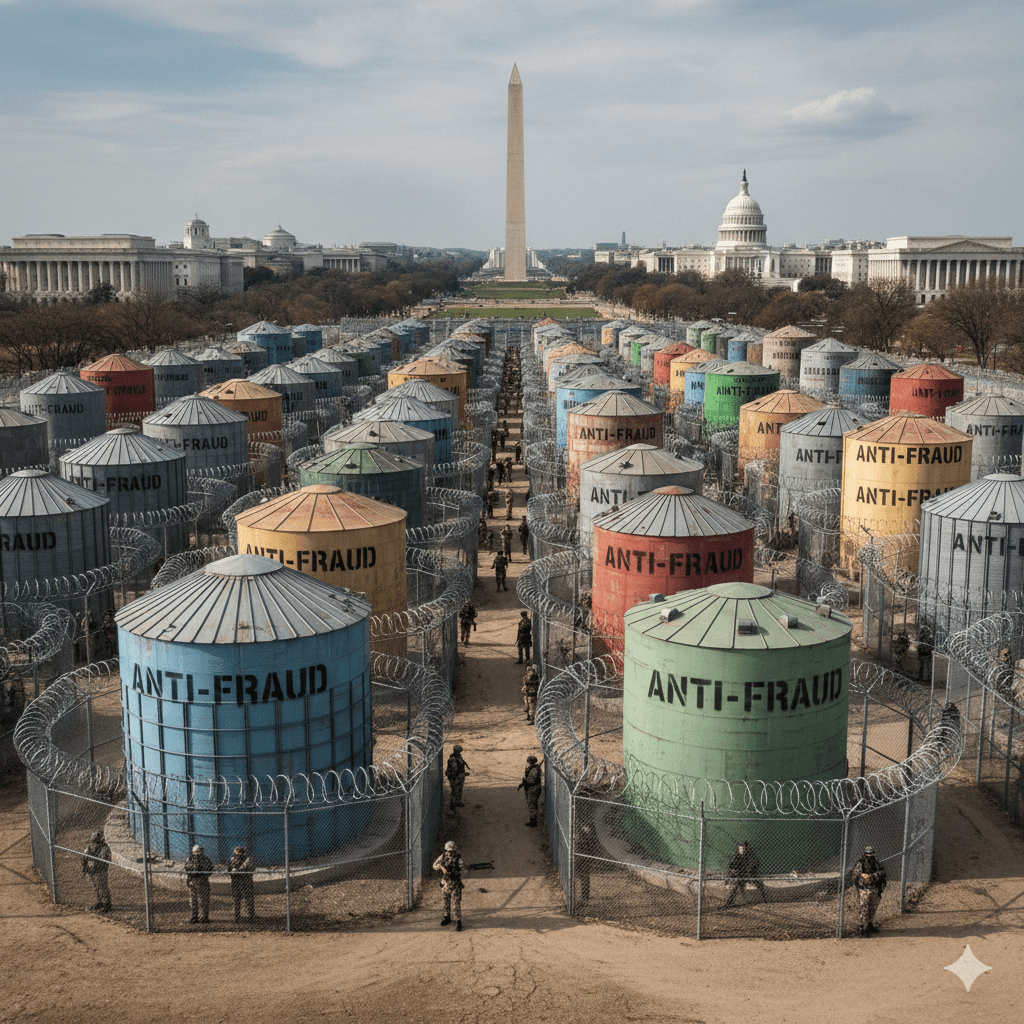
(And yes, I know that the Capitol is not north of the Washington Monument…yet.)

 Bredemarket
1 Comment