
(From imgflip)
Yes, I broke a cardinal rule by placing an undefined acronym in the blog post title.
99% of all readers probably concluded that the “NPE” in the title was some kind of dangerous drug.
And there actually is something called Norpseudoephedrine that uses the acronym NPE. It was discussed in a 1998 study shared by the National Library of Medicine within the National Institutes of Health. (TL;DR: NPE “enhances the analgesic and rate decreasing effects of morphine, but inhibits its discriminative properties.”)

But I wasn’t talking about THAT NPE.
I was talking about the NPEs that are non-person entities.
But not in the context of attribute-based access control or rivers or robo-docs.
I was speaking of using generative artificial intelligence to write text.
My feelings on this have been expressed before, including my belief that generative AI should NEVER write the first draft of any published piece.
A false accusation
A particular freelance copywriter holds similar beliefs, so she was shocked when she received a rejection notice from a company that included the following:
“We try to avoid employing people who use AI for their writing.
“Although you answered ‘No’ to our screening question, the text of your proposal is AI-generated.”
There’s only one teeny problem: the copywriter wrote her proposal herself.
(This post doesn’t name the company who made the false accusation, so if you DON’T want to know who the company is, don’t click on this link.)
Face it. (Yes, I used that word intentionally; I’ve got a business to run.) Some experts—well, self-appointed “experts”—who delve into the paragraph you’re reading right now will conclude that its use of proper grammar, em dashes, the word “delve,” and the Oxford comma PROVE that I didn’t write it. Maybe I’ll add a rocket emoji to help them perpetuate their misinformation. 🚀
Heck, I’ve used the word “delve” for years before ChatGPT became a verb. And now I use it on purpose just to irritate the “experts.”
The ramifications of a false accusation
And the company’s claim about the copywriter’s authorship is not only misinformation.
It’s libel.
I have some questions for the company that falsely accused the copywriter of using generative AI to write her proposal.
- How did the company conclude that the copywriter did not write her proposal, but used a generative AI tool to write it?
- What is the measured accuracy of the method employed by the company?
- Has the copywriter been placed on a blocklist by the company based upon this false accusation?
- Has the company shared this false accusation with other companies, thus endangering the copywriter’s ability to make a living?
If this raises to the level of personal injury, perhaps an attorney should get involved.

A final thought
Seriously: if you’re accused of something you didn’t do, push back.
After all, humans who claim to detect AI have not been independently measured regarding their AI detection accuracy.
And AI-powered AI detectors can hallucinate.
So be safe, and take care of yourself, and each other.
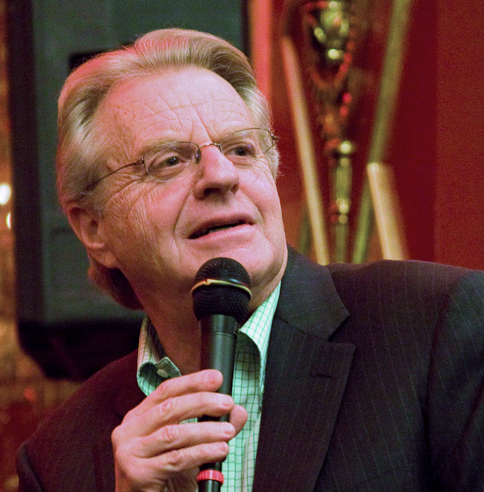
Jerry Springer. By Justin Hoch, CC BY 2.0, https://commons.wikimedia.org/w/index.php?curid=16673259.

 Bredemarket