
About two weeks ago, I asked myself the question “How Soon Will I Have to Change My Temperamental Writer Generative AI Suggestions/Rule?“
Perhaps that time has come.
Perhaps not.
What are my temperamental writer generative AI suggestions and rule?
If you haven’t seen my June 5 blog post or my June 13 LinkedIn article on this topic, here is a brief recap of how I use generative AI in my writing:

- Suggestion 1: A human should always write the first draft.
- Suggestion 2: Only feed bits to the generative AI tool.
- An ironclad rule: Don’t share confidential information with the tool.
This post will focus on the first suggestion, although the ironclad rule will come up in the discussion also.
There are several reasons why I believe that a human should write the first draft, and the generative AI tool should only be used to improve the draft. Two of these reasons (I won’t get into the ego part) are as follows:
- Iterate on my work to make it better. For me, the process of writing itself lets me tweak the text throughout the written content. In my view this makes the first draft much better, which makes the final version even better still.
- Control the tone of my writing. One current drawback of generative AI is that, unless properly prompted, it often delivers bland, boring text. Creating and iterating the text myself lets me dictate the tone of voice and eliminates the need to rewrite the whole thing later to change the tone.
However, there is one drawback to my method. It takes a lot longer.
- If you submit a prompt to a generative AI tool and receive results in a minute, and if you tweak the prompt four times to make it better, you’ll have a complete first draft in five minutes.
- Using my method, I don’t create a first draft in five minutes. It usually takes me between 60 and 120 minutes (not counting “sleep on it” time) to crank out a first draft the old fashioned way.
Let’s look at a different way to use generative AI in writing.
What is writer.com?
The Content Marketing Institute recently hosted a three-day series of webinars on content marketing called ContentTECH 2023.

One of the sessions, “Generative AI FTW: Must-Have Use Cases and Requirements for Success,” was presented by Alex Wettreich (LinkedIn, Twitter) of Writer, which promotes itself as providing the “AI platform built for the enterprise.”
This isn’t your general-purpose generative AI tool that throws everyone’s prompts into the same data warehouse. This is truly a tool for your enterprise:
Unlike other large language models, Palmyra, our family of LLMs, is built for business….
Ability to self-host: Offered as self-hosted option. Own, host, and customize your own version of our LLM.
From https://writer.com/platform/
Guess what this means? All of my personal concerns about sharing confidential data with a generative AI tool are eliminated. Read Writer’s Terms of Service:
7.1. Ownership. All data, information, files, or other materials and content that Customer makes available to Company for the purpose of utilizing the Service (including, without limitation, training data, prompt inputs, and drafts) (“Customer Content”) shall remain the sole property of Customer. Customer shall retain all intellectual property rights in the Customer Content. Company does not screen Customer Content, is not responsible for storing or maintaining backups of any Customer Content, and is not responsible for the content of or any use by Customer of the Customer Content.
From https://writer.com/terms/
Now that we’ve talked about the basics of Writer, let’s see how it creates content.
What is writer.com’s generative AI writing process?
With Writer, the generative AI tool writes the first draft.
[W]hat we did at Writer was simple: customers already had their style guides built into Writer — their writing style, terminology, and must-have language. We used that plus samples of customers’ best blog posts, help articles, headlines, email subject lines, ads, and more. Writer can create first drafts that are significantly better than other tools because the content is modeled off your best content and trained on your voice.
From https://writer.com/blog/generative-ai-capabilities/
The training data is important. A marketer who uses Writer is guided along the way.
“Create a unique, consistent, and relatable voice that shines through every communication touch point — at scale. Your marketing team doesn’t have time for the copyediting (or scolding).”
“Keep your editorial guidelines up-to-date and easy to access. From punctuation to capitalization rules to grade level and specific terminology, put all your guidance in one place.”
“Make your core messaging easy to repeat. Keep company voice, terms, and boilerplate consistent, no matter who’s writing.”
From https://writer.com/use-cases/marketing/
But is Writer’s output as bland as the reputed “style” from other generative AI tools? If it is, then you won’t save any time by using Writer, since you’ll have to rewrite everything to fit your tone of voice anyway.
Now I haven’t tested Writer, but Trello has. And it sounds like Trello’s tone of voice has been preserved even when the bots write the content.
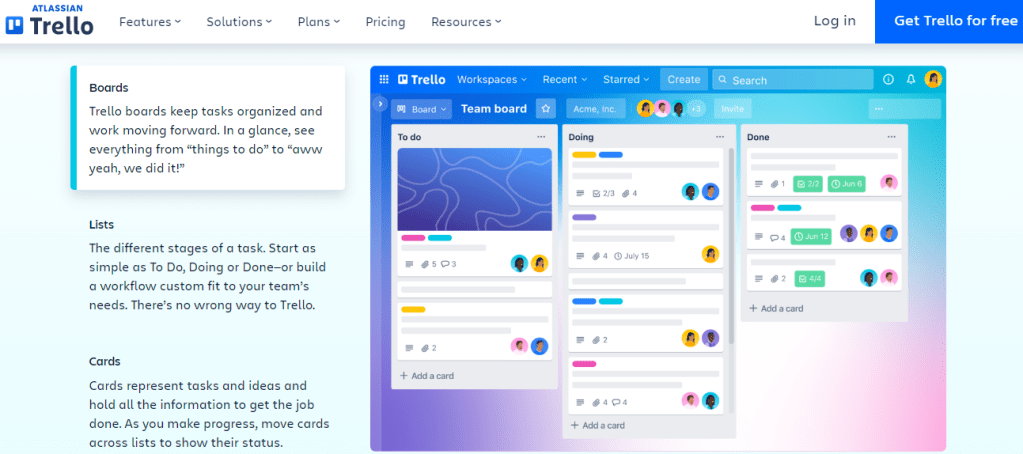
Trello avoids the “professional voice” trap traditional software companies fall into (aka stodgy, robotic tone) by treating the person who reads their content like a coworker….With phrases like “go from Trello zero to Trello hero,” you can see that the writers at Trello had permission and encouragement to have fun while writing help content, and that fun translates to a delightful experience for users….
Leah Ryder told us, “With the 10-year anniversary of Trello around the corner, combined with major developments in-product with the new Views feature, it seemed like the right time to update and align our brand and product towards our shared goal of empowering productivity for teams everywhere.”…
Trello’s brand refresh was 1.5 years in the making, and it took a tremendous amount of strategic leadership, partnered with cross-team collaboration to make it happen. It couldn’t have happened without ten years of defining and committing to rule-breaking brand principles. Over the next decade, there’s no doubt the product will change as it adapts to user needs, but with strong brand principles in place, Trellists can always expect a sense of joy built into everything Trello creates.
From https://writer.com/blog/trello-brand-refresh/
The guidance provided by Writer ensures that Trello continues to sound…Trello-y, even after Trello became a small part of Atlassian.
What does this mean?
So if Writer and Trello are correct in their assertions, it IS possible for a well-designed generative AI tool to create a first draft that does NOT require extensive rewrites. Or, if you control your data warehouse, fact-checking. This preserves the ability to save time, since you don’t have to rewrite bland text or correct inaccurate text.
Of course, you have to buy Writer. As of today, Writer’s price for a team of five or fewer people is $18/user/month. Talk to them if you want a larger offering for your entire enterprise.
The people who review for G2 have identified alternatives to Writer, including some well-known names such as Grammarly, Jasper, and Notion. As time goes on, the major players such as Microsoft will incorporate AI into existing and new products, but whether these tools will allow tone of voice specification and privacy preservation remains to be seen.
Let’s see how long my “human drafts first” suggestion lasts.

 Bredemarket
5 Comments