
I recently published “The Temperamental Writer’s Two Suggestions and One Rule for Using Generative AI.” If you didn’t read it, the three ways I use generative AI are as follows:
- (Suggestion) A human should always write the first draft.
- (Suggestion) Only feed bits to the generative AI tool.
- (Rule) Don’t share confidential information with the tool.
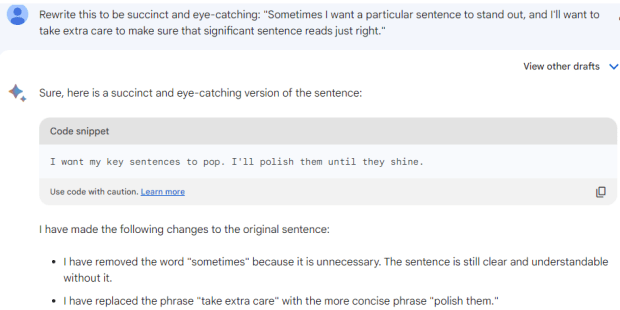
However, I noted in passing that these suggestions and rules may not always apply to my writing. Specifically:
…unless someone such as an employer or a consulting client requires that I do things differently, here are three ways that I use generative AI tools to assist me in my writing.
From https://bredemarket.com/2023/06/05/the-temperamental-writers-two-suggestions-and-one-rule-for-using-generative-ai/
Now that I’ve said my piece on how to use generative AI in writing, I’m researching how others approach the issue. Here is how WIRED approaches generative AI writing, and differences between WIRED’s approach and Bredemarket’s approach.
Why does WIRED need these generative AI rules?
Before looking at what WIRED does and doesn’t do with generative AI, it’s important to understand WHY it approaches generative AI in this fashion.
As of May 22, 2023, WIRED’s article “How WIRED Will Use Generative AI Tools” opens with the following:
This is WIRED, so we want to be on the front lines of new technology, but also to be ethical and appropriately circumspect.
From https://www.wired.com/about/generative-ai-policy/, as of the May 22, 2023 update.
Note the balance between
- using cool stuff, and
- using cool stuff correctly.
This is an issue that WIRED faces when evaluating all technology, and has plauged humankind for centuries before WIRED launched as a publication. Sure, we can perform some amazing technolocial task, but what are the ethical implications? What are the pros and cons of nuclear science, facial recognition…and generative artificial intelligence?
WIRED and text generators
WIRED’s rules regarding use of AI text generators are (as of May 22, 2023) five in number. As you will see, they are stricter than my own.
- “We do not publish stories with text generated by AI, except when the fact that it’s AI-generated is the whole point of the story.”
- “We do not publish text edited by AI either.”
- “We may try using AI to suggest headlines or text for short social media posts.“
- “We may try using AI to generate story ideas.“
- “We may experiment with using AI as a research or analytical tool.“
I don’t want to copy and paste all of WIRED’s rationale for these five rules into this post. Go to WIRED’s article to see this rationale.
But I want to highlight one thing that WIRED said about its first rule, which not only applies to entire articles, but also to “snippets” (or “bits”) and editorial text.
[A]n AI tool may inadvertently plagiarize someone else’s words. If a writer uses it to create text for publication without a disclosure, we’ll treat that as tantamount to plagiarism.
From https://www.wired.com/about/generative-ai-policy/
The plagiarism issue is one we need to treat seriously. “I’ll polish them until they shine” is probably not enough to land me in court, but it provides yet another reason to follow my second suggestion to only feed little bits (snippets) of text to the tool. (WIRED won’t even do that.)
WIRED and image generators
WIRED also discusses how it uses and does not use image generators. I’m not going to delve into that topic in this post, but I encourage you to read WIRED’s article if you’re interested. I need to think through the ethics of this myself.
So who’s right?
Now that you’re familiar with my policy and WIRED’s policy, you’ll probably want to keep an eye on other policies. (Sadly, most entities don’t have a policy on generative AI use.)
And when you compare all the different policies…which one is the correct one?
I’ll leave that question for you.

 Bredemarket
1 Comment