
There is a draft proposal (from GIPHT and CDISC) for vaccine certificate interoperability, but will the players pay attention?

I’ve gone on ad nauseum about the plethora of vaccine certificate options that are being developed by public and private entities.

Wouldn’t it be nice if all of these different options were able to talk to each other, so that my existing blue certificate would talk to health systems that require the orange certificate or the red certificate?

Two organizations are pursuing this dream of interoperability.

The Global Information for Public Health Transformation (GIPHT) initiative of the Learning Health Community has collaborated with CDISC to develop a minimum set of key data elements for documenting vaccinations. The goal of the collaboration is to achieve multinational agreement around one global core data standard that will enable the success of vaccine credentialing applications and secure sharing of essential information for uses such as safe travel.

The organizations have published a draft standard for public review. This draft attempts to define the minimum key data elements, and draws upon the work of several different organizations.

The set of common data elements proposed has been based upon recommendations made available by the European eHealth Network as referenced by the European Commission in announcing their plans for a Green Certificate to facilitate travel by Europeans among EU countries. This set of common data elements has also been informed through U.S. CDC. The elements have been aligned with standards from HL7, CDISC and ISO (standards development organizations), where applicable.

Of course, we have to ask the question: why listen to GIPHT and CDISC? Well, these two organizations claim a previous success, as noted in their press release.

“CDISC developed and published a COVID-19 data standard in less than a month by leveraging existing global clinical research standards, including those for vaccinesvirology and Ebola,” stated Rhonda Facile, Vice President of Partnerships and Development, CDISC.

However, there is one significant difference between exchanging COVID-19 data and exchanging vaccine certificate data. The former is an exchange of medical data which is of primary interest to health professionals. The latter has much greater ramifications, since it can potentially affect border crossings, travel in general, and access to facilities such as casinos, sports stadiums, and concert venues.

Is it even possible to develop a vaccine certificate interoperability standard that satisfies the foreign affairs and transportation ministries of multiple countries, the major airlines and airports, the casino operators, the major sports leagues, AND Taylor Swift?

LOS ANGELES – MARCH 14: Guest arrives for the 2019 iHeartRadio Music Awards on March 14, 2019 in Los Angeles, California. (Photo by Glenn Francis/Pacific Pro Digital Photography). By Toglenn (Glenn Francis) – This file has been extracted from another file: Taylor Swift 2 – 2019 by Glenn Francis.jpg, CC BY-SA 4.0, https://commons.wikimedia.org/w/index.php?curid=81523364

(We know Ms. Swift’s views on facial recognition, but as far as I know she has not expressed her views on vaccine certificates.)

And if it is possible, will all of these parties agree that GIPHT and CDISC are the ones to develop the standard?
How many vaccine certificates (not health passports) will citizens in Africa and elsewhere need to do anything?

This is a follow-up to my April 9 post, with a slight correction. I need to stop using the term “health passport,” and should instead use the term “vaccine certificate.” So starting now I’m doing that. Although I still think passports are cool, even if vaccine certificates aren’t passports.

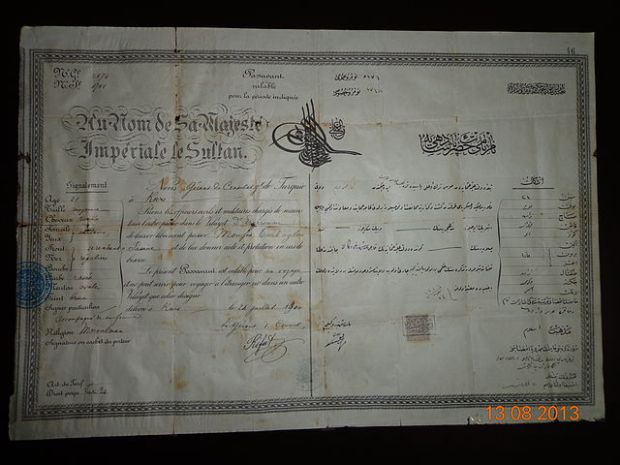
An Ottoman passport (passavant) issued to Russian subject dated July 24, 1900. By FurkanYalcin3 – Own work, CC BY-SA 3.0, https://commons.wikimedia.org/w/index.php?curid=27699398

It’s also a follow-up to my February 16 post, which noted that there are a whole bunch of health pa- I mean vaccine certificates that are being marketed by various companies and organizations.

In addition to Clear’s Health Pass, there are a myriad of other options, including AOKpassCommonPass, IATA Travel Pass, IBM Digital Health Pass, the Mvine-iProov solutionScan2Fly from AirAsia, VaccineGuard from Guardtime, VeriFLY from Daon, the Vaccination Credential Initiative, and probably some others that I missed.

Obviously it takes a while to solve such issues, so you can’t expect that all of this would be resolved by April.

And you’re right.

As Chris Burt of FindBiometrics recently noted, the whole vaccine certificate issue was recently discussed by a panel at an ID4Africa webinar. Now even if you haven’t heard of the organization ID4Africa, you can reasonably conclude that the organization is in favor of…IDs for Africa.

And even they are a bit skittish about vaccine passports, at least for now.

Questions around how these digital health certificates should work, where and whether they should be used, and what can be done to mitigate the risks associated with them remain, and were explored by an international panel of experts representing major global organizations convened by ID4Africa. They found that too much remains unknown to inform final decisions…

The panel warned against rushing headlong into adoption of vaccine certificates without a better understanding of what they were, how they would work, and how individual information would be protected. And there are major questions all over the “how they would work” question, including the long-standing question of how vaccine certificates would be interoperable.

It quickly emerged that while several groups represented are working on similar projects, there are some key differences in goals.

The WHO is building specification which are intended to create digital records not for crossing borders or proving health status to any third party, but merely for continuity of care. Its working group also includes ICAO, IATA, and ISO, each of which have their own applications in mind for digital health credentials.

See the list above.

And even if you just look at the WHO’s project, it’s still not finalized. The present timeframe calls for a version 1.0 of its specification by the end of June, but timelines sometimes slip.

Chris Burt details many other issues in his article, but for purposes of my post, it’s relevant to say that it will be months if not years before we will see any sort of interoperability between vaccine certificates.