
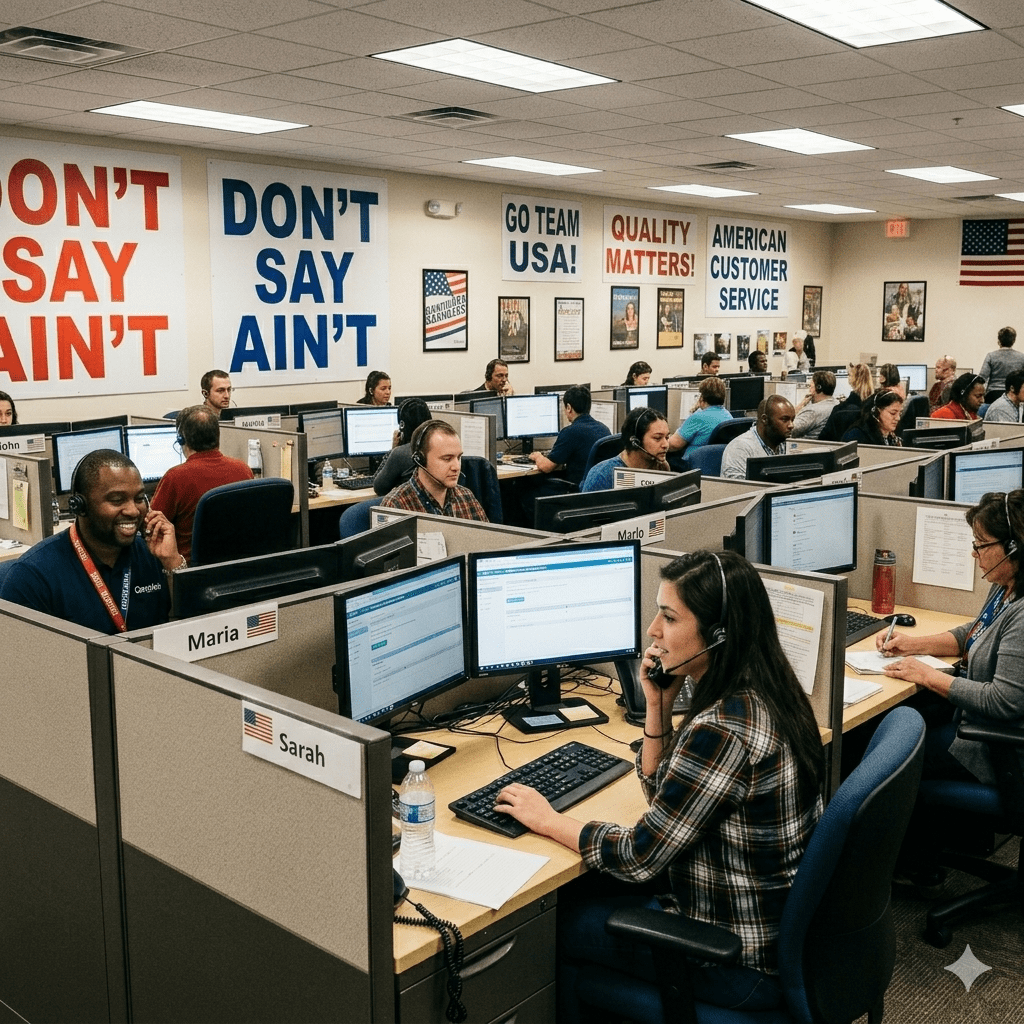
I belatedly learned about Federal Communications Commission Chair Brendan Carr’s proposals regarding call centers. But it’s important to note that there are three different proposals, each with different impacts.
- “First, the FCC will vote on reforms that can encourage businesses to bring call center jobs back the U.S.”
- “Second, the FCC will explore ways to improve customer service at existing call centers, including a proposal to require call takers to be proficient in American Standard English.”
- “Third, the FCC will address illegal robocalls that originate abroad by seeking comment on the targeted use of tariffs or bonds.”
Americans
Regarding those prized call center jobs that Americans hunger to fulfill so much, will the “reforms” include the abolition of the national $7.25 an hour minimum wage to make U.S.-based call center positions more attractive to employers? Well, employers in states that don’t have a higher minimum wage, anyway. Because call center jobs are a prime example of the jobs that Americans DON’T want to do. They’re worse than the data labeler jobs that require you to watch adult content.
English
Plus, many of these $7.25 an hour minimum wage states are in places where “American Standard English” is not widely spoken. Take Georgia and Oklahoma, each of which have a state minimum wage of $5.15, but that wage is overridden by the higher federal level.
Will the FCC consider Okie Talk as American Standard English?
Or will companies be required to import Yankees to make those calls? And offer unsweet tea options in the break room?
Robocalls
Which brings us to robocalls. Most people hate robocalls. (My secret: when someone from a random number calls me about my Google business listing, I immediately turn on call recording and the accompanying announcement. That shuts them up.)
But when thinking about possible ways to battle robocalls, the first answer that doesn’t come to mind is tariffs. That’s about as effective as…well, tariffs. Ask Jack Daniels and Jim Beam how tariffs have worked out for them.
Of course, both companies could solve their income problems by setting up call centers to call Americans, in American Standard English, and urge them to buy American…
…well, except that both Jack Daniels and Jim Beam are age restricted products, which makes calling somewhat difficult. I don’t think ANY company is pioneering age estimation by voice.

 Bredemarket