
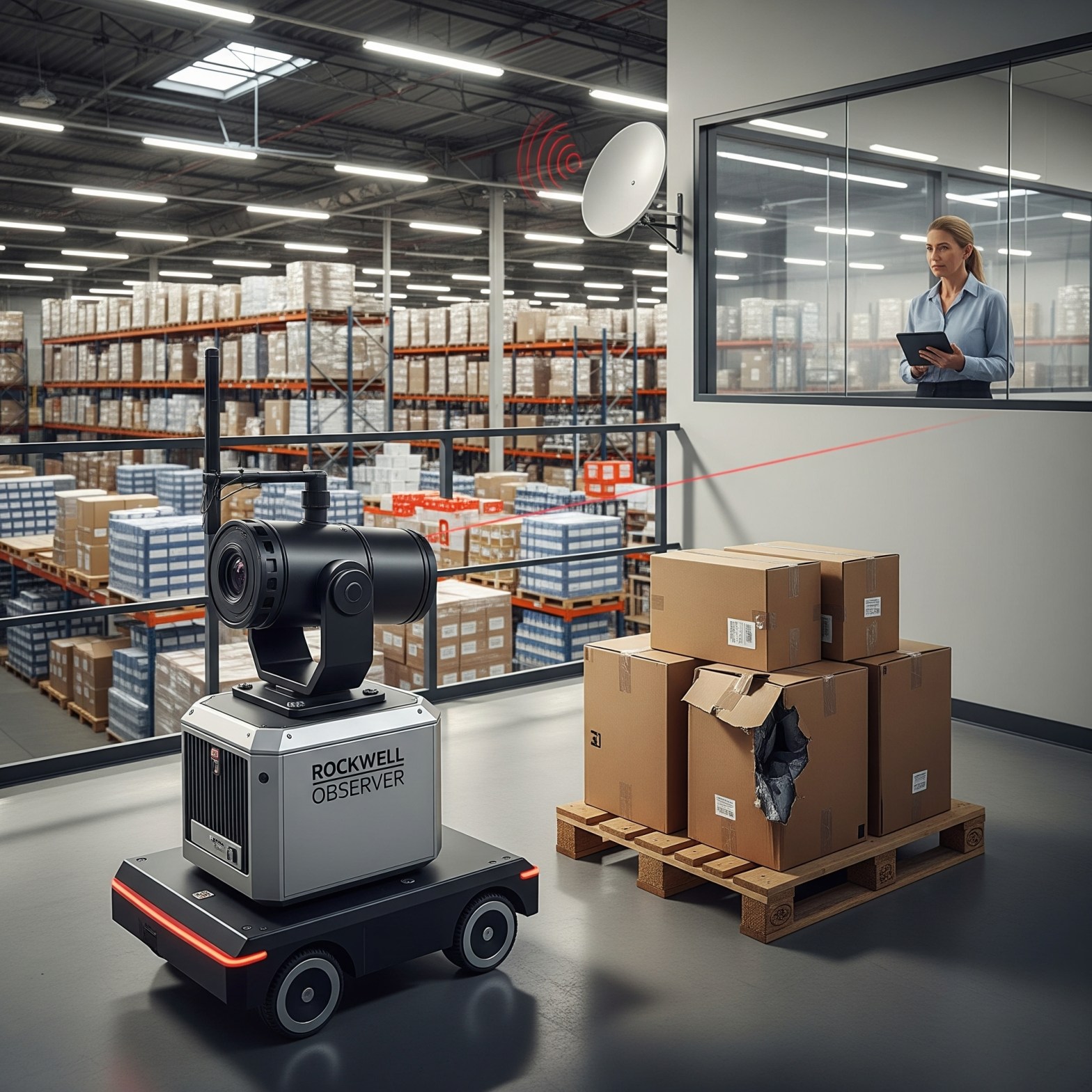
Some NPE’s Watching Me

(Imagen 4)

Unless you’re in the surveillance industry, surveillance sounds like a dirty word. I once knew an identity/biometric CEO who forcefully declared that HIS company would NEVER work in the surveillance industry.

Imagen 4.

But as Goddard Technologies notes, surveillance can be useful even if you’re NOT chasing bad people.

But before I describe how, I’m going to reveal my age.

Kennedy (John) William (Smokey) Gordy

Let’s talk about a singer who went by the name Rockwell. This was supposedly to conceal the fact that his last name was Gordy (he is Berry’s son). But he didn’t really conceal the fact that one of the uncredited backup vocalists on his wonderful one hit was a man named Michael Jackson. This was in the 1980s, when Michael Jackson was kinda sorta popular. OK, now do you remember the song?

“Somebody’s Watching Me” by Rockwell.

This excerpt from the lyrics provides the sinister tone of the song:

People call me on the phone, I’m trying to avoid
But can the people on TV see me, or am I just paranoid?

But that was the 1980s, when there was always a person in the surveillance loop. Even if there was a video camera hidden in Rockwell’s shower, some person was looking at the feed.

Things have changed.

Goddard Technologies’ “The Rise of Robotic Observers”

Now non-person entities (NPEs) are no longer the stuff of science fiction, and they can do things that only humans could do 40 years ago.

Sandra Krombacher shared one example from a LinkedIn article by Jon Kaplan of Goddard Technologies.

Kaplan’s theme:

“While much of the attention has gone to robots that do something (cleaning, welding, lifting), there’s a quieter, equally important shift happening: the rise of robots that observe.”

But what do they observe?

“These robots navigate environments, gather data, and report back. Think of them as mobile sensors with wheels, legs or propellers that identify open doors, check for damage, verify inventory, or confirm environmental conditions.”

Kaplan then notes that there are human beings that perform similar tasks, and that therefore these observer bots “align with how many industrial jobs actually work.” After the observations are collected, then humans—or perhaps other bots—can act upon the observations.

Does this affect how you perceive non-person entities? How do you feel about non-person entities that merely collect data for others to act? This is technically “surveillance,” but it could potentially reduce costs, increase profits, or even save lives.

Do you sell robotic observers, or something equally important?

Jon Kaplan used a LinkedIn article to tell his story about Goddard Technologies’ activities with observing robots.

But maybe your firm has your own story to tell.

Imagen 4. And I have to give credit where credit is due. I asked Google Gemini to create a picture with a wildebeest-authored LinkedIn article, but the article title, “The Grass Ceiling: Overcoming Obstacles in the Corporate Savana” (sic), didn’t come from me but from Google.

Why haven’t you written a LinkedIn article about your product? This lets you reach B2B prospects who are more likely on LinkedIn than on TikTok. In fact, I wrote a LinkedIn article about LinkedIn articles. (I wrote it so long ago that I only asked my clients six questions rather than seven questions.) And I’ve also written LinkedIn articles for Bredemarket clients.

Do you need help in writing that LinkedIn article that tells the world about your product? Maybe you could become one of my clients, since I help create content for tech marketers. Contact me.

Do we need smart cities, or are “average intelligence” cities good enough?

The Thales website has an article that apparently was originally written in late 2018 or early 2019, but was (as of today) last updated in October 2020. The article is entitled “Digital identity trends – 5 forces that are shaping 2020.”

For purposes of this post (and yes, “for purposes of this post” is a common phrase I use when encountering a listicle), I’m going to focus on the third of the five forces, an accelerating shift towards smart cities.

I first encountered smart cities six years ago, when MorphoTrak’s Vice President of Sales sent a colleague and myself to a smart cities conference. Inasmuch as MorphoTrak was a biometric company, I was obviously paying attention to the presentations that related to biometric identity, but I also paid attention to one of the speakers from my area – Acquanetta Warren, then (and now) mayor of the city of Fontana, California. I wasn’t able to find any accounts of her 2014 presentation, but Warren spoke about smart city needs in 2017.

Fontana (Calif.) Mayor Acquanetta Warren said that Smart City developments can be particularly important in light of natural disasters and emergencies, such as the destruction Hurricane Harvey caused in Texas.

“What happens when that happens?” Warren said. “Does everything stop? Are we able to text or email each other to let each other know ‘we’re trapped, we’re in these positions, come and help us?’ ”

Mayor Warren’s comments illustrate that there is clearly a continuum on the smart city spectrum. When you read some smart city concepts and implementations, you get a view of systems of systems tracking automobiles and parking spaces, calculating anticipated carbon monoxide levels, and doing other “smart” stuff.

Mayor Warren is interested in more basic needs, such as the ability of a Fontana citizen to get help if the San Andreas Fault does its thing.

Or, perhaps, less pressing needs, such as graffiti removal.

https://iframe.publicstuff.com/#?client_id=156 as of November 23, 2020.

This is a much simpler model than what Thales envisions in its article. In Fontana, I can report a graffiti violation anonymously. In the Thales model, “digital identity is the key that unlocks the individual’s access to a rich array of services and support.” And no, your Facebook or Google login doesn’t count.

Smarter cities worry privacy advocates, Back in 2018, the ACLU was urging public discussion about proposals in Portland, Maine to outfit street lights with wi-fi hotspots – and other monitoring sensors.

Proponents said there was nothing to worry about.

“We are very interested in deploying a variety of sensors that may be able to help with vehicle counts in intersections, numbers of pedestrians or bikes using a trail or bike path,” said Troy Moon, the city’s sustainability coordinator. “Some of these may look like a camera but only detect shapes.”

Opponents were not reassured.

“I always figured Big Brother was going to be some giant face on a wall, not a tiny camera hidden inside a light bulb,” said Chad Marlow, advocacy and policy counsel for the ACLU. “But what is particularly troubling here is the stealthy way in which the product is being marketed and pitched to the press; to wit, as an energy-efficient light bulb with built-in monitoring technology.”

And those who have followed the topic know that concerns have only accelerated since 2018. Just to cite one example, San Francisco has passed a strict ordinance regulating introduction of any surveillance technology.

This has resulted in a near-bifurcation in the adoption of smart city technologies, as countries such as India adopt a leading role in smart city adoption, while countries with greater privacy concerns such as the United States are slower to adopt the technologies.

I guess you can call these latter countries leaders in the “average intelligence” city movement. These countries will adopt some digital measures to improve city management, but will not go all out and do everything that is technologically possible. For example, a municipality may use technology such as Adobe Experience Manager Forms to enable digital form submission – but they’re not going to track your movements after you submit the form.

Because of the debate and the concerns, these latter countries will continue to be “average intelligence” cities in the future, while cities in other parts of the world will become smarter, for better or worse.